.webp)
.webp)
.webp)
.webp)






- Even against a serious geopolitical backdrop — the US-Iran conflict and the closure of the Strait of Hormuz — corporate fundamentals held up broadly, with nearly two-thirds of S&P 500 companies reporting revenue growth above 5% and participation extending well beyond the mega-cap leaders to sectors such as US biotech and industrials.
- Semiconductors were the standout performer, rising more than 100% on artificial intelligence (AI) demand and supply bottlenecks, while the global software sector was down approximately 20% on fears of AI-driven disruption — the same theme cutting in opposite directions across the two sectors.
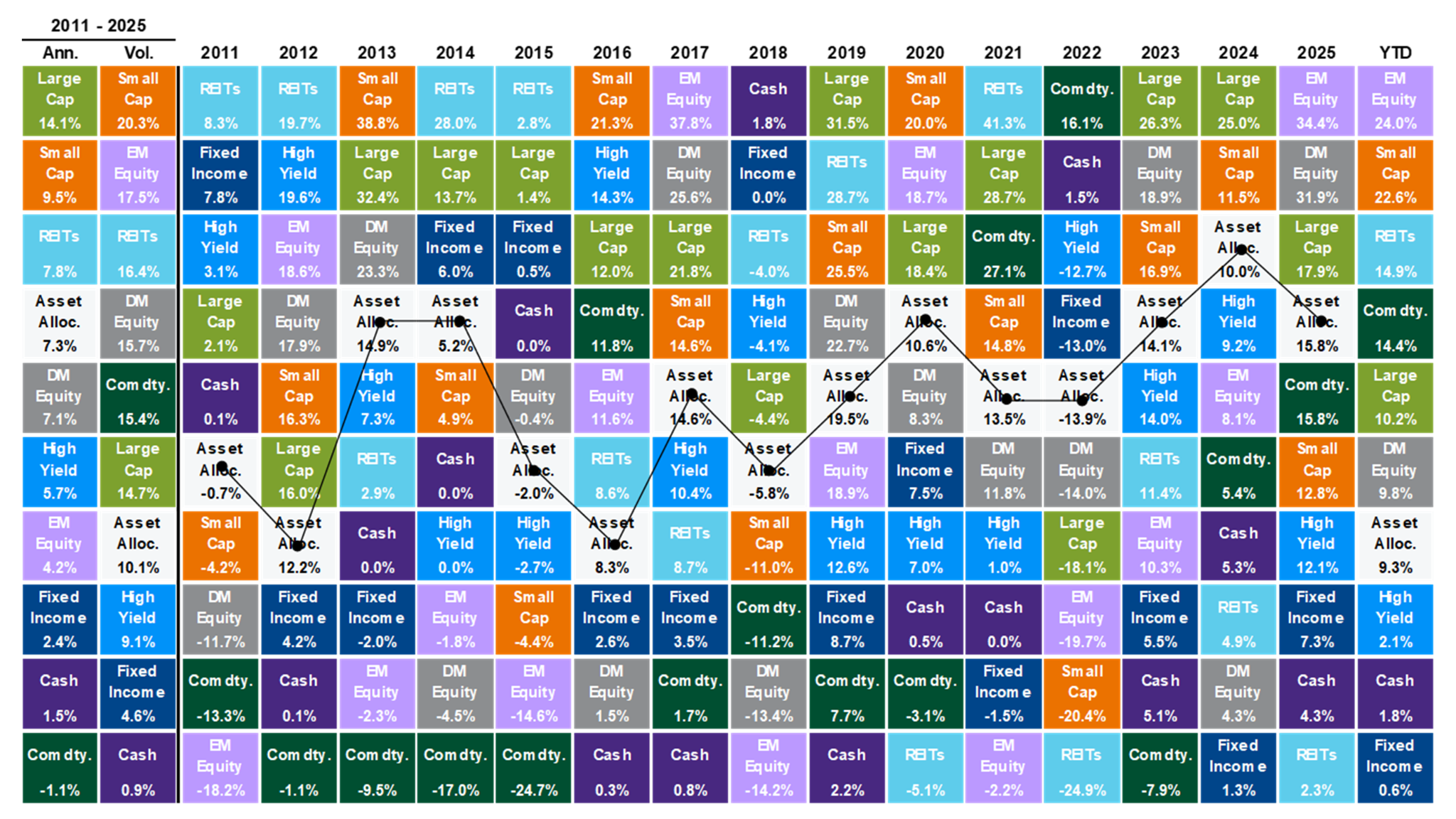
- The gap between the best- and worst-performing markets was unusually wide, a reminder that diversification across regions, sectors, and factors may matter more, not less, when leadership is concentrated.
The first half of 2026 will be remembered as a semiconductor story. The sector rose more than 100% over six months while another, global software, fell more than 20%.
For long-term investors, however, the lesson goes beyond which area of AI theme outperformed. Instead, the key takeaway is that leadership was concentrated, regionally uneven, and capable of reversing. A portfolio built around last year's narrative would have looked very different from one built around this year's data. That is the case for diversification, expressed in market outcomes rather than in theory.
The dynamic was not confined to global indices. Bank of Korea flagged that two companies — Samsung Electronics and SK Hynix — had come to represent more than half of the entire Korean market's capitalisation, a striking example of how a single theme can leave even a national index dependent on a handful of names.
This overview summarizes what drove markets in the first half of 2026, how regional and factor returns diverged, and why investors should remain diversified, invested and confident.
What were the macro drivers in the first half of 2026?
Four forces shaped the half, and they often pulled in different directions.
- The first was a sharp reversal in Fed policy expectations. When the US-Iran conflict began in late February, markets were positioned for roughly three rate cuts over 2026. By mid-year that had inverted completely: at Kevin Warsh's first meeting as Fed Chair in June, nine of eighteen FOMC members projected a rate hike by year-end, and the market had moved to price a hike as the more likely next step.
- That points to the second driver: war and oil. The conflict closed the Strait of Hormuz and pushed crude sharply higher, feeding directly into headline inflation and, through it, into the rates repricing above. It remains to be seen whether oil prices will determine a sustained increase in inflation, or if the price spike will be temporary.
- The third was artificial intelligence — less a single event than the organising theme of the half. It drove the demand surge behind semiconductors, the disruption fears that weighed on software, and a wave of debt-funded capital expenditure that fed through into fixed income supply.
- The fourth was earnings. Beneath the macro noise, fundamentals held up: nearly two-thirds of S&P 500 companies reported revenue growth above 5%, an acceleration on the prior quarter, and the semiconductor rally in particular was underpinned by profit growth rather than multiple expansion, which has a more durable foundation.
A tale of two sectors: semiconductors versus software
Semiconductors were a clear winner by a wide margin, with the index (the Philadelphia SOX) rising more than 100% over the period. The driver was earnings — hard data, beyond sentiment. Demand for AI computing infrastructure simply ran ahead of supply, and supply bottlenecks in advanced chips gave pricing power to the companies able to meet that demand.
It is a simple, yet incredibly compelling, story that cut in opposite directions across sectors. While semiconductors surged, the global software sector fell approximately 30% — before it bottomed out in mid April — on concern that AI may disrupt established software business models.
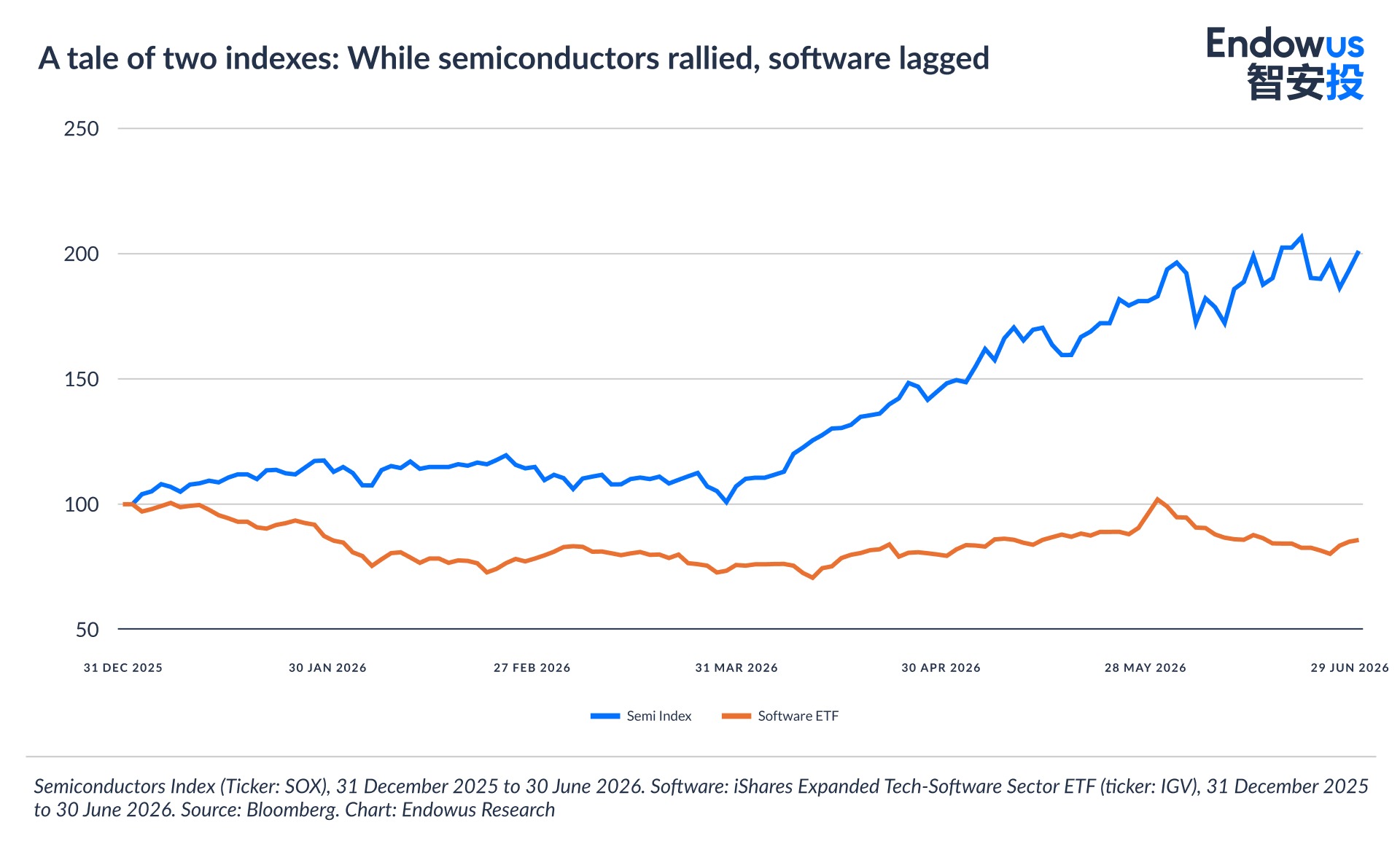
One way to frame the split is what some investors call HALO — heavy assets, low obsolescence. Semiconductor manufacturing rests on large, hard-to-replicate physical assets and deep process expertise, which are difficult to disrupt quickly. Parts of the software sector, by contrast, carry lighter physical assets and face a higher risk that AI tools erode their pricing power. The market very simply rewarded the former and penalised the latter.
Why regional returns diverged so sharply
Regional performance tracked exposure to the AI and semiconductor supply chain. In North Asia, Korea's KOSPI rose about 87%, Taiwan's TWSE about 57%, and Japan's Nikkei 225 about 34% — gains driven largely by semiconductor and AI-related companies rather than by broad-based domestic strength.
The contrast with other major Asian markets was stark. Hong Kong-listed Chinese equities, as measured by the Hang Seng China Enterprises Index (HSCEI), fell about 16%, and India's Nifty 50 fell about 13%, in dollar terms. Both markets had fewer direct AI beneficiaries, and liquidity appeared to rotate away from them as investors funded positions elsewhere.
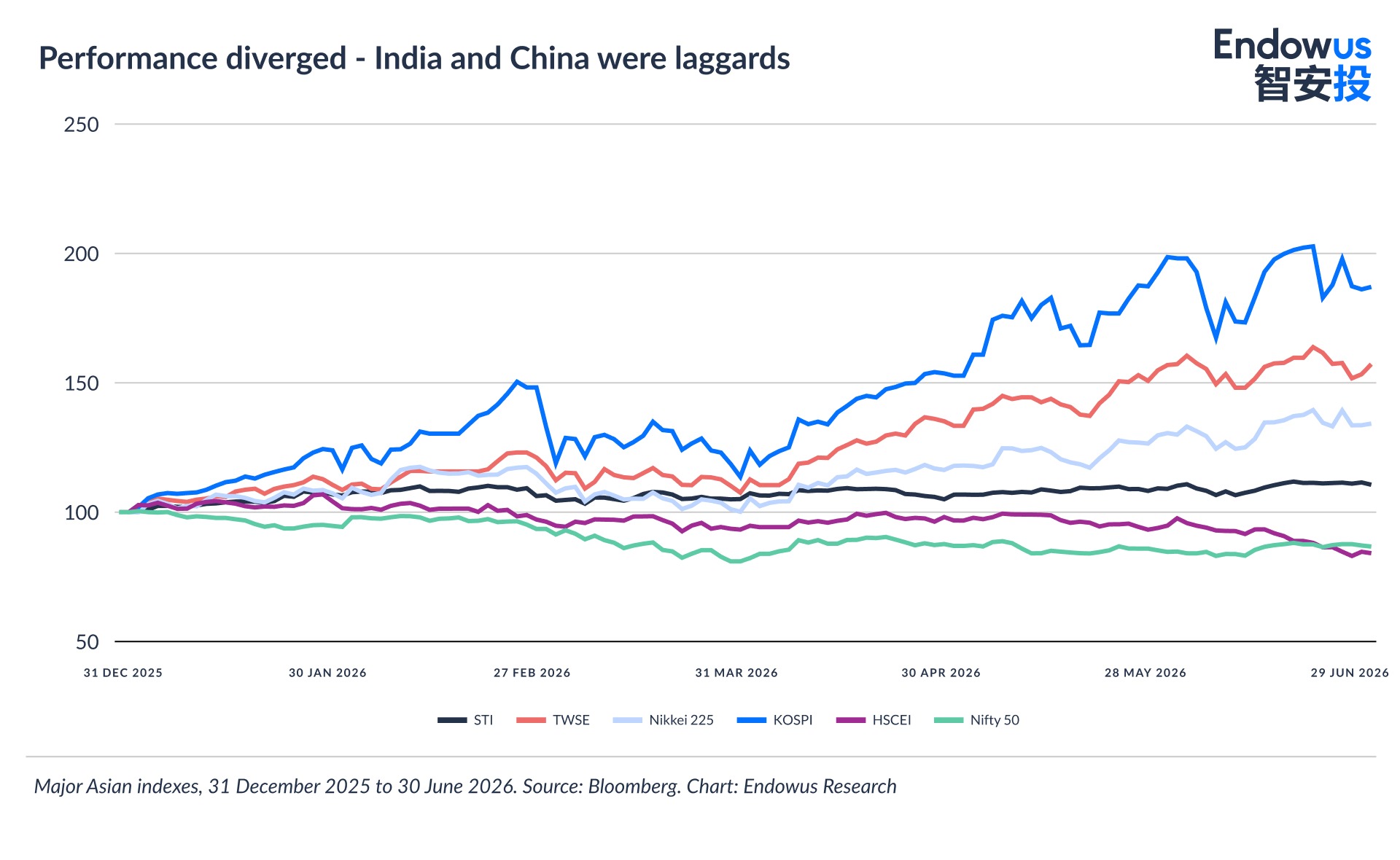
The broader point for investors here is that a single global theme can produce very different outcomes depending on where a market sits in the supply chain.
The return of flows into US assets
Capital flows into US equities were notably strong in the first half of 2026. This reversed the prevailing narrative of 2025, when much of the commentary focused on moving away from US assets and the US dollar.
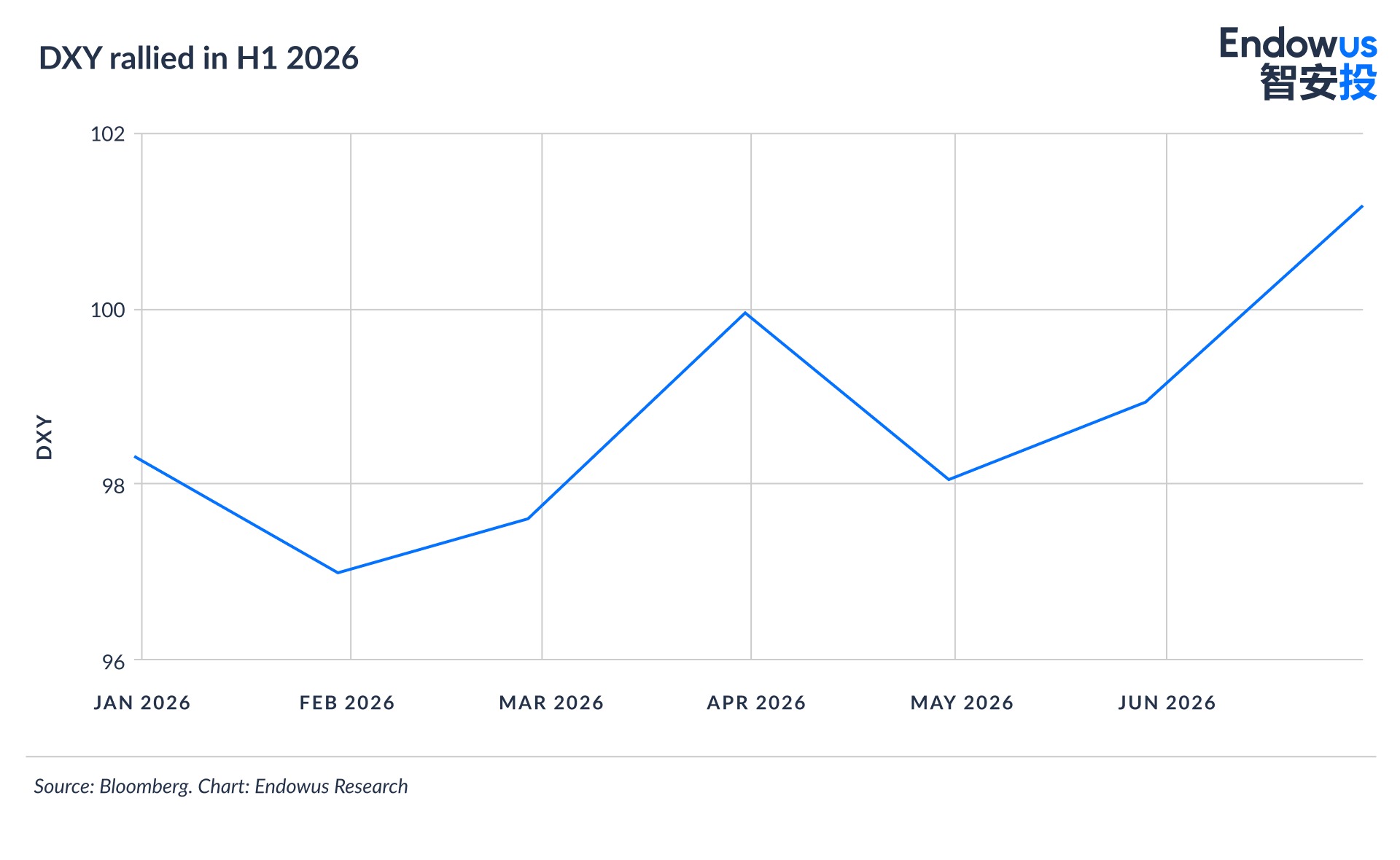
Narratives about capital leaving a market can reverse quickly, and they did here. For investors, the practical implication is that positioning a portfolio around a single macro storyline — in either direction — carries the risk that the storyline changes faster than the portfolio can be repositioned.
Commodities and the “store of value” pullback
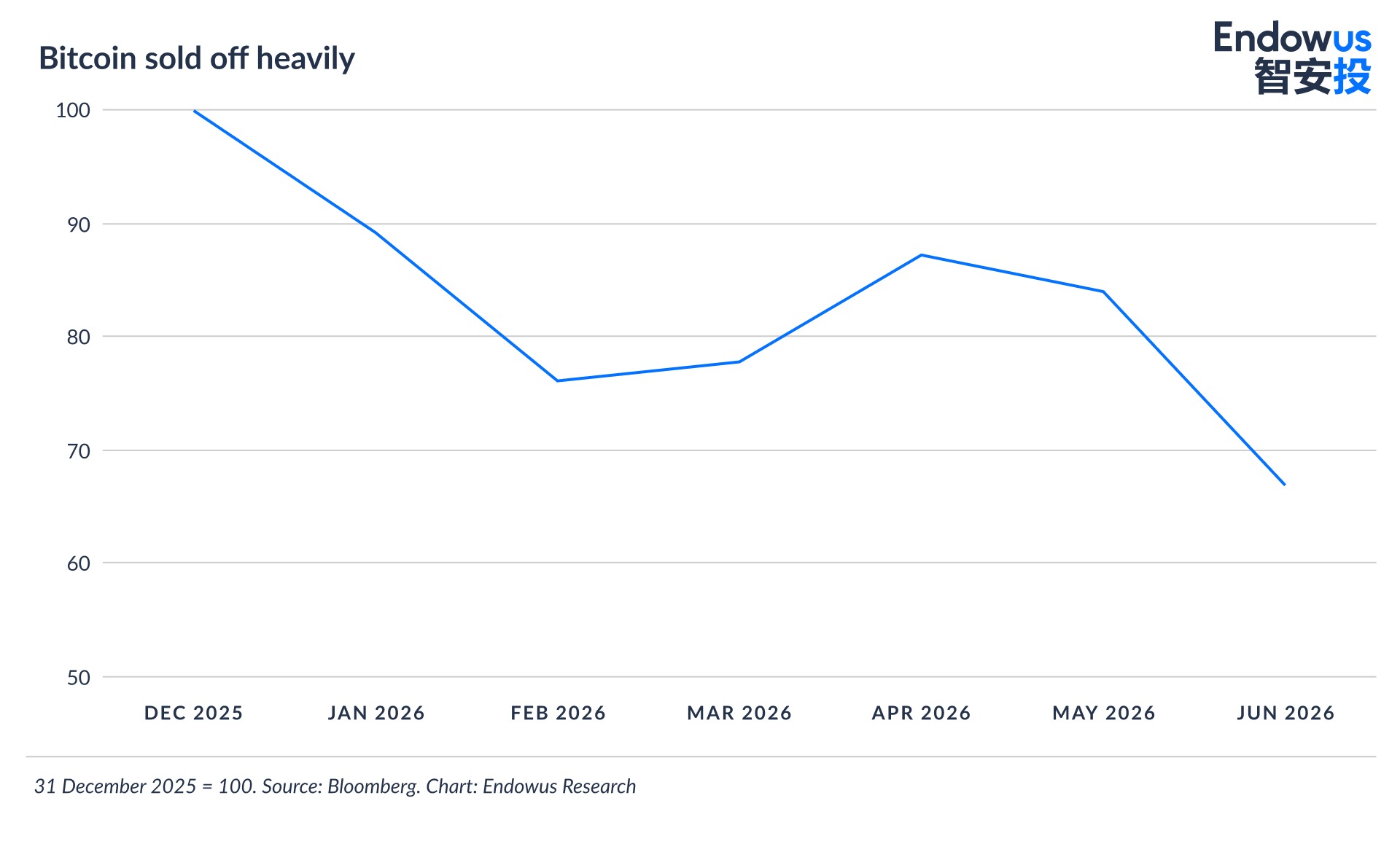
Assets often described as stores of value pulled back over the half. Gold, silver, and Bitcoin all declined, even as equity risk appetite held up in many markets. Brent crude oil also fell sharply from the highs it reached during the US-Iran conflict.
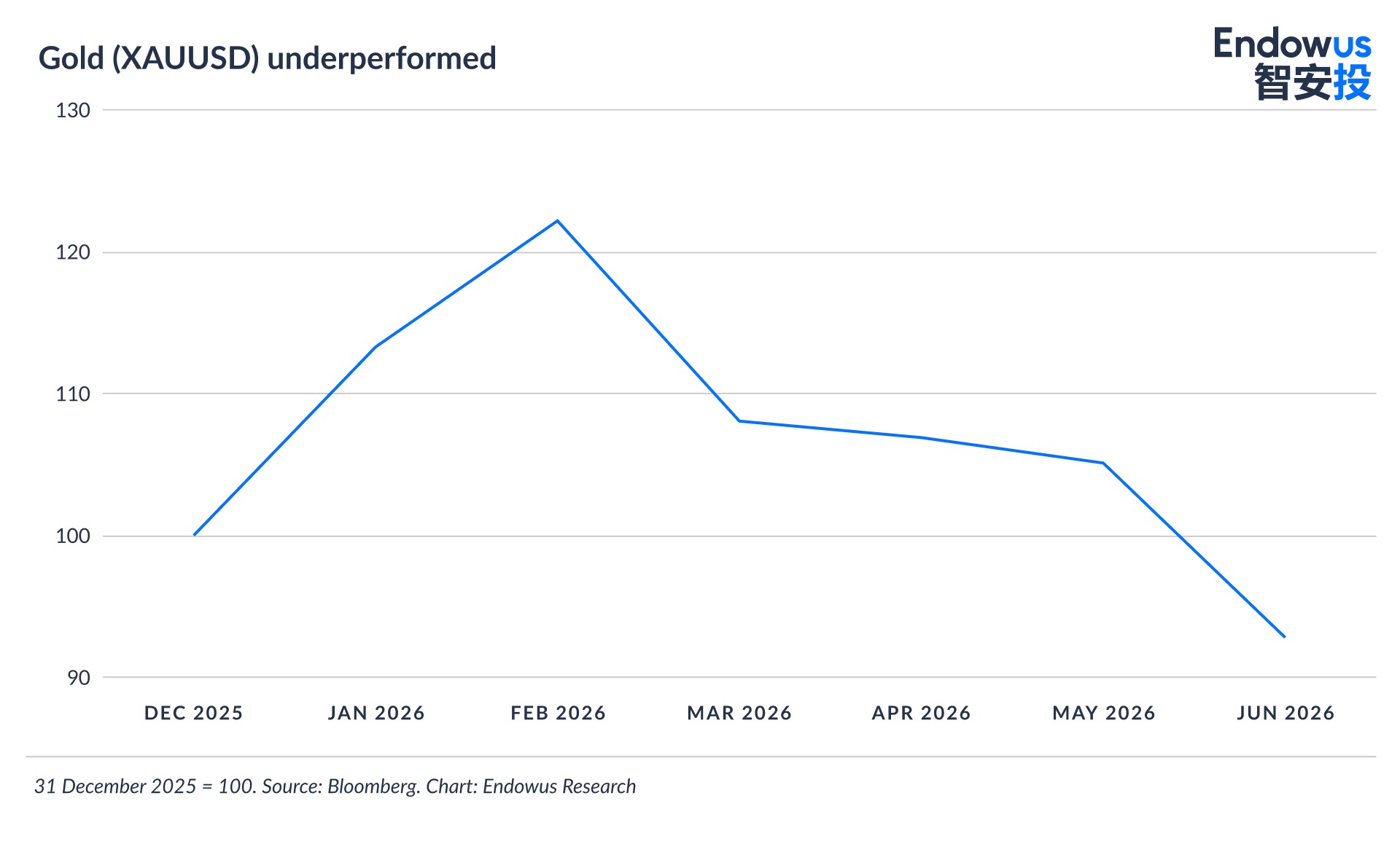
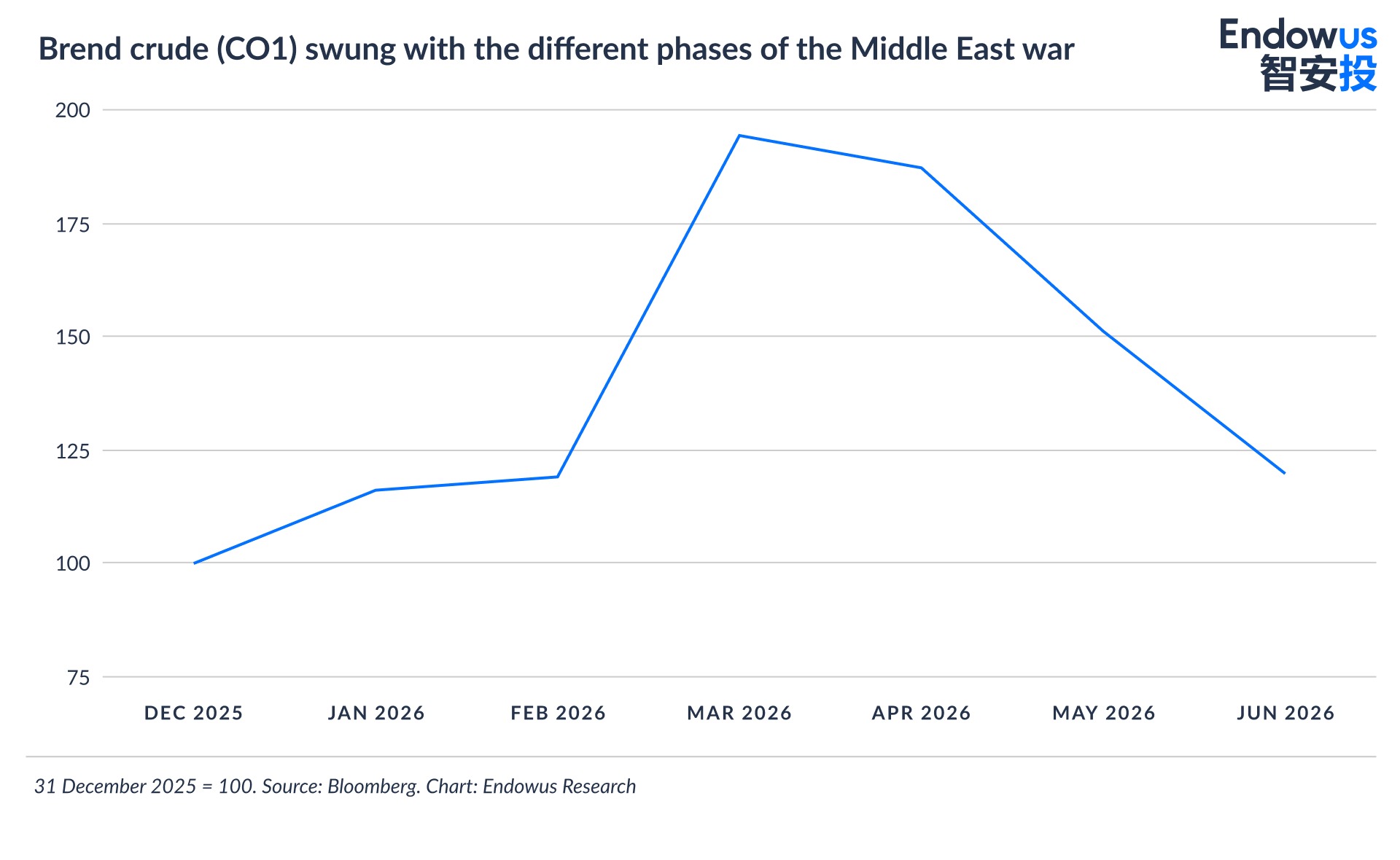
These moves are a useful reminder that no single asset is a reliable hedge in all conditions. Assets valued primarily as stores of value may fall precisely when investors expect them to hold firm, which is why their role in a portfolio warrants sizing rather than high-conviction (or blind devotion…)
Beneath the surface, market breadth began to improve
The headline story of narrow, semiconductor-led leadership masked a broadening beneath the surface. Small-capitalisation stocks outperformed large-capitalisation stocks, value outperformed growth, and Europe, Japan, and emerging markets outperformed the US — with the notable exceptions of China and India.
Individual sectors outside technology also participated. US biotech rose about 30% and US industrials rose about 19%. The transport sector, which was hurt by the conflict in March, began to recover later in the half. Nearly two-thirds of S&P 500 companies reported revenue growth above 5%, an acceleration from the prior quarter.
Broadening breadth suggests that the productivity gains associated with AI may be spreading beyond the companies that build the infrastructure to the companies that use it. That is a healthier composition of returns than leadership concentrated in a single sector.
Fixed income stayed muted
Fixed income returns were subdued through the first half of 2026. Rates stayed higher for longer as inflation proved stickier than expected — the 30-year US Treasury yield reached 5.20% in May, its highest since 2007, before easing as oil pulled back — which weighed on bond prices. A widening US fiscal deficit, estimated by primary dealers at close to US$2 trillion for the year, added to the pressure on the long end.
A second, less obvious factor was supply. A large share of AI-related capital expenditure has been funded by debt, adding new issuance to the market, alongside heavy primary-market activity more broadly. All else equal, greater bond supply may weigh on prices and support yields — a dynamic worth watching as the AI buildout continues.
Investment implications
The first half of 2026 offered an unusually clear illustration of a familiar principle. When leadership is narrow, the return of an index may depend heavily on a small number of companies or a single theme. That can flatter returns while leadership holds, and expose a portfolio when it turns.
In our view, the appropriate response is not to chase the leaders after the fact, nor to abandon them, but to continue to hold diversified exposure across regions, sectors, and factors, and to size positions deliberately. On one hand, concentration in this year's winners would have delivered strong returns; on the other, it would have left a portfolio dependent on those winners continuing to lead, and exposed to markets such as China and India that lagged sharply, and which may outperform in the second half of the year.
While it is tempting to try to predict market moves and react swiftly to the latest headlines, it has been proven time and again ineffective and detrimental for portfolio performance. Switching asset classes based on short-term macro moves, or chasing the latest winners may lead to - at the very least - an increase in costs (one of the few controllable variables in investing), and at worst to underperformance if conditions change.
Endowus was created with the goal of harnessing long-term returns for investors by building globally diversified portfolios using institutional-share-classes from a curated list of funds, so that our clients are not reliant on a single market or theme to carry their outcomes. Our goal is to provide them with balanced portfolios tailored to their risk profile, and help them achieve their financial objectives.
If you would like to review how diversified your current allocation is, you can speak with an Endowus advisor or explore our globally diversified portfolios.
Frequently asked questions
What was the best-performing sector in the first half of 2026?
Semiconductors were the best-performing sector, rising more than 100% over the period. The gains were driven by strong demand for AI computing and by supply bottlenecks in advanced chips. However, this asset class’ performance in H1 2026 is not necessarily a guide to future performance or returns.
Why did Chinese and Indian equities underperform other major Asian markets?
Hong Kong-listed Chinese equities and Indian equities both fell over the half, in contrast to Korea, Taiwan, and Japan. Both markets had fewer direct beneficiaries of the AI and semiconductor theme, and liquidity appeared to rotate towards markets with greater exposure to it. Similarly to what happens with winners, underperforming markets or sectors may turn positive going forward, as sector and market leadership tends to shift.
Does strong semiconductor performance mean I should concentrate my portfolio in technology?
Not necessarily. Strong past performance in one sector does not indicate future returns, and concentrating a portfolio in a single theme raises the risk that a change in leadership has an outsized effect on your outcome. Diversification across sectors and regions is one way to manage that risk.
How can Hong Kong investors gain diversified global exposure?
Hong Kong investors may access globally diversified portfolios through platforms that use low-cost, institutional-share-class funds. Endowus offers advised, globally diversified portfolios, and clients may invest using cash.
What does “higher for longer” mean for bonds?
“Higher for longer” describes interest rates staying elevated for an extended period. When rates stay high, bond prices may remain under pressure, which is part of why fixed income returns were muted in the first half of 2026. Whether this risk will eventually materialize remains to be seen, but it has been a dominant theme in the second quarter of 2026.
Risk Warnings
Investment involves risk. Past performance is not an indicator nor a guarantee of future performance. The value of investments and the income from them can go down as well as up, and you may not get the full amount you invested. Rates of exchange may cause the value of investments to go up or down.
This article is not intended to be relied upon as a forecast or research or investment advice, and should not form the basis of any investment or other decisions. The information contained herein is not intended, and should not be construed, as any legal, tax, regulatory, accounting or financial advice. If you would like investment, accounting, tax or legal advice, you should consult with your own professional advisors regarding your individual circumstances and needs.
The information in this article may not be suitable for all investors. You are responsible for any action that you take or decision that you make in reliance on any content in this article, and you agree that Endowus HK Limited (“Endowus”) is not liable under any circumstances.
No invitation or solicitation
Neither the information, nor any opinion, contained in this article constitutes a recommendation, offer or solicitation by Endowus or its affiliates to you to buy or sell any securities, collective investment schemes or other financial instruments or services, nor shall any such security, collective investment scheme, or other financial instruments or services be offered or sold to any person in any jurisdiction in which such offer, solicitation, purchase, or sale would be unlawful under the securities laws of such jurisdiction. This is not intended to be an invitation or offer made to the public to subscribe for any financial product or to enter into any transaction.
Accuracy of Information
Whilst Endowus has made reasonable efforts to provide accurate and timely information, there may be inadvertent delays, omissions, technical or factual inaccuracies or errors in any such information. Endowus does not warrant or represent that the information in this article is correct, accurate or reliable.
Opinions
Any opinion or estimate above is made on a general basis and none of Endowus, nor any of its affiliates, representatives or agents have given any consideration to nor have made any investigation of the objective, financial situation or particular need of any user, reader, any specific person or group of persons. Opinions expressed herein are subject to change without notice. Any forward-looking statements, prediction, projection or forecast on the economy, stock market, bond market or economic trends of the markets contained in this article are subject to market influences and contingent upon matters outside the control of Endowus and therefore may not be realised in the future.
In presenting the information above, none of Endowus, its affiliates, directors, employees, representatives or agents have given any consideration to, nor have made any investigation of the objective, financial situation or particular need of any user, reader, any specific person or group of persons. Therefore, no representation is made as to the completeness and adequacy of the information to make an informed decision. You should carefully consider whether any investment views and products/services are appropriate in view of your investment experience, objectives, financial resources and relevant circumstances.
This article has not been reviewed by the Securities and Futures Commission of Hong Kong.
Endowus HK Limited (CE No. BQR225) is licensed by the Securities and Futures Commission of Hong Kong to carry on Type 1 (dealing in securities), Type 4 (advising on securities), and Type 9 (asset management) regulated activities.
.png)

.png)