.webp)
.webp)
.webp)
.webp)





- The credit spectrum runs from the highest investment-grade ratings down to high yield; the dividing line sits at BBB−/Baa3, and default risk rises sharply below it.
- High-yield bonds pay a wider spread to compensate for higher default probability and typically lower recovery, and that spread widens in stress and narrows in calm.
- Neither end is inherently better: investment grade may offer stability, high yield may offer income, so the right mix depends on the role fixed income plays for you.
The bond market sorts issuers along a spectrum that runs from the safest sovereigns to companies whose survival is in doubt, and it prices the distance between them precisely. A government bond and the debt of a heavily leveraged company are both bonds, but treating them as the same thing is how investors misjudge risk.
The investment-grade versus high-yield distinction should be best read as measurable differences — in ratings, default probability, recovery, and spread — that define the risk-return trade-off.
What are investment grade bonds, and what are high yield bonds?
The three main agencies — Moody’s, S&P, and Fitch — rank issuers from highest quality to default. The single most consequential division is investment grade (BBB−/Baa3 and above) versus high yield (BB+/Ba1 and below).
The line is priced sharply for practical purposes, as many institutions may hold only investment-grade bonds, so an issuer slipping from BBB− to BB+ — a “fallen angel” — can force selling by holders that may no longer own it.
Does default risk rise proportionally as rating deteriorates?
The two components of credit risk, probability of default and recovery given default, both turn against the investor as ratings fall.
The first is the probability of default: the likelihood that an issuer fails to meet a scheduled interest or principal payment over a defined period. It is horizon-dependent, expressed either as a marginal annual rate or, as the rating agencies report it, cumulatively over several years. It does not rise evenly with declining quality — default frequency stays low and broadly flat across investment grade, then climbs steeply once an issuer crosses into speculative grade. A rating is, in effect, an opinion calibrated to this measure: a ranking of relative default likelihood, not a guarantee against it.
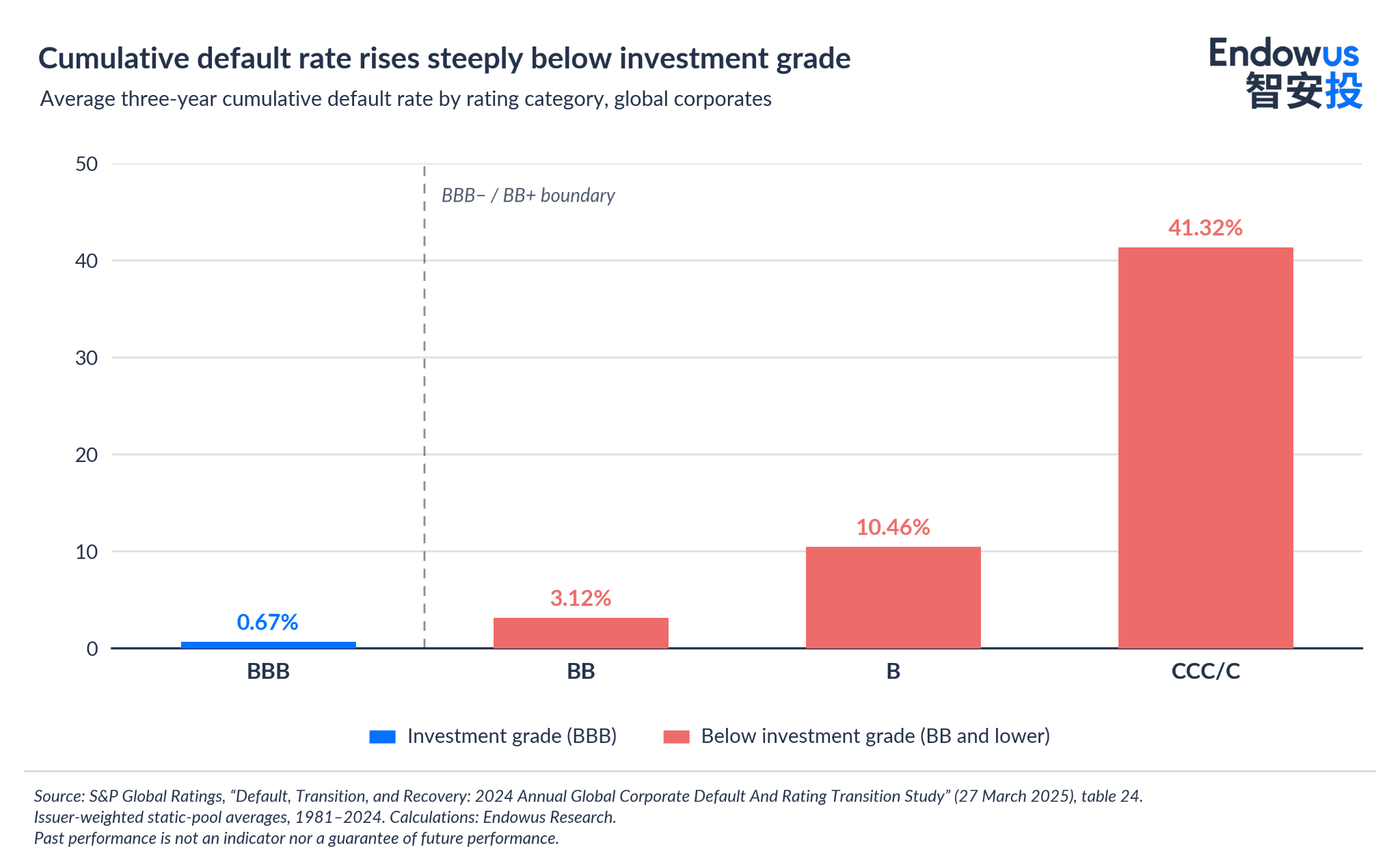
Default rates climb steeply below investment grade. On S&P Global's long-run data, three-year cumulative default rates rise from 0.67% for BBB to 3.12% for BB, 10.46% for B, and 41.32% for CCC/C. The one-year picture is just as stark: 0.08% for investment grade against 3.54% for speculative grade. Past performance is not necessarily a guide to future performance or returns.
The second is recovery given default: the share of a claim's value a creditor recoups after an issuer fails, whose complement is the loss given default, or one minus the recovery rate. Recovery is governed largely by seniority and security — a creditor's position in the capital structure — so senior secured claims fare materially better than unsecured or subordinated ones.
What is a credit spread and why does it fluctuate depending on market conditions
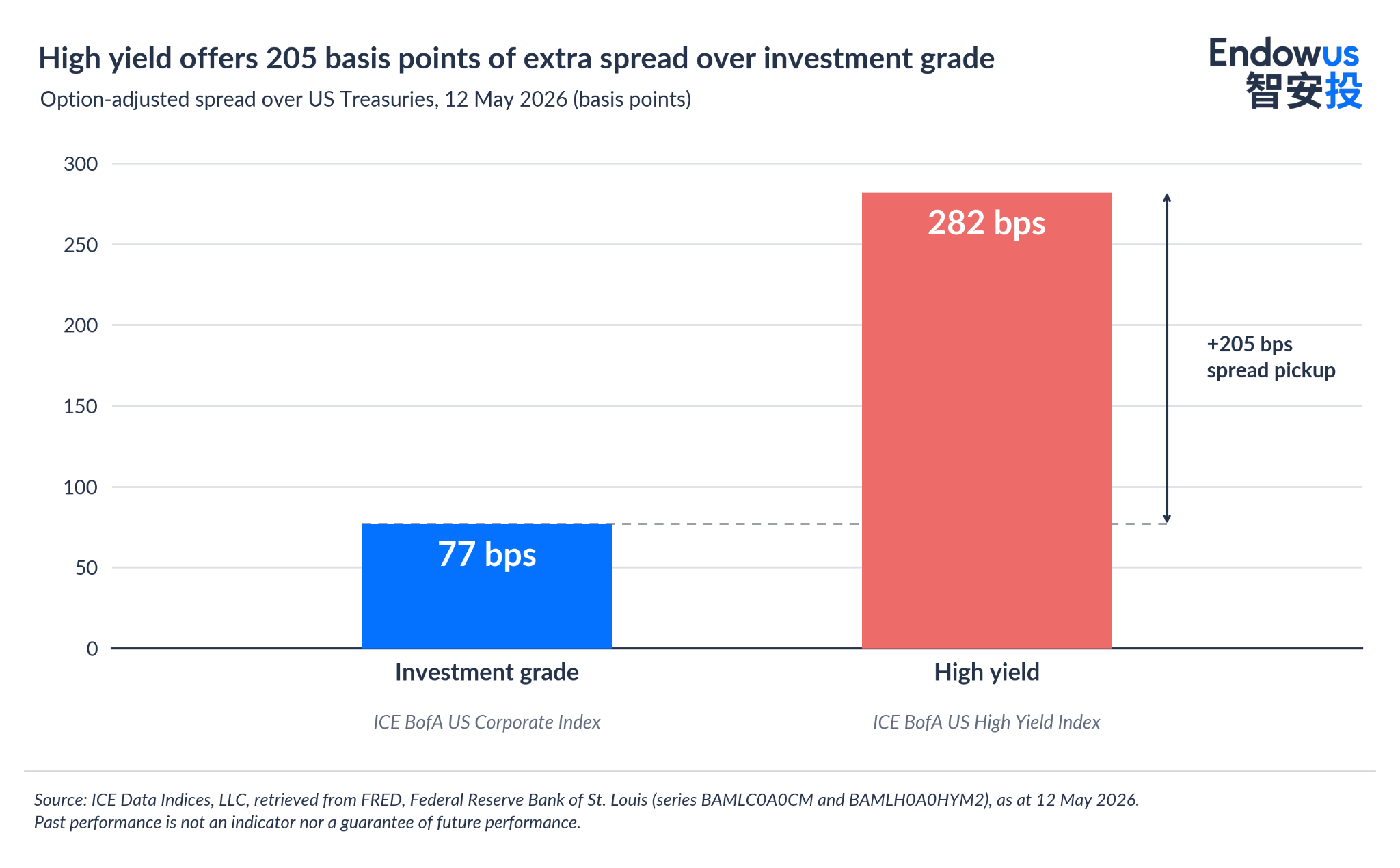
A credit spread is the extra yield a bond pays over a comparable government bond — the market’s price for credit and liquidity risk. As at 12 May 2026, the ICE BofA US Corporate Index option-adjusted spread was 0.77% (77 basis points) and the US High Yield equivalent was 2.82% (282 basis points), from Ice Data Indices via the Federal Reserve Bank of St. Louis. Past performance is not an indicator nor a guarantee of future performance.
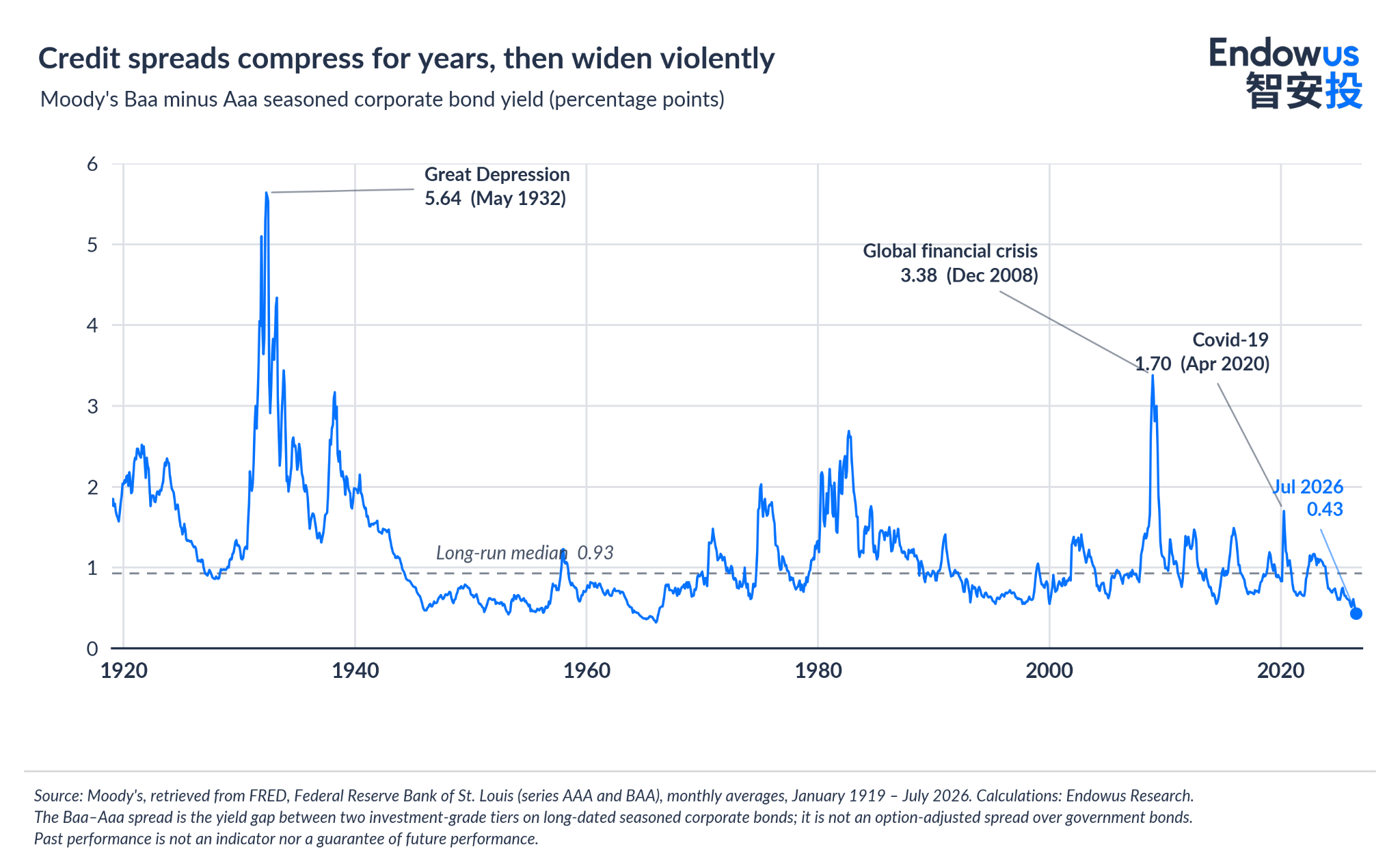
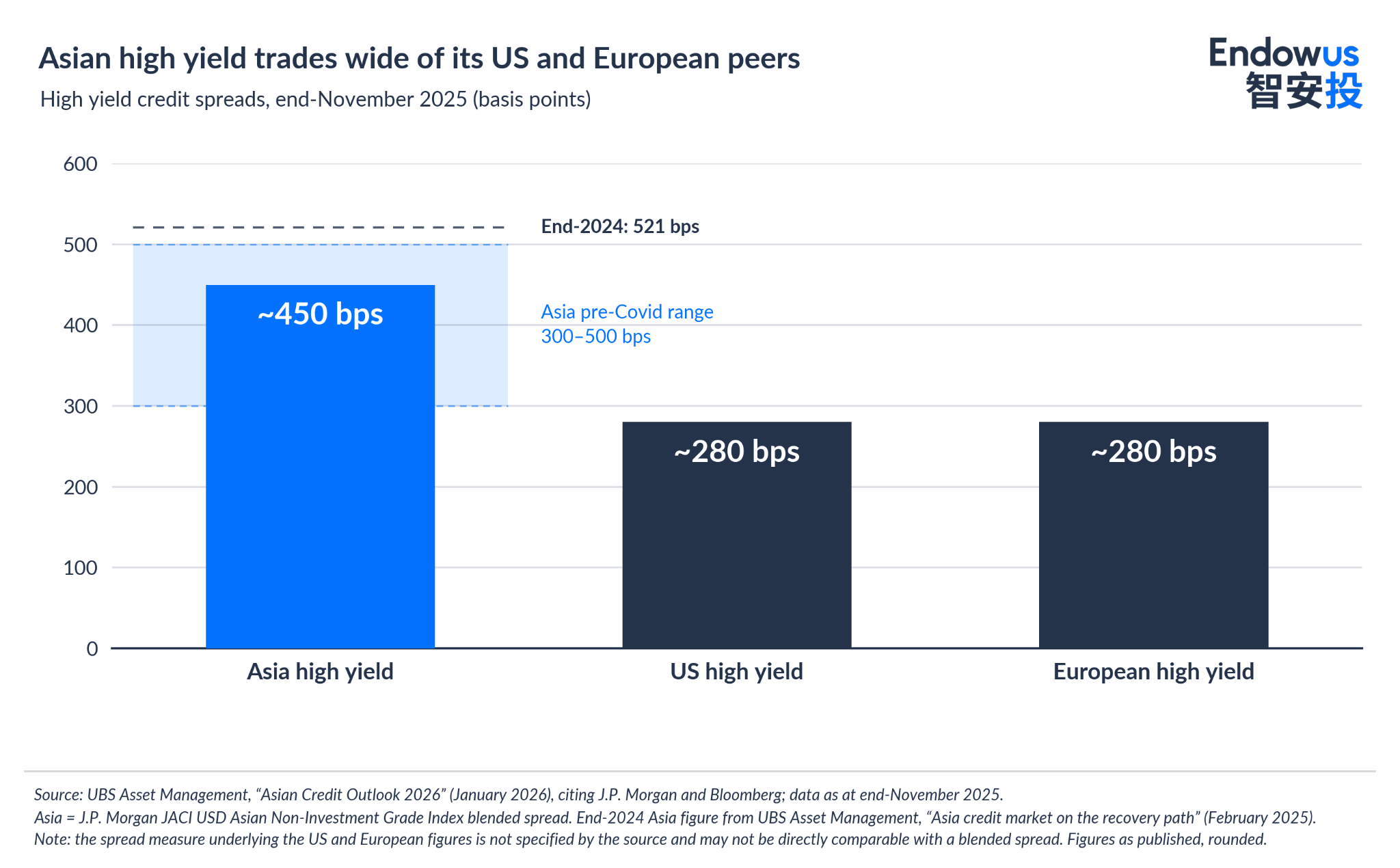
Calm is not the state that defines the asset. The high-yield spread reached roughly 21.82% in December 2008 and spiked to about 10.87% on 23 March 2020 (Ice Data Indices, via FRED). In Asia, UBS Asset Management, citing J.P. Morgan, put the Asia credit high-yield blended spread near 521 basis points at end-December 2024, above a pre-pandemic range of roughly 300 to 500 basis points.
Is investment grade or high yield better for a portfolio?
Investment grade and high yield behave differently, and they earn their places in a portfolio for different reasons.
- Investment grade typically carries low default risk, and is driven more by changes in interest rates than by credit events, which is why higher-quality and government bonds may diversify equity risk when in times of market stress.
- High yield offers more income and return potential, but behaves more like equity risk in a downturn: its spreads widen just as equities fall, so the diversification benefit may be weakest precisely when an investor most wants it.
There is also a case that active management may have more scope to add value in high yield than in investment grade bonds. Default and recovery outcomes vary widely from issuer to issuer, downgrades can force selling at poor prices, and broad indices weight by the amount of debt outstanding, tilting exposure toward the most indebted borrowers. Those features create dispersion that careful security selection may exploit — a potential source of value, not a guarantee of outperformance.
The practical discipline is to size your credit exposure to the job it is meant to do, while knowing how different assets within fixed income behave in different market conditions, which helps make informed decisions. To sum up, adding high yield exposure may lift a portfolio’s income and expected return; on the other, it may amplify drawdowns and erode the very diversification away from equity that draws many investors to bonds in the first place. The right balance follows from your objectives and horizon.
Endowus provides access to institutionally managed bond funds spanning the credit spectrum, on a fee-only basis.
Frequently asked questions
What is the difference between investment grade and high yield bonds?
Investment-grade bonds (BBB−/Baa3 or higher) carry a low default probability. High-yield bonds (BB+/Ba1 or lower) carry higher default probability and typically lower recovery, and pay a wider spread to compensate.
Why do high yield bonds pay more?
The extra yield compensates for higher expected loss — a greater chance of default and lower recovery — and for lower liquidity. It is payment for risk, not evidence of a better bond.
What is a credit spread?
The additional yield a corporate bond pays over a comparable government bond. It reflects credit and liquidity risk, widening in stress and narrowing when confidence returns.
Disclaimer
Risk Warnings
Investment involves risk. Past performance is not an indicator nor a guarantee of future performance. The value of investments and the income from them can go down as well as up, and you may not get the full amount you invested. Rates of exchange may cause the value of investments to go up or down.
This article is not intended to be relied upon as a forecast or research or investment advice, and should not form the basis of any investment or other decisions. The information contained herein is not intended, and should not be construed, as any legal, tax, regulatory, accounting or financial advice. If you would like investment, accounting, tax or legal advice, you should consult with your own professional advisors regarding your individual circumstances and needs.
The information in this article may not be suitable for all investors. You are responsible for any action that you take or decision that you make in reliance on any content in this article, and you agree that Endowus HK Limited ("Endowus") is not liable under any circumstances.
No invitation or solicitation
Neither the information, nor any opinion, contained in this article constitutes a recommendation, offer or solicitation by Endowus or its affiliates to you to buy or sell any securities, collective investment schemes or other financial instruments or services, nor shall any such security, collective investment scheme, or other financial instruments or services be offered or sold to any person in any jurisdiction in which such offer, solicitation, purchase, or sale would be unlawful under the securities laws of such jurisdiction.
This is not intended to be an invitation or offer made to the public to subscribe for any financial product or to enter into any transaction.
Accuracy of Information
Whilst Endowus has made reasonable efforts to provide accurate and timely information, there may be inadvertent delays, omissions, technical or factual inaccuracies or errors in any such information. Endowus does not warrant or represent that the information in this article is correct, accurate or reliable.
Opinions
Any opinion or estimate above is made on a general basis and none of Endowus, nor any of its affiliates, representatives or agents have given any consideration to nor have made any investigation of the objective, financial situation or particular need of any user, reader, any specific person or group of persons. Opinions expressed herein are subject to change without notice.
Any forward-looking statements, prediction, projection or forecast on the economy, stock market, bond market or economic trends of the markets contained in this article are subject to market influences and contingent upon matters outside the control of Endowus and therefore may not be realised in the future.
In presenting the information above, none of Endowus, its affiliates, directors, employees, representatives or agents have given any consideration to, nor have made any investigation of the objective, financial situation or particular need of any user, reader, any specific person or group of persons. Therefore, no representation is made as to the completeness and adequacy of the information to make an informed decision. You should carefully consider whether any investment views and products/services are appropriate in view of your investment experience, objectives, financial resources and relevant circumstances.
This article has not been reviewed by the Securities and Futures Commission of Hong Kong.
Endowus HK Limited (CE No. BQR225) is licensed by the SFC for Type 1 (Dealing in Securities), Type 4 (Advising on Securities), and Type 9 (Asset Management) regulated activities.


.png)