.webp)
.webp)
.webp)
.webp)





- The Nasdaq 100 is a market-capitalisation-weighted index of 100 of the largest non-financial companies listed on the Nasdaq exchange, with technology stocks accounting for more than half of the index by weight.
- Unlike the S&P 500, which spans 500 companies across all sectors, the Nasdaq 100's concentrated exposure to technology and growth companies means it may deliver higher long-run returns — but with correspondingly higher volatility.
- Investors in Hong Kong can access the Nasdaq 100 through ETFs with the goal of building exposure to the technology sector.
The 21st century's most powerful economic engine runs through a single exchange. The Nasdaq 100 — home to Apple, Microsoft, Nvidia, and Amazon — has become, for many investors, the defining proxy for global technology and innovation. Over the 15 years to the end of 2024, it delivered strong annualised returns that outpaced the S&P 500 and other major equity indices.
The structural case for the Nasdaq 100 — concentrated exposure to companies that generate potentially high returns on capital and are high-growth industry leaders — is hard to question. But it is fair to ask what is an ideal allocation and how does it fit into a diversified portfolio.
This article explains what the Nasdaq 100 tracks, how it is constructed, how it compares to the S&P 500, and how investors in Hong Kong may use it as part of a broader investment strategy.
What does the Nasdaq 100 track?
The Nasdaq 100 is a stock market index that includes 100 of the largest non-financial companies listed on the Nasdaq Stock Market. It was launched in January 1985 and is maintained by Nasdaq, Inc.
The index uses a modified market-capitalisation weighting methodology. In practice, this means larger companies receive a higher weight, with a “cap” preventing any single company from dominating the index beyond a set threshold. The index rebalances quarterly, with an annual reconstitution every December.
As of June 2026, technology companies accounted for close to 60% of the index by weight, with consumer discretionary (~21%) and health (~5%) far behind. The ten largest constituents — including Apple, Microsoft, Nvidia, Amazon, Meta, and Alphabet — together account for more than 50% of total index weight.
The index excludes financial companies by design. This distinguishes it meaningfully from the S&P 500, which includes banks and insurers, and explains why the Nasdaq 100's sector composition tilts so heavily toward technology and growth.
How does the Nasdaq 100 differ from the S&P 500?
Investors often compare the Nasdaq 100 to the S&P 500. The main difference is that the S&P 500 tracks 500 large-cap US companies across all 11 Global Industry Classification Standards (GICS) sectors. The Nasdaq 100 tracks 100 companies, excludes financials, and sits on a single exchange — not across NYSE and Nasdaq as the S&P 500 does.
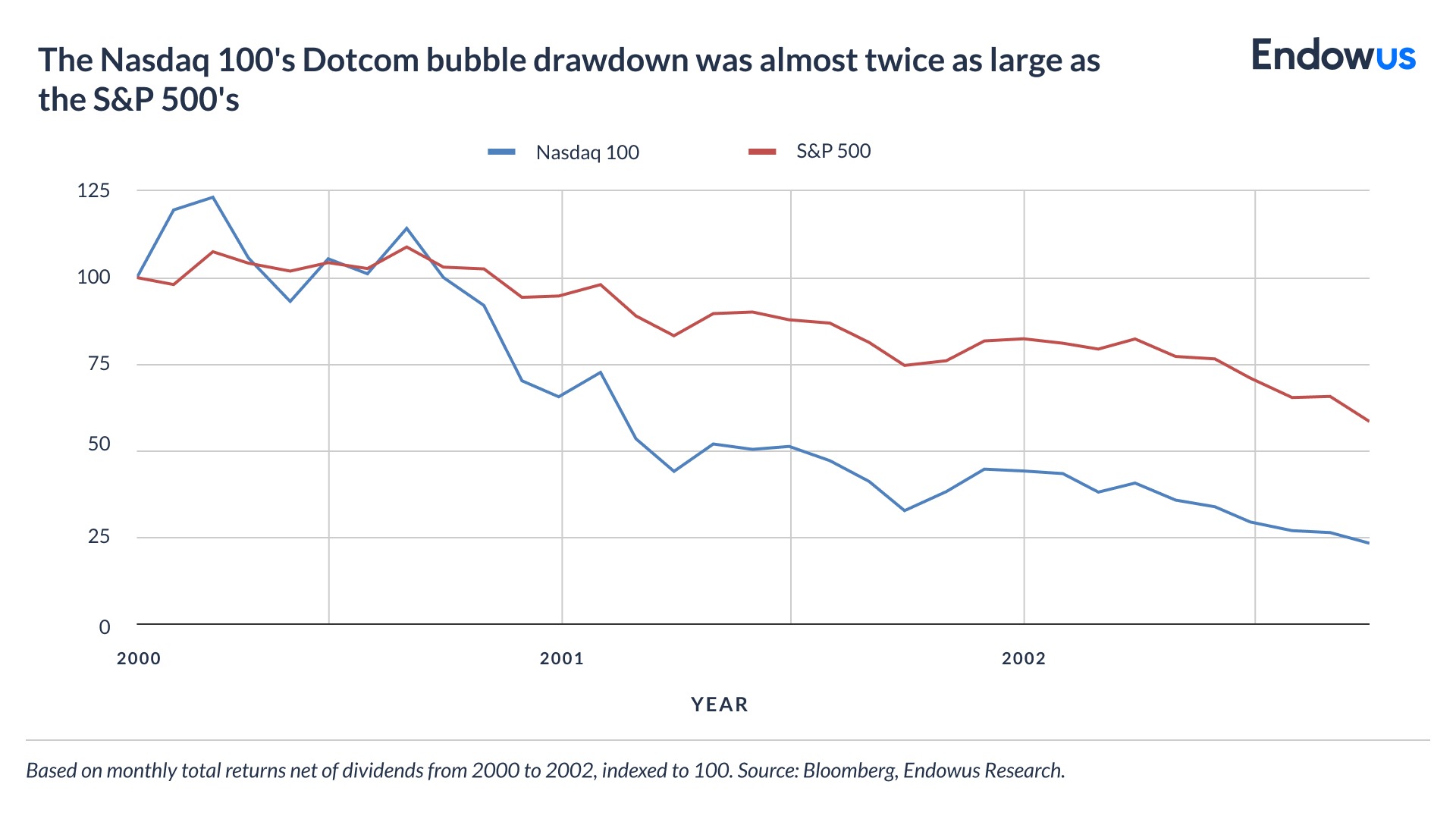
This difference in scope and sector mix produces meaningfully different risk profiles. The Nasdaq 100 has historically exhibited higher volatility. During the dot-com bust of 2000–2002, it fell more than 80% from peak to trough. During the 2022 rate-driven growth sell-off, it declined more than 33% — roughly double the S&P 500's drawdown over the same period.
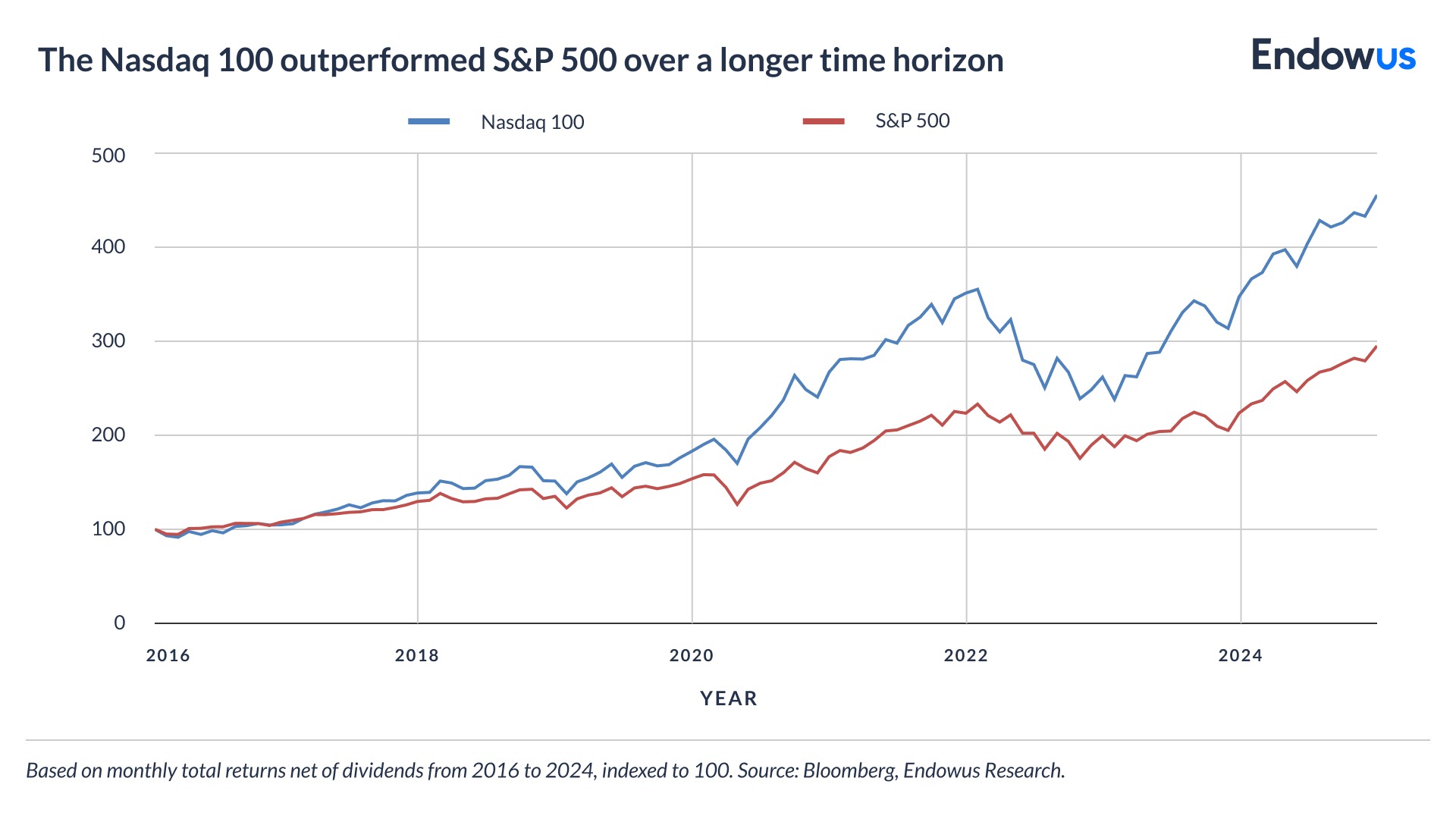
The flip side is return. Over the decade that ended in December 2024, the Nasdaq 100 generated annualised returns significantly above the S&P 500, driven by the extraordinary earnings growth of its largest constituents. Whether this outperformance persists depends heavily on the trajectory of technology earnings and interest rate policy — and investors should pay attention to both.
A concentrated index also carries concentration risk. When Nvidia alone accounts for roughly 8% of the Nasdaq 100's total weight, the index's performance becomes closely tied to the fortunes of a single company. Investors should be aware of this structural reality.
Why has Nasdaq 100 attracted so much capital?
The secular growth story in technology has been the defining investment narrative of the past two decades. Cloud computing, artificial intelligence, digital advertising, and e-commerce have produced some of the highest-returning businesses in market history — and most of them sit in the Nasdaq 100.
The index also benefits from a self-reinforcing dynamic: as technology companies grow and their market capitalisations rise, their weight in the index increases, drawing further capital from passive investors tracking it.
For investors outside the United States, the Nasdaq 100 offers a straightforward route to some of the world's highest-quality businesses. In Hong Kong, exposure to Nasdaq 100 firms may provide access to companies in the strongest performers in AI infrastructure, cloud computing, and consumer technology space.
That said, the concentration in US technology also means the Nasdaq 100 introduces regulatory risk (US technology policy, in particular) and valuation sensitivity to interest rate movements. These are features of the index, not flaws — but they require acknowledgement.
Why should Hong Kong investors include Nasdaq 100 in their portfolios?
Portfolio construction is about combining assets whose risk and return characteristics exhibit low correlation. The Nasdaq 100 has historically shown relatively low correlation with bonds and alternative assets, and moderate correlation with broader equity markets — making it a potentially useful building block when sized appropriately.
For investors with a long time horizon — say, 10 years or more — the higher short-term volatility of the Nasdaq 100 may be an acceptable trade-off for its potential long-run return. For investors closer to drawing on their capital, a smaller allocation or none at all may be more appropriate.
More broadly, a portfolio with a core allocation to a global equity index — such as MSCI World or a total-market fund — supplemented by a satellite allocation to the Nasdaq 100 may capture the upside of technology-driven growth while maintaining sector diversification.
The key discipline is sizing. An uncapped tilt to the Nasdaq 100 in a rising-rate or decelerating-growth environment may produce significant short-term underperformance. Positioning it as a measured satellite rather than a core holding is typically more appropriate for retail investors.
How to invest in the Nasdaq 100 from Hong Kong
The most common vehicle for accessing the Nasdaq 100 is an ETF that tracks the index. The Invesco QQQ Trust (ticker: QQQ) is the largest and most liquid, listed on the Nasdaq in the United States. For investors preferring ETFs listed on the Hong Kong Stock Exchange, the Invesco QQQ ETF (Stock Code: 3455) , iShares Nasdaq 100 ETF (Stock Code: 2834), and Global X Nasdaq 100 Covered Call Active ETF (Stock Code: 3451) are the standard choices.
The Nasdaq 100 is a concentrated bet on the continued dominance of US technology and growth companies — one that has rewarded patient investors over long time horizons, but that carries real volatility and concentration risk that must be managed.
A more risk-conscious approach would be to treat the Nasdaq 100 as a high-conviction satellite allocation within a broader globally diversified portfolio — not as a standalone core position.
The Endowus Global Technology model portfolio aims to provide access to the most innovative technology and technology-related companies around the world, across various market capitalisations and sectors.
Geographically, while the model portfolio has most of its holdings in the US — which represents a large opportunity set in technology investing — it is also invested in other leading innovators and rising stars in geographies such as Asia and Europe.
For investors using Endowus, our advisers can help you determine whether and how much technology exposure is appropriate for your goals, time horizon, and risk profile. Schedule a free consultation today.
Frequently asked questions about investing in the Nasdaq 100 from Hong Kong
What is the Nasdaq 100?
The Nasdaq 100 is a stock market index tracking 100 of the largest non-financial companies listed on the Nasdaq exchange. It uses a modified market-capitalisation weighting and is reconstituted annually. Technology companies account for more than half its weight.
How is the Nasdaq 100 different from the Nasdaq Composite?
The Nasdaq Composite includes all companies listed on the Nasdaq exchange — more than 3,000 stocks. The Nasdaq 100 is a subset of the 100 largest non-financial companies. The Nasdaq 100 is the more commonly tracked index for investment purposes.
Is the Nasdaq 100 a good investment?
The Nasdaq 100 has delivered strong long-run returns, but it carries higher volatility than broader equity indexes such as the S&P 500. Whether it is suitable depends on your investment horizon, risk tolerance, and existing portfolio. All investments carry risk, and past performance is not necessarily a guide to future performance or returns.
How can I invest in the Nasdaq 100 from Hong Kong?
The most common route is through an ETF. Major options include the Invesco QQQ Trust (listed in the US and in Hong Kong). Endowus also provides access to funds with significant exposures to high-growth technology and technology-related companies around the world — offering similar exposure to high-growth technology companies while remaining more globally diversified.
What are the risks of investing in the Nasdaq 100?
Key risks include concentration in a small number of large technology companies, sensitivity to interest rate movements (which affect the valuation of growth stocks), currency risk for non-USD investors, and regulatory risk across US and Chinese technology sectors. Investors should weigh these against their individual circumstances.
<divider><divider>
Risk Warnings
Investment involves risk. Past performance is not an indicator nor a guarantee of future performance or returns. Projected performance or returns is not guaranteed to materialise. The value of investments and the income from them can go down as well as up, and you may not get the full amount you invested.
Rates of exchange may cause the value of investments to go up or down. Individual stock performance does not represent the return of a fund.
General risk warnings relating to collective investment schemes
Before making an investment decision, you are reminded to refer to the relevant prospectus/ offering document for specific risk considerations and related fees and charges.
Funds are not a bank deposit and not capital guaranteed, and is subject to investment risks, including the possible loss of the principal amount invested.
Some of the funds also involve derivatives. Do not invest in them unless you fully understand and are willing to assume the risks associated with them.
Opinions
Any forward-looking statements, prediction, projection or forecast on the economy, stock market, bond market or economic trends of the markets contained in this material are subject to market influences and contingent upon matters outside the control of Endowus HK Limited (“Endowus”) and therefore may not be realised in the future. Further, any opinion or estimate is made on a general basis and subject to change without notice. In presenting the information above, none of Endowus HK Limited, its affiliates, directors, employees, representatives or agents have given any consideration to, nor have made any investigation of the objective, financial situation or particular need of any user, reader, any specific person or group of persons. Therefore, no representation is made as to the completeness and adequacy of the information to make an informed decision. You should carefully consider (i) whether any investment views and products/ services are appropriate in view of your investment experience, objectives, financial resources and relevant circumstances. You may also wish to seek financial advice through a financial advisor or the Endowus platform and independent legal, accounting, regulatory or tax advice, as appropriate.
No invitation or solicitation
Nothing contained in this article should be construed as a solicitation, an offer to buy or sale, or recommendation, to acquire or dispose of any security, commodity, investment or to engage in any other transaction in any jurisdiction in which such solicitation, offer to buy or sale would be unlawful under the securities laws in such jurisdiction. No information included [on this website/ in this article] is to be construed as investment advice or as a recommendation or a representation about the suitability or appropriateness of any advisory product or service; or an offer to buy or sell, or the solicitation of an offer to buy or sell, any security, financial product, or instrument; or to participate in any particular trading strategy. Investors should seek independent financial and tax advice before making any investment decision.
Product Risk Rating: Please note that any product risk rating (the “PRR”) provided by us is an internal rating assigned based on our product risk assessment model, and is for your reference only. The PRR is subject to change from time to time. The PRR does not take into account your individual circumstances, objectives or needs and should not be regarded as advice or recommendation to purchase, hold or sell any fund or make any other investment decisions. Accordingly, you should not solely rely on the PRR in making your investment decision in the relevant Fund.
This advertisement has not been reviewed by the Securities and Futures Commission or any regulatory authority in Hong Kong.


.png)