.webp)
.webp)
.webp)
.webp)






- The Occupational Retirement Schemes Ordinance (ORSO), Cap. 426, governs Hong Kong’s voluntary, employer-established occupational retirement schemes, which operate alongside — and predate — the mandatory Mandatory Provident Fund (MPF) system.
- The two regimes differ most on vesting and portability: MPF benefits vest immediately and are fully portable, whereas ORSO benefits often vest on a service-linked scale, and for members who joined after 1 December 2000 only the minimum MPF benefit portion must be preserved and transferred.
- Members of defined-contribution ORSO schemes bear investment risk and face capped mandatory contributions, so those facing a projected retirement-income gap may consider voluntary contributions or private investment to supplement their scheme.
Hong Kong operates two occupational retirement regimes in parallel. The Mandatory Provident Fund (MPF) covers most of the workforce, but a smaller and older system continues to sit beside it: schemes governed by the Occupational Retirement Schemes Ordinance (ORSO). As at 30 June 2026, 2980 ORSO schemes held about HK$311.4 billion for roughly 253,000 employees, according to the Mandatory Provident Fund Schemes Authority (MPFA).
ORSO is a shrinking, legacy segment, with an asset base roughly one-fifth the size of the MPF’s (though average assets per member is almost 4 times higher). Yet the schemes it governs can diverge from the MPF in ways that materially affect an individual member’s outcome, particularly on vesting, portability, and tax. Those differences matter most at two moments: when an employee is offered a one-off choice between an ORSO scheme and the MPF, and when they leave a job.
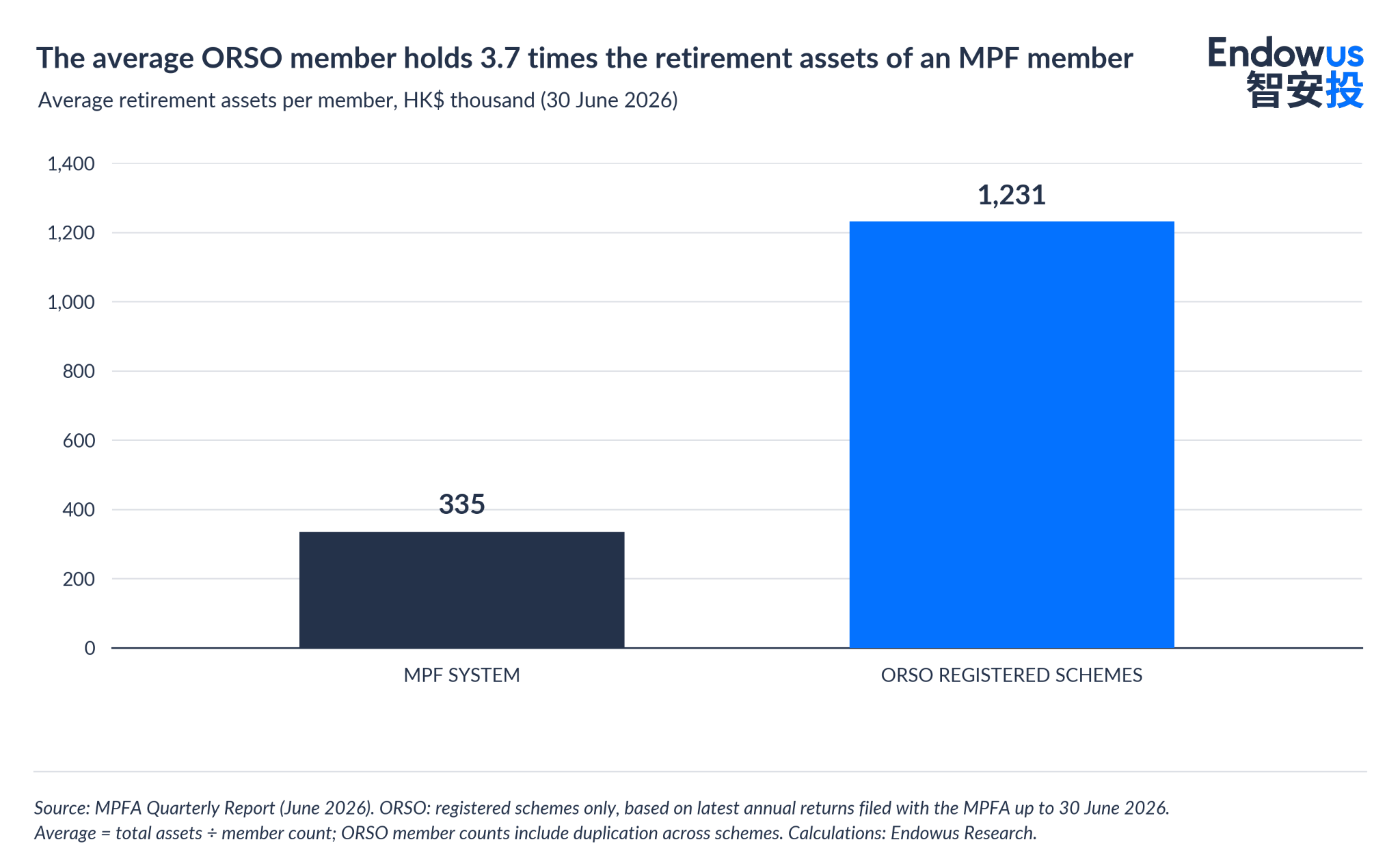
This article explains what ORSO is, how its schemes are classified, how they interact with the MPF, how benefits are taxed, and what members should weigh when deciding how their retirement savings are invested.
While there is legal information included in this article, readers are encouraged to consult a lawyer or a tax advisor for a more comprehensive understanding of the rules and regulations around ORSO and MPF.
What is ORSO, and who regulates it?
The Occupational Retirement Schemes Ordinance came into operation in October 1993. It established a registration system for occupational retirement schemes that employers set up voluntarily, and it set standards for how those schemes are regulated and funded. The purpose was to give members greater certainty that promised benefits would be paid when they fall due.
The MPFA administers the regime as the Registrar of Occupational Retirement Schemes. This is the same authority that oversees the MPF, but the two systems run under separate legislation and on different terms. The defining contrast is the voluntary nature of ORSO, whereas MPF participation is mandatory for most employees aged 18 to under 65.
A 2020 amendment to the ordinance broadened the MPFA’s inspection and investigation powers. The change confirmed that schemes must remain genuinely employment-based, and closed the door to ORSO structures being marketed to the public as investment vehicles.
What are registered and exempted ORSO schemes? What is defined benefit and what is defined contribution?
An employer that sets up an ORSO scheme must apply to the MPFA within three months for either a registration certificate or an exemption certificate. Operating a scheme without applying is an offence. For additional information, employer should seek legal consultation or advice.
Registered schemes are those that do not qualify for exemption. Exempted schemes fall into narrow categories, principally offshore schemes already approved by an overseas authority with functions similar to the MPFA’s. Since June 2020, the MPFA no longer grants exemption on the basis that Hong Kong permanent identity card holders make up only a small share of members.
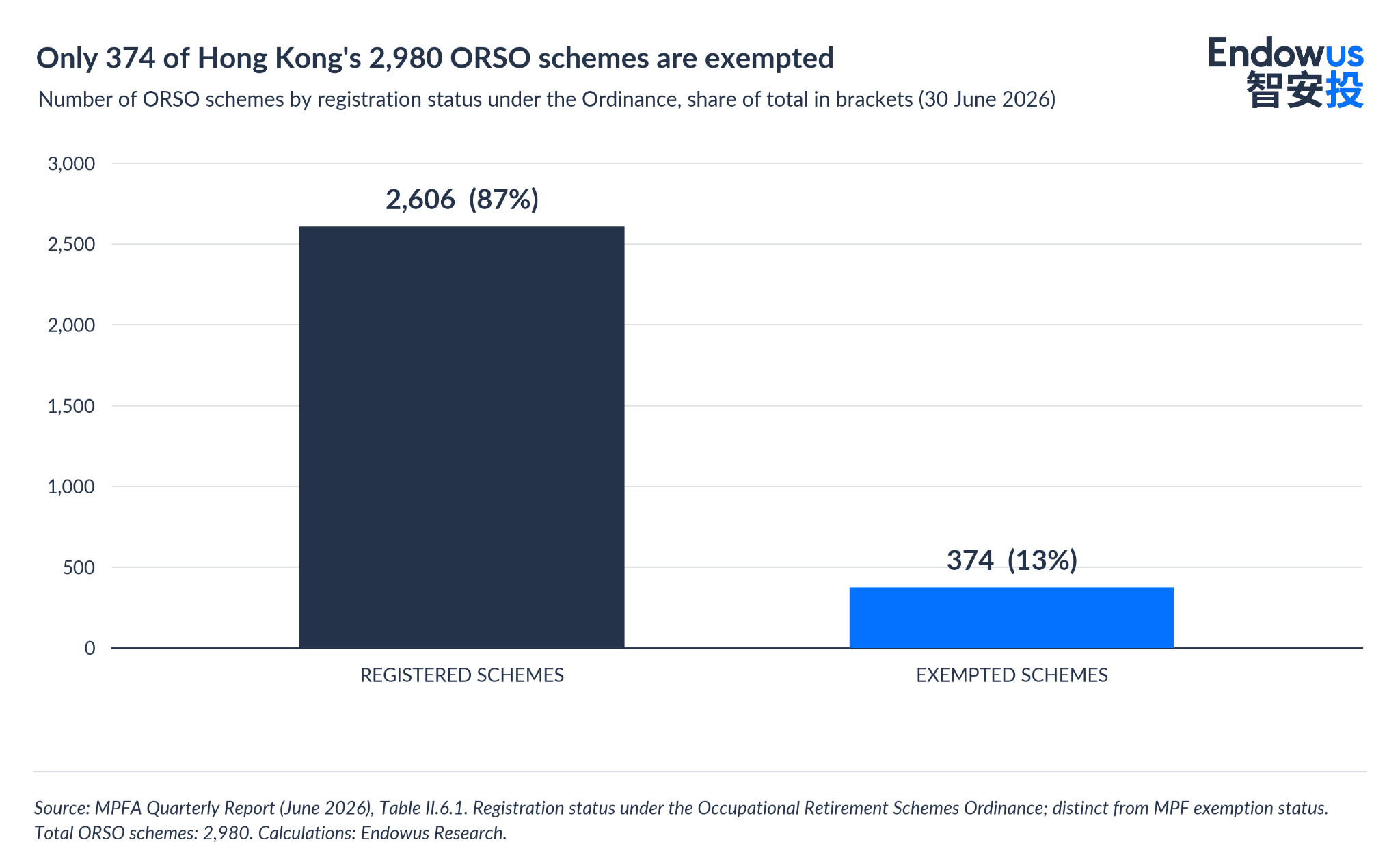
Schemes are also either defined contribution or defined benefit. In a defined-contribution (DC) scheme, the benefit equals contributions plus investment return, usually subject to a vesting scale. In a defined-benefit (DB) scheme, a formula, typically based on years of service and final salary, sets the benefit. Most ORSO schemes are DC.
One distinction causes frequent confusion. An “ORSO exempted scheme” is exempt from certain provisions of the ordinance. An “MPF-exempted ORSO scheme” is a different thing: it holds an MPF exemption certificate under the Mandatory Provident Fund Schemes (Exemption) Regulation (Cap. 485B), which allows it to serve as an alternative to the mandatory MPF.
How does an ORSO scheme interact with the MPF?
Where an employer offers an MPF-exempted ORSO scheme, it must give each new eligible employee a one-off, irrevocable choice between that scheme and an MPF scheme. The employer must provide the prescribed information — including contribution arrangements, vesting scales, and minimum MPF benefits — within 10 days of the employee becoming eligible. The employee then has 30 days to respond in writing; without a response, the employee is deemed to have chosen the MPF.
The choice binds for the duration of employment with that employer. A fresh choice arises only on joining a new employer that also offers both options.
For employees who joined after 1 December 2000, benefits up to the minimum MPF benefits (MMB) are subject to the same preservation, portability, and withdrawal rules as the MPF. The MMB is the lesser of two amounts: the benefits accrued while the MPF exemption applied, or 1.2 multiplied by final average monthly relevant income and by years of post-2000 service. The relevant-income figure used in that calculation has been capped at HK$30,000 a month since June 2014 (MPFA).
Employees who joined on or before 1 December 2000 are grandfathered, and fall outside these MPF-style requirements.
For further information, please refer to the ORSO legislation or consult a lawyer.
Where do ORSO and MPF regimes differ most?
The key difference is vesting. MPF benefits vest fully and immediately, so contributions belong to the employee from the outset. Many ORSO schemes instead apply a vesting scale tied to length of service. An employee who leaves early may therefore forfeit some or all of the employer’s contributions — an outcome that cannot occur under the MPF.
Beyond vesting, the regimes differ on contribution flexibility, portability, investment control, and statutory protection. The table below sets out the principal contrasts.
How are ORSO benefits taxed?
The Inland Revenue Department (IRD) sets out the tax treatment in its guidance, DIPN 23. Three points matter most to members.
First, an employer’s ordinary annual contributions to a recognised ORSO scheme are deductible against profits tax, but only up to 15% of the employee’s total emoluments. Second, an employee’s own contributions are never taxed on receipt, since they represent a return of savings.
Third, and most consequentially, the tax on the employer-funded portion depends on why the benefit is paid. Benefits received on retirement, death, incapacity, or terminal illness are exempt. Benefits received on any other basis are, in principle, fully assessable. Benefits received on termination of service sit between the two: they are exempt only up to a “proportionate benefit.”
The proportionate benefit equals the accrued benefit multiplied by completed months of service, divided by 120, with service capped at 120 months, or ten years. The IRD’s own worked example is instructive: on an accrued benefit of HK$100,000 after 72 completed months, the proportionate benefit is HK$100,000 multiplied by 72 and divided by 120, or HK$60,000; only the remaining HK$40,000 is taxable.
The distinction between “retirement” and “termination” is therefore valuable. Under the ordinance, “retirement” carries a defined meaning — broadly, leaving at or after a specified age of at least 45, or after at least ten years of service. Where a departure qualifies as retirement, the employer-funded benefit is exempt in full (IRD, DIPN 23).
This is not comprehensive taxation advice. For additional information, please seek help from taxation experts and professionals.
What happens to your ORSO benefits when you change jobs?
For members who joined after 1 December 2000, the minimum MPF benefits cannot be paid out on leaving. They must be transferred to an MPF scheme — or to a master trust or industry scheme — and preserved until a permitted withdrawal event. Benefits above the MMB may be withdrawn or retained according to the scheme’s rules and vesting scale. If a scheme is wound up, the employer and the scheme’s designated person must notify both the MPFA and each member within 14 days.
One recent change is worth noting. Since 1 May 2025, employers can no longer use the mandatory portion of retirement-scheme benefits to offset the post-transition part of statutory severance or long service payments. The abolition applies to MPF-exempted ORSO schemes through a statutory “carved-out benefits” formula, so ORSO members are affected in broadly the same way as MPF members (Labour Department).
For additional details and information, please refer to the regulation or consult a lawyer.
Investment implications
Both MPF and defined-contribution ORSO members bear investment risk directly: the eventual benefit reflects contributions plus investment return. Mandatory contributions are also capped — MPF employee mandatory contributions, for instance, are limited to HK$1,500 a month. For many members, the mandatory pillars alone may fall short of the income needed to sustain their standard of living in retirement, particularly as Hong Kong ages. The share of residents aged 65 and over has risen to 1 in 5, according to the United Nations.
History suggests the gap can be narrowed, though not without risk. Over the life of the MPF system to 2026, equity funds and mixed-asset funds — together about 80% of MPF assets — returned an annualised 4.8% and 4.4% respectively, net of fees, against inflation of 1.8%. Past performance is not necessarily a guide to future performance or returns.
Two levers may help close a projected shortfall. Members may make tax-deductible voluntary contributions (TVC) to the MPF, which carry an annual tax deduction of up to HK$60,000, shared with qualifying deferred-annuity premiums. Alternatively, or in addition, they may invest privately outside the mandatory schemes, where they keep control over strategy, cost, and asset mix.
For the savings that the ceiling leaves uncovered, an investor can build a globally diversified portfolio through Endowus HK solutions. This same logic connects to Hong Kong's other retirement building blocks, including the Hong Kong annuity, Silver Bond, and other residual approaches to generating retirement income.
In our view, the practical question for an ORSO member is not which regime is superior in the abstract, but how their scheme’s specific vesting, portability, and investment terms fit a longer retirement plan. On one hand, an ORSO scheme with generous employer contributions and a reasonable vesting scale can be a valuable component of retirement savings. On the other, capped mandatory saving and employer-controlled investment choices mean most members are likely to need a deliberate, diversified plan of their own.
For investors using Endowus, our advisers can help you assess how your MPF or ORSO benefits fit alongside your wider portfolio, and how to structure any voluntary or private investments around them.
Frequently asked questions about ORSO in Hong Kong
What is the difference between ORSO and the MPF?
ORSO governs occupational retirement schemes that employers establish voluntarily; the MPF is a mandatory system for most employees. ORSO schemes may be defined benefit or defined contribution and often apply a vesting scale, whereas MPF benefits are defined contribution and vest immediately.
Is an ORSO scheme mandatory in Hong Kong?
No. Setting up an ORSO scheme is voluntary for employers. Where an employer offers an MPF-exempted ORSO scheme, new eligible employees are given a one-off choice between that scheme and the MPF.
What happens to my ORSO benefits if I leave my job?
If you joined the scheme after 1 December 2000, the minimum MPF benefits portion must be transferred to an MPF, master trust, or industry scheme and preserved. Benefits above that amount are dealt with according to the scheme’s rules and vesting scale.
Are ORSO benefits taxable in Hong Kong?
Benefits from your own contributions are not taxed. Employer-funded benefits are exempt on retirement, death, incapacity, or terminal illness; on termination of service they are exempt only up to the proportionate benefit calculated under the Inland Revenue Ordinance, with any excess assessable.
Can I choose between an ORSO scheme and the MPF?
Only when your employer offers an MPF-exempted ORSO scheme. You then have a one-off, irrevocable choice, and must respond within 30 days of receiving the prescribed information, or you are deemed to have chosen the MPF.
Disclaimer
Endowus HK Limited is licensed by the Securities and Futures Commission (CE No. BQR225) under the Securities and Futures Ordinance (Cap. 571) to carry on Type 1 (Dealing in Securities), Type 4 (Advising on Securities) and Type 9 (Asset Management) regulated activities.
Risk Warnings
Investment involves risk. Past performance is not an indicator nor a guarantee of future performance or returns. Projected performance or returns is not guaranteed to materialise. The value of investments and the income from them can go down as well as up, and you may not get the full amount you invested. Rates of exchange may cause the value of investments to go up or down. Individual stock performance does not represent the return of a fund.
General risk warnings relating to collective investment schemes
Before making an investment decision, you are reminded to refer to the relevant prospectus / offering document for specific risk considerations and related fees and charges. Funds are not a bank deposit and not capital guaranteed, and are subject to investment risks, including the possible loss of the principal amount invested. Some of the funds also involve derivatives. Do not invest in them unless you fully understand and are willing to assume the risks associated with them.
Opinions
Any forward-looking statements, prediction, projection or forecast on the economy, stock market, bond market or economic trends of the markets contained in this material are subject to market influences and contingent upon matters outside the control of Endowus HK Limited (“Endowus”) and therefore may not be realised in the future. Further, any opinion or estimate is made on a general basis and subject to change without notice. In presenting the information above, none of Endowus HK Limited, its affiliates, directors, employees, representatives or agents have given any consideration to, nor have made any investigation of the objective, financial situation or particular need of any user, reader, any specific person or group of persons. Therefore, no representation is made as to the completeness and adequacy of the information to make an informed decision. You should carefully consider (i) whether any investment views and products / services are appropriate in view of your investment experience, objectives, financial resources and relevant circumstances. You may also wish to seek financial advice through a financial advisor or the Endowus platform and independent legal, accounting, regulatory or tax advice, as appropriate.
No invitation or solicitation
Nothing contained [in this article] should be construed as a solicitation, an offer to buy or sale, or recommendation, to acquire or dispose of any security, commodity, investment or to engage in any other transaction in any jurisdiction in which such solicitation, offer to buy or sale would be unlawful under the securities laws in such jurisdiction. No information included [in this article] is to be construed as investment advice or as a recommendation or a representation about the suitability or appropriateness of any advisory product or service; or an offer to buy or sell, or the solicitation of an offer to buy or sell, any security, financial product, or instrument; or to participate in any particular trading strategy. Investors should seek independent financial and tax advice before making any investment decision.
Product Risk Rating
Please note that any product risk rating (the “PRR”) provided by us is an internal rating assigned based on our product risk assessment model, and is for your reference only. The PRR is subject to change from time to time. The PRR does not take into account your individual circumstances, objectives or needs and should not be regarded as advice or recommendation to purchase, hold or sell any fund or make any other investment decisions. Accordingly, you should not solely rely on the PRR in making your investment decision in the relevant Fund.
This advertisement has not been reviewed by the Securities and Futures Commission or any regulatory authority in Hong Kong.


.png)