.webp)
.webp)
.webp)
.webp)





- Private credit is a diversified investment opportunity that expands beyond direct lending, including asset-based finance, secondaries and specialty finance.
- Private credit secondaries are growing rapidly because of the rise of evergreen funds and credit continuation vehicles.
- Asset-based finance offers a different risk profile and is attracting capital.
Please note that private credit products are only for Professional Investors on Endowus. As an advanced yield-generating instrument, private credit products may carry a high degree of risk and may not be suitable for general retail investors. This article is for informational and educational purposes only and does not constitute a solicitation, an offer to buy or sell, or a recommendation for any investment product or strategy.
Private credit's market performance has been the talk of the town in the past six months, amidst warnings of potential crashes and news of redemption requests and gating.
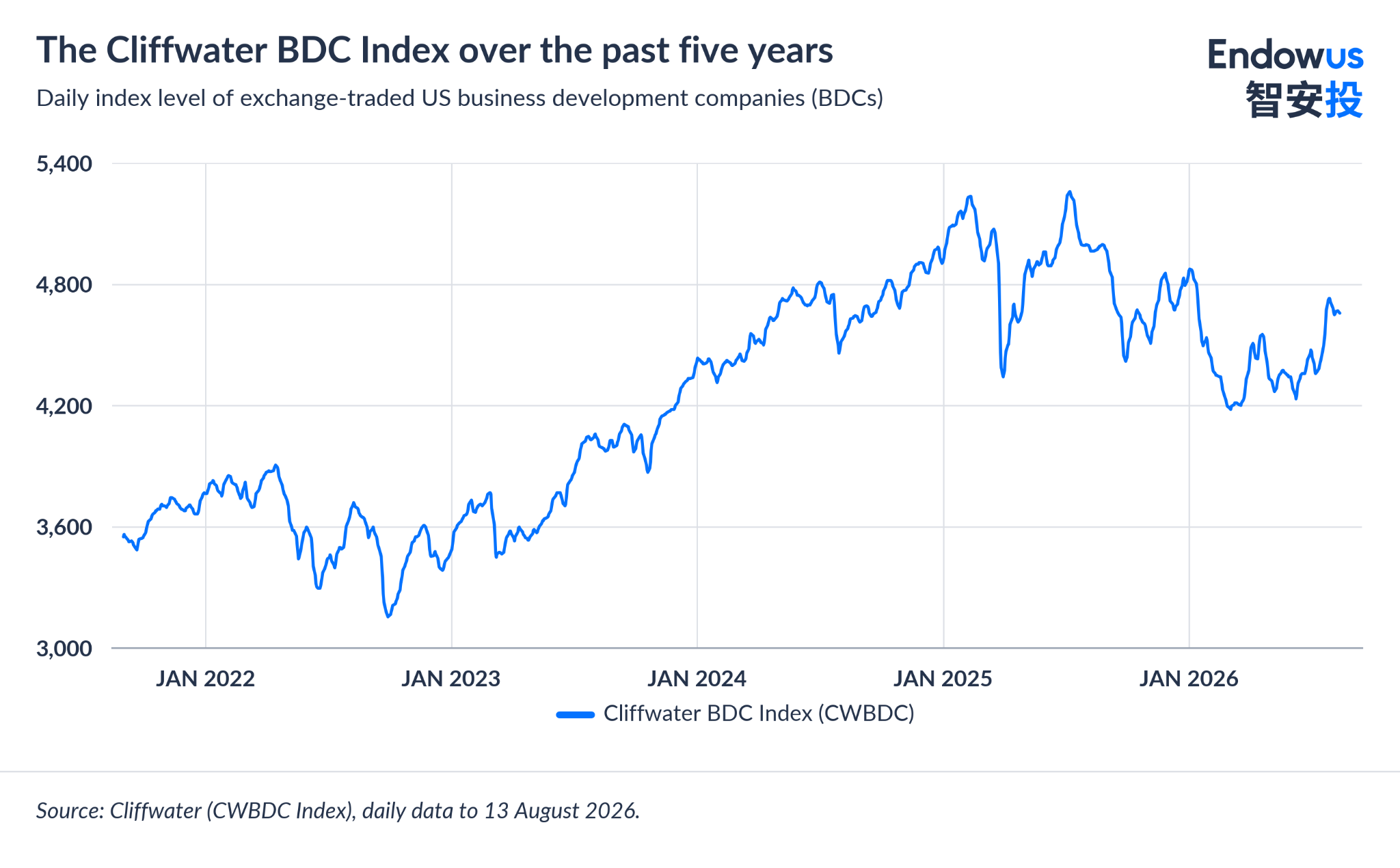
As we entered H2, 2026, the Cliffwater BDC Index (CWBDC), which measures the performance of lending-oriented, exchange-traded Business Development Companies, has been showing some signs of recovery.
Some US direct lending exposure was focused on software companies,which have bounced back after reaching their trough around mid-April 2026. As shown by the chart below, the iShares Expanded Tech-Software Sector ETF is up 34.24% over the past six months.

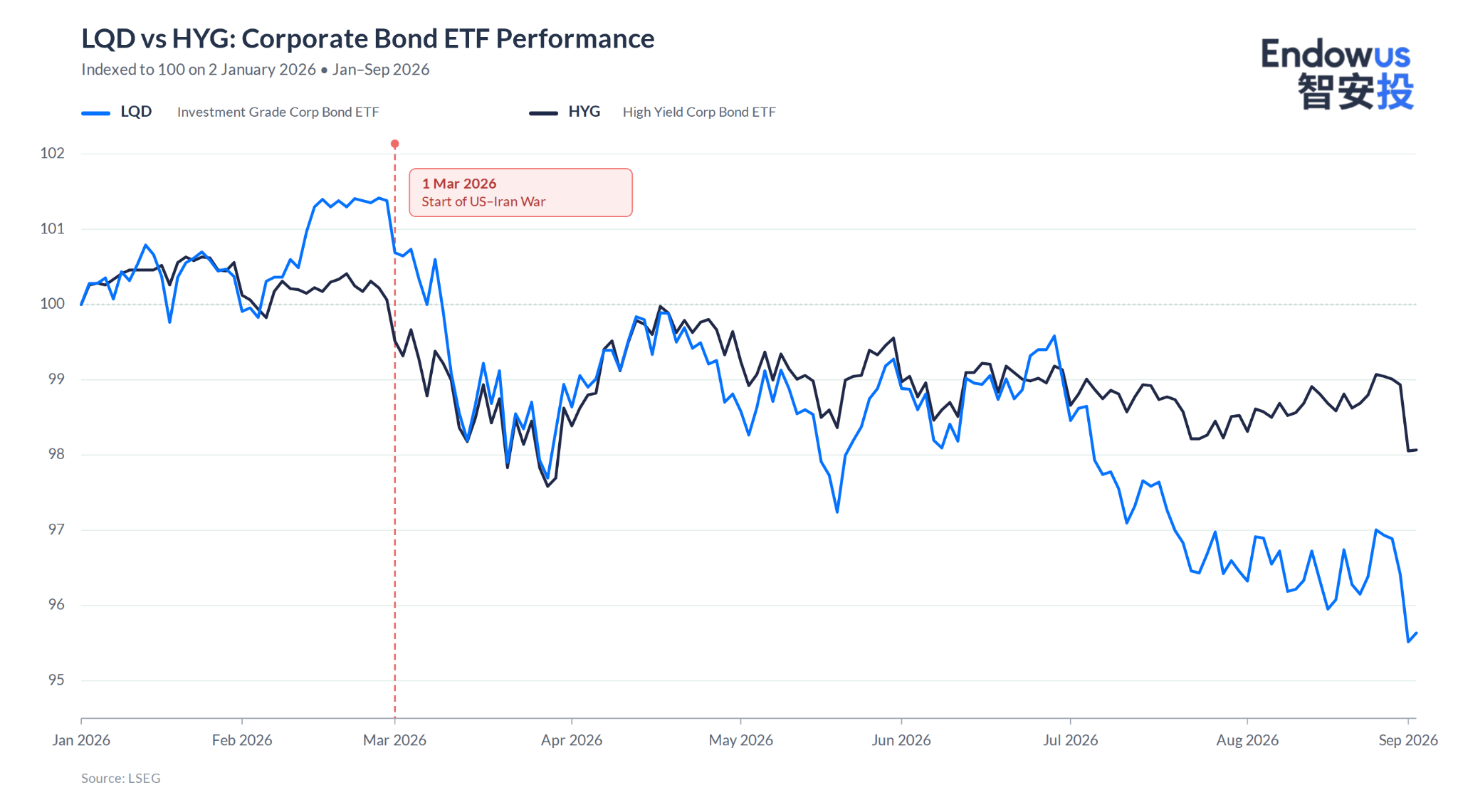
An additional potential driver of demand for direct lending exposure has been persistent uncertainty over the US interest rate path. More specifically, a shift in monetary policy stance since earlier this year, and a selloff in the long end which has pushed yields higher may have impacted the prices of both investment-grade and high-yield fixed-rate credit. Private credit, by contrast, is predominantly floating-rate, so its coupons reset with prevailing rates rather than suffering the price erosion that fixed-coupon instruments experience when yields rise.
What is private credit, and is it the same as direct lending?
A common misconception exists when it comes to public information and news about private credit. Most news outlets and many non-sector practitioners tend to conflate private credit and direct lending, but direct lending is only one type of product within a much larger universe.
As pricing increased due to increased demand in the direct lending space, firms started to look at diversification opportunities in other areas of private credit. Two examples below are secondaries and asset-based finance.
What are private credit secondaries, and how big is the opportunity?
Private credit secondaries have reached unprecedented levels, with transaction volume in the first half of 2026 reaching USD 20.4 billion. This more than doubles the volume recorded in the first half of 2025 and has already surpassed the full-year 2025 total of approximately USD 20 billion, in just six months.
Driver of the Rise of Private credit secondaries
The first driver is the growing use of evergreen funds and credit continuation vehicles, which together have turned general partner-led deals into a standard part of the market rather than a niche option. An evergreen fund has no fixed end date. Instead of being wound down after a set number of years like a traditional fund, it can keep raising capital and making new loans indefinitely, with investors able to enter or exit only at set intervals.
A continuation vehicle works differently. It lets a fund manager move a group of well-performing loans out of an ageing fund and into a brand new vehicle at a freshly agreed valuation, so those loans can keep earning for longer instead of being sold off simply because the original fund's term is ending. Investors in the old fund are then given a choice: cash out at that new valuation, or roll their stake into the new vehicle and stay invested. What was once used mainly to rescue funds holding distressed assets has become a routine tool fund managers use to manage their best-performing loans and give investors more control over when they get their money back.
The second driver is more resilient pricing. Limited partners have historically avoided the secondary market because of the steep discounts sellers were forced to accept. Increased buyer competition has since narrowed that gap considerably.
What do secondaries transactions mean for investors?
Part of the recent growth in secondaries market activity has coincided with redemption pressure on these vehicles, as investors seeking liquidity have found standard redemption channels constrained. Viewed this way, secondaries function less as a symptom of distress within private credit and more as a release valve, a mechanism through which liquidity can be manufactured when needed, when a fund's underlying assets remain sound. The rise of credit secondaries suggests that the volatility private credit has experienced through periods of redemption pressure may reflect a transition toward a more mature market structure, in which liquidity solutions exist alongside long-term private exposure rather than in place of it.
What is asset-based finance and why is it in the news lately?
Different Risk Profile Compared to Direct Lending
Traditionally, direct lending has dominated the public conversation about private credit, but asset-based finance (ABF) is now increasingly discussed as a strategy by many prominent fund managers. Part of the appeal lies in the sheer range of collateral ABF can be built on. A single ABF portfolio might be secured by:
- consumer finance receivables, e.g. credit card balances or student debt, or
- hard assets, e.g. aircraft, railcars or data centres, or
- financial assets, e.g. fund finance and insurance-linked securities, or
- real estate, e.g. residential mortgages to bridge loans, or
- corporate assets like receivables, intellectual property and royalty streams, etc.
ABF collateral also tends to hold an observable market value independent of any single business's fortunes. In comparison, direct lending is typically secured only by a first lien on the borrower's own assets or enterprise value, meaning the lender's claim may be subordinate to creditors having a lien on a specific valuable asset. If it is a large loan to a single firm, that firm’s performance may determine the value of the loan. While a direct loan concentrates credit risk in one borrower, ABF spreads it across many underlying obligors, often thousands of individual consumer loans, leases or receivables within one pool.
The repayment schedule is also different. ABF principal is not returned in one lump sum at maturity the way a corporate loan typically is. It comes back progressively as the underlying assets amortise, often returning the majority of principal within the first few years of the investment. That structure means ABF exposure typically shrinks steadily over the life of the deal.
Direct lending moves in the opposite direction: principal stays fully outstanding until maturity (bullet payment), and refinancing risk may build up and then crystallise all at once when the loan comes due. That risk may grow more relevant as increased demand potentially caused some loosening of covenant protections in the broader direct lending market.
How much has ABF grown?
The scale of this shift becomes evident when examining the flow of institutional capital into the space. The global private asset-based finance market surpassed USD 6.1 trillion in 2025 and is projected to exceed USD 9 trillion by 2029, a trajectory increasingly driven by the participation of the largest asset managers.
In December 2025, PIMCO raised more than USD 7 billion for a private asset-based finance strategy targeting loans secured by hard and financial assets, spanning residential mortgages, consumer markets, digital infrastructure, auto loans, equipment lending and aircraft leasing, bringing the firm's total private asset-based finance assets past USD 20 billion.
What are the drivers of ABF growth?
Over the past decade, direct lending allocations have been popular among institutional investors, so a large base already exists; new capital increasingly goes toward diversification rather than simply growing that sleeve further. ABF offers a way to capture private credit exposure without concentrating further in single-name, cycle-sensitive corporate risk. Insurance capital in particular has been a significant driver, since ABF's amortising, contractual cash flows match long-duration liabilities far better than a bullet-maturity corporate loan, a preference reflected in Moody's finding that 44% of major insurers plan to increase allocations to ABF and private placements specifically.
Invest with clarity: Access private credit fund solutions with Endowus Hong Kong
Taken together, these shifts, a stabilizing performance backdrop, deepening secondary market liquidity, and the rise of asset-based finance, point to a private credit market that is maturing rather than merely recovering.
For investors looking to build exposure to this evolving asset class, Endowus Private Wealth offers access to institutional-grade private credit strategies, spanning direct lending, asset-based finance, and evergreen structures, through partnerships with leading managers such as HPS, Oaktree, etc. Explore Endowus's private credit and private markets solutions to see how they could fit into your portfolio.
Please note: Access to private credit funds is currently limited to clients who qualify as Professional Investors (PI). To qualify, you will generally need to provide proof of a portfolio worth at least HK$8 million in net assets, as required under Hong Kong's regulatory framework. This eligibility requirement reflects the more complex risk and liquidity profile of private credit as an asset class, which is why it is not yet open to all retail investors.
Frequently Asked Questions
Who can invest in private credit funds on Endowus?
Access to private credit funds is currently limited to clients who qualify as Professional Investors (PI). To qualify, you will generally need to provide proof of a portfolio worth at least HK$8 million in net assets.
Why has private credit held up better than other types of bonds when interest rates are uncertain?
Most private credit loans have interest payments that adjust along with prevailing rates. So when rates rise, the payments investors receive go up too, rather than the loan losing value the way a fixed-rate bond would.
What are "private credit secondaries," and why is that market growing so quickly?
Think of it like a resale market. Instead of waiting years for a private credit investment to mature, investors can sell their stake to someone else who wants in. More investors wanting flexibility, plus fairer pricing for sellers, has pushed this market to record volumes in 2026.
Does more buying and selling in the secondary market mean something is wrong with private credit?
Not necessarily. It's better understood as a pressure release valve, giving investors a way to access their money sooner if they need it, without forcing funds to sell off perfectly healthy loans. Many see it as a sign the market is growing up, not breaking down.
What is asset-based finance, and how is it different from typical private lending?
Typical private lending (direct lending) means loaning money to one company, so if that company struggles, the loan is at risk. Asset-based finance instead lends against a large pool of things like car loans, mortgages, or equipment leases, so no single default has much impact, and the money tends to come back to investors gradually rather than all at once at the end.
Disclaimer
Risk Warnings
Investment involves risk. Past performance is not an indicator nor a guarantee of future performance or returns. Projected performance or returns is not guaranteed to materialise. The value of investments and the income from them can go down as well as up, and you may not get the full amount you invested. Rates of exchange may cause the value of investments to go up or down. Individual stock performance does not represent the return of a fund.
General risk warnings relating to collective investment schemes
Before making an investment decision, you are reminded to refer to the relevant prospectus/offering document for specific risk considerations and related fees and charges. Funds are not a bank deposit and not capital guaranteed, and are subject to investment risks, including the possible loss of the principal amount invested. Some of the funds also involve derivatives. Do not invest in them unless you fully understand and are willing to assume the risks associated with them.
Opinions
Any forward-looking statements, prediction, projection or forecast on the economy, stock market, bond market or economic trends of the markets contained in this material are subject to market influences and contingent upon matters outside the control of Endowus HK Limited (“Endowus”) and therefore may not be realised in the future. Further, any opinion or estimate is made on a general basis and subject to change without notice. In presenting the information above, none of Endowus HK Limited, its affiliates, directors, employees, representatives or agents have given any consideration to, nor have made any investigation of the objective, financial situation or particular need of any user, reader, any specific person or group of persons. Therefore, no representation is made as to the completeness and adequacy of the information to make an informed decision. You should carefully consider whether any investment views and products/services are appropriate in view of your investment experience, objectives, financial resources and relevant circumstances. You may also wish to seek financial advice through a financial advisor or the Endowus platform and independent legal, accounting, regulatory or tax advice, as appropriate.
No invitation or solicitation
Nothing contained in this article should be construed as a solicitation, an offer to buy or sell, or recommendation, to acquire or dispose of any security, commodity, investment or to engage in any other transaction in any jurisdiction in which such solicitation, offer to buy or sell would be unlawful under the securities laws in such jurisdiction. No information included in this article is to be construed as investment advice or as a recommendation or a representation about the suitability or appropriateness of any advisory product or service; or an offer to buy or sell, or the solicitation of an offer to buy or sell, any security, financial product, or instrument; or to participate in any particular trading strategy. Investors should seek independent financial and tax advice before making any investment decision.
Product Risk Rating
Please note that any product risk rating (the “PRR”) provided by us is an internal rating assigned based on our product risk assessment model, and is for your reference only. The PRR is subject to change from time to time. The PRR does not take into account your individual circumstances, objectives or needs and should not be regarded as advice or recommendation to purchase, hold or sell any fund or make any other investment decisions. Accordingly, you should not solely rely on the PRR in making your investment decision in the relevant Fund.
Endowus HK Limited (CE No. BQR225) is licensed by the Securities and Futures Commission for Type 1 (dealing in securities), Type 4 (advising on securities) and Type 9 (asset management) regulated activities.
This advertisement has not been reviewed by the Securities and Futures Commission or any regulatory authority in Hong Kong.


.png)