.webp)
.webp)
.webp)
.webp)






- A private equity fund pools capital to buy stakes in companies that are not listed on a stock exchange, and in Hong Kong it is generally offered only to Professional Investors.
- Eligibility and affordability are two independent gates: the law sets a professional investor test of a portfolio of at least HK$8 million, while each fund sets its own minimum subscription.
- The central trade-off is liquidity, because capital is typically committed for around a decade, so the decision rests on whether you can hold through a long, illiquid horizon.
Private market strategies have moved from the edges of institutional portfolios towards the centre of the wealth conversation in Hong Kong, and the marketing has travelled faster than the understanding.
The local questions are simpler and more useful — who may invest, on what terms, and what has just changed. For an investor here, “how do I invest?” has a legal answer before it has a financial one: two independent gates, a statutory eligibility test and a commercial minimum set by each fund. Clearing one says nothing about the other.
This guide sets out what a private equity fund is, how it is offered in Hong Kong, how the structure actually works, the two gates, the risks that follow from the structure rather than from any single fund, and what the SFC’s September 2026 guidance changes.
What is a private equity fund?
A private equity fund is a pooled vehicle that invests in the equity of companies not listed on a public stock exchange. It is run by a general partner (GP), the manager, on behalf of limited partners (LPs), the investors who provide most of the capital.
There is often confusion between two concepts - “private funds” and “private equity funds.” “Private” describes how a fund is offered, by private placement rather than to the public. Typically, private placements are aimed at more sophisticated investors, but there are exceptions in certain countries. “Private equity” describes what a fund is invested in, namely stakes in unlisted companies. Private funds also include exposure to private credit, hedge funds, real estate, and infrastructure strategies .
A hedge fund and a private equity fund, while both typically aimed at a more sophisticated client base, are fundamentally different. Hedge funds tend to pursue liquid strategies in traded instruments, whereas a private equity fund holds companies for years and works to improve them before selling. A form of private equity is venture capital, which invests in privately owned, high-growth companies.
Public and private funds in Hong Kong
In Hong Kong, offering a collective investment scheme to the public is generally an offence under the Securities and Futures Ordinance unless the SFC authorises the scheme or an exemption applies. The exemption that private funds rely on is that the offer is made only to professional investors.
Private equity funds are not SFC-authorised, so they are offered on that professional-investor basis. As a direct consequence, the fund’s offering and marketing documents are not reviewed by the regulator, which places more of the due-diligence burden on the investor. The table below sets out some of the practical differences.
How a private equity fund works
At the fund inception, investors (LPs) only make a commitment, a legal promise to provide capital up to an agreed sum at a date decided by the fund’s manager (GP). The GP decides when to draw that capital down - in instalments, known as capital calls - typically as investments are made (but there are exceptions, for instance NAV loans), and eventually returns cash as distributions when holdings are sold.
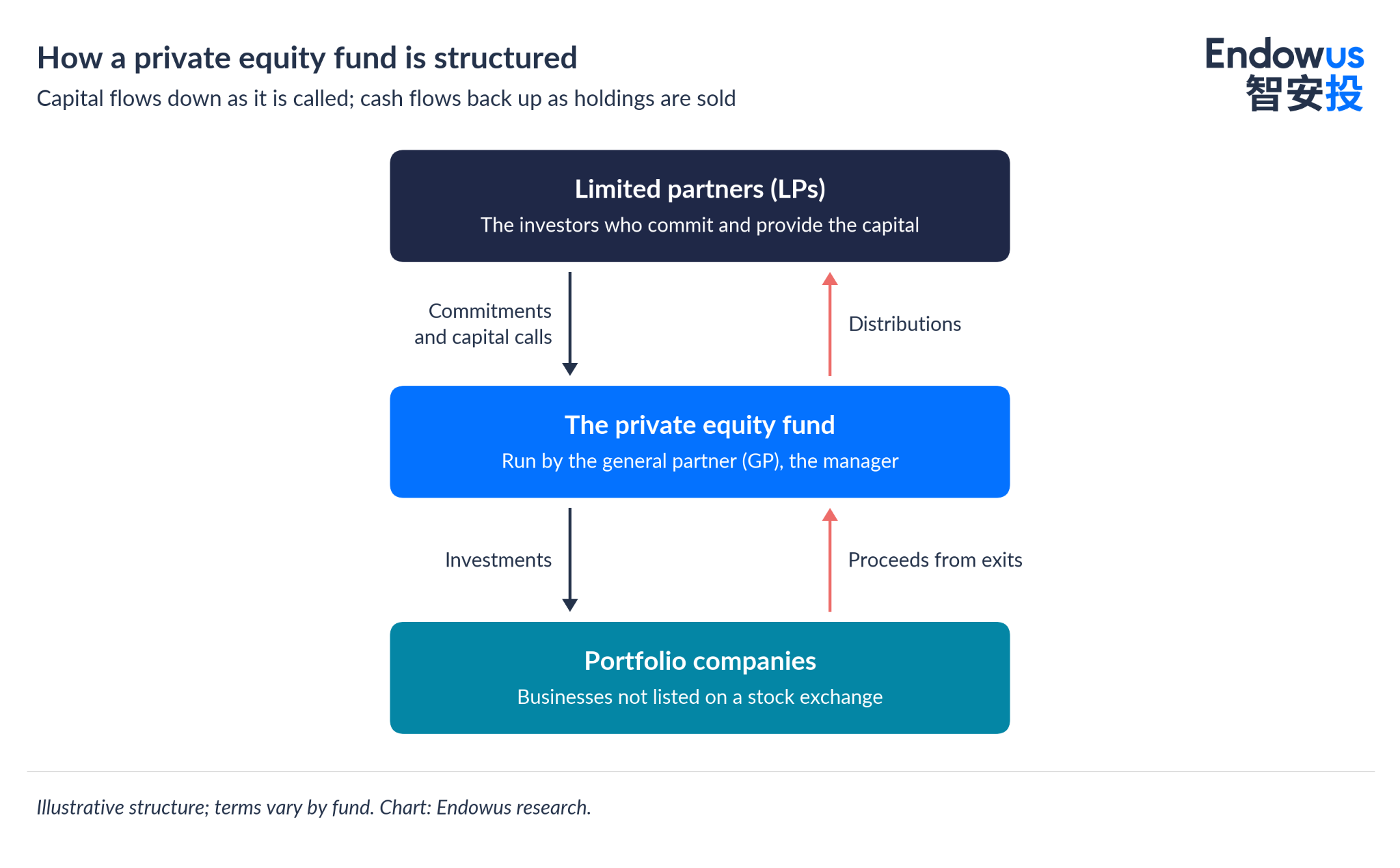
Because the underlying companies are unlisted, the fund’s value is estimated from periodic valuations of the portfolio companies rather than a continuous market price, a key topic when it comes to assessing risk. A closed-end private equity fund typically runs for around a decade, and investors usually cannot withdraw during that term.
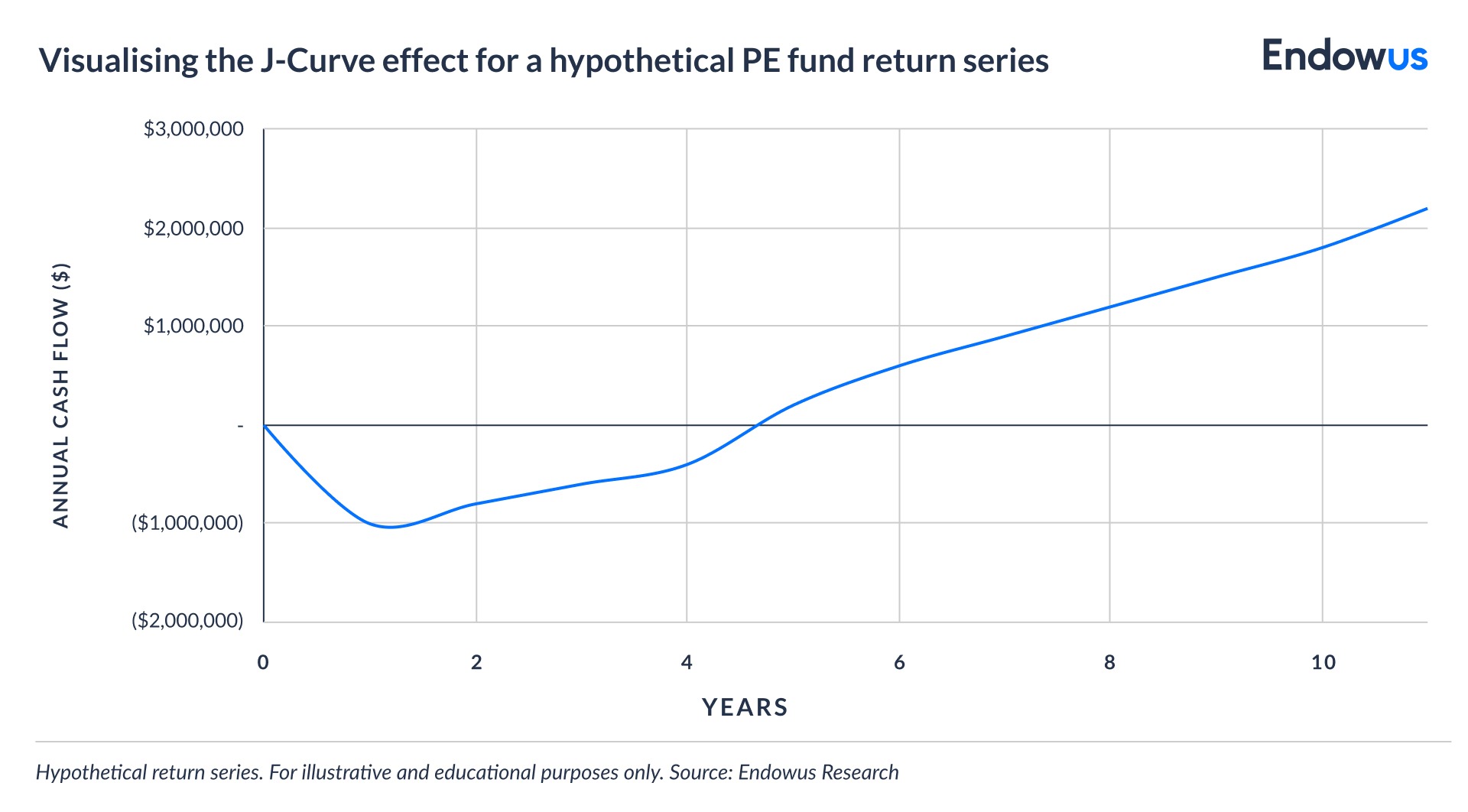
That timing produces a characteristic pattern often called the J-curve. Fees and set-up costs are charged from the start, while gains, if any, arrive later as holdings mature and are sold. Cumulative net value to investors therefore tends to fall before it may rise.
What are the two main limitations for investors to access private equity funds?
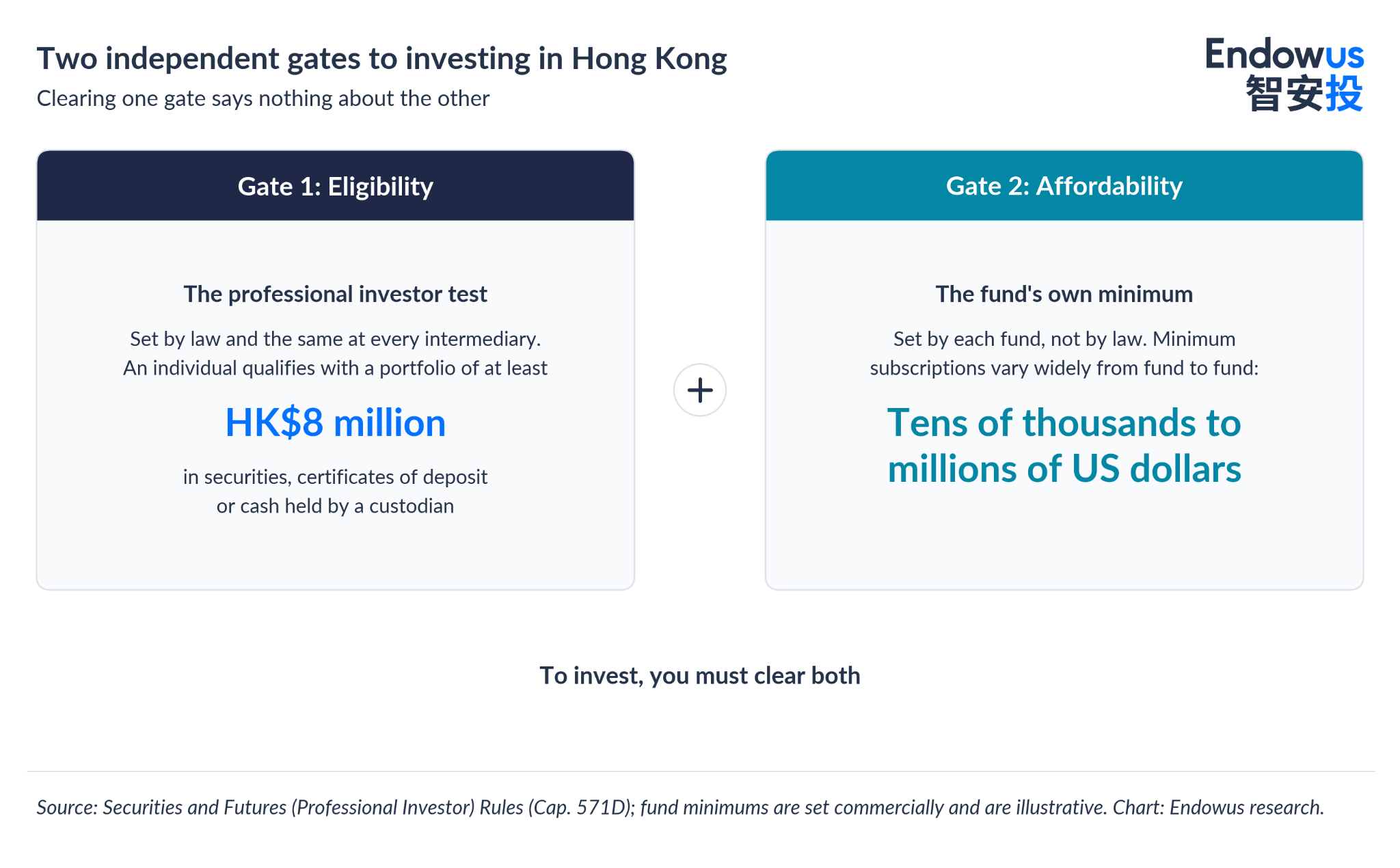
Under Hong Kong’s Securities and Futures Rules, an individual generally qualifies with a portfolio of at least HK$8 million in securities, certificates of deposit, or cash held by a custodian. The threshold is set by law and is the same at every intermediary. Status is checked by the intermediary, re-confirmed at least annually, and the consent can be withdrawn.
In addition to this legal threshold, each fund sets its own minimum subscription, which can range from tens of thousands to millions of US dollars.
The two gates are independent: an investor may clear the eligibility test yet fall short of a fund’s minimum, or meet a minimum yet not qualify as a professional investor.
To be clear, private equity (and more broadly, private market) funds limit the number of investors because they want to keep their structure lean, and prefer to communicate and interface with a limited number of - typically very sophisticated - LPs. Beyond the mere wealth requirements, the fund minimum subscriptions are typically an operational guardrail, as LPs have to be managed, diligenced and informed.
What are the key elements to watch for an investor in a private equity fund?
If you gain exposure to private equity, you have to pay close attention to four key elements.
- Liquidity risk. There is no active secondary market for most private equity interests, so capital is effectively locked up for the fund’s life - if the fund is closed-end. An investor who needs the money early may be unable to exit, or may only do so at a discount.
- Valuation. Private equity holdings are marked periodically from models rather than traded continuously, so those marks can be stale, and write-downs tend to lag because managers hold some discretion over their timing. This phenomenon is called smoothing, and it typically causes reported volatility to understate the true variability of value. Steadiness may be a feature of the measurement method, not evidence that the underlying companies are less volatile.
- Fees and fee structure. Research on US funds found that most of a manager’s expected revenue comes from fixed fees that do not depend on performance, and carried interest can still be paid even when a portfolio performs poorly. Because fees are levied from the outset and compound, they are a direct cause of the early dip in the J-curve.
- Manager dispersion is key to successful outperformance. . Academic work
covering funds through the mid-2000s found average returns to investors, after fees, broadly comparable to public equity indices, but with wide dispersion between individual funds and some evidence that strong managers persisted; later research questioned that persistence on data grounds . Past performance is not a guide to future performance.
The mechanics explain the spread: holdings cannot be arbitraged, portfolios are concentrated, outcomes depend on the manager’s operational work, and leverage magnifies both good and poor results. Manager selection, in other words, is a tremendously important source of alpha.
What is the difference between closed-end and evergreen funds?
Not all private market funds are closed-end. A growing number are structured as evergreen funds. The distinction changes how money is raised from investors, more importantly, how it might be distributed back to investors.
Because an evergreen fund is entered and exited at an appraisal-based NAV, the smoothing described above affects the price you actually pay or receive. Its redemption windows are typically capped and can be suspended, so they are a managed form of liquidity, not liquidity on demand.
A listed route also exists. Some closed-ended alternative funds trade on the exchange, where liquidity comes from selling shares rather than redeeming at NAV, and the share price may trade away from that NAV.
What the SFC’s September 2026 guidance changes
In September 2026, the SFC issued a circular on SFC-authorised funds with exposure to private market assets. It sets out enhanced disclosure expectations in offering documents and, where appropriate, the Key Facts Statement, so that the risks are described in a clear and balanced way.
Authorised funds already face a cap of 15% of net asset value on investments that are neither listed nor quoted. The circular signals that an authorised fund with a substantial share of private-market exposure may be treated as a complex product; that classification brings suitability obligations that apply even to unsolicited trades, which in practice raises the bar for selling such a fund to retail investors.
The takeaway for readers is twofold: private-market exposure is no longer confined to unauthorised funds, and a fund’s offering documents are the place to confirm how it is classified.
Investment implications
Endowus provides access to private market strategies for Professional Investors only. They must meet the eligibility test set out by the SFC. Investors who qualify can review the eligibility and opt-in process, while readers who do not can begin with our investor education and a general investment account.
Private equity can earn a considered place in some long-horizon portfolios, but Professional Investors should also consider the costs (long lock-ups, appraisal-based valuations, and layered fees) and the asset class and fund’s fit within their investment goals, including risk-profile and time horizon. Past performance is not a guarantee of future returns.
Frequently asked questions
Who can invest in a private equity fund in Hong Kong?
Private equity funds are generally offered only to professional investors. An individual usually qualifies with a portfolio of at least HK$8 million in securities, certificates of deposit, or cash held by a custodian.
How much money do I need to invest?
Two separate things. You must qualify as a professional investor, and you must meet the fund’s own minimum subscription. The two are independent.
Why do private equity returns look steadier than the stock market?
Partly because the holdings are valued periodically from models rather than priced continuously, and write-downs can lag. Reported volatility may therefore understate the true variability of value, so steadiness should not be read as safety.
Can I sell out of a private equity fund early?
Usually not in a closed-end fund during its term. Evergreen funds may offer periodic windows, but these are typically capped and can be suspended. Some listed alternative funds trade on the exchange, where the price may differ from NAV.
What does the SFC’s September 2026 guidance mean for me?
It raises disclosure expectations for authorised funds with private-market exposure, and some may be treated as complex products, which tightens how they are sold to retail investors. Check a fund’s offering documents to see how it is classified.
Disclaimer
Risk Warnings
Investment involves risk. Past performance is not an indicator nor a guarantee of future performance. The value of investments and the income from them can go down as well as up, and you may not get the full amount you invested. Rates of exchange may cause the value of investments to go up or down.
This article is not intended to be relied upon as a forecast or research or investment advice, and should not form the basis of any investment or other decisions. The information contained herein is not intended, and should not be construed, as any legal, tax, regulatory, accounting or financial advice. If you would like investment, accounting, tax or legal advice, you should consult with your own professional advisors regarding your individual circumstances and needs.
The information in this article may not be suitable for all investors. You are responsible for any action that you take or decision that you make in reliance on any content in this article, and you agree that Endowus HK Limited (“Endowus”) is not liable under any circumstances.
No invitation or solicitation
Neither the information, nor any opinion, contained in this article constitutes a recommendation, offer or solicitation by Endowus or its affiliates to you to buy or sell any securities, collective investment schemes or other financial instruments or services, nor shall any such security, collective investment scheme, or other financial instruments or services be offered or sold to any person in any jurisdiction in which such offer, solicitation, purchase, or sale would be unlawful under the securities laws of such jurisdiction.
This is not intended to be an invitation or offer made to the public to subscribe for any financial product or to enter into any transaction.
Accuracy of Information
Whilst Endowus has made reasonable efforts to provide accurate and timely information, there may be inadvertent delays, omissions, technical or factual inaccuracies or errors in any such information. Endowus does not warrant or represent that the information in this article is correct, accurate or reliable.
Opinions
Any opinion or estimate above is made on a general basis and none of Endowus, nor any of its affiliates, representatives or agents have given any consideration to nor have made any investigation of the objective, financial situation or particular need of any user, reader, any specific person or group of persons. Opinions expressed herein are subject to change without notice.
Any forward-looking statements, prediction, projection or forecast on the economy, stock market, bond market or economic trends of the markets contained in this article are subject to market influences and contingent upon matters outside the control of Endowus and therefore may not be realised in the future.
In presenting the information above, none of Endowus, its affiliates, directors, employees, representatives or agents have given any consideration to, nor have made any investigation of the objective, financial situation or particular need of any user, reader, any specific person or group of persons. Therefore, no representation is made as to the completeness and adequacy of the information to make an informed decision. You should carefully consider whether any investment views and products/services are appropriate in view of your investment experience, objectives, financial resources and relevant circumstances.
Endowus alternatives and Endowus Private Wealth are available to Professional Investors in Hong Kong only.
Endowus HK Limited is licensed by the Securities and Futures Commission (CE No. BQR225) under the Securities and Futures Ordinance (Cap. 571) to carry on Type 1 (dealing in securities), Type 4 (advising on securities) and Type 9 (asset management) regulated activities.
This article has not been reviewed by the Securities and Futures Commission of Hong Kong.


.png)