.webp)
.webp)
.webp)
.webp)





.jpg)
- Private equity funds invest in businesses, ranging from early-stage startups to more mature enterprises, with the objective of facilitating expansion or effective turnarounds, ultimately exiting and selling their investment for a profit.
- Unlike traditional investments such as stocks, bonds, and cash, private equity is characterised by illiquidity, finite durations, fewer regulatory constraints, and higher risk, though generating greater returns for investors in the long run.
- Successful funds go beyond acquisition by actively enhancing operations and tracking financial progress. Understand the strategies of private equity firms to generate returns based on the target company’s maturity.
- Endowus Hong Kong offers curated private equity strategies managed by HarbourVest, EQT, Partners Group, Stepstone, Carlyle and more for our Professional Investor clients. Contact us to learn more.
As private markets continue to grow and evolve, a foundational understanding of their unique lexicon becomes paramount for private equity beginners. This glossary serves as a guide for private equity investors, distilling the complex terminology of the asset class into 10 essential concepts.
What is private equity?
Private equity refers to a category of alternative investment that involves investing equity in non-publicly traded companies. Private equity funds invest in businesses, ranging from early-stage startups to more mature enterprises, with the objective of facilitating expansion or effective turnarounds, ultimately exiting and selling their investment for a profit. Given that the vast majority of companies globally are privately held, private equity funds operate within an immense market opportunity.
While the market opportunity is immense, the industry is currently navigating notable headwinds; in 2024, assets under management (AUM) fell by 2% to $4.7 trillion—the first decline since tracking began in 2005. Despite this, buyout investment value rebounded by 37% year-over-year to $602 billion, reflecting the industry's underlying resilience.
Unlike traditional investments such as stocks, bonds, and cash, private equity is characterised by illiquidity, finite durations, fewer regulatory constraints, and higher risk, though generating greater returns for investors in the long run.
Read more: An introduction to private equity
What is a private equity fund?
Private equity funds consist of three main entities: General partners (GPs), limited partners (LPs), and the private companies that private equity funds invest in.
#1 General Partners
General Partners, or fund managers, manage and make decisions for the fund. To closely align with their investors’ interests, GPs typically contribute a small percentage (1% to 3%) of the fund’s capital, ensuring they have "skin in the game". GPs are incentivised with carried interest—a share of profits paid only after reaching a preset minimum return known as the hurdle rate.
#2 Limited Partners
Limited Partners are investors who contribute capital but do not partake in daily management. Due to significant capital commitments and long holding periods, this class is primarily accessible to institutional LPs like pension funds, university endowments, and high-net-worth individuals. Recently, holding periods have lengthened to five or more years, leading to some investor frustration regarding liquidity.
Common strategies and deals in private equity
Private equity firms employ several strategies to generate returns based on the target company’s maturity:
- Venture Capital: Minority investments in early-stage startups with high growth potential but unproven models.
- Growth Equity: Investing in established, fast-growing companies that need capital to scale. Unlike buyouts, these are often minority investments, though investors still expect significant influence over operations.
- Leveraged Buyouts (LBO): The most common strategy involves acquiring a controlling stake using significant debt (and minimal cash). The debt is often placed on the acquired company’s balance sheet. Ideal targets are mature, non-cyclical companies with predictable cash flows and low existing debt.
- Distressed Investments: Focuses on struggling companies facing financial distress or bankruptcy.
In terms of deal types, management buyouts (MBOs) occur when an existing management team buys a controlling share of their assets. Corporate carve-outs involve acquiring a specific division within a corporation; while they often fetch lower valuation multiples, they are complex and can unlock significant underprioritised value. Additionally, secondary buyouts involve the sale of a company from one private equity firm to another.
How to operate and measure performance of a private equity fund
Successful funds go beyond acquisition by actively enhancing operations and tracking financial progress. Managers use specialised expertise to overhaul companies while applying specific metrics to ensure transparent value creation.
The "value creation" toolkit
Modern private equity has shifted its focus toward operational improvements as a primary source of added value. Managers utilise a "value creation toolkit" that includes building high-calibre management teams, implementing technology and digital transformations, and leveraging synergies across portfolio companies to improve operating performance. As Blackstone notes, large-scale managers can use their functional expertise to take high-performing companies to the next level.
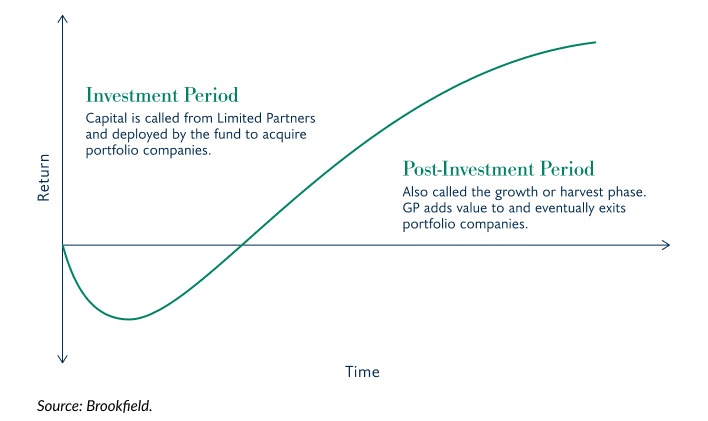
The J-Curve effect
The J-curve represents the performance lifecycle of a fund. Returns are typically negative in the early years—the "trough"—due to management fees and investment expenses. As investments create value and companies exit, returns eventually become positive, forming the upward slope of the J-curve.
Measuring performance of a private equity fund: IRR, MOIC, and DPI
The traditional measures of performance create a comprehensive picture of a fund's health:
- Internal Rate of Return (IRR): Measures the annual rate of return, though it can overvalue early returns and ignore total return over time.
- Multiple of Invested Capital (MOIC): Describes the net total return relative to capital invested. While it measures value creation, it ignores the time value of money or market fluctuations.
- Distributions to Paid-In Capital (DPI): The ratio of cumulative distributions paid back to LPs relative to their investment. In volatile markets, investors prioritise DPI because it represents realised, liquid returns rather than "on-paper" unrealised value.
Benchmarking & PME
Benchmarking involves comparing a fund’s performance against industry peers. The Public Market Equivalent (PME) measures how a PE fund’s performance compares to a public equity benchmark over the same period, determining if the fund is generating "alpha" beyond what public markets would have achieved.
The Exit: Maximising gains
The final stage of the PE lifecycle is the harvesting period. The most well-known exit is the Initial Public Offering (IPO), though these can be complex and time-consuming. Other strategies include strategic sales to another corporation or secondary buyouts.
Critically, while PE firms defend their role in strengthening businesses, the industry faces ongoing scrutiny regarding its impact on sectors like healthcare and retail, where aggressive restructuring has been blamed for job losses or financial distress. Finally, for those seeking more flexibility, Evergreen structures have emerged. These provide automatic reinvestment and potential periodic liquidity without the rigid 10-year termination date of traditional close-ended funds.
Innovation in access: The evergreen funds
Traditional closed-end funds often trap capital in a 10-year cycle of unpredictable capital calls, creating a "MOIC drag" where idle cash dilutes overall returns. For most individual investors, the multi-million dollar commitments required to diversify across managers and vintages make a world-class private market portfolio nearly impossible to replicate.
Evergreen funds (or open-ended funds) solve this by removing fixed end dates, allowing capital to remain fully deployed and compound indefinitely. These structures offer significantly lower investment minimums and periodic liquidity, enabling investors to build diversified private market exposure with the ease of a few clicks.
However, investors should be aware of "gates"—quarterly redemption limits (typically 5-10%) designed to protect the fund from forced asset sales during market shocks. While providing more flexibility, Evergreen funds require a clear understanding of net returns after fees. When used correctly, they are a powerful tool for compounding wealth without the rigid constraints of traditional fund lifecycles.
Take the next step in your investment journey. If you are a Professional Investor, we invite you to connect with our licensed financial advisors to learn more about Endowus’ private market offerings.
Read more:
- Understanding alternative investments
- Q&A with CIO Hugh Chung on widened investor access to private markets
- Are there more opportunities in private equity?
- Why become a professional investor in Hong Kong
<divider><divider>
Risk Warnings
Investment involves risk. Past performance is not an indicator nor a guarantee of future performance. The value of investments and the income from them can go down as well as up, and you may not get the full amount you invested.
Opinions
Whilst Endowus HK Limited (“Endowus”) has tried to provide accurate and timely information, there may be inadvertent delays, omissions, technical or factual inaccuracies or typographical errors.
Any forward-looking statements, prediction, projection or forecast on the economy, stock market, bond market or economic trends of the markets contained in this material are subject to market influences and contingent upon matters outside the control of Endowus and therefore may not be realised in the future. Further, any opinion or estimate is made on a general basis and subject to change without notice. In presenting the information above, none of Endowus, its affiliates, directors, employees, representatives or agents have given any consideration to, nor have made any investigation of the objective, financial situation or particular need of any user, reader, any specific person or group of persons. Therefore, no representation is made as to the completeness and adequacy of the information to make an informed decision. You should carefully consider (i) whether any investment views and products/ services are appropriate in view of your investment experience, objectives, financial resources and relevant circumstances.
No invitation or solicitation
Neither the information, nor any opinion, contained in this article constitutes a promotion, recommendation, solicitation, invitation or offer by Endowus or its affiliates to buy or sell any securities, collective investment schemes or other financial instruments or services, nor shall any such security, collective investment scheme, or other financial instruments or services be offered or sold to any person in any jurisdiction in which such offer, solicitation, purchase, or sale would be unlawful under the securities laws of such jurisdiction. This is not intended to be an invitation or offer made to the public to subscribe for any financial product or other transaction.
This advertisement has not been reviewed by the Securities and Futures Commission or any regulatory authority in Hong Kong.


.png)