- A Hong Kong savings insurance return is a combination of a guaranteed cash value the insurer is contractually obliged to pay, and a non-guaranteed projection that depends on the insurer’s investment results and bonus decisions. The headline return figure blends the two.
- Two public tools let you judge the projection without relying on the seller: the fulfilment ratios insurers have disclosed by product series since 2016–17, and the Insurance Authority’s illustration rate caps of 6.0% for Hong Kong dollar policies and 6.5% for other currencies, in force since 1 July 2025.
- For retirement planning, the shape of the cash flows matters as much as the rate: early surrender values sit well below premiums paid, an illustrative policy may take roughly a decade to break even, and the headline internal rate of return is quoted at a horizon that may be far longer than your own.
“Savings insurance” is among the most widely used financial products in Hong Kong: a long-term participating life policy, sold as a savings or retirement plan, handed with a benefit illustration that has two columns of numbers and one headline return.
A savings insurance return is two figures stapled together, and only one of them is a promise - the guaranteed cash value, which is a contractual obligation of the insurer. The rest (the reversionary and terminal bonuses, or the dividends) is a projection that relies on the insurer’s own investment performance and its discretion over how much to pay.
Hong Kong gives policyholders two public, cost-free tools to tell the promise from the projection: fulfilment-ratio disclosure, and, since mid-2025, a cap on the return that may be illustrated.
This article explains what savings insurance is, how to read the two columns, the three different returns a single policy can be made to show, what the fulfilment ratio does and does not tell you, what the 2025 caps changed, what it costs to leave early, and where a policy of this kind belongs in a Hong Kong retirement plan.
What is savings insurance in Hong Kong?
Savings insurance (儲蓄保險) is a type of life insurance policy whose main purpose is accumulation, rather than protection. You pay premiums — as a single lump sum, or over a few years — the insurer invests them, and the policy builds a cash value that you can later surrender for or draw on. Most such policies are participating, or “par”, which means you share in the insurer’s results through non-guaranteed bonuses or dividends layered on top of a guaranteed base.
A point that the search results rarely make plainly: this is not a bank deposit. It is not covered by the Deposit Protection Scheme, which protects eligible bank deposits up to HK$800,000 per depositor per Scheme member and excludes insurance and other non-deposit products. The Deposit Protection Board sets that limit, in force since 1 October 2024.
The counterparty on a savings policy is the insurer. The guaranteed cash value is a promise the insurer must keep, backed by its own financial strength and the Insurance Authority’s prudential supervision rather than by a deposit-style guarantee. The Hong Kong Government has consulted on a statutory policyholder protection scheme in 2022 but took no further action ever since, so for now there is no equivalent backstop if an insurer fails. That is a feature of the product to understand, not a reason for alarm; it is simply why the word “guaranteed” on an illustration means “contractually owed by this insurer”, and nothing wider.
Guaranteed or non-guaranteed: what are the two columns on the illustration?
Every benefit illustration separates value into two columns. The guaranteed column is what the insurer must pay you under the contract. The non-guaranteed column is a projection: its delivery depends on the insurer’s investment performance, claims experience, expenses, and its own decisions on how much to distribute. Under adverse conditions, the Insurance Authority notes, the non-guaranteed amount may fall to zero (Insurance Authority Glossary - Non-guaranteed dividend or bonus).
The non-guaranteed projection rests on an assumed investment return chosen by the insurer. That assumption is what the 2025 illustration caps constrain, as the next sections explain. The terms below appear on most illustrations.
The Insurance Authority’s guide to participating policies and the Investor and Financial Education Council’s explainer on what to check before buying one both set out these terms from the policyholder’s side, without a product to sell.
How can one policy show three different returns?
Because the two columns can be summarised in several ways, the same policy can be made to show very different returns — all of them arithmetically correct.
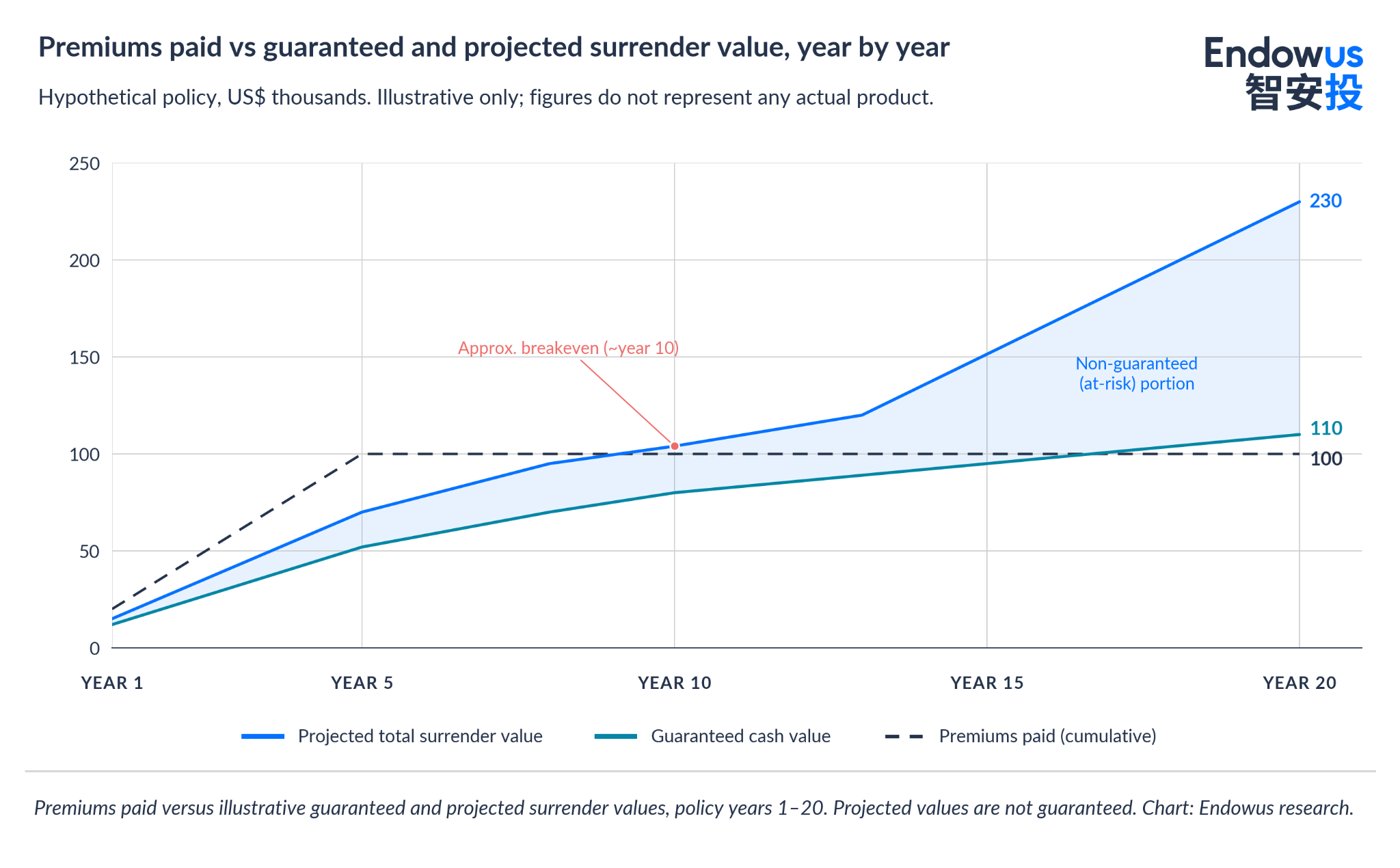
Consider a hypothetical policy, illustrative only and not based on any actual product: you pay US$20,000 a year for five years, US$100,000 in total. At year 20 the illustration shows a guaranteed cash value of US$110,000, a projected non-guaranteed amount of US$120,000, and a projected total of US$230,000.
Only the internal rate of return accounts for the timing of payments — which is precisely why the Insurance Authority defines its illustration cap on IRR rather than on a headline percentage. The gap between the 6.5% simple average and the 4.72% projected IRR is the difference between ignoring and respecting the time value of money. The chart below plots the same example year by year.
What does the fulfilment ratio tell you, and what can’t it?
A fulfilment ratio compares what an insurer actually paid in non-guaranteed benefits with what it illustrated when the policy was sold. A ratio of 100% means it paid exactly what it projected; below 100%, less; above, more.
A projection is only as good as the insurer’s record of meeting past projections. Phased in from 2016–17, fulfilment-ratio disclosure requires insurers to publish, for each participating product series, the non-guaranteed benefits they actually paid as a proportion of what they illustrated at the point of sale. The requirement now sits in the Insurance Authority’s Guideline GL16 (edition effective 31 March 2026), and the Authority — which spells the term “fulfillment” — lists where each insurer discloses it. Make sure to consult the Authority’s website or obtain advice from a qualified insurer to get the full extent of the information you need.
The fulfillment ratio matters because it affects the projection. In the example above, a projected IRR of 4.72% assumes the full non-guaranteed amount is paid. If an insurer delivered 80% of what it illustrated, the same policy’s projected IRR would fall to about 4.09%; at 60%, to about 3.38%. The guaranteed-only return of 0.53% is the floor. This performance example is illustrative of the mechanics of this specific financial product, and is not intended to drive or influence the reader’s financial decisions.
We should also care to add that a fulfilment ratio is a backward-looking gauge; it is reported by product series, so it can reflect an old series rather than the one you are offered. It tells you how well an insurer has honoured past illustrations for a given series, which is important to establish credibility, but it won’t tell you what a new policy will pay.
What did the July 2025 illustration caps change?
Until recently, insurers competed partly on how high an illustrated return they could show. But a Practice Note from the Insurance Authority, issued with its circular of 28 February 2025 and effective 1 July 2025, now caps the internal rate of return that may appear in a point-of-sale benefit illustration for a participating policy at 6.0% for Hong Kong dollar policies and 6.5% for policies in other currencies. The cap applies across scenarios, payment modes and policy options, and to the sales calculators that generate these figures.
The Authority has been explicit that the cap limits the illustration, not the payout, so it is a mere limitation to potentially boastful marketing language. In its own words, insurers can still pay more, so the measure “will not impact the actual policy returns” (Insurance Authority, 30 March 2025).
Some additional elements to consider. The currency choice has an impact on the illustrated ceiling and your exchange-rate exposure over a multi-decade horizon, while the potential “bonus lock-in” option (which some policies offer) converts a portion of accumulated non-guaranteed value into a more stable form. It makes part of the projection firmer, usually in exchange for giving up potential upside.
What does it cost to surrender a policy early?
The headline return assumes you hold the policy to the illustrated horizon. Leave early and the arithmetic inverts. On the same hypothetical policy we considered in the example above, surrendering at year five returns roughly US$70,000 against US$100,000 paid, which would be an internal rate of return of about −11.7%. By year eight, the loss narrows to about −0.9%, and the policy reaches approximate breakeven, near +0.5%, only around year 10.
The reason is structural: acquisition costs, including distribution commissions, are concentrated in the first years of the policy, with Hong Kong’s own rules making the front-loading explicit. From 1 January 2026, no more than 70% of the total commission payable on a regular-premium participating policy may be paid in the first policy year, with the balance spread over later years; and since 1 October 2025, referral fees that broker companies pay above a 50% benchmark attract closer regulatory scrutiny (Insurance Authority).
The cooling-off period works as a penalty-free exit opportunity for the client. Under the Authority’s Guideline GL29, you have 21 calendar days, counted from the earlier of the policy’s delivery or the cooling-off notice, to cancel. A regular-premium policy is refunded in full within that window; a single-premium policy’s premium is refunded after deducting any market value adjustment that was disclosed in advance.
For retirement planning, the lesson is that liquidity is the hidden price: the cash is committed for years, and the horizon on the illustration may be far longer than your own.
Savings insurance, deposits or investing: which does what?
The comparison between different plans should be focused on who bears the risk, what is contractual, and how quickly you can get your money back.
Shorter two-to-five-year savings policies exist as a cash-management tool, closer in spirit to a fixed deposit than to a retirement plan; they sit outside this article’s scope. For cash specifically, our guide to time deposit rates in Hong Kong is the better comparison.
Where does savings insurance fit in a Hong Kong retirement plan?
A useful way to place any retirement product is as a layer in a stack. The compulsory base is the Mandatory Provident Fund; on top sit the tax-deductible layers — Tax Deductible Voluntary Contributions and the Qualifying Deferred Annuity Policy; an annuity can provide an income floor; and above those lies the discretionary layer of ordinary savings and investments.
Savings insurance belongs in that discretionary layer. Whether it earns a place there depends on your personal preferences and risk profile. The questions to settle first are not about the rate, but rather how long the money can stay committed, in which currency you will eventually need it, and if the illustrated horizon is anywhere near your own.
Investment implications
A participating policy combines life cover and accumulation in one contract. An investor should assess the two separately. In the worked example, the accumulation side has a guaranteed cash value that implies an IRR of 0.53% at year 20 and carries the insurer’s credit risk - in other words, it is priced for the typically very low probability of the insurance company being unable to fulfill its obligations. The projected IRR of 4.72% depends on the insurer’s investment results and bonus decisions - which is the most uncertain element. The fulfilment ratio for the product series and the surrender value in each policy year should be checked.
For the accumulation years of a retirement account, Endowus offers globally diversified portfolios and Fund Smart, and Fixed-Rate Savings for shorter-term cash. Endowus provides these products and does not sell insurance; they are not substitutes for the protection element of a life policy, and Fixed-Rate Savings, whose terms are short, is not a like-for-like alternative to a 10- or 20-year policy. Like all investments, these carry market risk and no capital guarantee. For a sense of how a fee-only, conflict-free platform differs from commission-based distribution, see our note on how robo-advisers differ.
A participating policy offers a contractual guaranteed value, bonuses smoothed across good and bad years, life cover. It also forces saving discipline. It does also require long lock-ins, front-loaded costs, and a non-guaranteed return that is typically the largest component of IRR.
Frequently asked questions
What is savings insurance?
A life insurance policy designed mainly for saving: you pay premiums, the insurer invests them, and the policy builds a cash value you can surrender for or draw on. Most are participating, meaning part of the return is a non-guaranteed share of the insurer’s results.
Is savings insurance covered by the Deposit Protection Scheme?
No. The Deposit Protection Scheme covers eligible bank deposits only, up to HK$800,000 per depositor per Scheme member, and excludes insurance and other non-deposit products. A savings policy’s guaranteed value is the insurer’s own contractual obligation, and Hong Kong has consulted on, but not yet enacted, a statutory policyholder protection scheme.
What is the fulfilment ratio in Hong Kong?
It is the non-guaranteed benefit paid by the insurer (rather than merely promised), expressed as a proportion of the amount shown at the point of sale, published annually by product series on insurers’ websites and listed by the Insurance Authority. Because it is backward-looking and specific to each series, it shows how well past projections were met, not what a new policy will pay.
Does the 6% illustration cap limit what my policy can pay?
No. Since 1 July 2025 the Insurance Authority has capped the return that may be illustrated on a participating policy at 6.0% for Hong Kong dollar policies and 6.5% for other currencies. The Authority has stated that the cap limits the illustration, not the actual payout; a policy may ultimately pay more or less.
How does savings insurance protect my money?
The guaranteed cash value and any death benefit are contractual promises from the insurer; the remaining illustrated value is not protected and depends on the insurer’s investment results and bonus decisions. Reading the guaranteed and non-guaranteed parts as two separate things is the honest way to understand the cover.
Disclaimer
General information, not insurance advice
This article is general information about how participating insurance policies work in Hong Kong. It is not advice on any insurance product and does not recommend buying, keeping or surrendering any policy. Endowus HK Limited is licensed by the Securities and Futures Commission (CE No. BQR225) for Types 1, 4 and 9 regulated activities; it does not carry on regulated activities under the Insurance Ordinance (Cap. 41) and does not sell insurance. [Insurance-specific wording provisional pending the IA content ruling.]
Risk Warnings
Investment involves risk. Past performance is not an indicator nor a guarantee of future performance or returns. Projected performance or returns is not guaranteed to materialise. The value of investments and the income from them can go down as well as up, and you may not get the full amount you invested. Rates of exchange may cause the value of investments to go up or down. Individual stock performance does not represent the return of a fund.
General risk warnings relating to collective investment schemes:
Before making an investment decision, you are reminded to refer to the relevant prospectus/offering document for specific risk considerations and related fees and charges. Funds are not a bank deposit and not capital guaranteed, and are subject to investment risks, including the possible loss of the principal amount invested. Some of the funds also involve derivatives. Do not invest in them unless you fully understand and are willing to assume the risks associated with them.
Opinions:
Any forward-looking statements, prediction, projection or forecast on the economy, stock market, bond market or economic trends of the markets contained in this material are subject to market influences and contingent upon matters outside the control of Endowus HK Limited (“Endowus”) and therefore may not be realised in the future. Further, any opinion or estimate is made on a general basis and subject to change without notice. In presenting the information above, none of Endowus HK Limited, its affiliates, directors, employees, representatives or agents have given any consideration to, nor have made any investigation of the objective, financial situation or particular need of any user, reader, any specific person or group of persons. Therefore, no representation is made as to the completeness and adequacy of the information to make an informed decision. You should carefully consider whether any investment views and products/services are appropriate in view of your investment experience, objectives, financial resources and relevant circumstances. You may also wish to seek financial advice through a financial adviser or the Endowus platform and independent legal, accounting, regulatory or tax advice, as appropriate.
No invitation or solicitation:
Nothing contained in this article should be construed as a solicitation, an offer to buy or sell, or recommendation, to acquire or dispose of any security, commodity, investment or to engage in any other transaction in any jurisdiction in which such solicitation, offer to buy or sell would be unlawful under the securities laws in such jurisdiction. No information included in this article is to be construed as investment advice or as a recommendation or a representation about the suitability or appropriateness of any advisory product or service; or an offer to buy or sell, or the solicitation of an offer to buy or sell, any security, financial product, or instrument; or to participate in any particular trading strategy. Investors should seek independent financial and tax advice before making any investment decision.
This advertisement has not been reviewed by the Securities and Futures Commission or any regulatory authority in Hong Kong.