.webp)
.webp)
.webp)
.webp)





- An exchange-traded fund (ETF) is an open-ended fund whose shares trade intraday on a stock exchange; global ETF assets reached a record US$23.11 trillion at the end of July 2026, according to ETFGI.
- Hong Kong holds a special place in ETF history: the Tracker Fund of Hong Kong, listed in November 1999 as Asia ex-Japan’s largest-ever IPO at the time, turned a crisis-era government intervention into the city’s first ETF.
- The creation and redemption mechanism, operated by authorised participants, keeps ETF prices close to net asset value in normal conditions. But the stress episodes of 2010, 2015, and 2020 show its limits.
In the 33 years since the first US-listed exchange-traded fund began trading, the wrapper has grown into a US$23.11 trillion global industry as at the end of July 2026.
Hong Kong as a specific place in this history, since the city’s first ETF was not a marketing exercise but a policy instrument, created to unwind a crisis-era government intervention.
More so further in this piece.
To simplify, an ETF is best understood as a combination of an open-ended fund with an unusual piece of market plumbing - the creation and redemption mechanism. The plumbing, not the listing, explains why ETFs trade close to fair value most of the time, why they have competitive fees, and why their behaviour under stress divides regulators and academics.
This article covers the history of the vehicle, its structure, the arbitrage mechanics that hold price and value together, the episodes when they came apart, and how Hong Kong’s ETF market works in practice.
Where did the ETF come from?
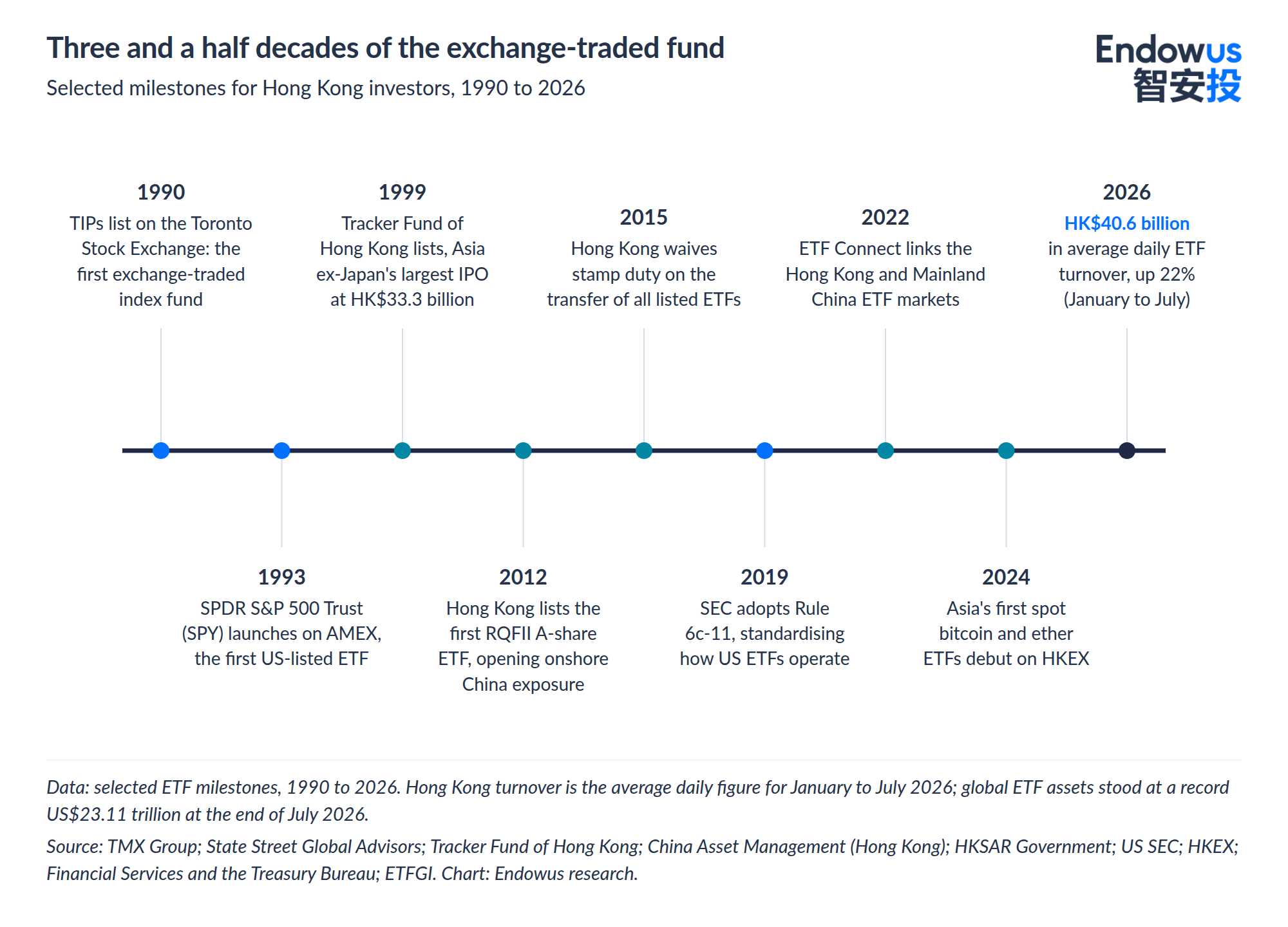
The intellectual origin of the ETF is the October 1987 crash, after which staff at the US Securities and Exchange Commission (SEC) expressed interest in a single tradable instrument representing the broad equity market. The first working version, the Toronto 35 Index Participation units, listed in Toronto on 9 March 1990; the product that defined the category, the SPDR S&P 500 ETF Trust (SPY), launched on 22 January 1993 as the first US-listed ETF.
Hong Kong’s entry was singular. After the government acquired roughly HK$118 billion of local equities defending its markets in August 1998, it needed to return the portfolio to the market without disrupting it. The answer was the Tracker Fund of Hong Kong (stock code 2800), listed in November 1999 with a HK$33.3 billion offering — then the largest IPO in Asia excluding Japan — and the city’s first ETF. Through the IPO and its subsequent tap facility, approximately HK$140.4 billion of Hang Seng Index constituent stocks had been returned to the market by October 2002.
Regulation of the wrapper globally was standardised only in September 2019, when the SEC adopted Rule 6c-11, and growth since has been relentless: ETFGI reports record global assets of US$23.11 trillion and record year-to-date net inflows of US$1.71 trillion at end-July 2026.
What is the structure of an ETF?
Legally, an ETF is an open-ended collective investment scheme whose shares also trade intraday on an exchange. In the United States, most ETFs are open-end funds under the Investment Company Act of 1940; in Europe, the dominant wrapper is the UCITS fund, typically Irish- or Luxembourg-domiciled, whose diversification rules cap single-issuer exposure at 10% and limit holdings above 5% to 40% in aggregate. In Hong Kong, ETFs offered to the public are collective investment schemes authorised by the Securities and Futures Commission (SFC) under the Code on Unit Trusts and Mutual Funds, and “SFC-authorised” is the operative term (authorisation is not a recommendation).
Most ETFs replicate an index physically; some are synthetic, holding collateral and obtaining the index return through a swap, which introduces counterparty risk. But they can also accommodate active strategies and, at the aggressive end, leveraged and inverse (L&I) products (this one is a funny example of an inverse product, if anyone ever heard about Jim Cramer), which Hong Kong regulates as a distinct, clearly labelled category: they rebalance daily, their long-run returns can diverge sharply from a multiple of the index, and the SFC caps the leverage they may employ. As a reminder to our readers, an exchange-traded note (ETN) is unsecured bank debt, not a fund, and has nothing to do with ETFs.
How does creation and redemption actually work?
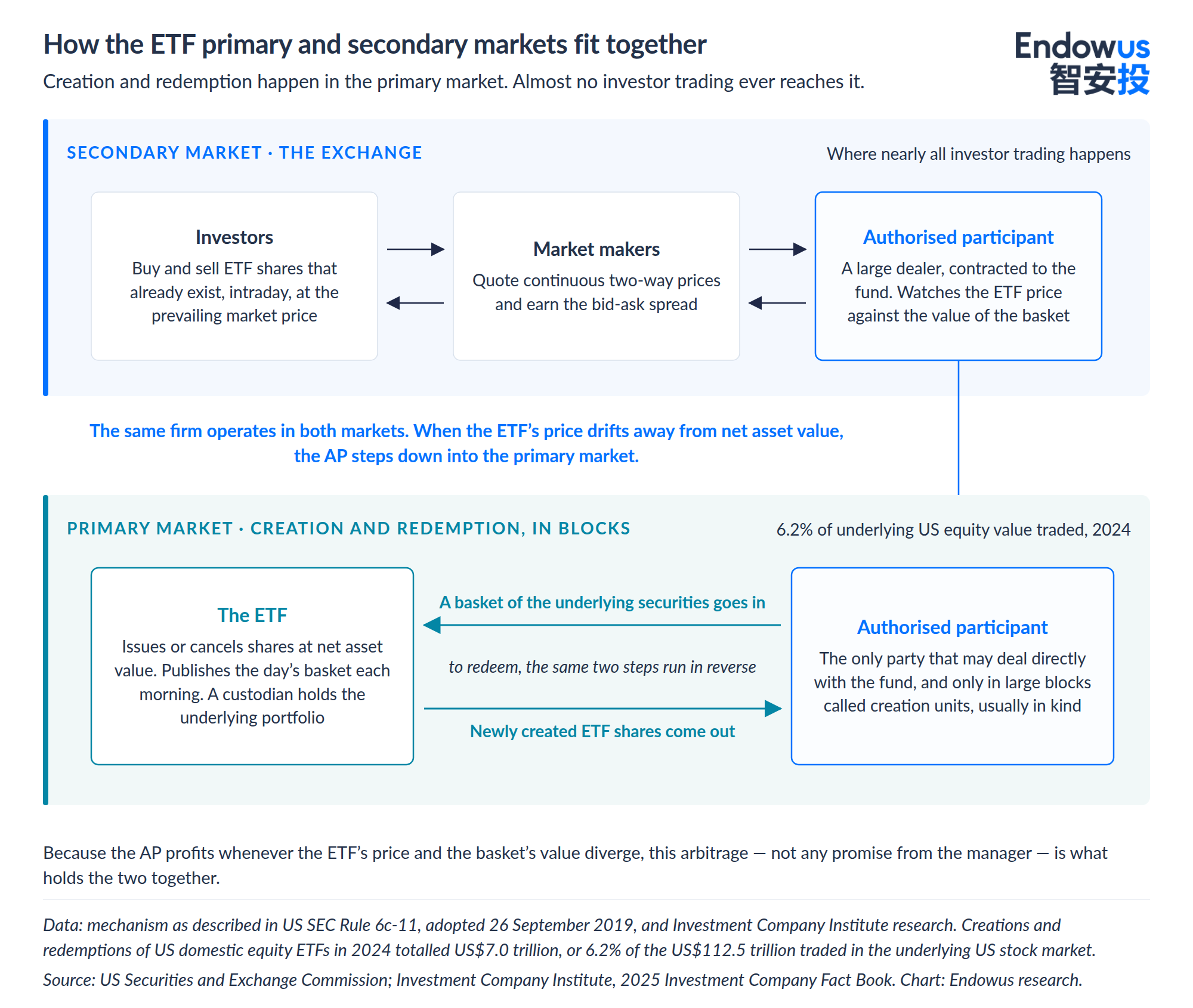
An ETF does not sell shares to the public directly. It transacts only with authorised participants (APs): these are dealers contractually permitted to create or redeem shares in large blocks (called “creation units”) usually by delivering or receiving a basket of the underlying securities published by the fund each morning. If the ETF trades above the value of its basket, an AP can buy the basket, exchange it for new ETF shares, and sell them at the premium; a discount invites the reverse. That arbitrage is what keeps ETF prices near net asset value.
While it may seem that this activity could have an outsized impact on the trading flows of the underlying shares, in reality most ETF trading never touches the underlying market. The Investment Company Institute reports that creations and redemptions of US domestic equity ETFs in 2024 were just 6.2% of the value traded in the underlying stocks; the rest was investors simply exchanging existing shares. The AP ecosystem is also deeper than it looks — ICI research shows funds contract with many more APs than are active at any time, and past withdrawals of individual APs were absorbed within days.
What happens under stress?
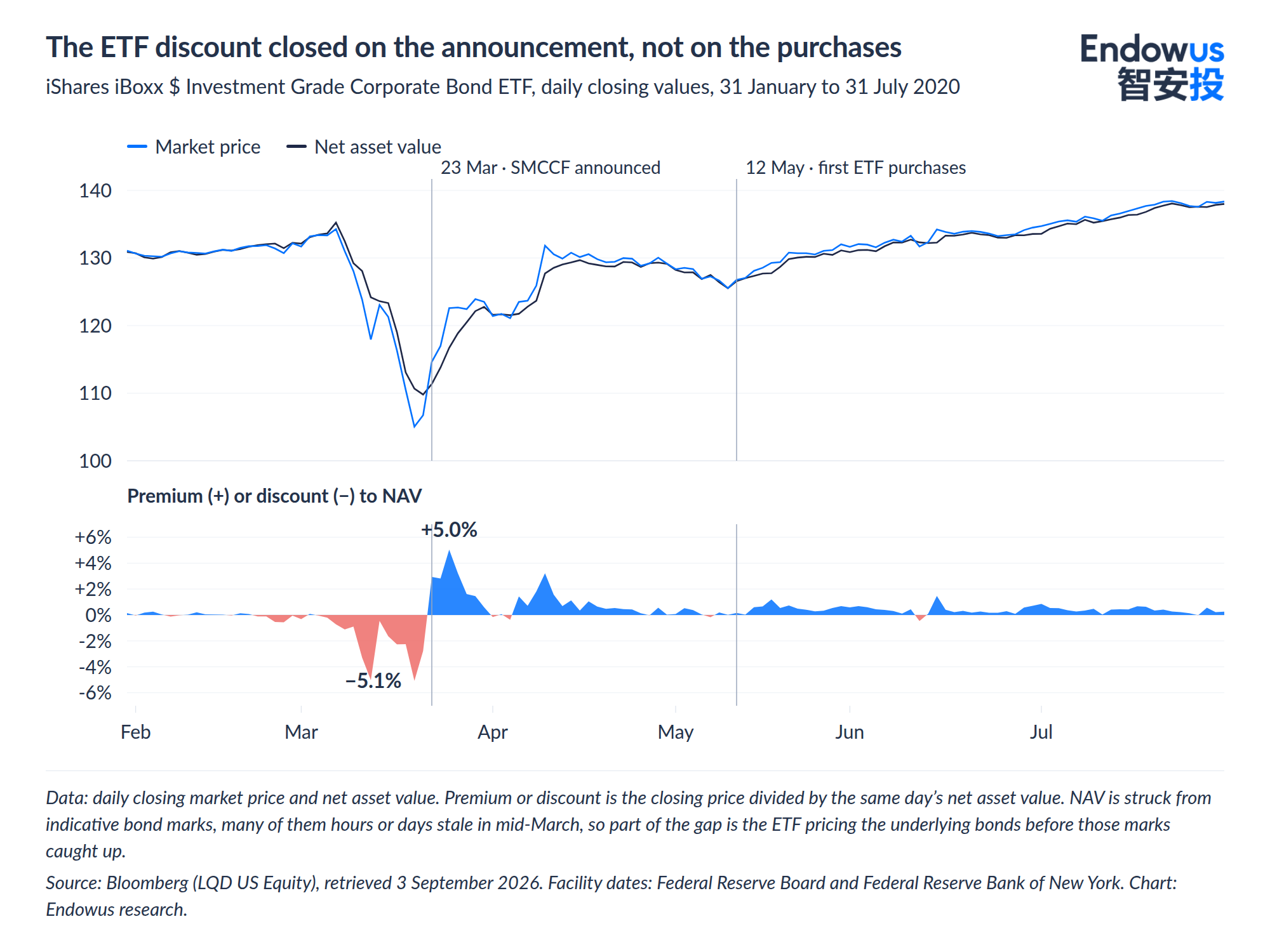
The arbitrage mechanism needs functioning two-way markets. In the flash crash of 6 May 2010 and again at the disorderly US market open of 24 August 2015, ETFs briefly traded far from the value of portfolios whose constituents were halted or had not opened, and many trades were later cancelled (SEC–CFTC and SEC staff reports on the respective episodes). March 2020 was the sterner test: large corporate bond ETFs traded at persistent discounts to net asset values that the Bank for International Settlements attributed to stale bond marks and balance-sheet-constrained dealers — on that reading, the ETF price was the more current estimate of value. The US Federal Reserve announced its Secondary Market Corporate Credit Facility on 23 March 2020, began buying corporate bond ETFs on 12 May 2020, and closed the facility on 31 December 2020 holding roughly US$14.2 billion. Academic evidence remains two-sided: Ben-David, Franzoni, and Moussawi (Journal of Finance, 2018) link higher ETF ownership to higher volatility in underlying stocks, while industry data emphasise how little primary market activity touches underlying markets.
How does Hong Kong’s ETF market work?
Hong Kong is now one of the world’s most active ETF venues. HKEX’s ETF and L&I Product Market Perspective counted 206 ETFs and 29 L&I Products at the end of January 2026, with average daily turnover of HK$39.0 billion that month; by end-April 2026, HKEX reported exchange-traded product market capitalisation of HK$698 billion and average daily turnover of HK$44.0 billion over the first four months of 2026, ranking Hong Kong the fourth most actively traded ETP market globally. Products trade across Hong Kong dollar, US dollar, and renminbi counters — 60%, 25%, and 15% of counters respectively at end-January 2026.

Liquidity depth was supported by two policy decisions. First, the government waived stamp duty on the transfer of all listed ETFs from 13 February 2015, removing a transaction cost that still applies to ordinary Hong Kong shares. Second, ETF Connect launched on 4 July 2022, folding eligible ETFs into the Stock Connect framework so that Mainland investors can trade eligible Hong Kong-listed ETFs and Hong Kong and international investors can trade eligible Mainland-listed ETFs. The Tracker Fund remains the market’s anchor, with a market capitalisation of HK$154.6 billion at end-January 2026, and is widely held indirectly through Mandatory Provident Fund (MPF) constituent funds.
Investment implications
Understanding the mechanics changes the questions an investor should ask: not “is this ETF cheap?” but “what is the realised tracking difference, where is the fund domiciled, how liquid are the underlying assets, and what does the wrapper do under stress?” Fund domicile matters for Hong Kong investors too: distributions from US-domiciled funds to Hong Kong residents suffer 30% US withholding because Hong Kong has no comprehensive income tax treaty with the United States, while Irish-domiciled UCITS funds incur 15% at fund level under the US–Ireland treaty.
ETFs and unit trusts are both potentially great portfolio builders. At Endowus, we build our portfolios with unit trusts accessed through institutional share classes, with trailer fees rebated in full. Investors can get started with Endowus HK to see how these building blocks fit a goals-based portfolio.
But investors with different goals can also add ETFs - better if they are carefully selected based on fees, liquidity and specific opportunities they cover.
In conclusion, our goal here was to get our readers to understand the ETF’s creation and redemption mechanism. ETFs have been a great piece of financial innovation, delivering intraday liquidity and low headline costs at scale. As with every financial product, however, there is a downside: the machinery depends on arbitrageurs showing up, the prices only approximate value, and the total cost of ownership extends beyond the expense ratio.
Frequently asked questions
What is an ETF in simple terms?
An exchange-traded fund is an open-ended investment fund (meaning a fund that is always open for new subscriptions) whose shares are listed on a stock exchange, so investors buy and sell them intraday at market prices. A creation and redemption mechanism operated by authorised participants keeps the market price close to the value of the underlying portfolio.
What was Hong Kong’s first ETF?
The Tracker Fund of Hong Kong (2800), listed in November 1999 to dispose of shares the government acquired during its 1998 market operation. Its HK$33.3 billion offering was the largest IPO in Asia excluding Japan at the time, and it remains one of the market’s largest and most liquid ETFs.
Do I pay stamp duty when trading ETFs in Hong Kong?
No. Stamp duty on the transfer of shares or units of all Hong Kong-listed ETFs was waived with effect from 13 February 2015, regardless of the ETF’s underlying portfolio. Brokerage and exchange fees still apply.
What are leveraged and inverse products, and are they ETFs?
L&I Products are SFC-authorised exchange-traded products that aim to deliver a daily multiple, or a daily opposite, of an index’s return, rebalancing every day. Because of daily compounding, their returns over longer periods can diverge sharply from the leveraged index return, and the SFC regulates them as a distinct category with capped leverage. They are trading tools rather than long-term holdings.
Can Mainland investors buy Hong Kong-listed ETFs?
Yes, within limits. Since ETF Connect launched on 4 July 2022, Mainland investors can trade Hong Kong-listed ETFs that meet Southbound eligibility criteria through their local brokers, and the eligible list is reviewed periodically. Synthetic ETFs and L&I Products are excluded from the scheme.
Disclaimer
Risk Warnings
Investment involves risk. Past performance is not an indicator nor a guarantee of future performance. The value of investments and the income from them can go down as well as up, and you may not get the full amount you invested. Rates of exchange may cause the value of investments to go up or down.
This article is not intended to be relied upon as a forecast or research or investment advice, and should not form the basis of any investment or other decisions. The information contained herein is not intended, and should not be construed, as any legal, tax, regulatory, accounting or financial advice. If you would like investment, accounting, tax or legal advice, you should consult with your own professional advisors regarding your individual circumstances and needs.
The information in this article may not be suitable for all investors. You are responsible for any action that you take or decision that you make in reliance on any content in this article, and you agree that Endowus HK Limited (“Endowus”) is not liable under any circumstances.
No invitation or solicitation
Neither the information, nor any opinion, contained in this article constitutes a recommendation, offer or solicitation by Endowus or its affiliates to you to buy or sell any securities, collective investment schemes or other financial instruments or services, nor shall any such security, collective investment scheme, or other financial instruments or services be offered or sold to any person in any jurisdiction in which such offer, solicitation, purchase, or sale would be unlawful under the securities laws of such jurisdiction.
This is not intended to be an invitation or offer made to the public to subscribe for any financial product or to enter into any transaction.
Accuracy of Information
Whilst Endowus has made reasonable efforts to provide accurate and timely information, there may be inadvertent delays, omissions, technical or factual inaccuracies or errors in any such information. Endowus does not warrant or represent that the information in this article is correct, accurate or reliable.
Opinions
Any opinion or estimate above is made on a general basis and none of Endowus, nor any of its affiliates, representatives or agents have given any consideration to nor have made any investigation of the objective, financial situation or particular need of any user, reader, any specific person or group of persons. Opinions expressed herein are subject to change without notice.
Any forward-looking statements, prediction, projection or forecast on the economy, stock market, bond market or economic trends of the markets contained in this article are subject to market influences and contingent upon matters outside the control of Endowus and therefore may not be realised in the future.
In presenting the information above, none of Endowus, its affiliates, directors, employees, representatives or agents have given any consideration to, nor have made any investigation of the objective, financial situation or particular need of any user, reader, any specific person or group of persons. Therefore, no representation is made as to the completeness and adequacy of the information to make an informed decision. You should carefully consider whether any investment views and products/services are appropriate in view of your investment experience, objectives, financial resources and relevant circumstances.
Endowus HK Limited is licensed by the Securities and Futures Commission of Hong Kong (CE No. BQR225) for Type 1 (dealing in securities), Type 4 (advising on securities), and Type 9 (asset management) regulated activities.
This article has not been reviewed by the Securities and Futures Commission of Hong Kong.


.png)