.webp)
.webp)
.webp)
.webp)





- Over the past decade, Hong Kong's headline Composite Consumer Price Index has ranged from 0.3% to 3.0%, so a moderate average can still conceal meaningful year-to-year price growth.
- Because inflation compounds, a 3% annual rate would roughly halve the purchasing power of a fixed sum within about 24 years, which makes it a central risk to retirement adequacy over a multi-decade horizon.
- The Mandatory Provident Fund (MPF) System has generated an annualised internal rate of return (net of fees) of 2.5% since the establishment, and equity and mixed-asset funds more, so a strategy that seeks real returns may call for appropriate diversification rather than excess cash; MPF returns are not guaranteed and vary by fund choice.
Hong Kong's inflation rate is currently moderate. Headline consumer prices rose 1.7% in the year to July 2026 and averaged 1.4% across 2025. For savers, that is a comfortable backdrop, though conditions may change.
The threat inflation poses to retirement is rarely a single high year. It is the steady erosion of purchasing power across decades. A retirement pot that grows more slowly than prices is losing real value, even as its nominal balance rises.
This article explains how Hong Kong measures inflation, what the rate has done over the last 10 years, how price growth compounds against savings, and how the MPF, cash, and a diversified portfolio compare in defending real value.
What is the inflation rate in Hong Kong?
The headline measure is the Composite Consumer Price Index, published monthly by the Census and Statistics Department. It aggregates three sub-indices covering low, medium, and higher household expenditure ranges, and reflects price changes for the household sector as a whole. The current base period is October 2019 to September 2020.
On that measure, the core inflation rate, that measures the total price change across all goods and services in an economy, rose 1.7% in the year to July 2026. The underlying inflation rate, which nets out the effect of the Government's one-off relief measures, was 2.0%, slightly higher than the core inflation rate.
The underlying rate is useful because relief measures — such as rates concessions, public housing rent waivers, and electricity subsidies — temporarily distort the headline index, and their unwinding does the reverse a year later. The underlying rate shows the persistent trend beneath that noise. In mid-2026 the pickup was led by electricity, gas, and water, as prior-year subsidies unwound, together with transport and fuel; housing and food remained contained.
How has Hong Kong's inflation rate moved over the last 10 years?
A decade of data shows a moderate but uneven path.
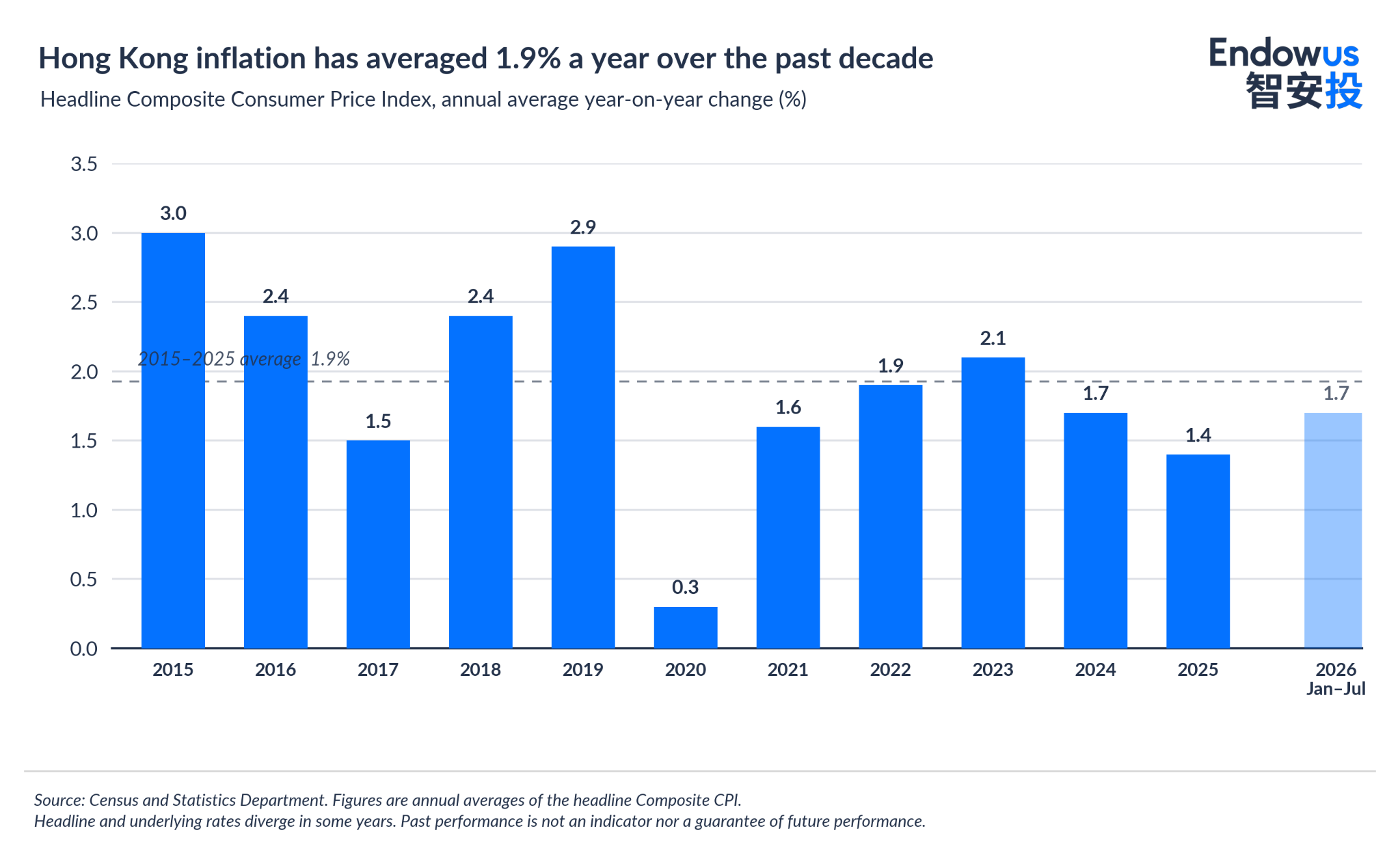
From 2015 to 2026, the inflation has been fluctuating from 0.3% to 3.0%. It is very frequent to see the annual inflation rate higher than the 10-year average inflation rate of 1.9%, so planning to the average understates the erosion a saver may face.
Why does inflation matter for your retirement savings?
Inflation reaches a saver through the gap between nominal and real returns. The nominal return is the rate an instrument pays; the real return is what remains after inflation, and it is the real figure that determines what savings can buy.
The effect compounds. The table below shows what HK$1,000 of idle cash would be worth in today's purchasing power after 20 and 30 years at three constant inflation rates.
Can the MPF and cash keep pace with inflation?
For most employees, retirement saving begins with the MPF. Employer and employee each contribute 5% of relevant income, between a minimum of HK$7,100 and a maximum of HK$30,000 in monthly income (the employer contributes also below the minimum).
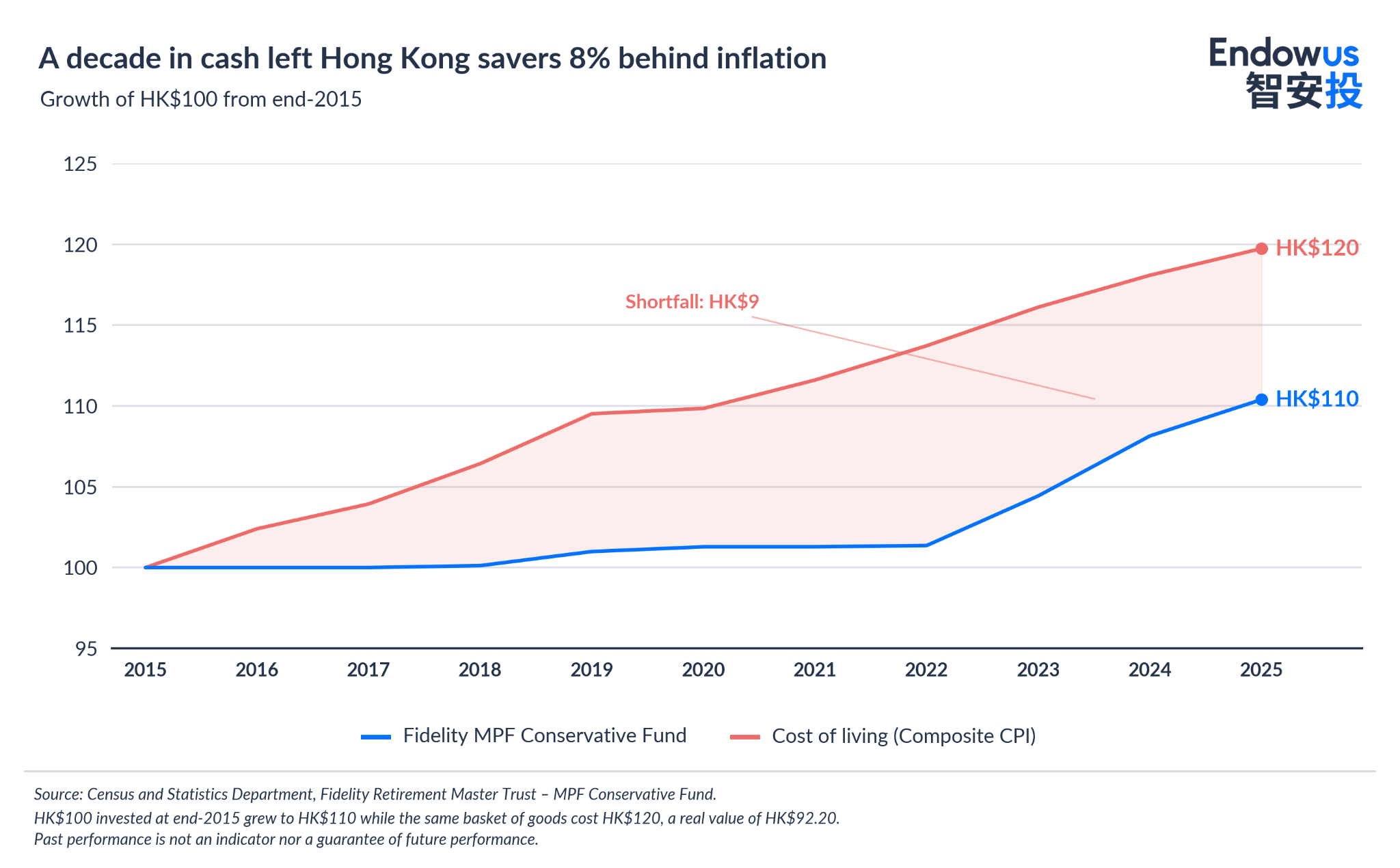
However, fund choice drives the outcome more than it is assumed. As of end-December 2025, both equity funds and mixed-asset funds were ahead of the 1.8% annualised inflation over the same period. However, the MPF Conservative Fund, a money-market fund benchmarked to the Prescribed Savings Rate, has returned less than inflation. Past performance is not an indicator nor a guarantee of future performance.
Outside the MPF, the HKSAR Government's retail bonds are the closest cash-like alternatives. The latest batch of the (inflation-linked) Silver Bond, for residents aged 60 and above, carries a minimum interest rate of 4.25% a year set by the Government. Twelve-month Hong Kong dollar time deposits have recently offered roughly 2% to 3%, a figure to confirm against current bank rates.
Monetary conditions are shaped externally. Under the Linked Exchange Rate System, the Hong Kong dollar is pegged to the US dollar and local interest rates largely follow US rates, so both the cost of holding cash and imported inflation are driven from outside Hong Kong.
What may protect purchasing power over the long run?
Defending purchasing power over a long horizon has historically meant accepting some short-term volatility in exchange for a positive real return. Cash offers nominal safety but the thinnest real returns. Nominal bonds are exposed to unexpected inflation. Equities have historically delivered positive real returns over long horizons and some inflation pass-through, though that protection is weaker in the short run. Real assets have shown a more direct link to inflation.
The UBS Global Investment Returns Yearbook 2025, covering global markets from 1900 to 2024, records annualised real returns of 5.2% for equities, 1.7% for bonds, and 0.5% for bills; since 2000, global equities returned 3.5% in real terms. These are global figures, not Hong Kong-specific, and past performance is not an indicator nor a guarantee of future performance. The pattern is consistent: over decades, the assets that best defend real value are not the safest in nominal terms.
Investment implications
In our view, the response to Hong Kong's inflation is less about forecasting the rate than about ensuring savings are structured to outpace it over time. Three layers help.
First, hold enough cash for liquidity and near-term needs, while recognising that idle cash beyond that buffer accepts a negative real return when yields sit below inflation. Second, treat the MPF as a deliberate allocation: fund choice, more than contributions alone, has determined whether MPF savings have beaten inflation over time. Third, for the balance with a long horizon, seek a real return through a globally diversified, appropriately risked portfolio.
On the one hand, Hong Kong's moderate inflation and its US-linked rate cycle mean the pressure to take risk has been less acute than in higher-inflation economies. On the other hand, a saver drawing on capital in 20 to 30 years is exposed to the cumulative erosion, not this year's rate. Endowus, with platform access fees of 0.1% to 0.60% a year, and its SFC-licensed advisers, can help size cash, MPF, and invested assets to an investor's own horizon and risk profile.
Frequently asked questions
What is the inflation rate in Hong Kong?
The headline Composite CPI rose 2.0% in the year to June 2026, and underlying inflation was 1.9%. Across 2025 as a whole, headline inflation averaged 1.4%. The Census and Statistics Department updates these figures monthly.
What has Hong Kong's inflation rate been over the last 10 years?
Annual headline inflation ranged from 0.3% in 2020 to 3.0% in 2015. The full year-by-year series is in the table above.
Does the MPF keep up with inflation?
Since inception the MPF System has returned 2.6% a year net of fees, and equity and mixed-asset funds have returned more, exceeding the 1.8% annualised inflation over the period. Returns are not guaranteed and depend on the funds chosen; a conservative default may lag inflation.
How can I protect my retirement savings from inflation?
Historically, seeking a positive real return through a diversified, appropriately risked portfolio, while holding only the cash needed for liquidity, has defended real value. Past performance is not an indicator nor a guarantee of future performance, and the right approach depends on your circumstances.
Disclaimer
Risk Warnings
Investment involves risk. Past performance is not an indicator nor a guarantee of future performance. The value of investments and the income from them can go down as well as up, and you may not get the full amount you invested. Rates of exchange may cause the value of investments to go up or down.
This article is not intended to be relied upon as a forecast or research or investment advice, and should not form the basis of any investment or other decisions. The information contained herein is not intended, and should not be construed, as any legal, tax, regulatory, accounting or financial advice. If you would like investment, accounting, tax or legal advice, you should consult with your own professional advisers regarding your individual circumstances and needs.
The information in this article may not be suitable for all investors. You are responsible for any action that you take or decision that you make in reliance on any content in this article, and you agree that Endowus HK Limited (“Endowus”) is not liable under any circumstances.
No invitation or solicitation
Neither the information, nor any opinion, contained in this article constitutes a recommendation, offer or solicitation by Endowus or its affiliates to you to buy or sell any securities, collective investment schemes or other financial instruments or services, nor shall any such security, collective investment scheme, or other financial instruments or services be offered or sold to any person in any jurisdiction in which such offer, solicitation, purchase, or sale would be unlawful under the securities laws of such jurisdiction.
This is not intended to be an invitation or offer made to the public to subscribe for any financial product or to enter into any transaction.
Accuracy of Information
Whilst Endowus has made reasonable efforts to provide accurate and timely information, there may be inadvertent delays, omissions, technical or factual inaccuracies or errors in any such information. Endowus does not warrant or represent that the information in this article is correct, accurate or reliable.
Opinions
Any opinion or estimate above is made on a general basis and none of Endowus, nor any of its affiliates, representatives or agents have given any consideration to nor have made any investigation of the objective, financial situation or particular need of any user, reader, any specific person or group of persons. Opinions expressed herein are subject to change without notice.
Any forward-looking statements, prediction, projection or forecast on the economy, stock market, bond market or economic trends of the markets contained in this article are subject to market influences and contingent upon matters outside the control of Endowus and therefore may not be realised in the future.
In presenting the information above, none of Endowus, its affiliates, directors, employees, representatives or agents have given any consideration to, nor have made any investigation of the objective, financial situation or particular need of any user, reader, any specific person or group of persons. Therefore, no representation is made as to the completeness and adequacy of the information to make an informed decision. You should carefully consider whether any investment views and products/services are appropriate in view of your investment experience, objectives, financial resources and relevant circumstances.
Endowus HK Limited (CE No. BQR225) is licensed by the Securities and Futures Commission for Type 1 (dealing in securities), Type 4 (advising on securities), and Type 9 (asset management) regulated activities.
This article has not been reviewed by the Securities and Futures Commission of Hong Kong.


.png)