.webp)
.webp)
.webp)
.webp)





- Asset management and wealth management are not competing services; rather, they have different roles within the financial services infrastructure. In Hong Kong, they also hold different Securities and Futures Commission (SFC) licences or registrations.
- In Hong Kong, asset management is a regulated activity — Type 9 under the Securities and Futures Ordinance — and you can check any firm’s licence, and the activities it is permitted to carry on, on the SFC public register before you invest.
- Once you can see the chain, there are three key questions you need to ask: who decides the asset mix, who is paid by whom, and who holds the assets you invested in.
“Asset management” and “wealth management” appear on the same account statements, brochures, and websites, and are often used as though they mean the same thing. They do not.
The two terms describe different links in one chain that runs from your money to the market. The fund house runs each fund. A portfolio manager may decide which funds you hold. An adviser or distributor recommends and sells. A trustee or custodian holds the assets. Most investors pass through three or four of these links without seeing the joins.
Once the chain is visible, the useful questions follow: who decides, who is paid by whom, and who holds the assets.
This article explains what asset management means in Hong Kong law, how it differs from wealth management, the four links between your money and the market with the SFC licence attached to each, and how to check who you are dealing with before you invest.
What asset management means — and what it means in Hong Kong
Asset management is the professional management of a portfolio of investments — shares, bonds, or funds — on behalf of someone else, for a fee. The manager makes the investment decisions within an agreed objective, while the client keeps ownership of the assets. In Chinese, the term is 資產管理.
It is a core part of global financial services that connects the people supplying investment capital (“asset owners”) with those who need it. Managers offer active management, passive management or both, and are usually split into traditional and alternative, though the boundary has recently blurred.
In Hong Kong, this is a regulated activity. Under Schedule 5 of the Securities and Futures Ordinance (Cap. 571), asset management is defined as Type 9, and it covers two things: managing a portfolio of securities or futures contracts for another person, and real estate investment scheme management — running an SFC-authorised real estate investment trust (REIT). A firm that carries on this business in Hong Kong must be licensed by the SFC.
What an asset manager actually does
An asset manager researches markets, constructs a portfolio, trades, manages risk, and reports to clients. The fund house is the manufacturer in this picture: it builds and runs each fund, and is paid a management fee out of the fund’s assets. Hong Kong investors tend to say “fund house” or “fund manager” for the same role; the SFC’s Fund Manager Code of Conduct uses “Fund Manager” to cover both managers of collective investment schemes and managers of discretionary client accounts.
The activity is substantial. At the end of 2025, 2,358 corporations and 15,747 individuals were licensed for Type 9 asset management in Hong Kong, according to the SFC’s Asset and Wealth Management Activities Survey. Global fund houses — firms such as BlackRock, Fidelity International, or Dimensional Fund Advisors — sit at this link in the chain. You can see the fund managers Endowus works with in its directory, and a worked example of what a fund house does in our piece on systematic, factor-based investing.
Asset management vs wealth management: the difference that matters to you
The clearest way to separate the two is by client, service, payment, licence, and communications.
Another way to portray the difference is to ask what question each firm is trying to answer, and what it is measured against. A wealth manager starts with you — your goals, life stage and risk tolerance — and asks what all of your money should be doing to reach those goals. An asset manager holds a pool of money and asks how to get the best return from it against the fund’s benchmark (or in absolute terms if its goal is absolute returns).
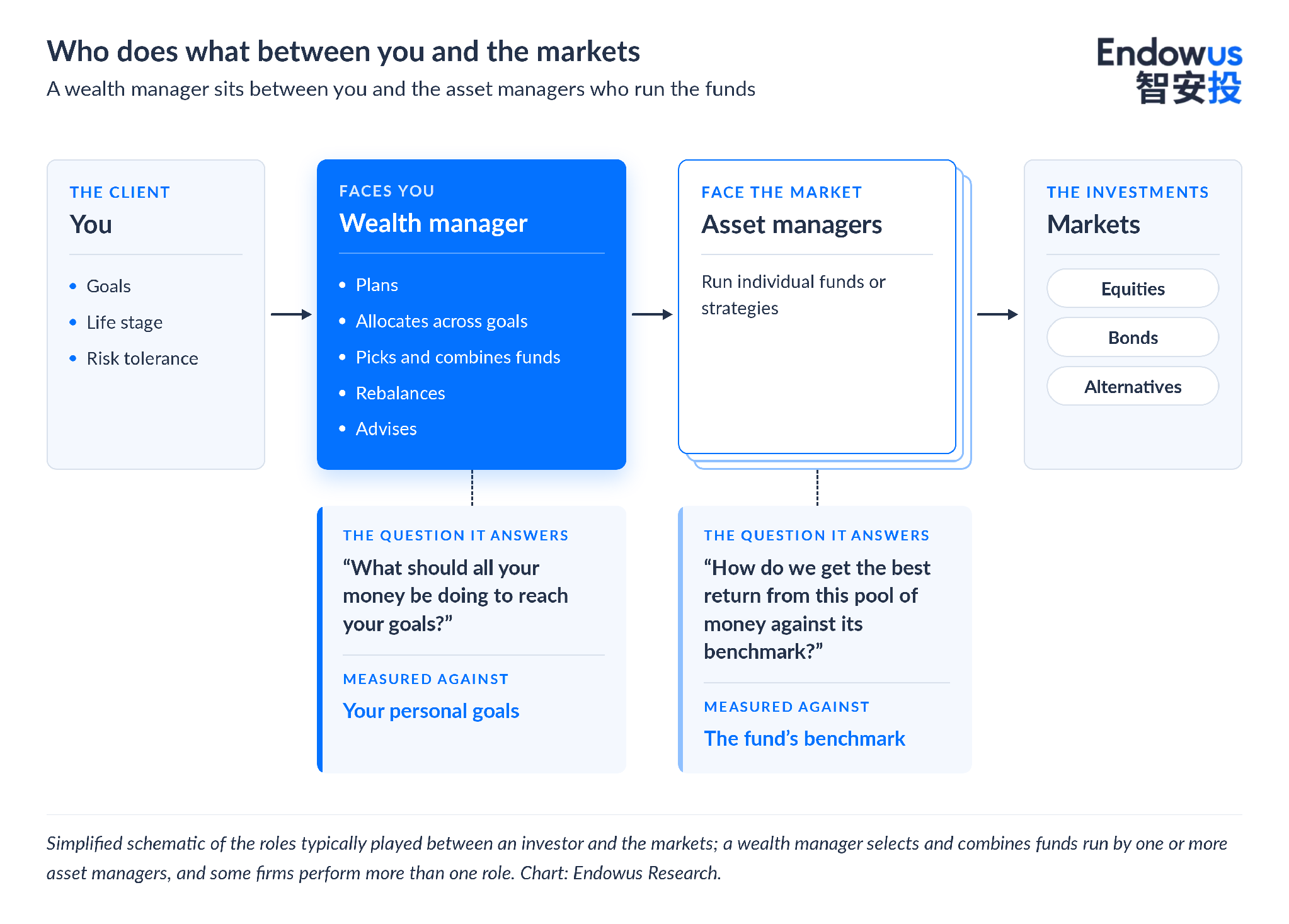
Since the objectives are different, success is also measured differently. A fund can do well against its benchmark, while your overall portfolio is still off track for your goals, or lag its benchmark while the portfolio as a whole stays on course. An asset manager is responsible for the returns of that specific fund, whereas a wealth manager is responsible for giving the client the best advice having solved for their investment goals and constraints.
The key tool of the wealth manager is the Investment Policy Statement - or an informal version of it. The goal is to better understand the client's background and objectives, risk tolerance and time horizon, asset-class preferences, liquidity needs and other constraints, the asset allocation, and how the portfolio will be run (discretion, rebalancing, tactical changes, implementation).
The two businesses overlap in practice. Wealth managers frequently use asset managers’ products — the funds in your portfolio are usually run by fund houses, not by the adviser who recommended them — and a private bank may do both jobs under one roof. “Investment management” is, in practice, another term for asset management. The SFC’s own figures show the split: at the end of 2025 it reported asset management and fund advisory business of about HK$31 trillion and private banking and private wealth management of about HK$12.9 trillion. The two segments overlap and cannot simply be added together, but they mark the industry’s own line between managing portfolios and managing client relationships.
The four links between your money and the market
To see where each fee and each decision sits, follow one Hong Kong dollar from you to the market. It passes through as many as four links.
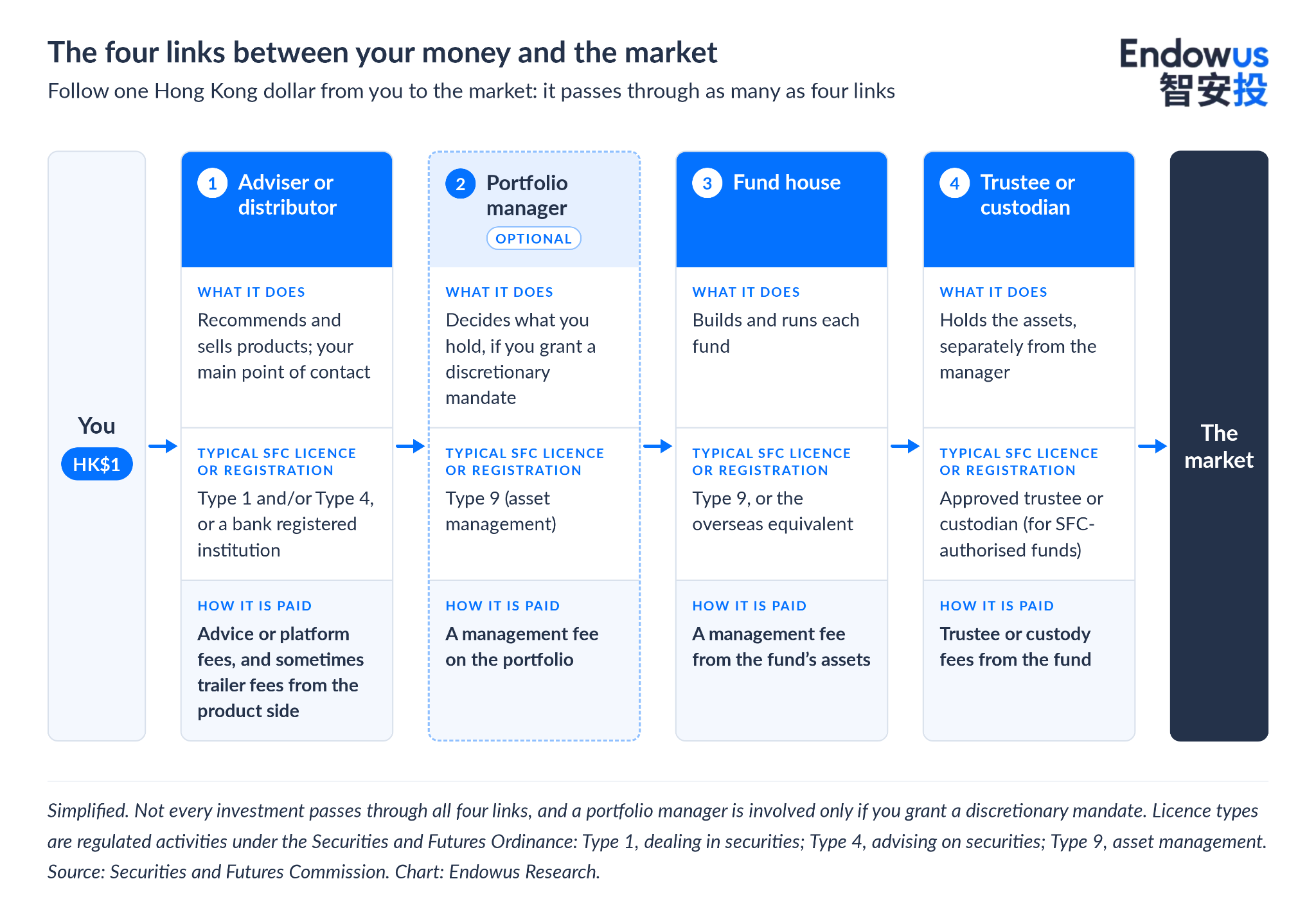
Fee and other payments collection is also a key information.
The adviser or distributor may be paid partly by the product side, through commissions known as trailer fees; this is a disclosed and legal model, and asset management for individuals almost always involves at least this link. We explain how trailer fees work separately (Endowus rebates all trailer fees back to investors). Moreover, the trustee or custodian holds the assets separately from the manager, so the firm that makes investment decisions does not hold the assets. The questions worth putting to any adviser at the first link are set out separately, and if you are weighing a digital platform against a traditional adviser, the models differ.
Discretionary vs advisory: who makes the decision
Under an advisory arrangement, you approve each transaction before it happens. Under a discretionary mandate, you agree an objective and a risk level, and the portfolio manager, holding a Type 9 licence, trades within those limits without asking each time. This is discretionary portfolio management.
The difference is easiest to see when something material happens. Take a hypothetical case in which markets fall 10% and a portfolio drifts away from its target mix.
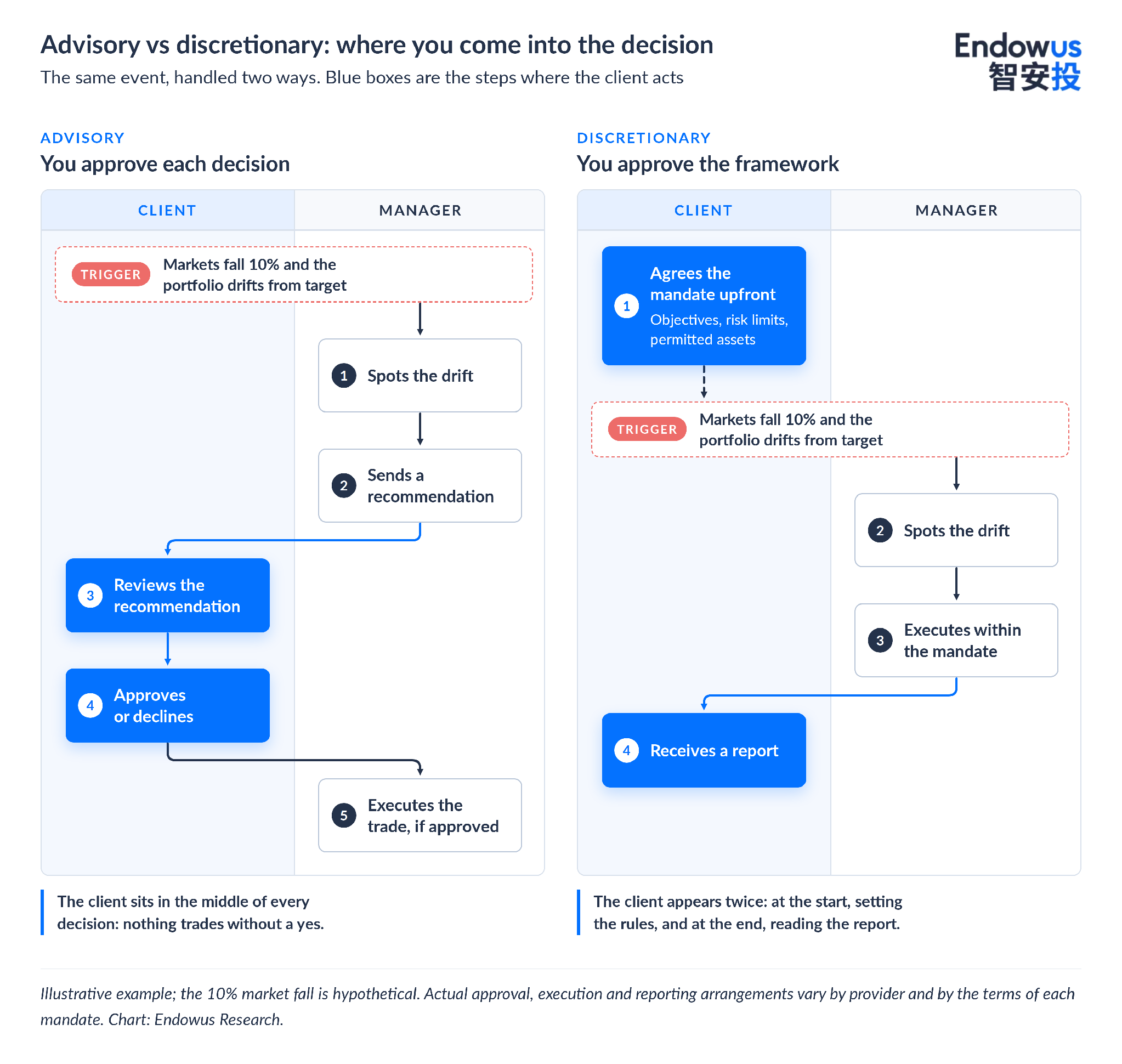
Under an advisory arrangement, the manager spots the drift and sends a recommendation, but nothing trades until you have reviewed it and said yes. Under a discretionary mandate, your decision was made earlier, when you agreed the objectives, risk limits and permitted assets; the manager rebalances within those limits, and you see what was done in the next report.
The trade-off follows from that timing. An advisory arrangement keeps every trade in your hands, but the portfolio can potentially stay off target for as long as the decision waits on you. A discretionary mandate acts without waiting for you, which is why the terms you agree upfront carry so much weight.
Neither is better in the abstract; they suit different people. If you grant a discretionary mandate, the mandate document should specify the objective, the risk level, any constraints, the reporting you receive, and the fees. You keep ownership of the assets, the right to see regular reports, and the right to terminate. Endowus builds these kinds of discretionary portfolios through its Flagship portfolios.
How to check who you are dealing with
Before you place money with any firm, you should verify your counterparty. The SFC maintains a public register of licensed corporations and registered institutions, which shows a firm’s central entity (CE) number and the regulated activities it is licensed for — so you can confirm that a firm claiming to manage portfolios actually holds a Type 9 licence, and that an adviser holds Type 1 (dealing in securities) or Type 4 (advising on securities). Banks appear as registered institutions rather than licensed corporations, because authorised institutions conducting regulated activities are registered with the SFC and supervised by the Hong Kong Monetary Authority as frontline regulator, though they remain subject to the same Ordinance.
Two practical checks matter. The CE number shown on a firm’s website should match the register. And the SFC publishes an Alert List of entities it believes are unlicensed or suspicious; impersonation of licensed firms is a known tactic, so it is worth confirming the name and CE number rather than trusting a website alone.
Where Endowus sits in the chain
Endowus HK Limited is licensed by the SFC (CE No. BQR225) for Type 1 (dealing in securities), Type 4 (advising on securities), and Type 9 (asset management) regulated activities. Endowus works with third-party fund houses rather than manufacturing its own funds. Under its Type 9 licence, Endowus builds and manages portfolios for clients [Compliance to confirm the approved wording]. As a matter of policy, Endowus rebates 100% of the trailer fees it receives from fund houses back to clients.
Investment implications
Rather than choosing between “asset management” and “wealth management” as if they were rival products (they’re not, they’re just different services), you can ask three things of any arrangement: who decides what you hold, who is paid by whom, and who holds your assets.
On one hand, a single relationship manager who combines advice, distribution, and service does real work, and for some investors a single point of contact is worth paying for. On the other hand, understanding the chain lets you see what you are paying for at each link, and decide where you want a professional to make the decisions and where you would rather choose funds yourself. For a discretionary portfolio built and managed for you, Endowus offers Endowus Flagship; to choose from fund houses directly, our platform offers Fund Smart. All investing carries market risk, portfolio values may fall as well as rise, and there is no capital guarantee.
Frequently asked questions
What is the difference between asset management and wealth management?
Asset management is the management of an investment portfolio to a defined objective, for a fee. Wealth management is broader: it coordinates your overall financial picture, and often includes planning as well as investments. Wealth managers commonly use asset managers’ products, so most investors use both.
Who are the big three asset managers?
By assets under management (AUM), the three largest are BlackRock (US$15.3 trillion as at 30 June 2026), Vanguard (about US$13.3 trillion as at 30 July 2026), and State Street Investment Management (US$6.3 trillion as at 30 June 2026), each figure taken from the firm’s own reporting. Naming them is not a recommendation, and they are not necessarily Endowus partners.
Who are the top asset managers in Hong Kong?
There is no official ranking. The SFC licenses more than 2,300 corporations for Type 9 asset management and publishes aggregate industry statistics, not league tables of individual firms. To check a specific firm, search the SFC public register.
What does SFC Type 9 mean?
Type 9 (asset management) is a regulated activity under the Securities and Futures Ordinance. A firm needs a Type 9 licence to manage a portfolio of securities or futures contracts for others, or to run an SFC-authorised REIT. You can confirm a firm’s licence on the SFC public register.
What is discretionary portfolio management?
It is an arrangement in which you agree an objective and risk level, and a licensed portfolio manager makes the buy-and-sell decisions within those limits without seeking your approval for each trade. You keep ownership of the assets, receive regular reports, and can terminate the mandate.
Disclaimer
Risk Warnings
Investment involves risk. Past performance is not an indicator nor a guarantee of future performance. The value of investments and the income from them can go down as well as up, and you may not get the full amount you invested. Rates of exchange may cause the value of investments to go up or down.
This article is not intended to be relied upon as a forecast or research or investment advice, and should not form the basis of any investment or other decisions. The information contained herein is not intended, and should not be construed, as any legal, tax, regulatory, accounting or financial advice. If you would like investment, accounting, tax or legal advice, you should consult with your own professional advisors regarding your individual circumstances and needs.
The information in this article may not be suitable for all investors. You are responsible for any action that you take or decision that you make in reliance on any content in this article, and you agree that Endowus HK Limited ("Endowus") is not liable under any circumstances.
No invitation or solicitation
Neither the information, nor any opinion, contained in this article constitutes a recommendation, offer or solicitation by Endowus or its affiliates to you to buy or sell any securities, collective investment schemes or other financial instruments or services, nor shall any such security, collective investment scheme, or other financial instruments or services be offered or sold to any person in any jurisdiction in which such offer, solicitation, purchase, or sale would be unlawful under the securities laws of such jurisdiction.
This is not intended to be an invitation or offer made to the public to subscribe for any financial product or to enter into any transaction.
Accuracy of Information
Whilst Endowus has made reasonable efforts to provide accurate and timely information, there may be inadvertent delays, omissions, technical or factual inaccuracies or errors in any such information. Endowus does not warrant or represent that the information in this article is correct, accurate or reliable.
Opinions
Any opinion or estimate above is made on a general basis and none of Endowus, nor any of its affiliates, representatives or agents have given any consideration to nor have made any investigation of the objective, financial situation or particular need of any user, reader, any specific person or group of persons. Opinions expressed herein are subject to change without notice.
Any forward-looking statements, prediction, projection or forecast on the economy, stock market, bond market or economic trends of the markets contained in this article are subject to market influences and contingent upon matters outside the control of Endowus and therefore may not be realised in the future.
In presenting the information above, none of Endowus, its affiliates, directors, employees, representatives or agents have given any consideration to, nor have made any investigation of the objective, financial situation or particular need of any user, reader, any specific person or group of persons. Therefore, no representation is made as to the completeness and adequacy of the information to make an informed decision. You should carefully consider whether any investment views and products/services are appropriate in view of your investment experience, objectives, financial resources and relevant circumstances.
This article has not been reviewed by the Securities and Futures Commission of Hong Kong.


.png)