.webp)
.webp)
.webp)
.webp)





- A carry trade funds a position in a low-yielding asset or currency and invests the proceeds in a higher-yielding one, aiming to capture the difference in yield.
- Carry can be profitable for long stretches because a low-yielding funding currency does not always weaken as economic theory predicts, but the return profile is skewed towards many small gains and occasional sharp losses.
- The August 2024 unwind of the Japanese yen carry trade, when Japan's Topix index fell 12% in a single day, shows how quickly a crowded, leveraged carry position can reverse and spill into global markets.
Interest rates differ from one country to the next, and from one point on the yield curve to another. Wherever they differ, the same opportunity appears: sophisticated investors tend to borrow “cheap” money and invest it where it earns more. That trade has a name — the carry trade.
The carry trade is one of the oldest and most widely used strategies in global markets, and understanding it explains a surprising amount of otherwise puzzling market behaviour. Its appeal - it pays a steady premium for bearing a risk that appears rarely - is also its danger: when the risk materializes, the unwinding can be severe.
This article explains what a carry trade is, how covered and uncovered interest rate parity explain why it can pay, the forms it takes beyond currencies, and the risks worth understanding even for investors who never run one.
What is a carry trade?
A carry trade funds a position cheaply - by borrowing at lower rates - and invests where the yield is higher, keeping the difference plus or minus any price move in the asset bought. The classic version borrows a low-interest-rate currency — historically the Japanese yen or the Swiss franc — and invests in a higher-yielding one.
There are two key factors in a carry trade:
- a sustainable interest rate differential and,
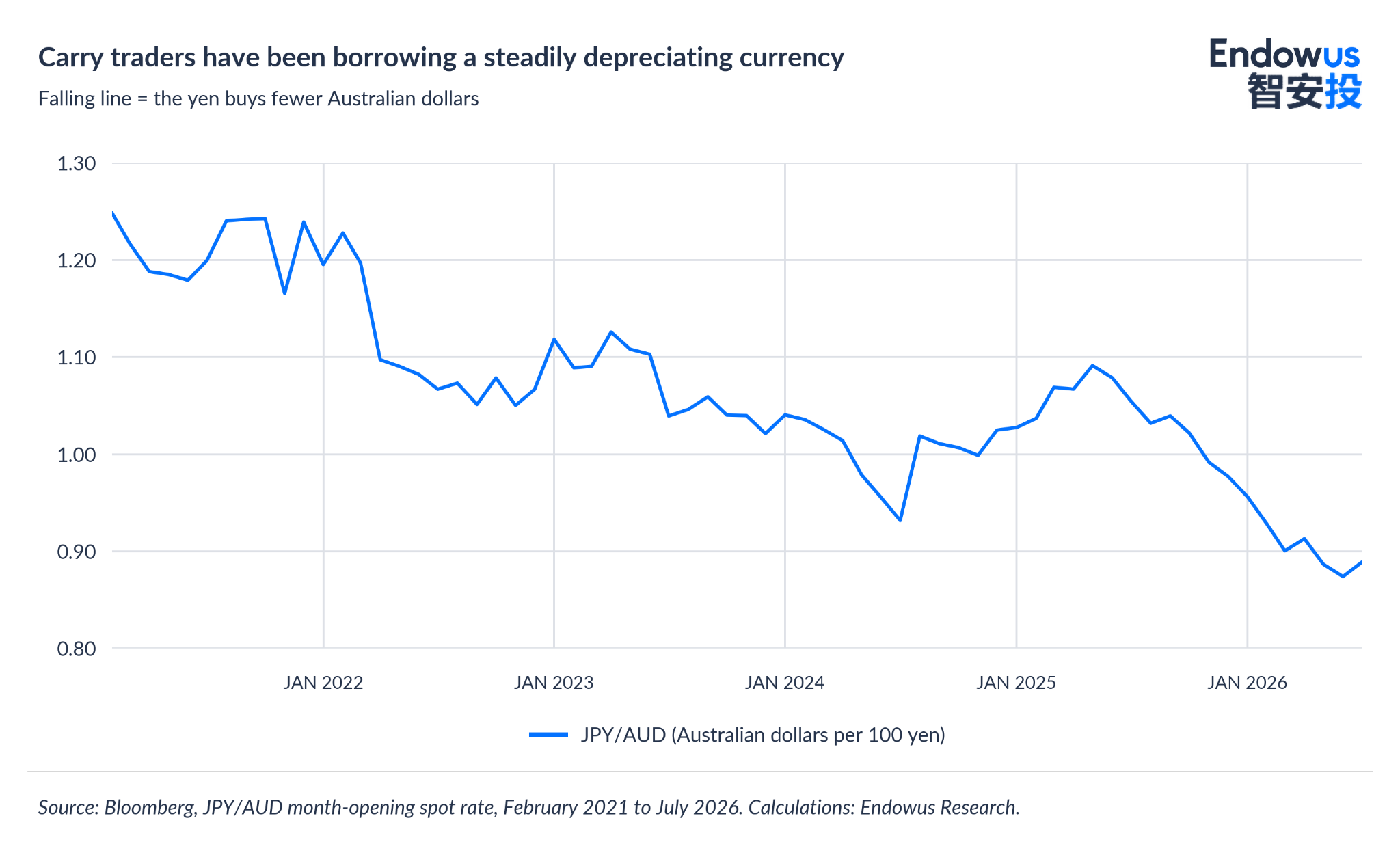
- the expectation that the funding currency does not appreciate (as the obligation to settle the debt in borrowing the cheap funding currency remains)
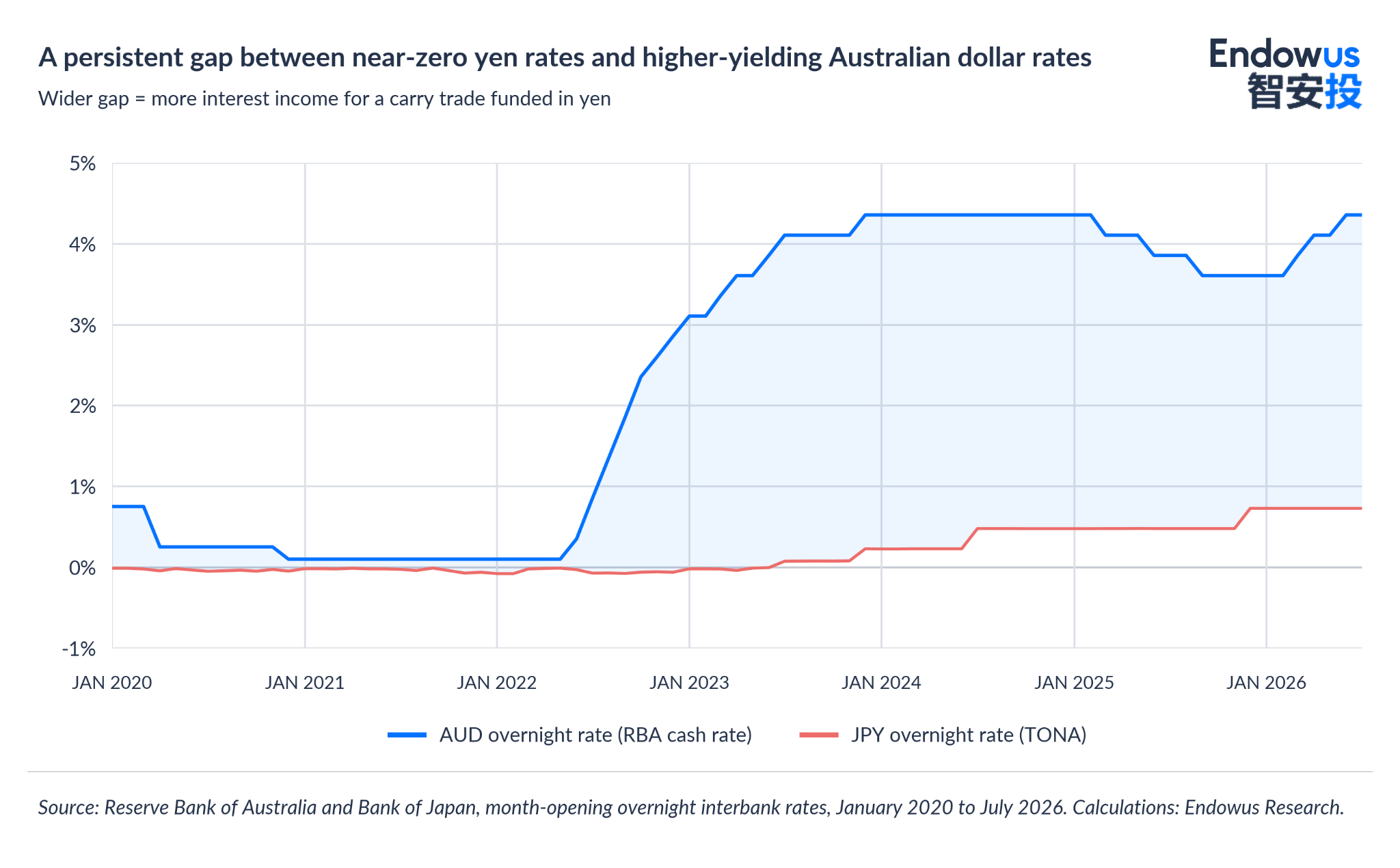
An illustrative example: borrow yen at 0.5% and invest in an Australian-dollar asset yielding 4.0%, for a gross carry of 3.5% a year before any currency move. Leverage raises the return on the investor's own capital, but a 3.5% strengthening of the yen may erase a year of carry. The figures are illustrative only, but the chart below shows the actual rate differential between Australia and Japan.
Why does it work when theory says it should not?
An investor can hedge the exchange-rate risk with a forward contract — an agreement made today to convert the currency back at a set rate later. Covered interest rate parity (CIP), a no-arbitrage relationship that holds tightly in normal conditions, prices that forward so as to cancel the interest-rate advantage almost exactly, leaving a hedged trade with little to gain.
Uncovered interest rate parity (UIP) is the corresponding economic hypothesis: that the expected change in the spot rate will offset the interest-rate differential, so the funding currency should appreciate by roughly the interest advantage, with that expected appreciation reflected in the forward rate. That appreciation would, in theory, eliminate the “carry” returns.
But UIP seldom holds in practice. The funding (low-yield) currency often fails to appreciate — indeed, high-yield currencies have tended to appreciate a little on average — a gap economists call the forward premium puzzle, which they attribute to the potential losses from sudden reversals caused by - for instance - changes in monetary policy.
How does carry appear in Hong Kong’s currency system?
The Hong Kong dollar is pegged to the US dollar within a band of 7.75 to 7.85 under the Linked Exchange Rate System (LERS). When the Hong Kong interbank rate, known as HIBOR, sits below comparable US dollar rates, investors may be tempted to borrow cheaply in Hong Kong dollars and hold higher-yielding US dollar assets.
When the gap widens, the Hong Kong dollar tends towards the weak end of its band, and the Hong Kong Monetary Authority may intervene to defend the peg. The carry incentive, and the intervention that can follow, are a recurring feature of Hong Kong's monetary system.
What is the main risk of a carry trade?
Carry's return profile is lopsided: small, steady gains in calm markets, and steep losses when turbulence arrives, as the Bank for International Settlements has described. Because carry positions are often crowded, a reversal can feed on itself.
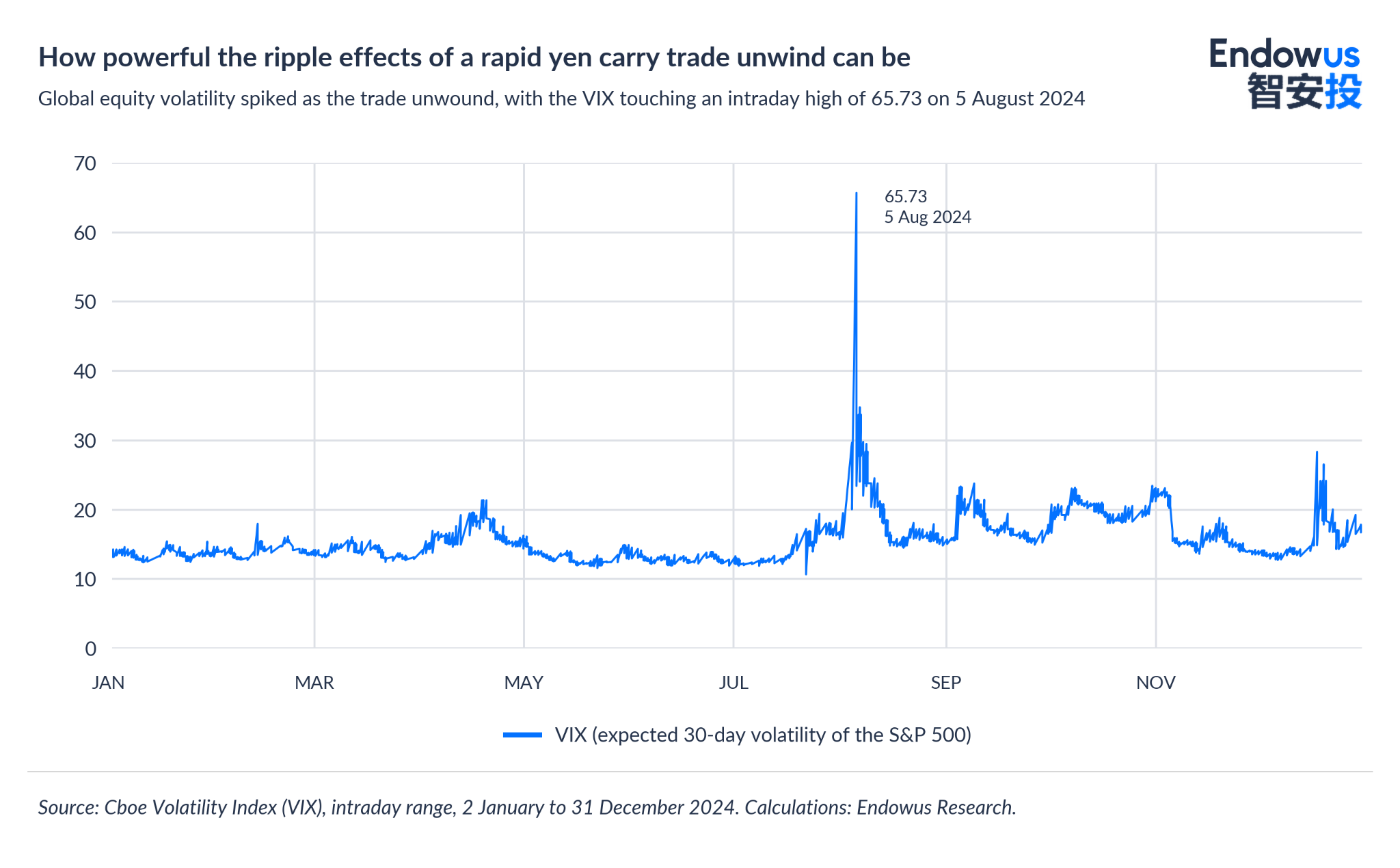
On 31 July 2024, the Bank of Japan raised its policy rate, and within days, on 5 August 2024, Japan's Topix index fell 12% in a single day as volatility spiked worldwide with VIX reaching 65.73, before markets stabilised within the week. Cheap funding had financed positions across global equities and bonds, so the unwind of JPY/USD carry trade travelled across markets. As a reminder, past market events are not necessarily a guide to future outcomes.
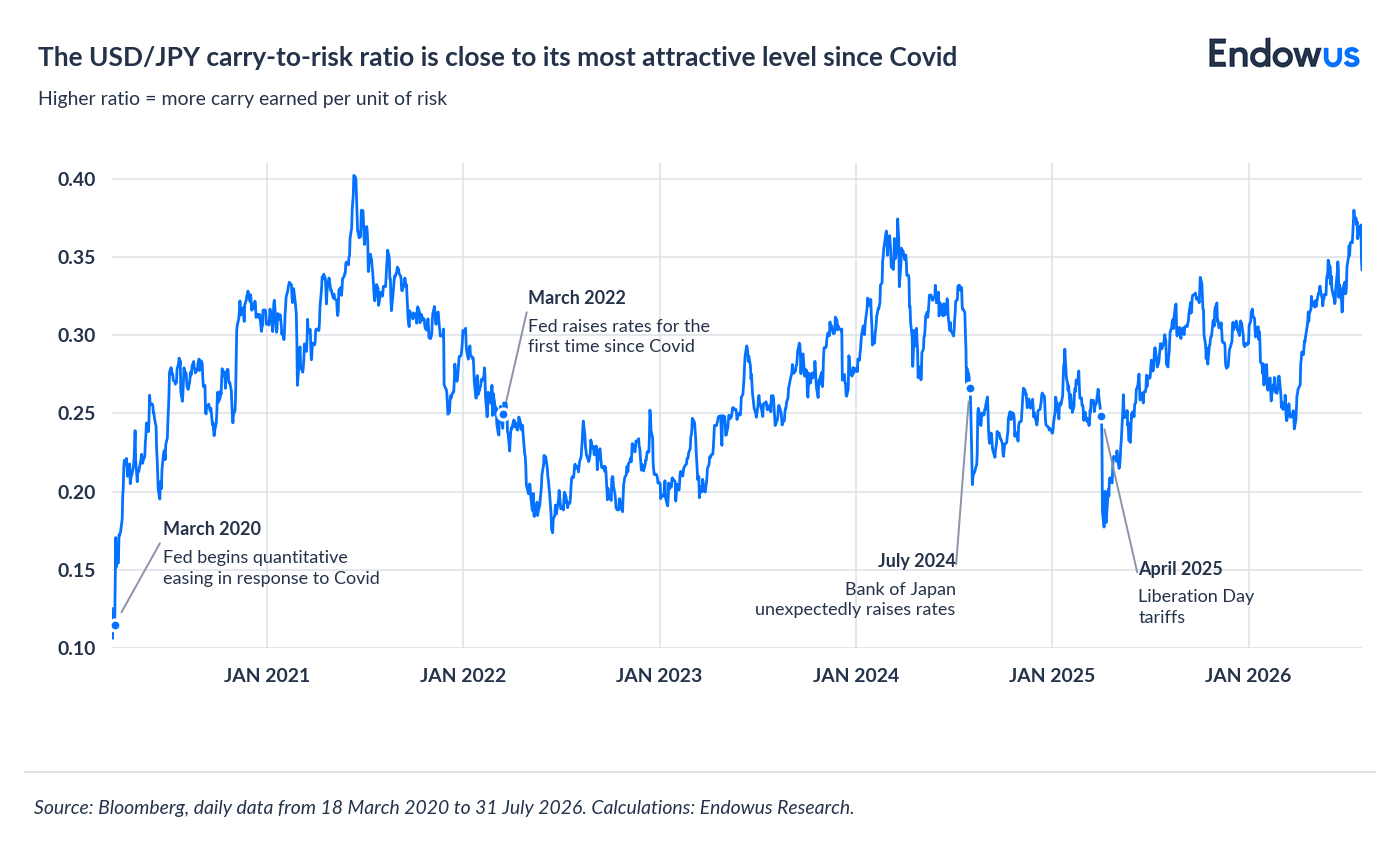
To evaluate how attractive and risky a carry trade is, the carry-to-risk ratio — the US-Japan rate differential divided by implied JPY volatility — measures reward per unit of currency risk in a carry trade. Risk rises and attractiveness reduces as the ratio falls toward zero, which happens when the rate gap narrows: from 2020-2022, when the Fed held rates near zero and the gap disappeared, and again in July 2024, when the BOJ's first rate hike to positive territory (a previous March 2024 hike had ended a long period of negative rates) in decades compressed it from the other side. Leverage amplifies this risk further, since most carry trades are built on borrowed capital, turning modest moves into potentially outsized losses.
Not every rate differential can be easily exploited: how government intervention can potentially unwind carry trade
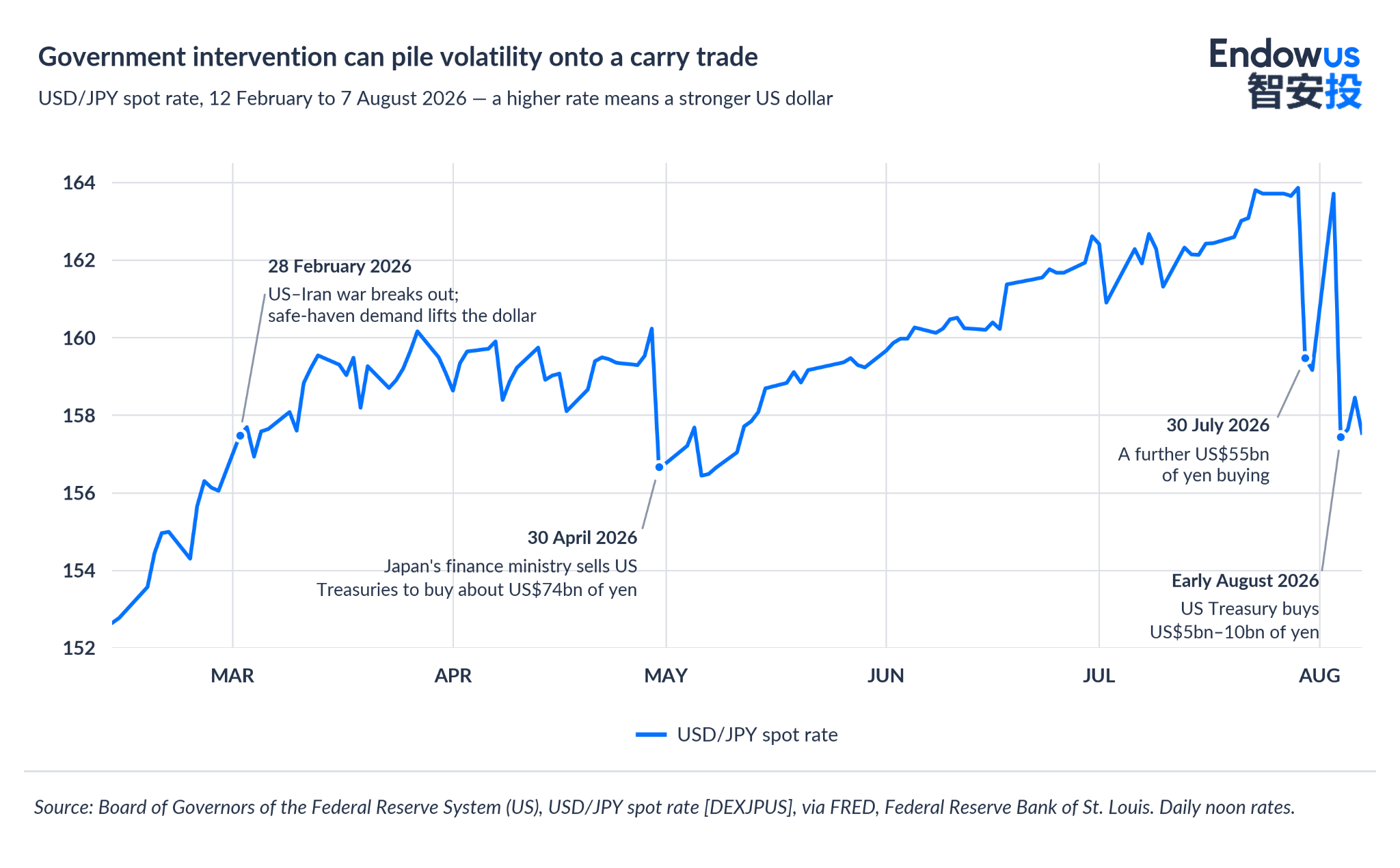
On 30 July 2026, the Japanese Ministry of Finance sold US Treasuries in the open market to raise dollars, then sold those dollars to buy $58.97 billion yen — hoping to halt the currency's continued depreciation. The operation was completed within a single day, and the yen appreciated sharply, gaining roughly 2% to 2.6% against the dollar. The rebound proved short-lived, as the dollar recovered the next day because investors continued to expect further yen depreciation.
Subsequently, the US and Japanese Treasuries conducted their first joint yen-buying intervention since 1998. The New York Fed, on behalf of the US Treasury, sold euros from the Exchange Stabilization Fund (ESF) to buy $5 billion to $10 billion worth of yen.
Note that the magnitude of the exchange rate move may not be proportional to the scale of the central banks' yen purchases. The fluctuation reflects investor expectations following the central banks' actions, more than the size of the intervention itself.
The rationale behind the joint intervention was twofold. First, Japan is the largest foreign holder of US Treasury securities, and continued dumping of Treasuries to fund yen purchases risked triggering a liquidity crisis in the US Treasury market. Second, sustained yen depreciation threatened to drag down the currencies of other export-oriented Asian economies — particularly South Korea — raising fears of a potential regional contagion reminiscent of the 1997–98 Asian Financial Crisis.
For the JPY/USD carry trade, this may materially raise the “risk” side of the equation. Coordinated intervention signals that policymakers may have decided to actively defend the yen against further depreciation, introducing sudden appreciation risk that can potentially trigger rapid, disorderly unwinds — as already seen when carry positions unwound sharply.
If the policy intervention is implemented, traders may have to deal with lower attractiveness and higher volatility for the trade.
Hurdles other than market volatility for carry trade: the case of China
Governments and central banks generally dislike their currency becoming a popular carry-trade base, since the resulting capital flows can destabilize the exchange rate and erode independent monetary policy.
Although the Chinese yuan has maintained a significantly lower interest rate than the US dollar since COVID, carry trades between the two currencies remain difficult to execute. China blocks this structurally, through strict controls on cross-border capital movement, daily currency fixings that manage the pace of CNY moves, and active intervention in both the CNY and CNH markets.
Why does this matter if you never run a carry trade?
Carry dynamics move the markets an ordinary investor already holds, so recognising them helps make sense of sudden, seemingly disproportionate price swings. Some retail products also embed carry-like exposure, from high-yield currency products to certain structured products and strategies that sell volatility.
Understanding carry is therefore less about running the trade than about spotting when a portfolio, or a product being marketed, is being paid to take carry-like risk.
Investment implications
Carry-like risk is embedded in more portfolios than investors often realise, and it tends to look attractive in calm markets precisely because its cost appears only in rare, sharp episodes.
The practical value of understanding carry is to recognise when an allocation or a product is being paid to take carry-like risk, and to size that exposure deliberately.
On one hand, carry strategies may deliver steady returns through calm periods. On the other hand, those returns compensate for a real risk of sharp losses, which leverage can potentially increase.
Does investing in foreign currency require putting on a carry trade?
Not necessarily.
Endowus has been expanding its multi-currency fund offerings to offer greater flexibility in managing foreign currency holdings — while giving you access to markets you don't hold the currency for.
Read more: Multi-currency expansion: Manage global assets hassle-free
Endowus HK builds globally diversified portfolios designed to manage risk across market conditions. Explore how a disciplined, evidence-based approach may help you avoid hidden risks.
Frequently asked questions
What is the simplest example of a carry trade?
Borrowing a low-interest-rate currency and investing in a higher-yielding currency or asset, keeping the difference in yield. The risk is that the exchange rate may move sharply against the investor.
What is the difference between covered and uncovered interest rate parity?
Covered interest rate parity applies when the currency risk is hedged with a forward contract, and arbitrage leaves no risk-free profit. Uncovered interest rate parity applies when the position is unhedged and relies on expected currency moves; it often fails in practice, which is what gives an unhedged carry trade its return.
How does the Hong Kong dollar peg create carry incentives?
Because the Hong Kong dollar is pegged to the US dollar, a gap between HIBOR and US dollar interest rates can make it profitable to borrow in one and invest in the other. If the gap widens, the Hong Kong Monetary Authority may intervene to keep the currency within its 7.75 to 7.85 band.
Why is the Japanese yen so often the funding currency?
Japan kept interest rates very low for many years, making yen borrowing cheap. That low funding cost made the yen a popular currency to borrow and sell in order to invest elsewhere.
Can investors be exposed to carry without realising it?
Yes. Certain foreign-currency deposits, high-yield currency products, and structured products carry embedded interest-rate or volatility exposure that behaves like a carry trade, even when it is not labelled as one.
Disclaimer
Risk Warnings
Investment involves risk. Past performance is not an indicator nor a guarantee of future performance. The value of investments and the income from them can go down as well as up, and you may not get the full amount you invested. Rates of exchange may cause the value of investments to go up or down.
This article is not intended to be relied upon as a forecast or research or investment advice, and should not form the basis of any investment or other decisions. The information contained herein is not intended, and should not be construed, as any legal, tax, regulatory, accounting or financial advice. If you would like investment, accounting, tax or legal advice, you should consult with your own professional advisors regarding your individual circumstances and needs.
The information in this article may not be suitable for all investors. You are responsible for any action that you take or decision that you make in reliance on any content in this article, and you agree that Endowus HK Limited ("Endowus") is not liable under any circumstances.
No invitation or solicitation
Neither the information, nor any opinion, contained in this article constitutes a recommendation, offer or solicitation by Endowus or its affiliates to you to buy or sell any securities, collective investment schemes or other financial instruments or services, nor shall any such security, collective investment scheme, or other financial instruments or services be offered or sold to any person in any jurisdiction in which such offer, solicitation, purchase, or sale would be unlawful under the securities laws of such jurisdiction.
This is not intended to be an invitation or offer made to the public to subscribe for any financial product or to enter into any transaction.
Accuracy of Information
Whilst Endowus has made reasonable efforts to provide accurate and timely information, there may be inadvertent delays, omissions, technical or factual inaccuracies or errors in any such information. Endowus does not warrant or represent that the information in this article is correct, accurate or reliable.
Opinions
Any opinion or estimate above is made on a general basis and none of Endowus, nor any of its affiliates, representatives or agents have given any consideration to nor have made any investigation of the objective, financial situation or particular need of any user, reader, any specific person or group of persons. Opinions expressed herein are subject to change without notice.
Any forward-looking statements, prediction, projection or forecast on the economy, stock market, bond market or economic trends of the markets contained in this article are subject to market influences and contingent upon matters outside the control of Endowus and therefore may not be realised in the future.
In presenting the information above, none of Endowus, its affiliates, directors, employees, representatives or agents have given any consideration to, nor have made any investigation of the objective, financial situation or particular need of any user, reader, any specific person or group of persons. Therefore, no representation is made as to the completeness and adequacy of the information to make an informed decision. You should carefully consider whether any investment views and products/services are appropriate in view of your investment experience, objectives, financial resources and relevant circumstances.
This article has not been reviewed by the Securities and Futures Commission of Hong Kong.


.png)