.webp)
.webp)
.webp)
.webp)






- On a weighted-average basis, roughly half of STOXX Europe 600 revenue is generated outside Europe (STOXX, FactSet GeoRev data, 31 March 2026), so European equities behave more like a set of globally diversified businesses than a bet on the European economy.
- A concentrated portfolio of 30 to 50 European holdings can carry enough names to diversify away most stock-specific risk while allowing sector, country, and factor exposures to be set deliberately rather than inherited from a broad index.
- For a Hong Kong investor whose portfolio is concentrated in local and Chinese equities, European-listed multinationals may offer diversification sourced from global revenue streams rather than a single region.
Investors often treat European equities as a directional call on eurozone growth. The make-up of the market suggests otherwise. Many of Europe’s largest listed companies earn the majority of their revenue outside Europe, and several earn the majority outside their home region altogether.
The case for European equities therefore rests on the global footprint of the businesses that list there, not on the European cycle. We spoke to Niall Gallagher, Lead Portfolio Manager of Jupiter European Select to discuss where European-listed companies actually earn their revenue, why the structure of the European market pushes them outward, how a concentrated portfolio can capture that exposure while managing portfolio risk, and what the distinction means for an investor constructing a globally diversified allocation.
European-listed companies generate a significant revenue abroad
The STOXX Europe 600 tracks 600 large-, mid-, and small-capitalisation companies across 17 European countries and covers close to 90% of the region’s free-float market capitalisation. Its aggregate revenue is not, however, a proxy for European demand. On a weighted-average basis, roughly half of that revenue is raised outside Europe, according to FactSet GeoRev data cited by STOXX as at 31 March 2026.
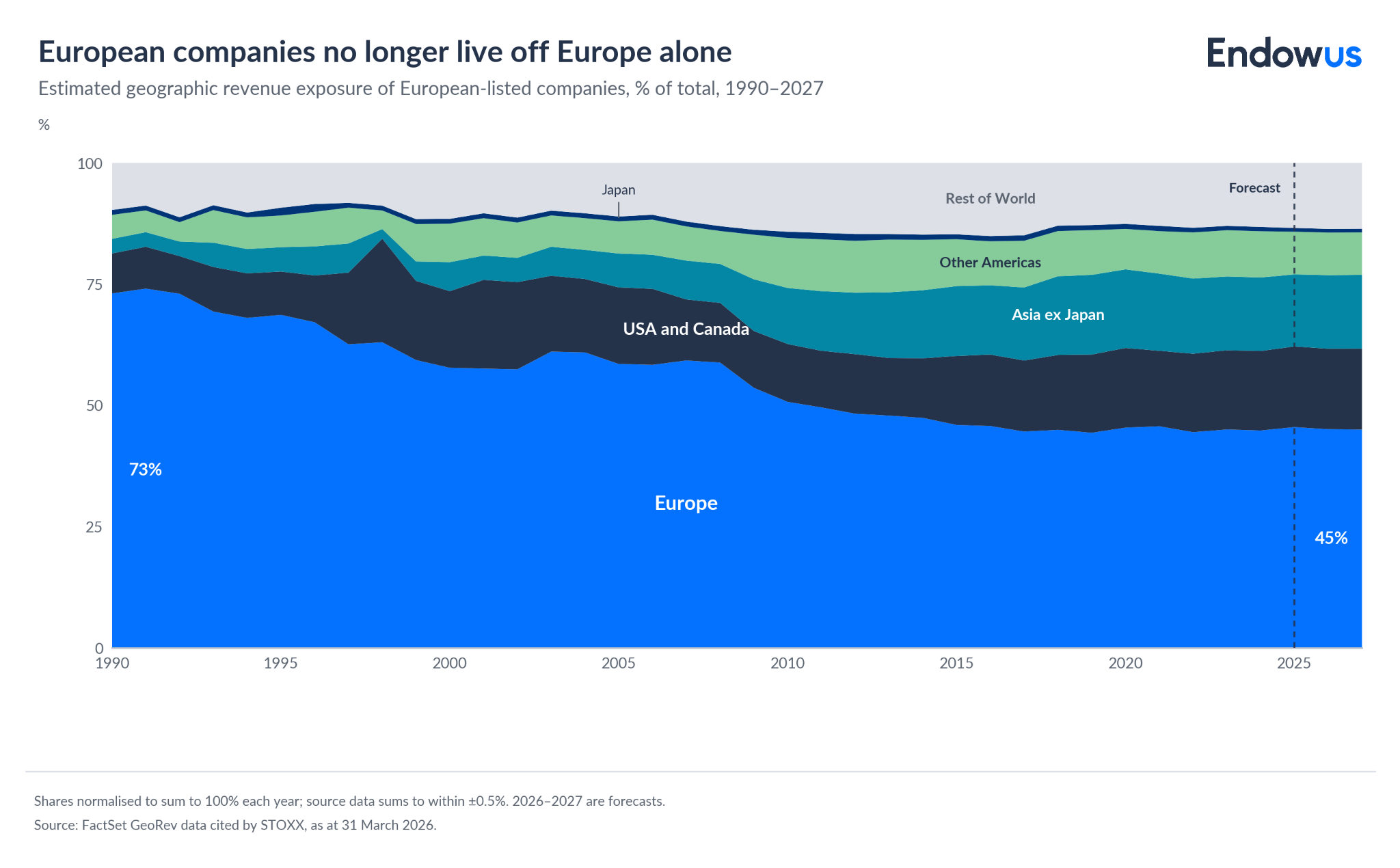
If we look at the components of the index we can get granular. Novartis, the Swiss pharmaceutical group, generated close to 69% of its 2025 net sales outside Europe. Nestle draws its largest single share of sales from the Americas (48%). At LVMH, Asia and the Americas together account for more than half of revenue.
For large European corporations, a globally distributed revenue base is the structural norm. An allocation to European equities can be an allocation to globally diversified companies that happen to be domiciled and listed in Europe.
The structure of the European market pushes companies outward
The European Union counted 450.4 million inhabitants as at 1 January 2025 (Eurostat, July 2025) — a large market, but often too small for a multinational to reach global scale within it. A German industrial company cannot reach world scale serving Germany alone; a Swiss pharmaceutical firm must sell across continents to fund its research.
This is where Europe differs from the United States. A large US company can achieve world scale while earning much of its revenue at home, because the domestic market is deep enough to support it. European companies have fewer alternatives, which may make their international revenue base more structural than a mix chosen opportunistically.
Why is concentration potentially positive for your portfolio?
A very broad index can accumulate factor exposures without intent, so that a portfolio which looks diversified is in fact exposed to a narrow set of risks spread across many holdings. A concentrated portfolio can address this directly. Research by Meir Statman (1987) found that 30 to 40 stocks are enough to diversify away most stock-specific risk. A portfolio of that size can therefore remain diversified while staying small enough for its sector, country, and factor tilts to be visible and intentional.
Whether such a portfolio ultimately shows lower volatility or better downside behaviour than a broad index depends on manager skill. It is illustrative rather than assured, and not a general property of concentration.
How diverse is European industry across sectors?
Concentration at the portfolio level need not narrow economic exposure, because European industry is varied. Germany leads in machinery, automotive components, and chemicals; Switzerland in pharmaceuticals and specialty ingredients; France in luxury and aerospace; the Nordic region in industrial technology and software; the United Kingdom in financial services and consumer goods; Italy in premium manufacturing. A portfolio of 30 to 50 holdings can therefore span the energy transition, demographic ageing, digitalisation, and global consumption at once.
Investment implications
The usual case for European equities is cyclical — cheap valuations, or a recovery due. Such arguments date quickly. The structural case is more durable: European-listed companies earn much of their revenue outside Europe, and that exposure can be held in a concentrated portfolio whose diversification comes from underlying earnings rather than the number of holdings.
For a Hong Kong investor whose equity exposure is concentrated in local and Chinese markets, a considered allocation to quality European equities may add diversification tied to global industrial growth, the energy transition, and infrastructure. In our view, the more important point is one of construction: diversification is better sourced from what companies do than from how many a portfolio holds.
On one hand, a concentrated European allocation may deliver genuine global diversification and intentional control of exposures. On the other hand, it raises the importance of manager skill, and European-listed companies remain subject to currency movements, regulatory change, and shifts in global demand. Sizing the position to its role in a broader portfolio is the discipline that matters.
For investors using Endowus, our advisers can help determine whether and how much European or global equity exposure suits your objectives, time horizon, and risk profile. Find out more about Jupiter Asset Management and its European equity strategy here.
Frequently asked questions
Are European equities a bet on the European economy?
Not primarily. Most large European-listed companies earn the majority of their revenue outside Europe, so their earnings track global demand more closely than eurozone growth. For a Hong Kong investor, they can serve as global diversification rather than a single-region bet.
How much of European companies’ revenue is earned outside Europe?
On a weighted-average basis, roughly half of STOXX Europe 600 revenue is earned outside Europe (FactSet GeoRev data cited by STOXX, 31 March 2026). Measures based on MSCI Europe have put the figure closer to 60%. The exact share varies with the index and methodology used.
Why might European equities suit a Hong Kong portfolio?
Hong Kong investors are often heavily weighted toward local and Chinese equities. European-listed multinationals earn revenue across the Americas, Asia, and Europe, so an allocation can broaden a portfolio’s revenue base and reduce reliance on a single market’s performance.
How can investors in Hong Kong gain exposure to European equities?
Common routes include exchange-traded funds tracking European or global indices, some of which are listed on the Hong Kong Stock Exchange, and actively managed funds with European exposure. On the Endowus platform, investors can access advised portfolios and actively managed strategies and speak to an adviser about sizing the exposure.
What are the risks of investing in European equities?
Key risks include currency movements between the euro, other reporting currencies, and the Hong Kong dollar; regulatory and policy change across the markets these companies serve; sensitivity to global demand; and, for concentrated strategies, greater dependence on manager skill. Investors should weigh these against their own circumstances.
Endowus HK Limited (“Endowus”) is licensed by the Securities and Futures Commission of Hong Kong (CE No. BQR225) to carry out Type 1 (dealing in securities), Type 4 (advising on securities) and Type 9 (asset management) regulated activities.
Risk Warnings
Investment involves risk. Past performance is not an indicator nor a guarantee of future performance. The value of investments and the income from them can go down as well as up, and you may not get the full amount you invested. Rates of exchange may cause the value of investments to go up or down. Individual stock performance does not represent the return of a fund.
This article is not intended to be relied upon as a forecast or research or investment advice, and should not form the basis of any investment or other decisions. The information contained herein is not intended, and should not be construed, as any legal, tax, regulatory, accounting or financial advice. If you would like investment, accounting, tax or legal advice, you should consult with your own professional advisors regarding your individual circumstances and needs.
The information in this article may not be suitable for all investors. You are responsible for any action that you take or decision that you make in reliance on any content in this article, and you agree that Endowus HK Limited is not liable under any circumstances.
General risk warnings relating to collective investment schemes
Before making an investment decision, you are reminded to refer to the relevant prospectus/ offering document for specific risk considerations and related fees and charges. Funds are not a bank deposit and not capital guaranteed, and are subject to investment risks, including the possible loss of the principal amount invested. Some of the funds also involve derivatives. Do not invest in them unless you fully understand and are willing to assume the risks associated with them.
No invitation or solicitation
Neither the information, nor any opinion, contained in this article constitutes a recommendation, offer or solicitation by Endowus or its affiliates to you to buy or sell any securities, collective investment schemes or other financial instruments or services, nor shall any such security, collective investment scheme, or other financial instruments or services be offered or sold to any person in any jurisdiction in which such offer, solicitation, purchase, or sale would be unlawful under the securities laws of such jurisdiction. This is not intended to be an invitation or offer made to the public to subscribe for any financial product or to enter into any transaction.
Accuracy of Information
Whilst Endowus has made reasonable efforts to provide accurate and timely information, there may be inadvertent delays, omissions, technical or factual inaccuracies or errors in any such information. Endowus does not warrant or represent that the information in this article is correct, accurate or reliable.
Opinions
Any opinion or estimate above is made on a general basis and none of Endowus, nor any of its affiliates, representatives or agents have given any consideration to nor have made any investigation of the objective, financial situation or particular need of any user, reader, any specific person or group of persons. Opinions expressed herein are subject to change without notice. Any forward-looking statements, prediction, projection or forecast on the economy, stock market, bond market or economic trends of the markets contained in this article are subject to market influences and contingent upon matters outside the control of Endowus and therefore may not be realised in the future.
Product Risk Rating: Please note that any product risk rating (the “PRR”) provided by us is an internal rating assigned based on our product risk assessment model, and is for your reference only. The PRR is subject to change from time to time. The PRR does not take into account your individual circumstances, objectives or needs and should not be regarded as advice or recommendation to purchase, hold or sell any fund or make any other investment decisions. Accordingly, you should not solely rely on the PRR in making your investment decision in the relevant Fund.
This article has not been reviewed by the Securities and Futures Commission of Hong Kong.


.png)