.webp)
.webp)
.webp)
.webp)





- Embarking on an IVF journey in Hong Kong requires careful mental and financial preparation. Costs for a single cycle, including supplementary procedures can vary significantly and could reach up to HK$150,000 or more.
- Find out how to strategically map your treatment timeline, manage hidden medical costs, and transition your assets for long-term family financial planning post-success.
Starting a family is a deeply personal and joyous milestone. Yet, the path is not always straightforward. For many in Hong Kong, in vitro fertilisation (IVF) offers a scientifically proven route to parenthood.
How do you mentally and financially prepare for this complex process? In this article, we'll break down the essentials of an IVF, from the basic steps of the IVF process and key planning tips to maximise success to practical financial considerations and strategies to make it more attainable.
This knowledge article is contributed by Sow Fertility. Sow Fertility is a digital health companion that transforms fertility and family-building in Asia by empowering individuals with accessible, holistic solutions through their membership platform. They work to break cultural stigmas, advocate for modern fertility policies, and partner with corporates, medical and holistic care providers to create inclusive, fertility-friendly workplaces and support systems.
Understanding the IVF Process: A Step-by-Step Overview
IVF is an assisted reproductive technology that combines an egg and sperm in a laboratory. It is a delicate process designed to improve your chances of a successful pregnancy. Here is what you can generally expect during a standard cycle.
The IVF process comprises the following steps:
Step 1: Egg & sperm collection
For women, the process begins with hormonal medications to stimulate the ovaries. This encourages the production of multiple mature eggs. Once ready, a trigger injection induces ovulation for retrieval.
Concurrently, the male partner provides a semen sample. This is carefully processed in the lab to isolate the healthiest sperm for fertilisation.
Step 2: Fertilisation
There are two primary methods for fertilising the eggs. In conventional IVF, eggs and sperm are combined in a laboratory dish, allowing sperm to naturally penetrate the eggs. Conversely, Intracytoplasmic Sperm Injection (ICSI) is used for cases where sperm mobility is an issue, in which a single sperm is directly injected into an egg. The resulting embryos are then monitored for several days (typically 3 to 5 days) as they develop.
Step 3: Embryo transfer
During the embryo transfer, doctors select one or more healthy embryos for transfer into the woman’s uterus. In some cases, doctors may recommend a frozen embryo transfer (FET) if Pre-Implantation Genetic Testing (PGT) is needed or the uterine environment is not optimal at the time of fresh embryo transfer. Frozen embryos can be thawed and transferred to a more optimal cycle, allowing for better timing and uterine preparation.
Step 4: Follow-up care
About 9-14 days post-transfer, a blood test is performed to test for human chorionic gonadotropin, or hCG, a hormone indicating a successful pregnancy. If the test is positive, your doctor will schedule ultrasound sessions to confirm the pregnancy and monitor fetal development.
How do you start preparing for your IVF journey?
Medical treatments often demand immediate decisions, which can lead to decision fatigue. Without a clear plan, the compounding costs of consultations and procedures can cause immense anxiety.
Step 1: Assessing your baseline with fertility testing
Before making significant financial commitments, it is recommended to seek a comprehensive fertility evaluation. Assessing your reproductive health provides crucial clarity for your next steps.
This typically involves reviewing your medical history, physical examinations, and blood tests. Women may undergo hormone testing and ultrasounds. Men usually complete a semen analysis to check sperm motility and count.
Step 2: Selecting the right location and clinic
The options available to you might vary based on your budget and local regulations (for example, in some jurisdictions, IVF is only allowed for legally married couples).
Pursuing treatment in Hong Kong versus a clinic abroad might also require very different logistical planning.
If you are not planning to use your embryos immediately after they are developed through IVF, it is also important to understand the logistics and ongoing costs for long-term embryo storage.
Step 3: Setting the timeline, factoring in time off and recovery
An IVF cycle needs to be timed to your menstrual cycle. The process generally starts on the first day of your period. And every step along the way of the process will require time from your day, whether it’s the ultrasound appointments to check for your follicles' readiness, recovering from the hormonal injections and egg retrieval, or going for your embryo transfer.
Hence, plan your time ahead accordingly and make sure you are comfortably ready for the procedures. If you plan to use an overseas clinic, be sure you schedule enough time before and after treatments.
IVF costs in Hong Kong
In Hong Kong, a baseline cycle at a private clinic typically costs more than HK$150,000. Public hospitals offer subsidised rates but have eligibility limitations around age.
The good news is that starting from tax year 2024/2025, assisted reproductive services such as IVF are now eligible for tax deductions under salaries tax and personal assessment, subject to a ceiling of HK$100,000 a year. Note that the tax deduction is only eligible for services provided by licensed assisted reproductive service providers.
Other IVF hidden costs considered
It is important to note that beyond the baseline costs, depending on your personal circumstances and medical profile, your specialist may recommend different options on items within the package, including genetic testing (PGT-A), embryo freezing, and specialised fertilisation (ICSI).
These can add from HK$3,000 to over HK$30,000 to your bill. Factoring in these potential costs is crucial for understanding your final bill and ensuring an adequate financial buffer.
Other potential costs might include auxiliary services, such as hiring a fertility consultant, visiting a Traditional Chinese Medicine practitioner or a naturopathic practitioner. While helpful, these services add to your overall financial commitment.
Financial planning for your IVF journey
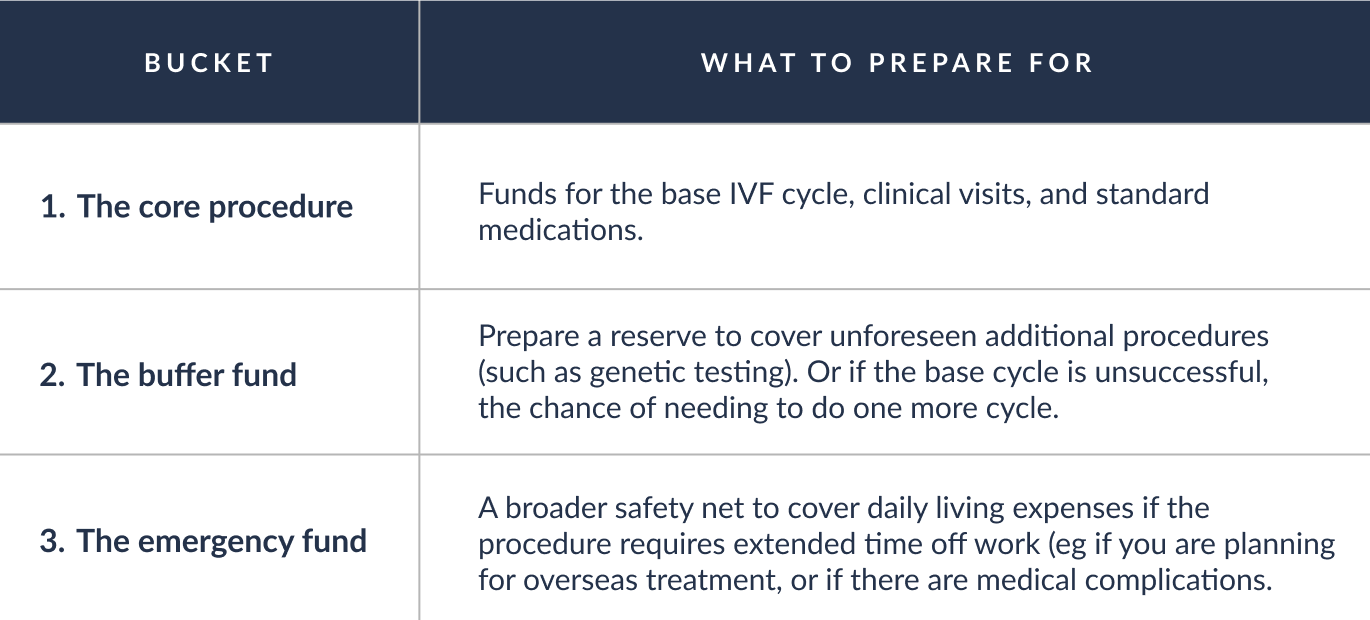
Embarking on an IVF journey requires both mental and financial planning. A clear “'bucketing” strategy can help simplify the financial complexity of this journey.
You can start by breaking down the total costs of the whole IVF journey into three distinct buckets.
Optimising your capital beyond cash savings
When financing medical procedures, people often rely solely on basic savings accounts. While drawing from your savings may make sense, planning earlier for this financial outlay can meaningfully reduce the stress with the associated costs to come.
Relying solely on bank savings to fund your IVF is practical, but today, inflation continues to erode the purchasing power of your savings.
Read more: The real cost of saving too much cash
Conversely, trying to grow wealth in the volatile stock market is potentially risky. A sudden market downturn could jeopardise your rigid treatment timeline. Furthermore, loss aversion can make these market swings incredibly stressful during an already emotional period.
Consider money market funds (MMFs) as a low-risk cash management option that may help you mitigate market volatility, and yet be able to offer higher return potential than a savings account. You can also opt for pre-built MMF portfolios such as the Endowus CashUp Portfolios.
If your journey is still a few years away, you can build your target savings with monthly investment plans into a low-cost, globally diversified portfolio such as the Endowus Flagship Portfolios.
Read more: How to build a diversified financial portfolio
Looking into the future: Your long-term family financial planning
A successful IVF outcome is a joyous, life-changing milestone. Yet, it is merely the first step in your family’s lifelong financial journey. Your expenses will quickly evolve to include paediatric healthcare, education, and housing upgrades.
To meet these multi-decade liabilities, you can build a comprehensive financial plan, clearly bucketing short-term financial goals (i.e. day-to-day family expenses), medium-term goals (e.g. mortgage or rental payments for housing upgrades) and longer-term goals (e.g. children’s university tuition fund) — each in itself a personalised portfolio tailored to its investment horizon and appropriate risk level.
Read more: Financial planning for new parents in Hong Kong
At Endowus, we believe everyone’s financial situation and investment goals are unique. You can schedule a 1-on-1 free consultation with our SFC-licensed client advisors, who would be more than happy to assist you in building a personalised financial plan. This will give you the mindspace to focus your time and energy on family building, as opposed to financial anxiety.
Sow Fertility: Guidance for personalised fertility planning
If you would like to obtain more information on the IVF, or advice on the process, you can reach out to Sow Fertility — a digital health companion platform that aims to empower fertility planning and family building in Asia, and is one of Endowus’ ecosystem partners as part of our WealthHERWay female empowerment programme.
Read more:
- How to invest your $100,000 or million
- Building an education fund for children in Hong Kong
- Tax guide 2025: calculation, allowances, and management tips
<divider><divider>
Risk Warnings
Investment involves risk. Past performance is not an indicator nor a guarantee of future performance. The value of investments and the income from them can go down as well as up, and you may not get the full amount you invested. Rates of exchange may cause the value of investments to go up or down.
This article is not intended to be relied upon as a forecast or research or investment advice, and should not form the basis of any investment or other decisions. The information contained herein is not intended, and should not be construed, as any legal, tax, regulatory, accounting or financial advice. If you would like investment, accounting, tax or legal advice, you should consult with your own professional advisors regarding your individual circumstances and needs.
The information in this article may not be suitable for all investors. You are responsible for any action that you take or decision that you make in reliance on any content in this article, and you agree that Endowus HK Limited (“Endowus”) is not liable under any circumstances.
No invitation or solicitation
Neither the information, nor any opinion, contained in this article constitutes a recommendation, offer or solicitation by Endowus or its affiliates to you to buy or sell any securities, collective investment schemes or other financial instruments or services, nor shall any such security, collective investment scheme, or other financial instruments or services be offered or sold to any person in any jurisdiction in which such offer, solicitation, purchase, or sale would be unlawful under the securities laws of such jurisdiction.
This is not intended to be an invitation or offer made to the public to subscribe for any financial product or to enter into any transaction.
Accuracy of Information
Whilst Endowus has made reasonable efforts to provide accurate and timely information, there may be inadvertent delays, omissions, technical or factual inaccuracies or errors in any such information. Endowus does not warrant or represent that the information in this article is correct, accurate or reliable.
Opinions
Any opinion or estimate above is made on a general basis and none of Endowus, nor any of its affiliates, representatives or agents have given any consideration to nor have made any investigation of the objective, financial situation or particular need of any user, reader, any specific person or group of persons. Opinions expressed herein are subject to change without notice.
Any forward-looking statements, prediction, projection or forecast on the economy, stock market, bond market or economic trends of the markets contained in this article are subject to market influences and contingent upon matters outside the control of Endowus and therefore may not be realised in the future.
In presenting the information above, none of Endowus, its affiliates, directors, employees, representatives or agents have given any consideration to, nor have made any investigation of the objective, financial situation or particular need of any user, reader, any specific person or group of persons. Therefore, no representation is made as to the completeness and adequacy of the information to make an informed decision. You should carefully consider whether any investment views and products/ services are appropriate in view of your investment experience, objectives, financial resources and relevant circumstances.
This article has not been reviewed by the Securities and Futures Commission of Hong Kong.


.png)