.webp)
.webp)
.webp)
.webp)





.jpg)
- In investing, “hedging” means protecting a portfolio’s downside by investing in assets with different profiles - so that some of these assets can absorb an equity market fall, for instance, or by buying explicit market insurance such as put options. For retail long-term investors, the cost of options-hedging - the latter - may outweigh the advantages.
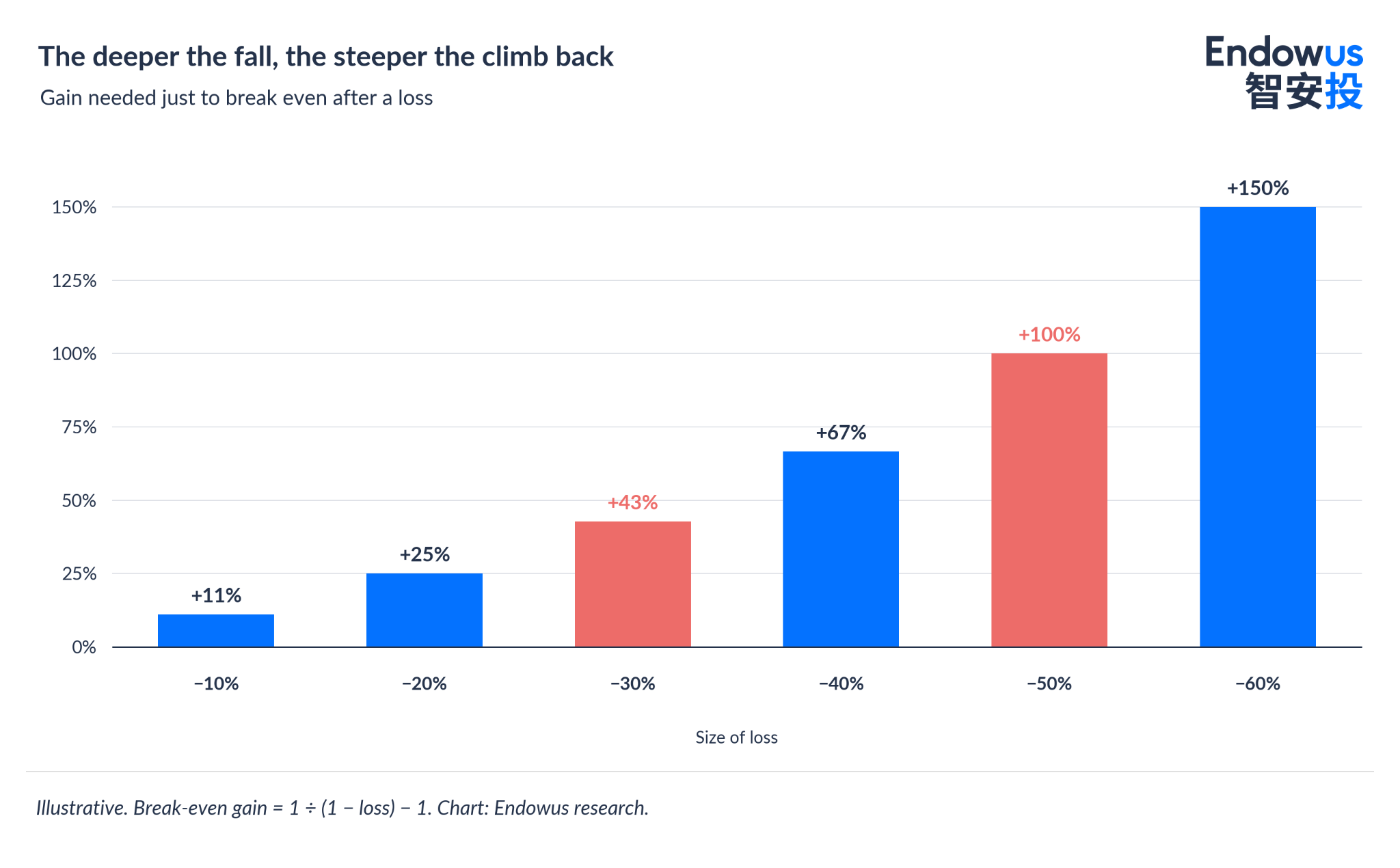
- Hedging is important because severe falls, while rarer than headlines imply, are harder to recover from: a 50% loss needs a 100% gain simply to break even.
- A portfolio matched to your true loss tolerance, diversified across assets that behave differently, and rebalanced on a schedule has historically provided most of the protection a long-term investor needs, at far lower cost than continuous insurance.
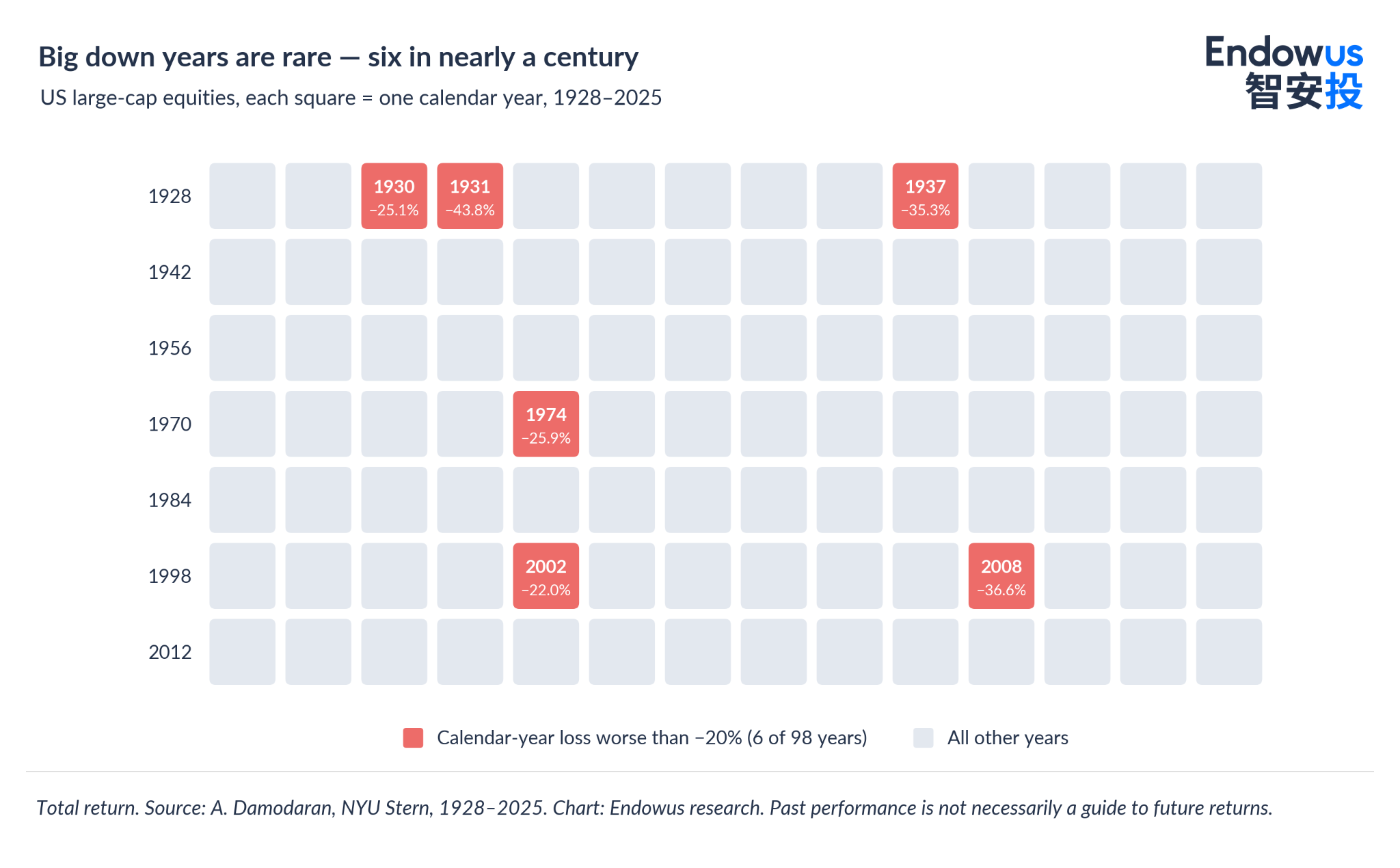
US large-cap equities have fallen by more than 20% in a single calendar year six times since 1928, and in each case the investors who fared best were the ones whose portfolios were built to absorb it.
The tools that put a portfolio in that position are known, collectively, as hedging. The word has acquired an intimidating reputation, bound up with derivatives and professional trading desks. In practice, most of what protects a long-term portfolio is simpler, cheaper, and already within reach of any investor.
This article looks at what hedging actually means, why protection matters even though severe falls are infrequent, what diversification can and cannot do, and the everyday tools most investors use to manage downside risk. We close with the narrower, options-based form of hedging (the subject of a companion, more complex piece) and where it fits.
What does hedging actually mean?
To hedge is to protect a portfolio from an adverse move in markets. It can mean constructing a portfolio whose mix of assets limits how far it can fall — assets with limited correlation with each other, assets that move in different directions in different market conditions. It can also mean buying a financial contract — most commonly a put option — that pays out when markets drop, in the way an insurance policy pays out after a loss.
Why does protection matter if big falls are rare?
Large losses are less frequent than a nervous news cycle suggests. US large-cap equities have posted a calendar-year loss worse than 20% six times since 1928 — about once every 16 years. For an investor with a 30-year horizon, the math is simple — it may happen twice. Past performance, however, is not an indicator of future returns or performance.
These episodes, however, may have a long-lasting impact on a portfolio. Losses and gains are asymmetric: a 30% fall requires a 43% gain to break even, and a 50% fall requires a 100% gain. The deeper the decline, the longer the potential climb back.
As an example, the worst single year on record, 1931, saw US large-cap equities fall about 44%. More recently, the 2008 loss of 37% took until 2012 to recover in full on a total-return basis — close to four and a half years with dividends reinvested (S&P Dow Jones Indices; recovery per Bloomberg data). Past performance is not necessarily a guide to future performance or returns.
For an investor that is still accumulating, time may repair most of this damage. But for one drawing on a portfolio in or near retirement, a deep fall at the wrong moment can be the difference between a plan that works and one that does not (something called sequence risk). That is why protection is worth thinking about in advance, rather than in the middle of a decline.
Diversification is also conditional, not guaranteed. In 2022, an inflation shock pushed high-quality bonds and equities down together: US Treasuries fell about 12.5% and the broad US bond market about 13%, alongside a falling stock market. The lesson is not that diversification fails, but that not all bonds are necessarily safe assets through every market downturn.
A final note on diversification: a diversified portfolio may partially protect you from the impact of an equity market downturn, but it is unlikely to totally insulate you from it, even if some of the assets have negative correlation with equities. That is because equity allocations are typically larger — especially in the accumulation phase — and this is a good thing. An excessively prudent allocation to equities may be good in drawdown years, but it prevents you from capturing the upside in the “good” years, which, according to the data shown above which refers to US equity markets, are typically the majority.
Does diversification protect me in a crisis?
Across normal conditions — most of any investing lifetime — holding assets that do not move together reduces volatility at no explicit cost. But in a severe crisis correlations rise and assets fall together: in 2008, equities, credit, and property declined in unison, and only a short list held up — high-quality government bonds, gold, and cash. The assets that did their job that year were a short list — high-quality government bonds, gold, and cash. US 10-year Treasuries returned about 20% and gold about 4%, while equities fell.
What are the everyday tools that do most of the work?
None of the following needs a trading account or a derivatives licence. Together, they account for most of the downside protection a long-term investor needs.
- Right-size your equity exposure. The most direct way to carry less risk is to hold less of the riskiest asset. Matching the share of equities to your time horizon and genuine loss tolerance does more than any overlay. But beware — being excessively prudent can also potentially lead to lost opportunities, especially at a younger age. So a truly honest assessment of your capacity and willingness to take risk is crucial.
- Hold a defensive sleeve. A portion in high-quality government bonds, and for some investors a small allocation to gold or cash, is the part of a portfolio designed to hold up in a crisis.
- Keep a liquidity buffer. Severe falls often coincide with a need for cash. An adequate cash reserve means you are not forced to sell at the bottom to meet a liability.
- Rebalance on a schedule. Trimming what has risen and topping up what has fallen is a disciplined, counter-cyclical habit that quietly sells high and buys low, and keeps risk from drifting upward unnoticed.
- Protect your behaviour. Over every rolling 20-year period in the historical record, US large-cap equities have delivered a positive total return in US-dollar terms. The largest avoidable risk in a severe fall is not the drawdown itself but the decision to sell at the bottom and miss the recovery. Past performance is not necessarily a guide to future performance or returns.
What is options hedging?
The tools above are sometimes called “natural” hedges: they protect by design rather than by contract. There is also an explicit form. An investor can buy a put option — the right to sell an asset at a set price — which behaves like an insurance policy, paying out when the market falls below that level.
It is precise and immediate, which makes it useful around a specific, short-dated risk, or for an investor who genuinely cannot tolerate a particular drawdown. But protection bought in the options market carries a recurring premium, and that cost compounds against a buy-and-hold investor over time. For most long-term portfolios, it is better understood as a specialist tool than a standing feature.
How option hedging works in detail — what the premium pays for, why it has historically cost more than it has returned, and when it earns its keep — is the subject of a companion article: “The price of protection: how option hedging works, and what it costs.”
Investment implications
Hedging is better understood as a property to build into a portfolio — which can or cannot translate into an additional asset purchase (for instance, as it happens with options). In our view, some level of protection for a long-term investor can be achieved through a portfolio that is well diversified, and that is rebalanced with discipline (because panic selling can do more damage than the market drawdown itself). Beyond that, there are specific tools that can help protect against a specific risk, but they are more complex and can be expensive, and are typically built for sophisticated investors.
On one hand, explicit hedges such as options offer exact, immediate cover and can protect against specific risks. On the other hand, that precision is rented at a price that can decrease returns for a long-term investor, while allocation, diversification, and rebalancing deliver much of the same protection at far lower cost. The goal is not to eliminate every fall (that is neither realistic nor necessary) but to ensure that when one arrives, both the portfolio and the investor can withstand it.
An Endowus adviser can help you set an allocation matched to your horizon and real tolerance for loss, so your portfolio is positioned before the next downturn rather than during it.
Frequently asked questions about hedging from Hong Kong
What does it mean to hedge a portfolio?
It means taking steps that limit the damage from a market fall — structural, such as holding a mix of assets that do not all fall together, or explicit, such as buying a put option that pays out when markets drop. For most long-term investors, the structural route does the bulk of the work.
Can Hong Kong investors protect a portfolio without using options?
Yes. Setting an equity allocation you can hold through a downturn, holding high-quality government bonds and cash, keeping a liquidity buffer, and rebalancing on a schedule provide most of the downside protection a long-term investor needs, with no premium to pay.
Can Hong Kong investors hedge with listed options?
Yes. HKEX lists options on the Hang Seng Index and other local benchmarks, including smaller “mini” contracts. An investor seeking protection would typically buy index put options rather than delta-hedge as a dealer does. There are limits, though. Each contract covers a fixed amount of index exposure, which may not match the size of a portfolio. And an index option protects only the holdings that track that index, so a globally diversified portfolio would be only partly covered. Buyers can lose the full premium they pay, and sellers can face losses well beyond the premium they receive.
Disclaimer
Risk Warnings
Investment involves risk. Past performance is not an indicator nor a guarantee of future performance or returns. Projected performance or returns is not guaranteed to materialise. The value of investments and the income from them can go down as well as up, and you may not get the full amount you invested. Rates of exchange may cause the value of investments to go up or down. Individual stock performance does not represent the return of a fund.
General risk warnings relating to collective investment schemes
Before making an investment decision, you are reminded to refer to the relevant prospectus/offering document for specific risk considerations and related fees and charges. Funds are not a bank deposit and not capital guaranteed, and are subject to investment risks, including the possible loss of the principal amount invested. Some of the funds also involve derivatives. Do not invest in them unless you fully understand and are willing to assume the risks associated with them.
Opinions
Any forward-looking statements, prediction, projection or forecast on the economy, stock market, bond market or economic trends of the markets contained in this material are subject to market influences and contingent upon matters outside the control of Endowus HK Limited (“Endowus”) and therefore may not be realised in the future. Further, any opinion or estimate is made on a general basis and subject to change without notice. In presenting the information above, none of Endowus HK Limited, its affiliates, directors, employees, representatives or agents have given any consideration to, nor have made any investigation of the objective, financial situation or particular need of any user, reader, any specific person or group of persons. Therefore, no representation is made as to the completeness and adequacy of the information to make an informed decision. You should carefully consider whether any investment views and products/services are appropriate in view of your investment experience, objectives, financial resources and relevant circumstances. You may also wish to seek financial advice through a financial advisor or the Endowus platform and independent legal, accounting, regulatory or tax advice, as appropriate.
No invitation or solicitation
Nothing contained in this article should be construed as a solicitation, an offer to buy or sell, or recommendation, to acquire or dispose of any security, commodity, investment or to engage in any other transaction in any jurisdiction in which such solicitation, offer to buy or sell would be unlawful under the securities laws in such jurisdiction. No information included in this article is to be construed as investment advice or as a recommendation or a representation about the suitability or appropriateness of any advisory product or service; or an offer to buy or sell, or the solicitation of an offer to buy or sell, any security, financial product, or instrument; or to participate in any particular trading strategy. Investors should seek independent financial and tax advice before making any investment decision.
Product Risk Rating: Please note that any product risk rating (the “PRR”) provided by us is an internal rating assigned based on our product risk assessment model, and is for your reference only. The PRR is subject to change from time to time. The PRR does not take into account your individual circumstances, objectives or needs and should not be regarded as advice or recommendation to purchase, hold or sell any fund or make any other investment decisions. Accordingly, you should not solely rely on the PRR in making your investment decision in the relevant Fund.
Endowus HK Limited (CE No.: BQR225) is licensed by the Securities and Futures Commission of Hong Kong.
This advertisement has not been reviewed by the Securities and Futures Commission or any regulatory authority in Hong Kong.


.png)