.webp)
.webp)
.webp)
.webp)





- In Hong Kong, the terms “unit trust” and “mutual fund” define two distinct legal architectures available for a pooled, SFC-authorised fund, held either through a trust with a trustee or a company with a board of directors. Despite these structural differences, both operate under the same regulatory and commercial frameworks.
- A Hong Kong fund investor pays an ongoing management fee, and part of that fee - the trailer commission - is paid to a distributor by the fund manager for as long as the money stays invested; whether that trailer is retained by the distributor or rebated to the investor may be the largest cost an investor can actually control.
- SFC authorisation means a fund’s offering documents have been vetted and the fund may be offered to the Hong Kong public — it is not an endorsement of the fund’s merits, a view on the manager, or any form of capital guarantee.
Most articles explaining unit trusts in Hong Kong are written by large banks. This is particularly relevant for how the fee structure is presented, and is the reason why we would like to also chime in.
Cost is a fundamental component of returns and a relevant slice of it is the trailer commission buried inside it, disclosed in the offering document and in the distributor’s required disclosure of monetary benefits, but rarely surfaced on a marketing page.
This article sets out what a unit trust is, what SFC authorisation does and does not mean, what an investor actually pays to hold one, how a unit trust compares with an exchange-traded fund for someone based in Hong Kong, and how to buy one.
What a unit trust is, and why Hong Kong calls it three different things
A unit trust is a pooled investment. Money from many investors is combined into a single portfolio, a professional manager runs it based on a stated mandate, and each investor owns units representing a share of the whole. The price of a unit is the fund’s net asset value (NAV): it is the total value of the portfolio divided by the number of units in issue, struck once a day after the market closes.
In Hong Kong, the words “unit trust” and “mutual fund” are typically used interchangeably, but they point to two distinct legal structures. A unit trust is constituted by a trust deed: an independent trustee holds the assets on behalf of investors, who are unitholders. A mutual fund corporation — including the open-ended fund company (OFC) structure Hong Kong introduced in 2018 — is a company with a board of directors, in which investors are shareholders and the company itself owns the assets. The Hong Kong Investment Funds Association sets the two side by side on exactly this basis: trust law and a trustee on one side, company law and a board on the other.
The distinction is under-served - it should be clarified, but for a retail holder it rarely changes the experience. Both structures can be SFC-authorised for public sale, both are priced on NAV, and in both the assets are held by an independent trustee or custodian, separate from the manager. The relevant protections operate the same way regardless of which label is on the document.
SFC authorisation: what it means, and what it does not
Before a fund may be marketed to the public in Hong Kong, the Securities and Futures Commission (SFC) must authorise it. Authorisation means the fund’s offering documents have been vetted for disclosure, and that the fund complies with the Code on Unit Trusts and Mutual Funds — a defined structure, investment limits, and ongoing disclosure obligations.
The SFC is explicit that authorisation is not a recommendation or endorsement of a product, that it does not guarantee the product’s commercial merits or its performance, and that it does not mean the product is suitable for any particular investor. The Investor and Financial Education Council puts the same point plainly: SFC authorisation does not guarantee a good return, and investing in an authorised fund does not free an investor from normal investment risk. The word is “authorised” rather than “approved” - as the latter would imply an endorsement.
What you actually pay: the full fee stack
A Hong Kong fund investor typically meets four layers of cost.
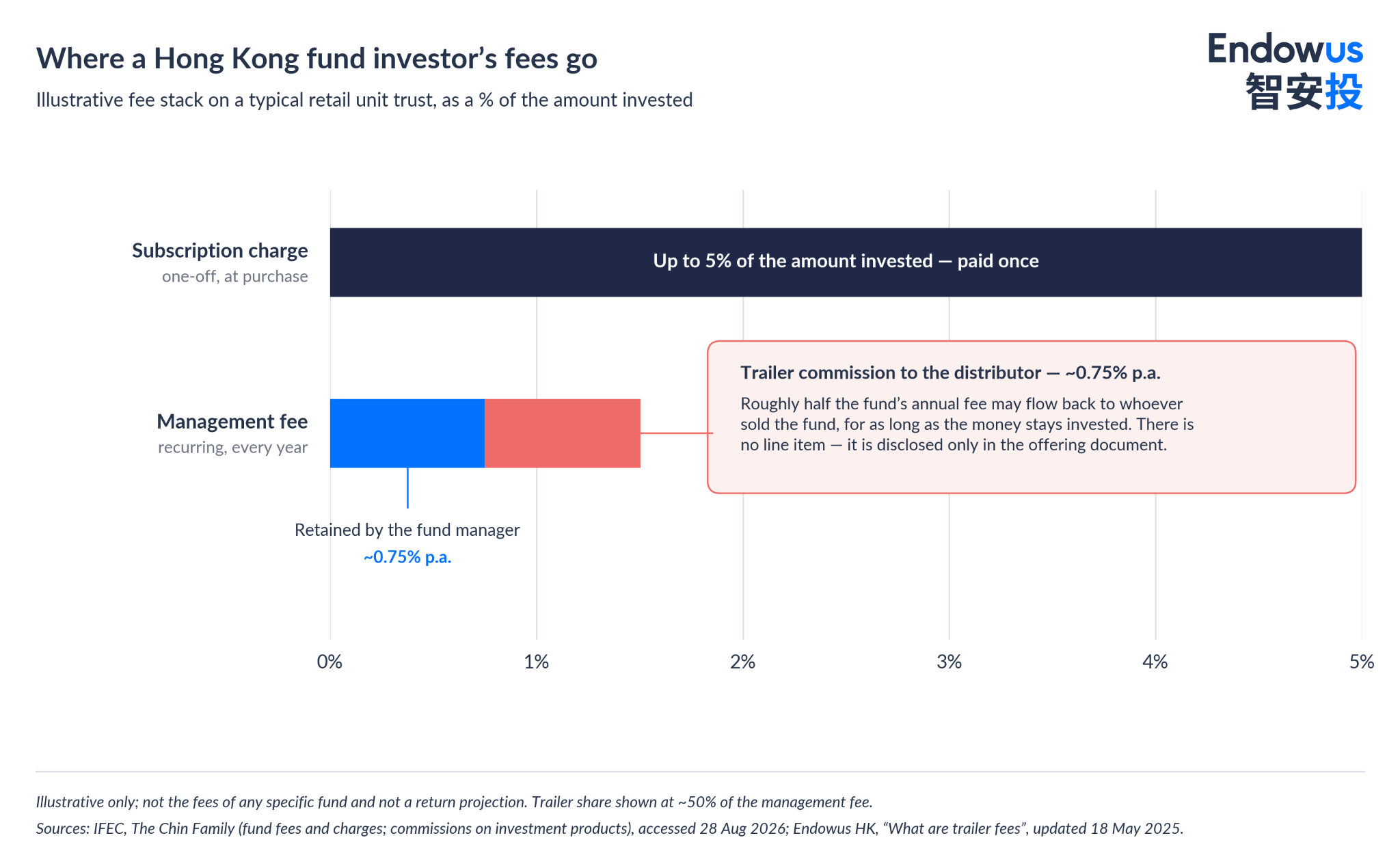
The first is the subscription or sales charge, a one-off fee deducted when money is first allocated by the end investor. IFEC’s own worked example uses a 5% front-load, and a 5% reference level still sits behind the discounts banks advertise.
The second is the ongoing management fee, charged by the fund every year as a percentage of assets. The third is trustee and administration cost, which is usually a small component of total costs. The fourth is the one that does not appear on marketing pages: the trailer commission, which is not a separate charge at all but a slice of the management fee that the fund manager pays back to whoever distributes the fund, for as long as the client stays invested.
IFEC’s illustration has a fund paying 60% of its annual management fee away as a trailer commission; our own account of the Hong Kong market notes that distributors are usually paid up to 60% of the fund’s management fee. The investor never sees a line item for it. It is disclosed in the offering document and SFC rules require distributors to disclose the maximum percentage of trailer commissions they may receive, but it never appears as a line item on an investor's statement.
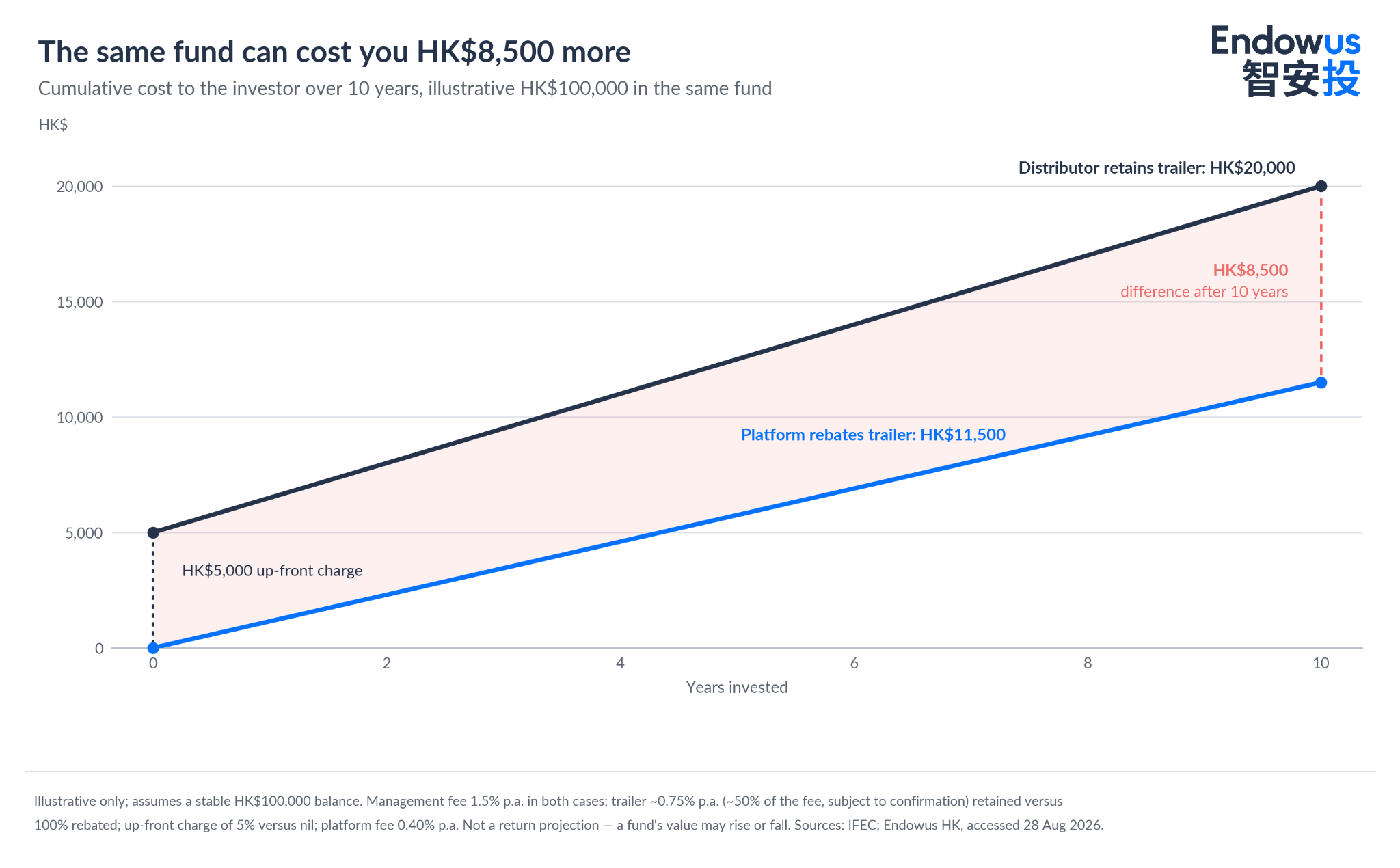
A visual may help understand the nature of the beast. The table below takes the same illustrative fund, held for 10 years, through a distributor that keeps the trailer and through a platform that rebates it. The fund’s own management fee is identical in both columns. The difference is who receives the trailer fee, and whether an upfront charge applies.
The mechanics of the trailer, and the Cashback mechanism by which a fee-only platform returns it, are set out in full on our dedicated trailer fees page.
Unit trusts versus ETFs, on the terms that matter in Hong Kong
The usual comparison between a unit trust and an exchange-traded fund (ETF) is articulated as “passive versus active” (as in, ETFs typically represent passive exposure while unit trusts can offer allocation to actively managed funds), but this is a simplification. The relevant features that vary between the two structures are currency, dealing, minimums, and access.
Hong Kong’s flagship broad-market trackers are increasingly dual-counter — the Hang Seng S&P 500 Index ETF lists an HKD counter (3195) alongside a USD counter (9195), and the ChinaAMC Nasdaq 100 ETF does the same (3086 and 9086). An HKD-based investor who buys the HKD counter with Hong Kong dollars pays no separate broker conversion. The so-called double-conversion cost is a function of the vehicle rather than of currency exposure as such: it arises when an HKD holder selects a USD-priced instrument — a US-listed ETF or the USD counter — that requires converting into US dollars on entry and back on exit. The underlying exposure is the same either way; the USD-priced route simply carries a different set of costs, of which conversion is one.
Where, then, is an ETF genuinely the better tool? It is a case-by-case decision, but broadly speaking, an investor who already holds US dollars, wants intraday liquidity, or wants low-cost exposure to a single broad index could consider a large US- or UCITS-listed ETF.
A unit trust may have additional advantages as it is a more flexible instrument - can be used for active exposure, specialist, or multi-asset, or where an investor contributes small HKD amounts each month — provided the trailer inside it is not quietly working against the return. Investors weighing a low-cost index route can compare it directly with our passive index collection and our guidance on how to invest in the S&P 500 from Hong Kong.
Both can be components of a diversified portfolio, and the Endowus Investment Office (IO) conducts their due diligence to select the funds available for clients on our platform. This is, incidentally, one of the advantages of our model, which is a hybrid of technology and human advice.
How to buy a unit trust in Hong Kong
You can buy a unit trust through a bank, an independent financial advisor, or an investment platform.
When it comes to banks, the fund typically sits inside a wider product shelf and the retail share class embeds the trailer commission. An insurer or independent financial adviser (IFA) often offers unit trusts through an investment-linked policy or advisory account, where charges vary and the trailer is also commonly retained. An investment platform, such as Endowus, decides whether to retain the trailer fee based on its commercial model.
The IFEC notes that a commission-based remuneration model may create potential conflicts of interest, as it may incentivise a distributor to recommend products based on the commissions they generate rather than solely on the client's interests. This is one reason the SFC requires distributors to disclose whether they are independent and the maximum trailer percentages they receive. A platform that rebates trailer fees in full removes that incentive at source, potentially realizing a full alignment of interests with the client.
Funds are sold in different share classes, and the cheaper institutional or “clean” classes, which do not carry a “trailer,” are generally not available to a direct retail purchaser. A platform’s best practice would be either to reach the institutional class where it exists, or to buy the retail class and rebate the trailer in full.
This goes beyond branding, and is truly a differentiating trait for a wealth platform. It is also an important component of the trust that is built between the platform and the clients.
Investment implications
Over a long horizon, the distribution model an investor chooses may matter more than most of the fund-selection decisions. As a matter of fact, as stated above, the distribution model may directly impact the fund-selection decisions by the distributor and, indirectly, the client.
Fees compound in the opposite direction as returns: every dollar of trailer retained by a distributor is a dollar that stops compounding for the investor, repeated annually for as long as the position is held.
An important element a Hong Kong fund investor can control is whether the trailer commission embedded in the fund works for the investor or for the seller.
Something worth noting is that this scrutiny does not remove risk: funds are not bank deposits and are not capital guaranteed, their value may fall as well as rise, and past performance is not necessarily a guide to future performance or returns.
On one hand, a fee-only platform that rebates 100% of trailer fees may materially improve net returns, and Endowus Fund Smart is built on exactly that basis — access to more than 400 SFC-authorised funds (as of August 2026) with trailers rebated and a single, stated platform fee. On the other hand, cost is one input among several: a fund’s mandate, an investor’s time horizon, and disciplined position sizing still decide the outcome. The right starting point is to be clear about which of those a given goal calls for, and then to make sure the cost of getting there is visible.
Frequently asked questions
What is a unit trust and how does it work?
A unit trust is a pooled fund: investors’ money is combined, a manager invests it against a set mandate, and each investor owns units priced at the fund’s net asset value, struck once a day. In Hong Kong such funds must be authorised by the SFC before they may be offered to the public.
What is the difference between a unit trust and a mutual fund?
They describe the same kind of product through two legal structures. A unit trust is a trust with an independent trustee holding the assets; a mutual fund corporation, including an open-ended fund company, is a company with a board of directors. For a retail holder the practical experience - NAV pricing, independent custody, SFC authorisation - is essentially the same.
What are unit trusts versus ETFs for a Hong Kong investor?
A unit trust deals once a day at NAV, can be bought in fractional HKD amounts, and reaches active and specialist strategies. An ETF trades intraday on-exchange in board lots. Currency matters most: an HKD-counter ETF needs no conversion, but a USD counter or a US-listed ETF adds an FX spread each way.
Is a unit trust a good investment?
That depends on factors specific to the fund and the investor rather than on the structure itself. Three things determine the outcome: the total cost of holding it — including any trailer commission — the investor’s time horizon, and the fund manager’s mandate and track record. All investments carry risk, and past performance is not necessarily a guide to future performance or returns.
What is a mutual fund?
A mutual fund is a pooled investment vehicle that gathers money from many investors and invests it in a diversified portfolio run by a professional manager. In Hong Kong the term is used interchangeably with “unit trust”, though strictly it refers to the corporate rather than the trust structure.
Disclaimer
Risk Warnings
Investment involves risk. Past performance is not an indicator nor a guarantee of future performance or returns. Projected performance or returns is not guaranteed to materialise. The value of investments and the income from them can go down as well as up, and you may not get the full amount you invested. Rates of exchange may cause the value of investments to go up or down. Individual stock performance does not represent the return of a fund.
General risk warnings relating to collective investment schemes
Before making an investment decision, you are reminded to refer to the relevant prospectus/offering document for specific risk considerations and related fees and charges. Funds are not a bank deposit and not capital guaranteed, and are subject to investment risks, including the possible loss of the principal amount invested. Some of the funds also involve derivatives. Do not invest in them unless you fully understand and are willing to assume the risks associated with them.
Opinions
Any forward-looking statements, prediction, projection or forecast on the economy, stock market, bond market or economic trends of the markets contained in this material are subject to market influences and contingent upon matters outside the control of Endowus HK Limited (“Endowus”) and therefore may not be realised in the future. Further, any opinion or estimate is made on a general basis and subject to change without notice. In presenting the information above, none of Endowus HK Limited, its affiliates, directors, employees, representatives or agents have given any consideration to, nor have made any investigation of the objective, financial situation or particular need of any user, reader, any specific person or group of persons. Therefore, no representation is made as to the completeness and adequacy of the information to make an informed decision. You should carefully consider whether any investment views and products/services are appropriate in view of your investment experience, objectives, financial resources and relevant circumstances. You may also wish to seek financial advice through a financial adviser or the Endowus platform and independent legal, accounting, regulatory or tax advice, as appropriate.
No invitation or solicitation
Nothing contained in this article should be construed as a solicitation, an offer to buy or sell, or recommendation, to acquire or dispose of any security, commodity, investment or to engage in any other transaction in any jurisdiction in which such solicitation, offer to buy or sell would be unlawful under the securities laws in such jurisdiction. No information included in this article is to be construed as investment advice or as a recommendation or a representation about the suitability or appropriateness of any advisory product or service; or an offer to buy or sell, or the solicitation of an offer to buy or sell, any security, financial product, or instrument; or to participate in any particular trading strategy. Investors should seek independent financial and tax advice before making any investment decision.
This advertisement has not been reviewed by the Securities and Futures Commission or any regulatory authority in Hong Kong.
Endowus HK Limited — CE No. BQR225, licensed for Type 1, Type 4, and Type 9 regulated activities.


.png)