.webp)
.webp)
.webp)
.webp)





.jpg)
"By periodically investing in an index fund, for example, the know-nothing investor can actually outperform most investment professionals."
– Warren Buffett, in Berkshire Hathaway shareholder letter in 1993
These are the wise words Warren Buffett wrote approximately 33 years ago in his letter to shareholders, on the topic of how retail investors should diversify.
Buffett advocated - and still does - that index-investing should be the appropriate one for retail investors. In his words, “...when an investor who does not understand the economics of specific businesses nevertheless believes it in his interest to be a long-term owner of American industry… that investor should both own a large number of equities and space out his purchases.”
Index investing, which involves tracking market indices rather than trying to beat them, has gained traction due to its simplicity and cost-effectiveness. It is often referred to as a passively-managed investment strategy.
Why choose unit trusts for passive index investing?
When it comes to index investing, the investment vehicle that comes to mind is typically exchange-traded funds (ETFs). But unit trusts and mutual funds can provide unique benefits for long-term investors that ETFs do not.
To begin with, the largest and most liquid ETFs are often priced in hard currencies, such as US dollars, which may not be the natural base currency for many investors. In order to invest in one of these ETFs, a Hong Kong investor would need to first convert their money into foreign currency (i.e. HKD to USD), thus incurring a conversion fee just to invest.
An additional fee would have to be paid upon redemption, when the investment proceeds is converted back to local currency. This double conversion when owning foreign-listed ETFs adds an additional layer of fees and administrative complexity, requiring extra time and effort to manage currency exposure. Unlike ETFs, unit trusts also have no bid-ask spread concerns, potentially resulting in lower overall costs. Finally, they may have lower tracking errors, which results in a closer mirroring of the index's performance.
What is tracking error?
Tracking error happens because indexes are theoretical. While replicating the index performances, managers of index funds and ETFs face challenges and frictions, such as transaction costs and timing differences, which can cause performance differences with the index. Asset managers work to minimise these frictions, but it is an additional issue investors need to be aware of.
Most importantly, most Hong Kong investors could be subject to a 30% dividend withholding tax on US-listed ETFs as there is currently no tax treaty between the US and Hong Kong.
Learn more: An inconvenient truth: Taxes on US-listed ETFs
How clients can adopt the passive investing strategy in their portfolios through Endowus
The Endowus Investment Office has curated our Passive Index Collection, which consists of funds that track various broad market indices, such as the S&P 500, the MSCI World, or the Bloomberg Global Aggregate Index.
By investing in these funds, clients can potentially enjoy instant diversification across multiple companies, sectors, and geographies. This helps reduce the risk associated with holding individual stocks.
Passive index collection: List of funds
Capturing the growth of the broader markets
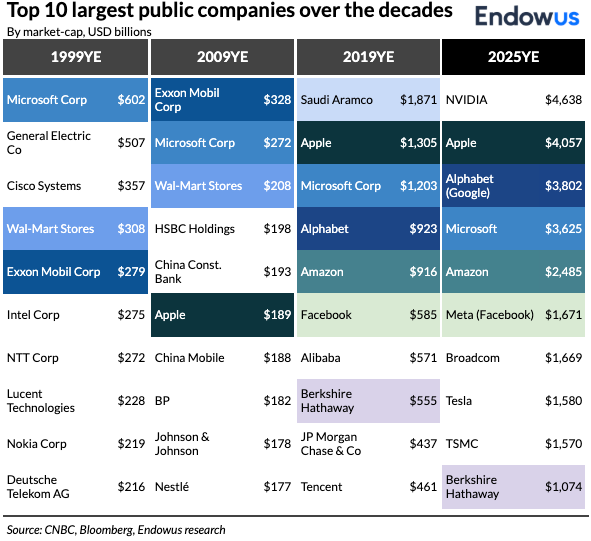
History proves that the world’s largest companies are unlikely to remain the largest. Even very well-known, big companies can be replaced within their industry by newcomers and disruptors.
Rather than buying and holding individual companies, buy-and-hold indices or broad-based strategies can capture the overall growth of a market or several markets.
Why invest passive index funds with Endowus?
Index funds tend to be rather straightforward, easy-to-own, and cost-effective investment products. Regardless, cost still matters a lot when comparing different investment vehicles and remains the best predictor of returns.
Endowus is one of the most cost-efficient ways to access mutual funds at zero subscription fees and switching costs. This is achieved through providing access to lower-cost institutional share class funds, which are not normally available to retail investors at other distributors, as well as rebating a 100% of trailer concessions back to our clients. Endowus clients can also access these same low fees when they transfer their mutual fund holdings from other financial institutions through transfers, with zero transfer fees.
As a result, we have helped our clients achieve an estimated US$50 million of cost savings per year. That can lower your investing expenses over time and can potentially allow you to pocket a larger share of your returns.
Click here to get started on Endowus today or check out our other curated fund offerings on Endowus Fund Smart.
Frequently asked questions
What is an index fund and how does it work?
Index funds are investment vehicles that track the performance of a specific market index, such as the S&P 500 or the MSCI World Index. The objective is to match the performance of the indices, rather than to outguess and beat the market, by replicating their broad market exposure.
Is index fund good for beginners?
Passive investing offers a stress-free yet scalable way to diversify your portfolio. By purchasing units in index funds, you can effectively own hundreds or even thousands of companies. For instance, the MSCI World Index comprises 1,429 constituents across 23 developed markets. This approach aligns with Buffett's wisdom, allowing you to space out purchases and benefit from long-term market growth without the need for extensive stock-picking expertise.
Are all index funds ETFs?
This is a big misconception that all ETFs are passively tracking the markets, while all mutual funds are actively managed. The truth is, that numerous ETFs are not indexed or traded actively, and many also track different sub-sectors of a single country’s market. At the same time, there are also unit trusts that are passive-indexed funds.
What should I note if I invest in passive indexes?
The weighting method of the index being tracked, the exposure of the underlying index, and tracking error and potential active risk in your “passive” index investment are the three things to know before adopting an index investing strategy.
Read more:
- ETF vs mutual fund — which is better?
- An inconvenient truth: Taxes on US-listed ETFs
- Why invest through Endowus
<divider><divider>
Risk Warnings
Investment involves risk. Past performance is not an indicator nor a guarantee of future performance or returns. Projected performance or returns is not guaranteed to materialise. The value of investments and the income from them can go down as well as up, and you may not get the full amount you invested.
Rates of exchange may cause the value of investments to go up or down. Individual stock performance does not represent the return of a fund.
General risk warnings relating to collective investment schemes
Before making an investment decision, you are reminded to refer to the relevant prospectus/ offering document for specific risk considerations and related fees and charges.
Funds are not a bank deposit and not capital guaranteed, and is subject to investment risks, including the possible loss of the principal amount invested.
Some of the funds also involve derivatives. Do not invest in them unless you fully understand and are willing to assume the risks associated with them.
Opinions
Any forward-looking statements, prediction, projection or forecast on the economy, stock market, bond market or economic trends of the markets contained in this material are subject to market influences and contingent upon matters outside the control of Endowus HK Limited (“Endowus”) and therefore may not be realised in the future. Further, any opinion or estimate is made on a general basis and subject to change without notice. In presenting the information above, none of Endowus HK Limited, its affiliates, directors, employees, representatives or agents have given any consideration to, nor have made any investigation of the objective, financial situation or particular need of any user, reader, any specific person or group of persons. Therefore, no representation is made as to the completeness and adequacy of the information to make an informed decision. You should carefully consider (i) whether any investment views and products/ services are appropriate in view of your investment experience, objectives, financial resources and relevant circumstances. You may also wish to seek financial advice through a financial advisor or the Endowus platform and independent legal, accounting, regulatory or tax advice, as appropriate.
No invitation or solicitation
Nothing contained [in this article] should be construed as a solicitation, an offer to buy or sale, or recommendation, to acquire or dispose of any security, commodity, investment or to engage in any other transaction in any jurisdiction in which such solicitation, offer to buy or sale would be unlawful under the securities laws in such jurisdiction. No information included [on this website/ in this article] is to be construed as investment advice or as a recommendation or a representation about the suitability or appropriateness of any advisory product or service; or an offer to buy or sell, or the solicitation of an offer to buy or sell, any security, financial product, or instrument; or to participate in any particular trading strategy. Investors should seek independent financial and tax advice before making any investment decision.
Product Risk Rating: Please note that any product risk rating (the “PRR”) provided by us is an internal rating assigned based on our product risk assessment model, and is for your reference only. The PRR is subject to change from time to time. The PRR does not take into account your individual circumstances, objectives or needs and should not be regarded as advice or recommendation to purchase, hold or sell any fund or make any other investment decisions. Accordingly, you should not solely rely on the PRR in making your investment decision in the relevant Fund.
Complex Products
Some of the funds contained in this article are complex products and investors should exercise caution when investing in these products. Though these products have been authorised by the SFC, authorization does not imply official recommendation. SFC authorization is not a recommendation or endorsement of a product nor does it guarantee the commercial merits of a product or its performance.
This advertisement has not been reviewed by the Securities and Futures Commission or any regulatory authority in Hong Kong.


.png)