.webp)
.webp)
.webp)
.webp)





The original version of this article first appeared in The Business Times.
America's national debt crossed US$40 trillion in August. Interest on that debt now costs more than the country’s entire defence budget. The 30-year Treasury yield touched 5.34 per cent on 18 August 2026, its highest level since 2007, and the curve has steepened as the front end remains anchored.
If you add the uncertainty and tension between a Fed biased towards hiking rather than cutting, oil that refuses to fall, core inflation stuck above 3 per cent, and a “new” America that treats allies as adversaries, you get this year’s most popular story: the US has finally borrowed too much, and the dollar will pay for it.
It is a compelling story. It is also mostly wrong. Here’s why.
The dollar that refuses to collapse
Currency seems to be where anxiety is the loudest, but it shouldn’t be. The dollar index sits at around 99 today. It traded above 109 in January 2025, fell hard through the spring of that year, and then did something the doomsayers did not expect: nothing. It has been range-bound for roughly 17 months. I showed this chart at the Endowus Wealth Summit two years running, and the reaction is always disbelief because the narrative had run so far ahead of the actual, underwhelming moves.
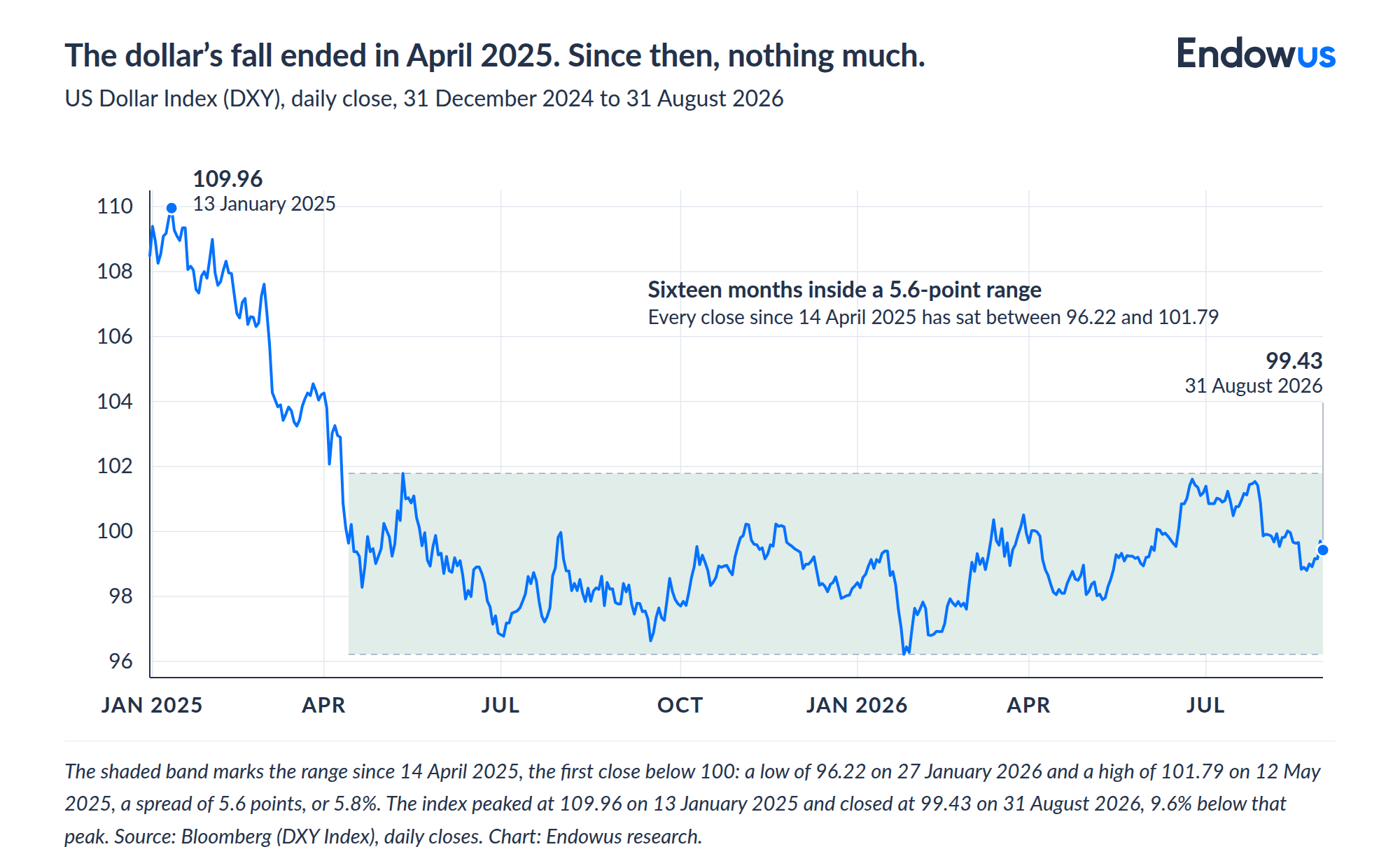
My former colleague Stephen Jen coined the term "dollar smile": the dollar strengthens in two extreme scenarios — when strong growth triggers inflation and higher rates, or when a crisis or geopolitical shock sends investors to it as a safe haven. In a normal environment, the dollar tends to weaken against a basket of currencies including the Euro, Japanese Yen, or Asian and emerging market currencies.
Textbook finance says a country paying 3.5 to 3.75 per cent, with a central bank more likely to hike than cut, should have a strengthening currency. The fact that the dollar is flat rather than surging shows the market is charging only a modest risk premium for fiscal and institutional uncertainty.
Debt is a balance sheet issue, not an income question
Almost every alarming chart you’ve seen compares government debt to GDP. But GDP is income. Debt-to-income tells you about the ability to service debt, and on that measure, the US is uncomfortable but not in crisis: net interest is around 3 per cent of GDP, a level last seen in the early 1990s, when nobody was writing the dollar's obituary.
To judge whether the absolute level of debt is dangerous, a lender looks at collateral, not income. For example, a private banking client with S$50 million of investments and property who borrows S$10 million against them is not a credit risk.
Look at the US the same way. The Federal Reserve's Financial Accounts, the closest thing to a national balance sheet, show total US non-financial debt of about US$81 trillion at the end of 2025: roughly US$34 trillion federal, US$21 trillion household and US$22 trillion business. Against that, American households alone hold US$184 trillion of net worth. Household debt relative to disposable income is near its lowest level since the late 1990s, and corporate America's current capital-investment boom is being funded largely from free cash flow, not debt.
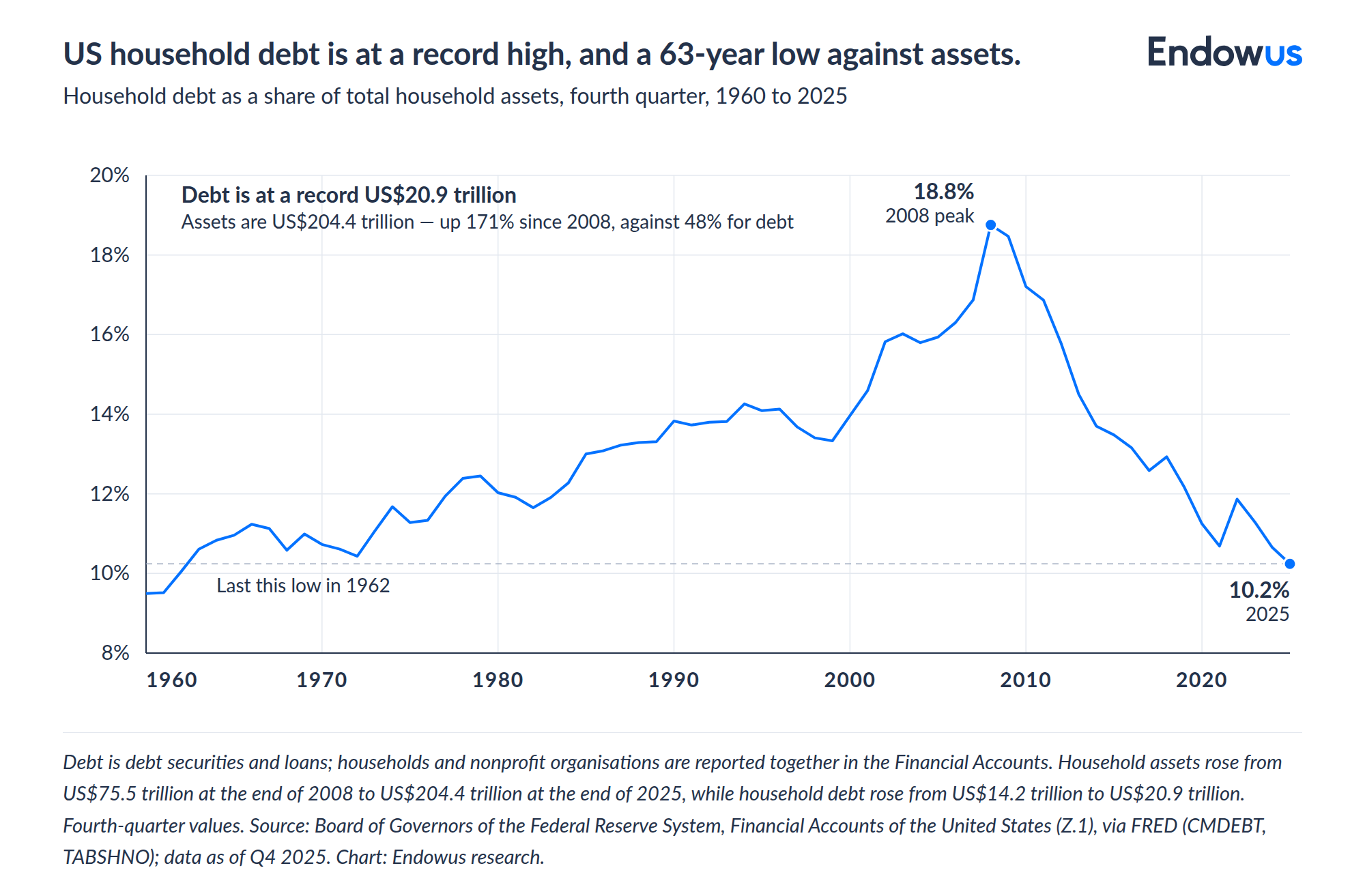
The debt problem, in other words, sits on the government balance sheet inside a very rich country. That is a governance and political problem, not a solvency one, which is why treasuries remain the deepest and most liquid market on earth, despite the fact that foreign government holders are diversifying by rotating from long bonds into bills, other government bonds, and gold.
In fact, this is one of the loudest claims out there, that foreign claims on US assets, especially treasuries, are dangerously high. What if everybody pulls their money? But why would they? What incentive is there for the US economy to collapse or the government to stall? The largest global economy - the largest financial markets falling hurts growth, financial returns, and financial stability for the rest of the world, and it’s a risk not even China would be willing to take.
China, once the largest holder of US Treasuries held US$1.32 trillion at its peak in November 2013. Its holdings have since more than halved, to US$633.4 billion as of June 2026. If you look at broader trends, 14 of the top 20 countries holding US Treasuries actually increased their ownership in the past one year versus six that reduced them, and the total amount held by foreign governments increased by US$205 billion to US$9.3 trillion. The foreign selling narrative is overblown.
What the evidence says about "something has to give"
Every sophisticated investor I speak to says the same thing: with both ends of the curve under pressure, something has to give. They may be right. But behavioural finance has a name for what happens next. Predictions of the American debt crisis have been made continuously since the debt was US$50 billion in the 1940s. Each time the number got bigger, the warning got louder, and each time the prediction failed, because a sovereign that borrows in its own currency, backed by the world's largest pool of wealth, does not fail on a schedule.
Recency bias makes us extrapolate a weak spring for the dollar into a decade of decline. Availability bias makes the US$40 trillion headline feel like a cliff edge rather than an important marker on a very long trajectory.
Three decades of investing have taught me that the most expensive mistake is not being wrong about a forecast. It is repositioning an entire portfolio around one. Investors who dumped dollar assets in April 2025 missed a 40 per cent rally in US equities.
Much ado about nothing?
You should still keep your equity exposure global, while including the American companies whose earnings are the reason the US is still a valuable asset and why the dollar has not collapsed. Treat gold and alternative currencies as diversifiers, not as a verdict on America, political or economic. And if tempted to make a big directional call on the dollar, remember you’d be betting against the most liquid, most efficient market in the world.
A good fiduciary advisor does not tell you where the dollar is going. It helps to size your exposures so that you do not need to know where it is headed. The US is not a household drowning in credit-card debt. It is a rich man borrowing against his assets. The question for the lender was never how much they owe. It was always what they own.
Disclaimer
Risk Warnings
Investment involves risk. Past performance is not an indicator nor a guarantee of future performance. The value of investments and the income from them can go down as well as up, and you may not get the full amount you invested. Rates of exchange may cause the value of investments to go up or down.
This article is not intended to be relied upon as a forecast or research or investment advice, and should not form the basis of any investment or other decisions. The information contained herein is not intended, and should not be construed, as any legal, tax, regulatory, accounting or financial advice. If you would like investment, accounting, tax or legal advice, you should consult with your own professional advisors regarding your individual circumstances and needs.
The information in this article may not be suitable for all investors. You are responsible for any action that you take or decision that you make in reliance on any content in this article, and you agree that Endowus HK Limited (“Endowus”) is not liable under any circumstances.
No invitation or solicitation
Neither the information, nor any opinion, contained in this article constitutes a recommendation, offer or solicitation by Endowus or its affiliates to you to buy or sell any securities, collective investment schemes or other financial instruments or services, nor shall any such security, collective investment scheme, or other financial instruments or services be offered or sold to any person in any jurisdiction in which such offer, solicitation, purchase, or sale would be unlawful under the securities laws of such jurisdiction.
This is not intended to be an invitation or offer made to the public to subscribe for any financial product or to enter into any transaction.
Accuracy of Information
Whilst Endowus has made reasonable efforts to provide accurate and timely information, there may be inadvertent delays, omissions, technical or factual inaccuracies or errors in any such information. Endowus does not warrant or represent that the information in this article is correct, accurate or reliable.
Opinions
Any opinion or estimate above is made on a general basis and none of Endowus, nor any of its affiliates, representatives or agents have given any consideration to nor have made any investigation of the objective, financial situation or particular need of any user, reader, any specific person or group of persons. Opinions expressed herein are subject to change without notice.
Any forward-looking statements, prediction, projection or forecast on the economy, stock market, bond market or economic trends of the markets contained in this article are subject to market influences and contingent upon matters outside the control of Endowus and therefore may not be realised in the future.
In presenting the information above, none of Endowus, its affiliates, directors, employees, representatives or agents have given any consideration to, nor have made any investigation of the objective, financial situation or particular need of any user, reader, any specific person or group of persons. Therefore, no representation is made as to the completeness and adequacy of the information to make an informed decision. You should carefully consider whether any investment views and products/ services are appropriate in view of your investment experience, objectives, financial resources and relevant circumstances.
This article has not been reviewed by the Securities and Futures Commission of Hong Kong.


.png)