.webp)
.webp)
.webp)
.webp)





.jpg)
- Exploring alternative investments outside traditional public markets provides institutional avenues to enhance portfolio diversification across non-traditional asset classes.
- Mastering specialised industry terminology from absolute return to private credit allows investors to evaluate complex market opportunities with clarity.
- Use this evolving glossary framework to build an analytical foundation to navigate private market investment structures effectively over time.
Alternative investments encompass asset classes and financial strategies outside public equities and fixed income. This simple A to Z glossary can help investors better understand the space.
For more information on alternative investments and Endowus Private Wealth, contact us for a consultation. To get started with Endowus, click here.
A to F—absolute return, alpha, dry powder, fund-level fee
Absolute return
Absolute return refers to the price gain or loss that an asset or portfolio achieves over a specific period. Performance is evaluated on an isolated basis without comparison to a benchmark or peer group. An absolute return strategy focuses on delivering consistent returns with lower volatility across different market environments.
Active management
Active management is an investing strategy where a fund manager chooses which assets to buy, hold, or sell to outperform a market index or benchmark. Besides seeking to beat the benchmark, active managers may also structure portfolios to manage risks, lower tax impacts, or achieve any other additional goals. This strategy is not unique to alternative assets.
Alternative investments
Alternative investments, often called "alts", refer to asset classes outside traditional public equity and fixed-income. The alternative space spans hedge funds, private equity, private credit and real assets. These strategies may also utilise less traditional mechanisms like short positions or structured leverage, and are typically restricted to professional investors.
Alpha
Alpha measures the fund’s return that cannot be explained by its beta (read below about beta). Frequently used as a gauge of investment performance, it quantifies the value a fund manager adds or subtracts relative to broader market movements.
Beta
Beta measures the responsiveness of a stock or fund’s valuation to changes in the overall stock market. If an index’s excess return above the risk-free rate is 1%, an asset with a beta of 1.4 would have an excess return (above the risk-free rate) of 1.4%.
To understand how macro shifts impact portfolio risk, read our deep dive on Geopolitics and long-term investing.
Buyout
A buyout involves purchasing a controlling interest, exceeding 50% of shares, in a company. Buyout strategies typically focus on improving the business operationally, meaning capital gains may potentially be realised when the enterprise is later sold at a premium.
Dry powder
Dry powder refers to unutilised cash reserves or liquid assets held on hand and available for deployment. In private equity and venture capital, this denotes capital committed by investors that has not yet been allocated to underlying investments.
Endowus Private Wealth
Endowus Private Wealth (EPW) provides clients investing a minimum of HK$8 million in assets with access to tailored institutional product suites. Working alongside a dedicated private wealth advisor, clients can establish a customised wealth implementation plan—the Endowus Wealth Implementation Plan (WIP)—tailored to their specific financial situation and needs.
Family office
A family office is an entity that centralises the financial management and wealth planning of wealthy individuals. Portfolios run by single-family or multi-family offices are typically geared toward the specific requirements of their principals.
Fund-level fee, or total expense ratio
The fund-level fee, or total expense ratio (TER), represents the annual cost charged by a manager for operating an investment fund, such as a unit trust. Calculated by dividing the total cost of the fund by its total assets, the TER is expressed as a percentage of the fund’s net asset value (NAV). Endowus seeks to optimise net returns by accessing lower-fee institutional share classes and rebating 100% of trailer fees as cashback to clients.
For more information on our transparent fees, click here.
Fund of funds
A fund of funds (FOF), also known as a multi-manager investment, is a vehicle that holds a portfolio of underlying funds rather than purchasing direct stocks, bonds, or other securities. Designed to achieve broader diversification and operational efficiency, an FOF can be legally structured as a unit trust, an open-ended fund company (OFC), or a limited partnership fund (LPF), spanning strategies from traditional retail funds to hedge funds and private equity.
Fund Smart
The Endowus Fund Smart platform is a curated list of best-in-class funds at the lowest possible cost across asset classes, geographies, and sectors, managed by top global fund managers. The funds are carefully selected by the Endowus Investment Office through a proprietary, institutional-grade screening process.
On Fund Smart, investors can customise their own portfolios of one or more unit trusts (also known as mutual funds) in just a few clicks.
Fundamental analysis
Fundamental analysis is a method used to determine the intrinsic value of an asset by examining operational metrics, financial statements, management quality, and market competition. This methodology aims to identify potential dislocations between the company’s real value and its current market price.
G to M—hedge funds, J curve, liquid alts, market neutral
General partners
General partners are the entities or firms legally responsible for the overall management, administration, and day-to-day operations of a fund partnership.
Hedge fund
A hedge fund pools investor capital to generate positive returns, similar to a unit trust. However, hedge funds operate under a relatively more flexible regulatory framework, giving them broad latitude to execute long/short, derivative, and leveraged strategies.
Illiquid alternatives
Illiquid alternative investments are assets that cannot be quickly converted into cash or easily traded. These strategies, including private equity, venture capital, and real assets, may require longer investment horizons. While these allocations may offer a liquidity premium and higher potential returns, they also typically carry more elevated risks and experience structural capital lock-ups before redemptions can be executed.
See also: Private infrastructure
Individual professional investor
An individual professional investor (IPI) is a regulatory classification under Securities and Futures Commission (SFC) guidelines for individuals who maintain a portfolio of at least HK$8 million and choose to opt in. These investors are eligible to access a broader suite of institutional allocations than traditional retail investors. They are assessed to possess the financial capacity and experience to navigate the risks of sophisticated financial strategies.
Infrastructure
Infrastructure refers to essential public and private networks necessary for an economy to function, such as utilities, transport systems, and healthcare facilities. Allocations into infrastructure can be executed through either debt or equity instruments.
Institutional professional investor
Institutional professional investors are organisations such as banks, insurance firms, and pension funds that leverage large pools of capital to negotiate lower fees and access specialised products. Fund managers often create specific institutional share classes that feature lower fees and higher minimum investment amounts.
Endowus minimises fund-level fees by working with fund managers to access their lower-fee share classes, alongside its industry-first practice of rebating 100% cashback on trailer fees to clients. For more information on our transparent fees, click here.
J curve
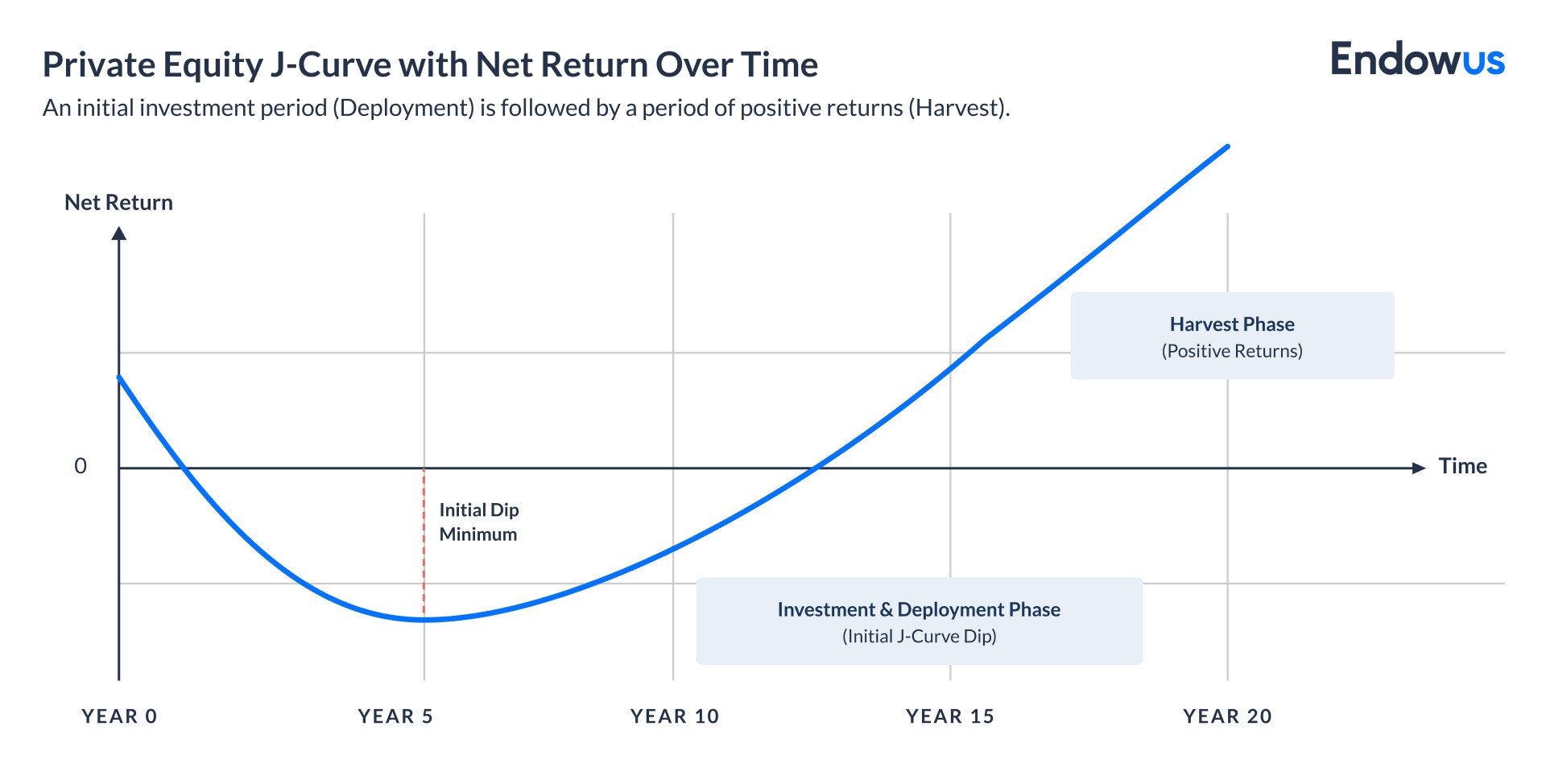
The J curve illustrates the multi-year cash flow and performance trajectory of private equity funds from deployment to harvest. The timeline is shaped like the letter "J" because early-stage deployment, management fees, and startup costs may produce initial negative returns, which are structurally designed to be followed by capital gains in later years as underlying assets grow in value.
Leveraged loan
A leveraged loan is a debt instrument extended to a corporate borrower that carries a heavy debt load or a poor credit history. Because leveraged loans carry a higher risk of default, they command higher interest rates than traditional loans to compensate for the credit risk.
Limited partners
Limited partners (LPs) are the investors who commit capital to a private equity fund or limited partnership structure. LPs contribute to the fund's capital pool but do not participate in its day-to-day operational management.
Liquid alternatives
Liquid alternative investments are vehicles designed to provide the same core strategies as traditional alternative investments but with relatively higher liquidity. Featuring lower investment minimums and regular redemption terms, these structures make alternative exposures more accessible to investors who may face capital or liquidity constraints in private markets.
Liquidity
Liquidity describes the ease and efficiency with which an asset or security can be converted into cash without incurring substantial fees, penalties, or valuation loss.
Liquidity risk
Liquidity risk represents the probability that investors may face constraints or penalties when trying to buy or sell their securities exactly when desired. Alternative assets are inherently thinly traded and relatively illiquid.
Market neutral
A market-neutral strategy seeks to deliver returns independent of the broader market environment by avoiding specific directional risks. This is typically managed by balancing matching long and short positions within equivalent dollar values, meaning performance is driven primarily by manager skill in selecting individual stocks or other exposures. Achieving zero market correlation—true market neutrality—remains subject to changing market conditions.
N to P—private credit, private real estate, performance fee
Natural resources
Natural resources encompass tangible commodities and physical materials across core sectors such as energy, metals and mining, agriculture, timber, and water. Allocations to this asset class are often structured as a strategic blend of private equity and infrastructure principles.
Net asset value
The net asset value (NAV) represents the per-share value of a fund, calculated by deducting total liabilities from total assets and dividing the remainder by the number of outstanding shares. This metric is standard for determining the daily pricing of unit trusts and exchange-traded funds (ETFs).
Open-end vs closed-end
Fund vehicles generally operate under two distinct structural formats:
- Open-end funds can continuously issue and redeem shares based on investor demand and capital inflows, a structure utilised by most hedge funds and unit trusts.
- Closed-end funds only issue a fixed number of shares once via an initial offering, without creating new shares to meet secondary market demand, and typically restrict structural redemptions prior to a defined maturity date.
Passive management
Passive management, or index investing, is a strategy where a fund structures its portfolio to replicate the performance of a specific market index or benchmark. Rather than tactically altering asset allocations based on economic indicators or attempting to identify mispriced securities, passive managers focus on minimising the tracking error relative to the target index.
Performance fee
A performance fee is an additional cost designed to align manager incentives with strong fund performance. Calculated as a percentage of fund returns above a specific hurdle rate, these fees typically include a high-water mark provision, meaning a performance fee may only be charged on new net profits after prior losses are fully recouped.
Private credit
Private credit refers to debt financing provided directly by non-bank investors, outside of public debt markets, to a range of borrowers including corporations, real estate, and infrastructure projects. It encompasses strategies such as direct lending, asset-based lending, mezzanine financing, distressed debt, and real estate or infrastructure debt.
Private equity
Private equity, or PE, refers to direct equity ownership or shares in corporate enterprises that are not publicly traded on any stock exchange or over-the-counter (OTC) market. Shares cannot be freely bought and sold - transactions require finding a willing counterparty directly, are typically infrequent, and are governed by shareholder agreements rather than exchange rules. Because there is no continuous market price, valuation is determined periodically by the company or its investors rather than by real-time supply and demand.
Private markets
Private markets include assets that are not publicly traded, such as private equity and private credit and real assets.
Private real estate
Private real estate involves the direct or indirect ownership of real property outside public markets, often executed through private investment. While the terms private real estate (PRE) and private equity real estate (PERE) are frequently used interchangeably, some industry frameworks define PERE more narrowly as investments made explicitly through private equity fund structures.
Public markets
Public markets are highly regulated markets where investors buy and sell traditional assets—including equities, fixed income, currencies, and standardised derivatives—either on formal exchanges, such as the New York Stock Exchange (NYSE), or liquid over-the-counter (OTC) networks. These markets are typically characterised by transparency, price discovery, regulatory oversight, and relatively high liquidity compared to private markets.
See also: ETFs vs mutual funds
Q to Z—qualitative investing, relative return, venture capital
Qualitative investing
Qualitative investing focuses on evaluating the subjective, non-numerical factors of an investment opportunity. This methodology examines elements such as a company's management team, brand strength, competitive positioning, and broader market trends, rather than relying solely on quantitative data.
Quantitative investing
Quantitative investing, or quant investing, uses statistical and mathematical models to understand the behaviour of assets, identify investment opportunities, and execute systematic trades. In a quant fund, securities are selected based on numerical data through algorithmic trading technology and advanced quantitative models, rather than relying on human discretion and judgement. These systems may evaluate a wide variety of trading signals, ranging from real-time company news and global asset values to macroeconomic data points.
Real assets
Real assets are long-term investments in physical, tangible properties, such as buildings, pipelines, or timber. This alternative asset class encompasses sectors like real estate, infrastructure, and commodities such as gold or oil.
Relative return
Relative return defines the net difference between a portfolio’s absolute performance over a specific period and the return of its target benchmark. Funds run on this basis focus on outperforming a chosen benchmark.
Secondaries
Secondaries involve trading existing investment holdings, typically less liquid positions such as shares of private equity, venture capital, or real estate funds.
Thematic investing
Thematic or megatrends investing is an approach that focuses on predicted long-term trends instead of specific sectors or companies. Examples of such future-driven themes are artificial intelligence, clean energy, healthcare, and the subscription economy.
Venture capital
Venture capital (VC) refers to allocations typically targeted at early-stage, pre-profit startups. VC managers typically accept minority equity stakes and elevated risks in exchange for high upside growth potential. This contrasts with traditional private equity investments, which generally target larger, more mature companies with a proven financial record and often involve acquiring majority stakes.
For more information on alternative investments and Endowus Private Wealth, please contact us for a consultation.
To get started with Endowus as a retail investor, click here.
<divider><divider>
Risk Warnings
Investment involves risk. Past performance is not an indicator nor a guarantee of future performance. The value of investments and the income from them can go down as well as up, and you may not get the full amount you invested. Rates of exchange may cause the value of investments to go up or down.
This article is not intended to be relied upon as a forecast or research or investment advice, and should not form the basis of any investment or other decisions. The information contained herein is not intended, and should not be construed, as any legal, tax, regulatory, accounting or financial advice. If you would like investment, accounting, tax or legal advice, you should consult with your own professional advisors regarding your individual circumstances and needs.
The information in this article may not be suitable for all investors. You are responsible for any action that you take or decision that you make in reliance on any content in this article, and you agree that Endowus HK Limited ("Endowus") is not liable under any circumstances.
No invitation or solicitation
Neither the information, nor any opinion, contained in this article constitutes a recommendation, offer or solicitation by Endowus or its affiliates to you to buy or sell any securities, collective investment schemes or other financial instruments or services, nor shall any such security, collective investment scheme, or other financial instruments or services be offered or sold to any person in any jurisdiction in which such offer, solicitation, purchase, or sale would be unlawful under the securities laws of such jurisdiction.
This is not intended to be an invitation or offer made to the public to subscribe for any financial product or to enter into any transaction.
Accuracy of Information
Whilst Endowus has made reasonable efforts to provide accurate and timely information, there may be inadvertent delays, omissions, technical or factual inaccuracies or errors in any such information. Endowus does not warrant or represent that the information in this article is correct, accurate or reliable.
Opinions
Any opinion or estimate above is made on a general basis and none of Endowus, nor any of its affiliates, representatives or agents have given any consideration to nor have made any investigation of the objective, financial situation or particular need of any user, reader, any specific person or group of persons. Opinions expressed herein are subject to change without notice.
Any forward-looking statements, prediction, projection or forecast on the economy, stock market, bond market or economic trends of the markets contained in this article are subject to market influences and contingent upon matters outside the control of Endowus and therefore may not be realised in the future.
In presenting the information above, none of Endowus, its affiliates, directors, employees, representatives or agents have given any consideration to, nor have made any investigation of the objective, financial situation or particular need of any user, reader, any specific person or group of persons. Therefore, no representation is made as to the completeness and adequacy of the information to make an informed decision. You should carefully consider whether any investment views and products/ services are appropriate in view of your investment experience, objectives, financial resources and relevant circumstances.
This article has not been reviewed by the Securities and Futures Commission of Hong Kong.


.png)