- MPF members cannot buy exchange-traded funds (ETFs) directly; but members may be able to invest in Constituent Funds through their MPF scheme that invest into the same pooled index vehicles (including ETFs) that retail investors use on the open market.
- Index-tracking funds aim to track a market index rather than beat it, which typically keeps their fees below those of actively managed funds — and across decades of contributions, fees compound and have a potentially meaningful impact on accumulation.
- Reviewing whether low-cost index funds or the Default Investment Strategy suit your horizon and risk profile is a practical step, but lower fees do not guarantee higher returns, and index funds still carry full market risk.
Exchange-traded funds (ETFs) have become a widely used, low-cost route to diversified investing: a single trade can buy exposure to an entire market index. Members of Hong Kong's Mandatory Provident Fund (MPF) cannot buy them directly, but the index-tracking constituent funds within MPF can.
Several of these funds gain their broadly diversified exposure by investing into pooled index vehicles, including ETFs, similar to the ones retail investors buy on the open market.
This article explains why MPF members cannot hold ETFs directly, how index-tracking MPF funds work and where they connect to ETFs, what the fee difference means over a career, and how to identify these funds within your own scheme.
Why can't you buy ETFs directly in your MPF?
The MPF is a statutory, employment-based retirement savings system overseen by the Mandatory Provident Fund Schemes Authority (MPFA), built around pooled investment funds.
Each member belongs to a scheme run by an approved trustee. Within that scheme, the member selects from a menu of constituent funds — equity funds, bond funds, mixed-asset funds, money market funds, and index-tracking funds, among others.
A member directs contributions into these funds but does not place trades in individual shares or ETFs. That’s because ETFs trade on an exchange like shares, whereas MPF contributions flow into Constituent Funds that are available within a member's MPF scheme.
However, the Constituent Fund can decide what it invests in, and that includes ETFs.
How do index-tracking MPF funds actually work?
An index-tracking fund sets out to replicate the performance of a market index - a local benchmark such as the Hang Seng Index, or the S&P 500, or a global benchmark such as MSCI World - rather than to outperform it. Instead of paying a team to research and select stocks, the fund holds the index's constituents in their index proportions, which limits the amount of expenses needed to run the fund.
Many MPF index funds do not assemble those holdings themselves. MPFA rules allow a constituent fund to invest into an approved Index-Tracking Collective Investment Scheme (ITCIS) — a category that includes qualifying ETFs and index funds. The Tracker Fund of Hong Kong, an ETF that tracks the Hang Seng Index, is one example of a vehicle an MPF index fund may hold.
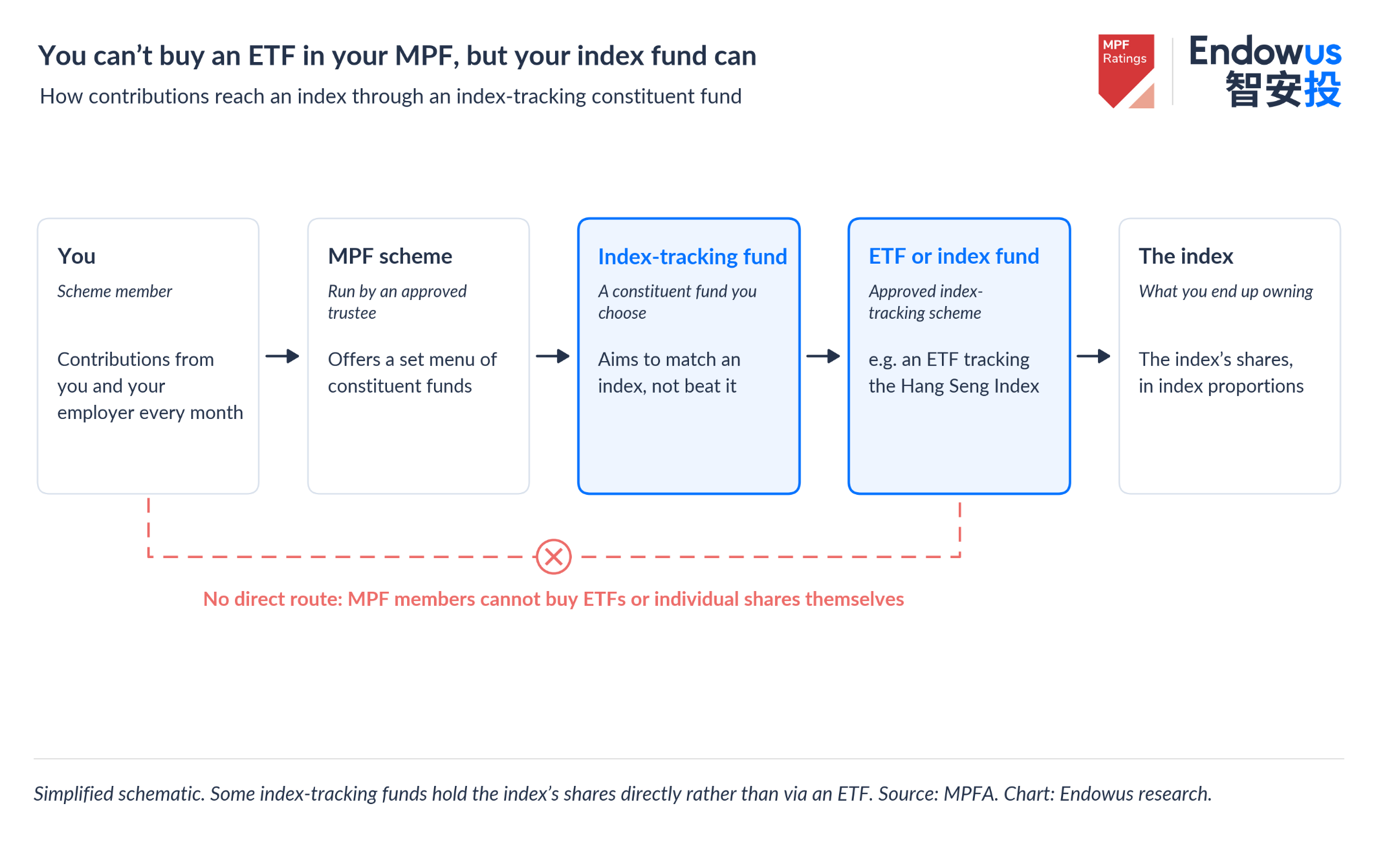
So the connection to ETFs is indirect, but it exists nevertheless. You cannot buy the ETF, but an MPF Constituent Fund may hold it.
What does the fee difference mean for your retirement?
Investors should always be aware of fees, as they are the only element that is known in advance (returns are not). They are often underestimated as a driver of investment decisions, but they are a key component of returns.
Every MPF fund reports a Fund Expense Ratio (FER), which captures its annual running costs as a percentage of assets.
Actively managed funds generally carry higher FERs than index-tracking funds, reflecting the potential additional cost of research and more frequent trading. The Default Investment Strategy (DIS), the standardised option that applies when a member makes no selection, is fee-capped by law, with management fees limited to 0.75% and recurring out-of-pocket ones at a further 0.2% of net asset value per year.
Small differences compound. A fee gap of a fraction of a percentage point, applied each year to an invested balance over three or four decades, can translate into a materially different final sum. This is an advantage that low-cost index funds can offer a long-term contributor.
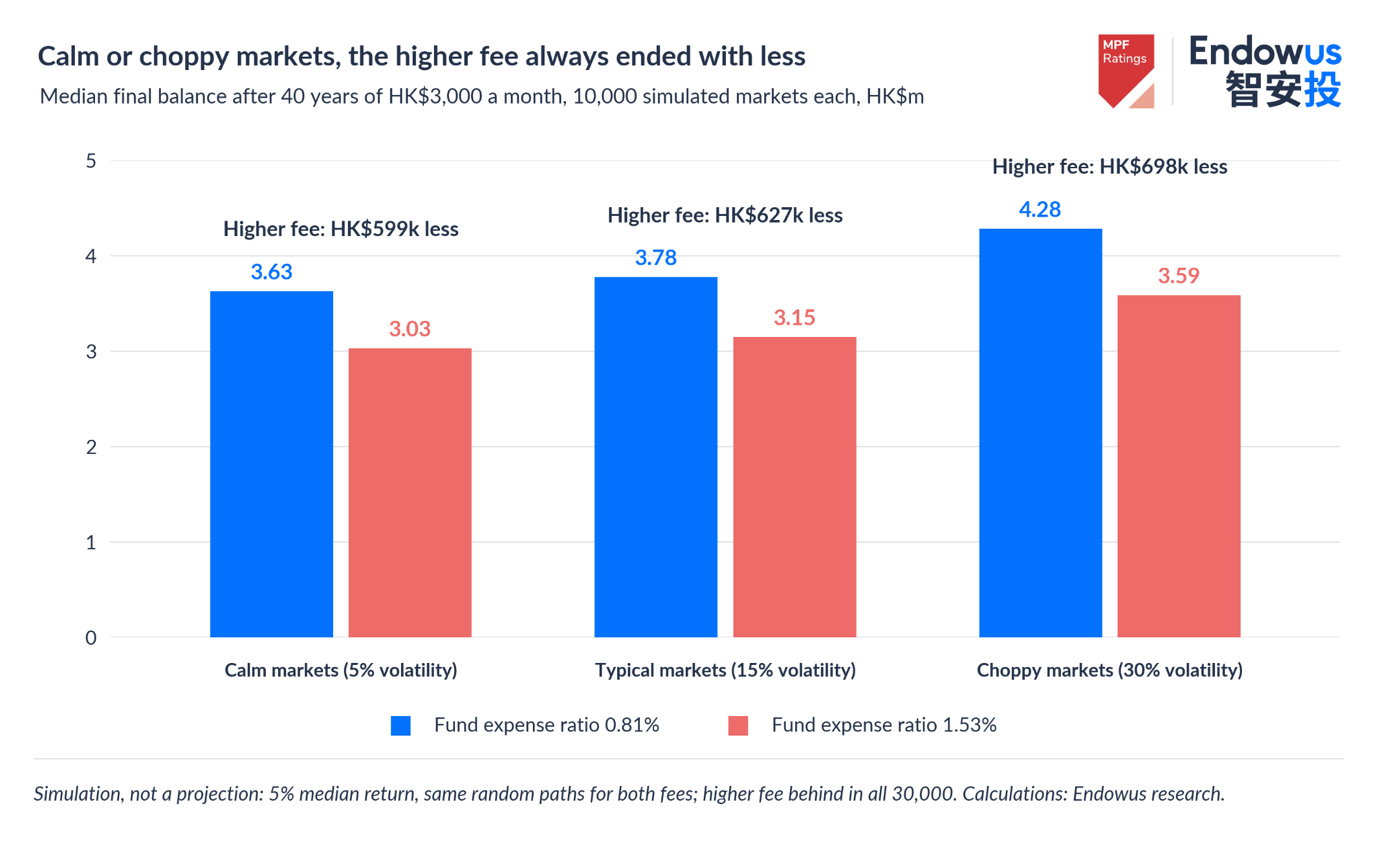
It is important to remind readers - a lower fee reduces drag; it does not guarantee a higher return.
How can you find index-tracking funds in your scheme?
The MPFA's online fund platform lists every constituent fund and its FER.
It is important to check three basic elements:
- the FER, for a like-for-like sense of cost;
- the index tracked by a specific fund, which tells you what exposure you are actually buying (for instance, Hong Kong equities, US large caps, or global equities);
- the fund's tracking difference, the gap between its return and the index's. Past performance is not necessarily a guide to future performance or returns.
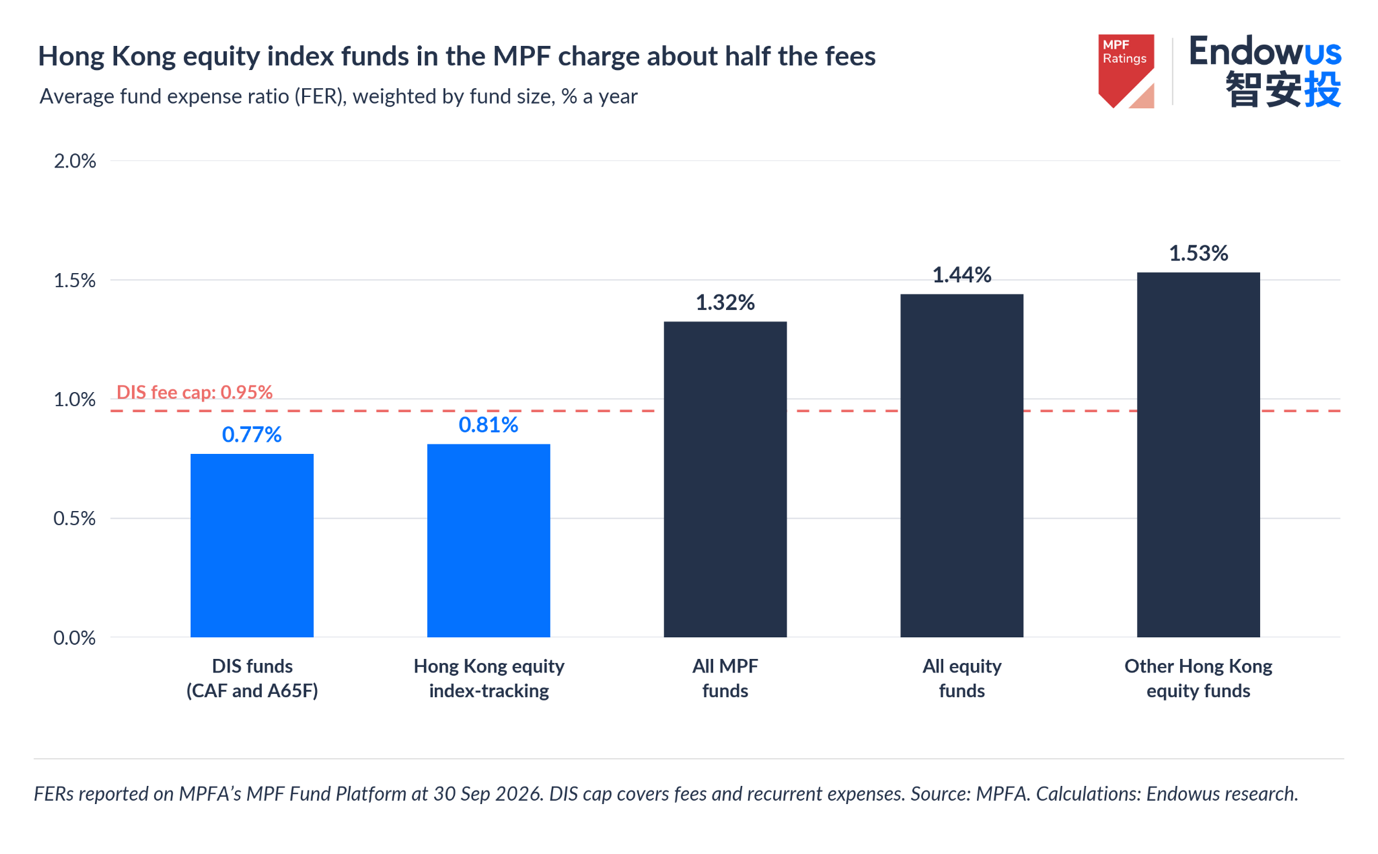
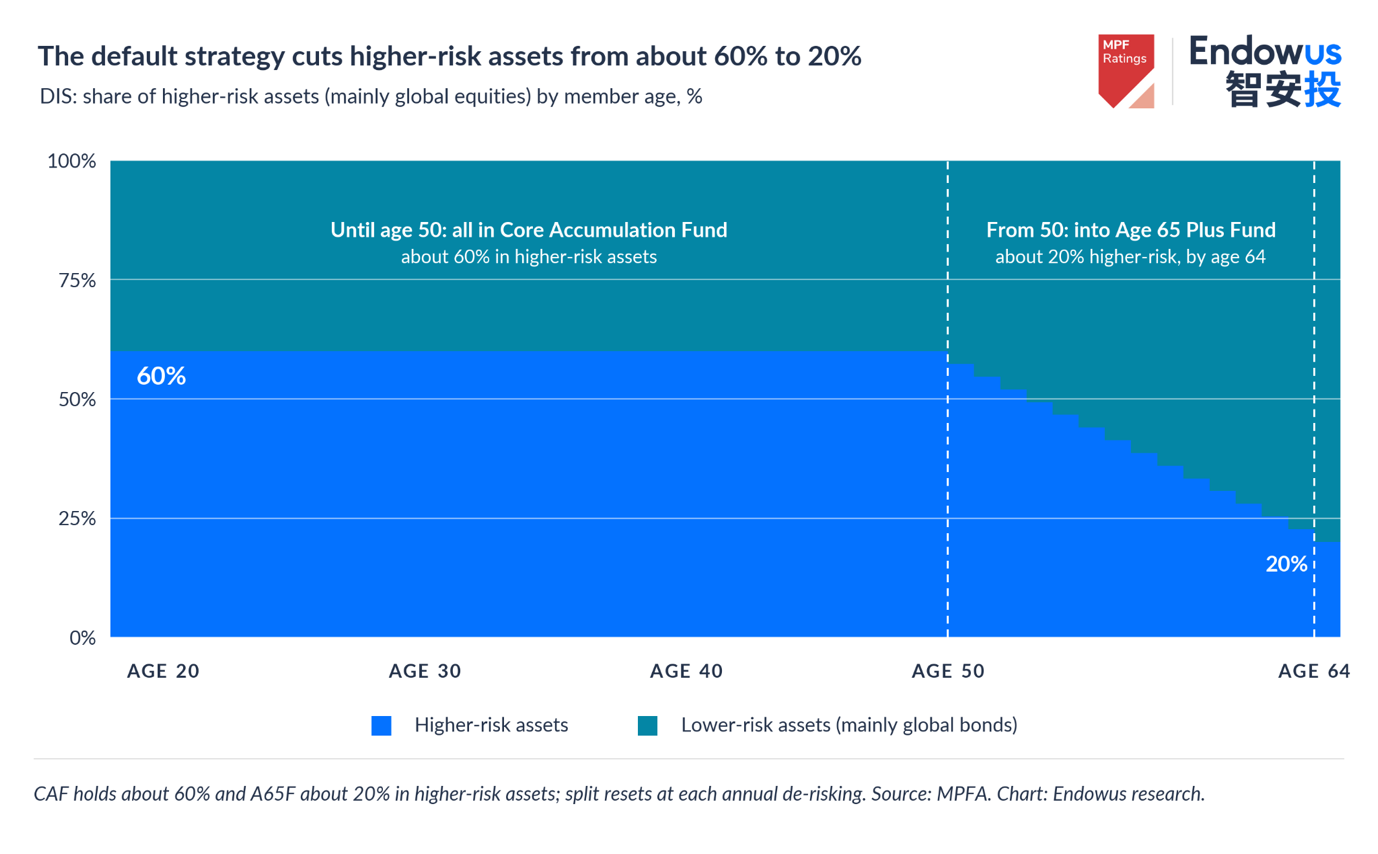
Members who would rather not choose fund by fund already have a low-cost, index-based default available. The DIS invests through globally diversified funds and automatically reduces investment risk as a member approaches age 65, within the fee caps noted above.
Investment implications
For many in Hong Kong, MPF is among the largest and longest-held pools of capital. Decisions made early — which funds to hold, and at what cost — will have consequences long after, and that is why fund selection deserves attention and focus.
Low-cost index-tracking funds - which may include ETF allocations - can help control costs, and may offer diversification and consistency in the long run. Index funds offer broad exposure at a low price and remove the risk of backing an active manager who may underperform. The caveat is that they deliver market returns, carry full market risk, and still require sensible choices about asset mix and time horizon.
Endowus's advisers in Hong Kong can help you review your portfolio, so that your retirement savings and your other investments pull in the same direction.
Frequently asked questions
Can I buy ETFs directly through my MPF?
No. You choose from the constituent funds offered by your MPF scheme rather than trading securities yourself. Some of those funds — index-tracking funds in particular — may gain their exposure by investing into ETFs through an approved index-tracking scheme.
Are there index funds in the MPF?
Yes. Most schemes offer index-tracking constituent funds covering markets such as Hong Kong, the US, or global equities. The Default Investment Strategy also uses low-cost, globally diversified funds.
Are index funds cheaper than actively managed funds in the MPF?
Index funds typically report lower Fund Expense Ratios, because tracking an index requires less research and trading than active management. Fees are only one factor, and the appropriate fund depends on your circumstances.
Do lower fees mean higher returns?
Not necessarily. Lower fees reduce the cost drag on your savings, but an index fund still carries full market risk and may differ slightly from its benchmark. Past performance is not necessarily a guide to future performance or returns.
How do I switch my MPF fund choices?
You can change your fund selection through eMPF, which offers a simple and quick way to switch. Before you switch though, think about your time horizon and risk tolerance. It's also worth reviewing each fund's cost and the index it tracks.
Disclaimer
Endowus HK Limited (CE No. BQR225) is licensed by the Securities and Futures Commission in Hong Kong.
Risk Warnings: Investment involves risk. Past performance is not an indicator nor a guarantee of future performance or returns. Projected performance or returns is not guaranteed to materialise. The value of investments and the income from them can go down as well as up, and you may not get the full amount you invested. Rates of exchange may cause the value of investments to go up or down. Individual stock performance does not represent the return of a fund.
General risk warnings relating to collective investment schemes: Before making an investment decision, you are reminded to refer to the relevant prospectus/offering document for specific risk considerations and related fees and charges. Funds are not a bank deposit and not capital guaranteed, and are subject to investment risks, including the possible loss of the principal amount invested. Some of the funds also involve derivatives. Do not invest in them unless you fully understand and are willing to assume the risks associated with them.
Opinions: Any forward-looking statements, prediction, projection or forecast on the economy, stock market, bond market or economic trends of the markets contained in this material are subject to market influences and contingent upon matters outside the control of Endowus HK Limited (“Endowus”) and therefore may not be realised in the future. Further, any opinion or estimate is made on a general basis and subject to change without notice. In presenting the information above, none of Endowus HK Limited, its affiliates, directors, employees, representatives or agents have given any consideration to, nor have made any investigation of the objective, financial situation or particular need of any user, reader, any specific person or group of persons. Therefore, no representation is made as to the completeness and adequacy of the information to make an informed decision. You should carefully consider whether any investment views and products/services are appropriate in view of your investment experience, objectives, financial resources and relevant circumstances. You may also wish to seek financial advice through a financial adviser or the Endowus platform and independent legal, accounting, regulatory or tax advice, as appropriate.
Product Risk Rating: Please note that any product risk rating (the “PRR”) provided by us is an internal rating assigned based on our product risk assessment model, and is for your reference only. The PRR is subject to change from time to time. The PRR does not take into account your individual circumstances, objectives or needs and should not be regarded as advice or recommendation to purchase, hold or sell any fund or make any other investment decisions. Accordingly, you should not solely rely on the PRR in making your investment decision in the relevant Fund.
No invitation or solicitation: Nothing contained in this article should be construed as a solicitation, an offer to buy or sell, or recommendation, to acquire or dispose of any security, commodity, investment or to engage in any other transaction in any jurisdiction in which such solicitation, offer to buy or sell would be unlawful under the securities laws in such jurisdiction. No information included in this article is to be construed as investment advice or as a recommendation or a representation about the suitability or appropriateness of any advisory product or service; or an offer to buy or sell, or the solicitation of an offer to buy or sell, any security, financial product, or instrument; or to participate in any particular trading strategy. Investors should seek independent financial and tax advice before making any investment decision.
This advertisement has not been reviewed by the Securities and Futures Commission or any regulatory authority in Hong Kong.