
- Mandatory Provident Fund (MPF) savings are preserved until age 65, with the law permitting early withdrawal on only six grounds: early retirement at 60, permanent departure from Hong Kong, total incapacity, terminal illness, a small balance of HK$5,000 or less, and death.
- Leaving Hong Kong permanently is the most common early claim; it can be made only once, it requires documentary proof of the right to live elsewhere, and a false declaration is a criminal offence.
- Every claim now runs through the eMPF Platform. Trustees generally pay a complete claim within 30 days — but withdrawing early ends the compounding (which those savings would produce until retirement).
For most of a working life in Hong Kong, the Mandatory Provident Fund (MPF) behaves like a one-way door. Contributions flow in from each pay cheque, month after month, and the balance compounds. But barring limited exceptions, the balance cannot be withdrawn before retirement.
The MPF is designed as preserved retirement savings. Under the Mandatory Provident Fund Schemes Authority (MPFA), benefits from mandatory contributions may normally be withdrawn only on reaching age 65. The exits before that age are deliberately narrow, each carrying its own evidence test, and most can be used only once.
This article sets out when early withdrawal is allowed and what each ground requires. It covers the six statutory grounds, how voluntary contributions differ, how a claim is filed through the eMPF Platform, what MPF cannot be withdrawn for, and what an early withdrawal costs in forgone compounding. It is general information, not advice on whether to make a claim.
What age can I withdraw my MPF, and what are the exceptions?
Preservation is the organising principle of the MPF. The MPFA states that members may withdraw benefits derived from mandatory contributions and tax-deductible voluntary contributions only on reaching age 65, except in certain specific circumstances. At 65, the baseline options are to take the money as a lump sum, to receive it by instalments, or to leave it invested; no application is required to keep it in the scheme.
Before 65, the law recognises six grounds for early withdrawal. The table below sets out, for each, who qualifies, the key evidence, and whether benefits are paid as a lump sum or can be taken by instalments.
What happens if I choose to retire early, at 60?
The earliest a member can withdraw MPF on retirement grounds is age 60 in the case of early retirement, but the break from work needs to be real. The member must have reached 60, have ceased all employment and self-employment, and make a statutory declaration that they have no intention of becoming employed or self-employed again. Benefits can then be taken as a lump sum or by instalments.
“Permanently” is the key adverb. A member who retires at 60, withdraws, and later takes a consultancy or part-time role is treated like any other worker: if they meet the definition of a regular or casual employee, their employer must enrol them in an MPF scheme, and contributions resume. The earlier withdrawal is not reversed, but new savings begin to accrue. A statutory declaration that is false is a criminal offence, so it should reflect a genuine intention at the time it is made.
Can I withdraw my MPF if I leave Hong Kong for good?
Permanent departure is the ground most emigrating and non-permanent residents can use, but it its criteria are strict. The member must declare, by statutory declaration, that they have departed or will depart Hong Kong to reside elsewhere with no intention of returning for employment or to resettle. They must also provide documentary proof, satisfactory to the trustee, that they are permitted to reside in a place outside Hong Kong — for example an immigration visa or a foreign passport.
What counts as proof depends on the destination and the circumstances (the bar is higher than just a travel document). The MPFA has stated that travel documents alone are not sufficient, that a Home Return Permit alone is not adequate proof, and that a working holiday visa does not establish permanent departure. Additionally, the MPFA explicitly states that British National (Overseas) [BN(O)] visas and passports are not recognized as valid documentary proof for early withdrawal. A Letter of Release from the Inland Revenue Department may also be requested.
The claim can be made only once against a departure date. A member already paid on this ground cannot claim again on the basis of a later departure, and the MPFA keeps a register of permanent-departure claimants. Returning to Hong Kong is allowed: a member who comes back and takes up work simply rejoins an MPF scheme, but cannot use permanent departure a second time.
Because the sums are large and the claim is one-way, the MPFA treats false declarations seriously. A member who makes a false or misleading statement is liable to prosecution; the MPFA performs random checks and refers suspected cases for enforcement, and past convictions have resulted in fines and imprisonment.
What happens in the event of total incapacity, terminal illness or death?
Total incapacity applies where a member has become permanently unfit to perform the particular kind of work they last did, certified by a registered medical practitioner or Chinese medicine practitioner.
Terminal illness has been a withdrawal ground since 1 August 2015. It requires certification, by a registered medical practitioner or Chinese medicine practitioner, that the member has an illness likely to reduce life expectancy to 12 months or less. The claim is made within 12 months of the certificate and is paid as a lump sum, and a member who qualifies may continue to work.
On death, accrued benefits form part of the member’s estate and are claimed by the personal representative or administrator, on production of a grant of probate or letters of administration.
What happens when the balance goes below HK$5,000?
A member may withdraw their MPF when the balance is HK$5,000 or less, held in a single MPF scheme, at least 12 months have passed since the last contribution date, and if the member declares, by statutory declaration, that they have no intention of becoming employed or self-employed again and hold no benefits in any other MPF scheme. The ground does not apply to minimum MPF benefits held within an exempted Occupational Retirement Schemes Ordinance (ORSO) scheme.
Voluntary contributions follow different rules
Not all MPF money is preserved on the same terms. Special voluntary contributions (SVC) are governed by each scheme’s own rules, which is why some can be withdrawn when the scheme allows rather than only at 65. Tax-deductible voluntary contributions (TVC) are different: they are preserved like mandatory contributions and can be withdrawn early only on the same six statutory grounds. The annual tax deduction for TVC and qualifying deferred annuity premiums is capped at HK$60,000 combined. For how TVC fits into a wider plan, see our guide to tax-deductible voluntary contributions.
How to claim through eMPF, and how long it takes
Since the MPF system migrated to the eMPF Platform, the claim process is the same whichever trustee holds the account. Claims are filed through the platform rather than sent to the MPFA or the trustee directly.
Retirement and early-retirement claims use form MPF(S)-W(R); the other grounds use form MPF(S)-W(O), with the relevant statutory declaration or medical certificate attached. A statutory declaration must be witnessed by a Commissioner for Oaths, a notary public, or a Justice of the Peace.
On timing, the MPFA states that trustees generally pay out a complete claim within 30 days of receiving all required documents. Incomplete paperwork is the usual cause of delay, and fund units are redeemed at the price on the redemption date, so the final amount moves with the market until the sale settles.
What MPF cannot be withdrawn for
It is worth being explicit about the cases that fall outside the six grounds, because they are the ones members most often expect to qualify for. Unemployment or redundancy is not a ground. Nor is it buying a home, repaying debts, meeting day-to-day medical bills outside the terminal-illness and total-incapacity tests, general financial hardship, or a temporary spell working or studying abroad. In each case the benefits stay preserved until one of the six grounds applies or the member reaches 65. For the mechanics of combining accounts after a job change, see our guide to MPF consolidation.
What withdrawing early costs
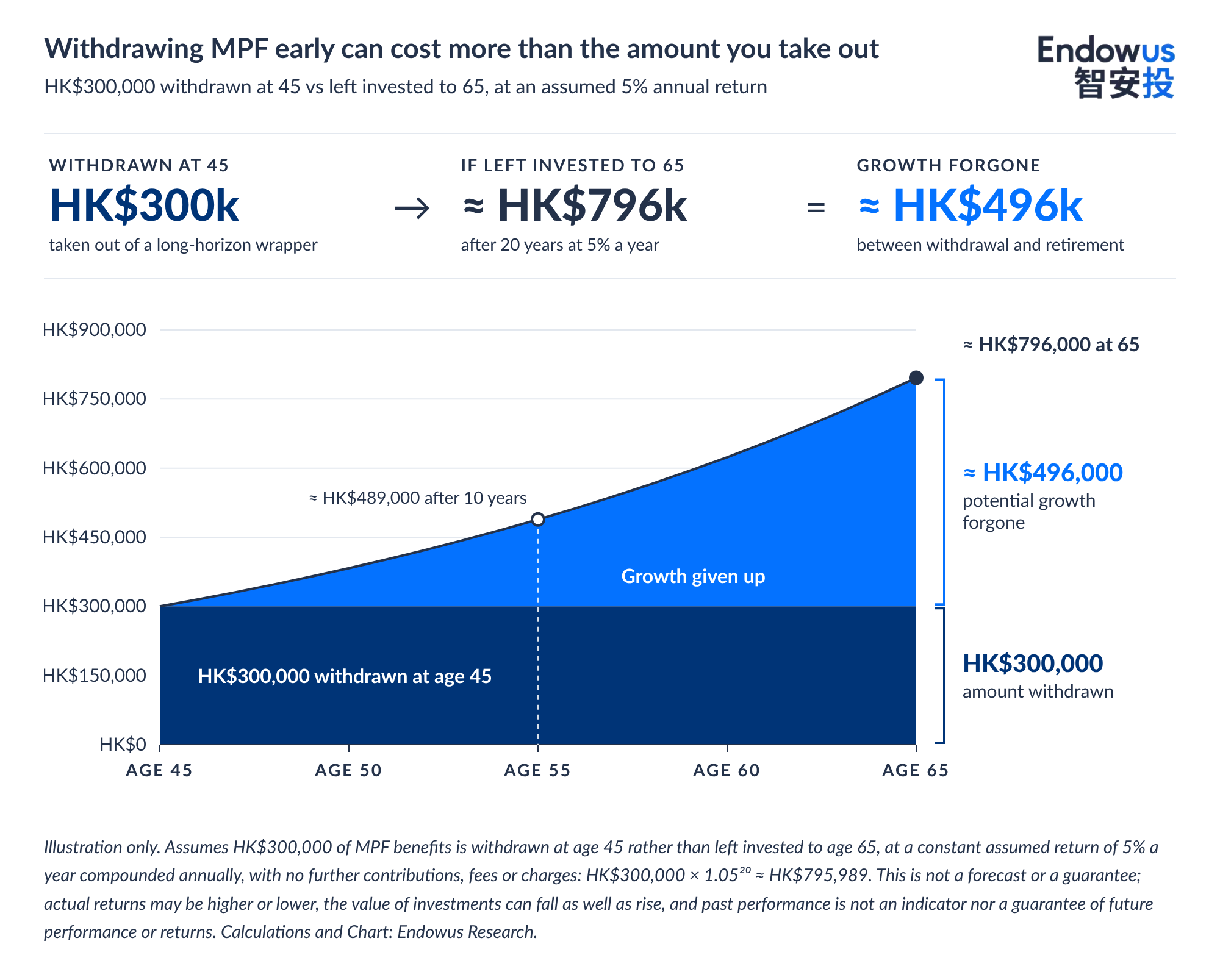
Beyond the eligibility tests, withdrawing early means foregoing potential compounding.
Consider a simplified illustration. HK$300,000 withdrawn at age 45, rather than left invested to 65, forgoes 20 years of compounding. At an assumed annual return of 5%, that HK$300,000 left invested would grow to about HK$796,000 over 20 years — so the early withdrawal gives up roughly HK$496,000 of potential growth. This is an illustration using round numbers and a single assumed rate, not a forecast or a guarantee; actual returns may be higher or lower, the value of investments can fall as well as rise, and past performance is not an indicator nor a guarantee of future performance or returns.
Where benefits are paid out in any case — on reaching 65, or on permanent departure — the question shifts from whether to withdraw to how to hold a lump sum against a long horizon. Those are planning questions rather than MPF-rule questions; our note on when to retire in Hong Kong covers the horizon side, and our MPF guide covers contributions and the basics.
Frequently asked questions
Can I withdraw my MPF early?
Yes, but only on six grounds: early retirement at 60, permanent departure from Hong Kong, total incapacity, terminal illness, a small balance of HK$5,000 or less, or death. Outside these, MPF stays preserved until age 65. The table above sets out what each ground requires.
Can I return to Hong Kong after withdrawing my MPF?
Yes. You can return. If you take up employment, your employer must enrol you in an MPF scheme again and contributions resume. You cannot claim on the permanent-departure ground a second time, even on a later departure date.
How long does it take to withdraw MPF?
The MPFA states that trustees generally pay a complete claim within 30 days of receiving all required documents. Missing documents, an unwitnessed statutory declaration, or the time taken to redeem fund units can extend that.
Is MPF withdrawal taxed in Hong Kong?
Benefits from your own mandatory and voluntary contributions are not subject to salaries tax when withdrawn on retirement, death, incapacity, terminal illness or permanent departure. Only the portion attributable to an employer’s voluntary contributions can be taxable, and only in certain cases. This is general information; for your own position, consult the Inland Revenue Department or a tax adviser (IRD, DIPN 23).
Can I withdraw my MPF if I lose my job?
No. Unemployment is not a ground for early withdrawal. Your benefits remain preserved until one of the six statutory grounds applies or you reach age 65.
Information in this article is sourced from the Mandatory Provident Fund Schemes Authority, the eMPF Platform and the Inland Revenue Department, and is accurate as at November 2026. MPF rules are subject to change.
Disclaimer
Risk Warnings
Investment involves risk. Past performance is not an indicator nor a guarantee of future performance or returns. Projected performance or returns is not guaranteed to materialise. The value of investments and the income from them can go down as well as up, and you may not get the full amount you invested. Rates of exchange may cause the value of investments to go up or down. Individual stock performance does not represent the return of a fund.
General risk warnings relating to collective investment schemes: Before making an investment decision, you are reminded to refer to the relevant prospectus/offering document for specific risk considerations and related fees and charges. Funds are not a bank deposit and not capital guaranteed, and are subject to investment risks, including the possible loss of the principal amount invested. Some of the funds also involve derivatives. Do not invest in them unless you fully understand and are willing to assume the risks associated with them.
Opinions
Any forward-looking statements, prediction, projection or forecast on the economy, stock market, bond market or economic trends of the markets contained in this material are subject to market influences and contingent upon matters outside the control of Endowus HK Limited (“Endowus”) and therefore may not be realised in the future. Further, any opinion or estimate is made on a general basis and subject to change without notice. In presenting the information above, none of Endowus HK Limited, its affiliates, directors, employees, representatives or agents have given any consideration to, nor have made any investigation of the objective, financial situation or particular need of any user, reader, any specific person or group of persons. Therefore, no representation is made as to the completeness and adequacy of the information to make an informed decision. You should carefully consider whether any investment views and products/services are appropriate in view of your investment experience, objectives, financial resources and relevant circumstances. You may also wish to seek financial advice through a financial adviser or the Endowus platform and independent legal, accounting, regulatory or tax advice, as appropriate.
No invitation or solicitation
Nothing contained in this article should be construed as a solicitation, an offer to buy or sell, or recommendation, to acquire or dispose of any security, commodity, investment or to engage in any other transaction in any jurisdiction in which such solicitation, offer to buy or sell would be unlawful under the securities laws in such jurisdiction. No information included in this article is to be construed as investment advice or as a recommendation or a representation about the suitability or appropriateness of any advisory product or service; or an offer to buy or sell, or the solicitation of an offer to buy or sell, any security, financial product, or instrument; or to participate in any particular trading strategy. Investors should seek independent financial and tax advice before making any investment decision. This advertisement has not been reviewed by the Securities and Futures Commission or any regulatory authority in Hong Kong.
Endowus HK Limited is licensed by the Securities and Futures Commission of Hong Kong (CE No. BQR225) for Type 1 (Dealing in Securities), Type 4 (Advising on Securities) and Type 9 (Asset Management) regulated activities.