.webp)
.webp)
.webp)
.webp)






- A tax-deductible voluntary contribution (TVC) is a separate MPF account you open yourself. It does not carry its own HK$60,000 deduction: a single HK$60,000 allowance covers your TVC and any qualifying deferred annuity premiums together, with your TVC counted against it first.
- A full HK$60,000 contribution lowers your salaries tax once, by between HK$1,200 and HK$10,200 depending on your marginal rate; the advertised HK$10,200 requires both the full contribution and a marginal dollar taxed at the top 17% rate.
- The tax saving is a one-off, whereas the fund expense ratio is charged every year the money stays locked up until age 65 — so over a multi-decade horizon the fund you choose can matter more to the outcome than the deduction you claim.
Each spring, in the weeks before the 31 March contribution deadline, Hong Kong’s MPF trustees converge on a single number: a tax saving of “up to HK$10,200.” The figure is arithmetically correct. It is also, for most of the people who read it, inaccurate as it does not apply to all savers.
The headline holds when there is a contribution of the full HK$60,000, and it is made by individuals earning income whose marginal dollar is taxed at the top progressive rate of 17%. The Mandatory Provident Fund Schemes Authority (MPFA) does not assume even the first of these in its own worked examples, which model a contribution of 10% of income rather than the cap.
The important question for readers is how much is the tax-deductible voluntary contribution (TVC) worth to them, and what is the cost to claim. The deduction is claimed once. The fund that then holds the money charges a fee every year until the balance is unlocked at age 65.
This article sets out which contributions qualify for the deduction, how the HK$60,000 ceiling is shared with a deferred annuity, what the saving is worth at each tax band, and the two costs the marketing rarely quantifies — a lock-in to age 65 and a fund menu the contributor does not choose. It closes with where money above the cap can more sensibly be invested.
A TVC is one of several voluntary contributions — and the only deductible one
Contributions to the MPF above the mandatory minimum take three forms. Employee voluntary contributions and employer voluntary contributions are both arranged through the workplace; neither carries a personal tax deduction. A TVC is different in kind: it is a separate account, opened by the individual directly with a trustee that offers one, entirely outside the employment relationship. Only a TVC is deductible against salaries tax.
Eligibility is wide. Any holder of an MPF contribution account or personal account may open a TVC, as may members of MPF-exempted occupational retirement schemes (ORSO). The ORSO carve-out matters: employees whose retirement provision sits in an exempted ORSO arrangement, rather than an MPF scheme, remain eligible to open a TVC alongside it. Our guide to ORSO sets out how the two regimes interact.
One HK$60,000 allowance, shared with a deferred annuity, TVC counted first
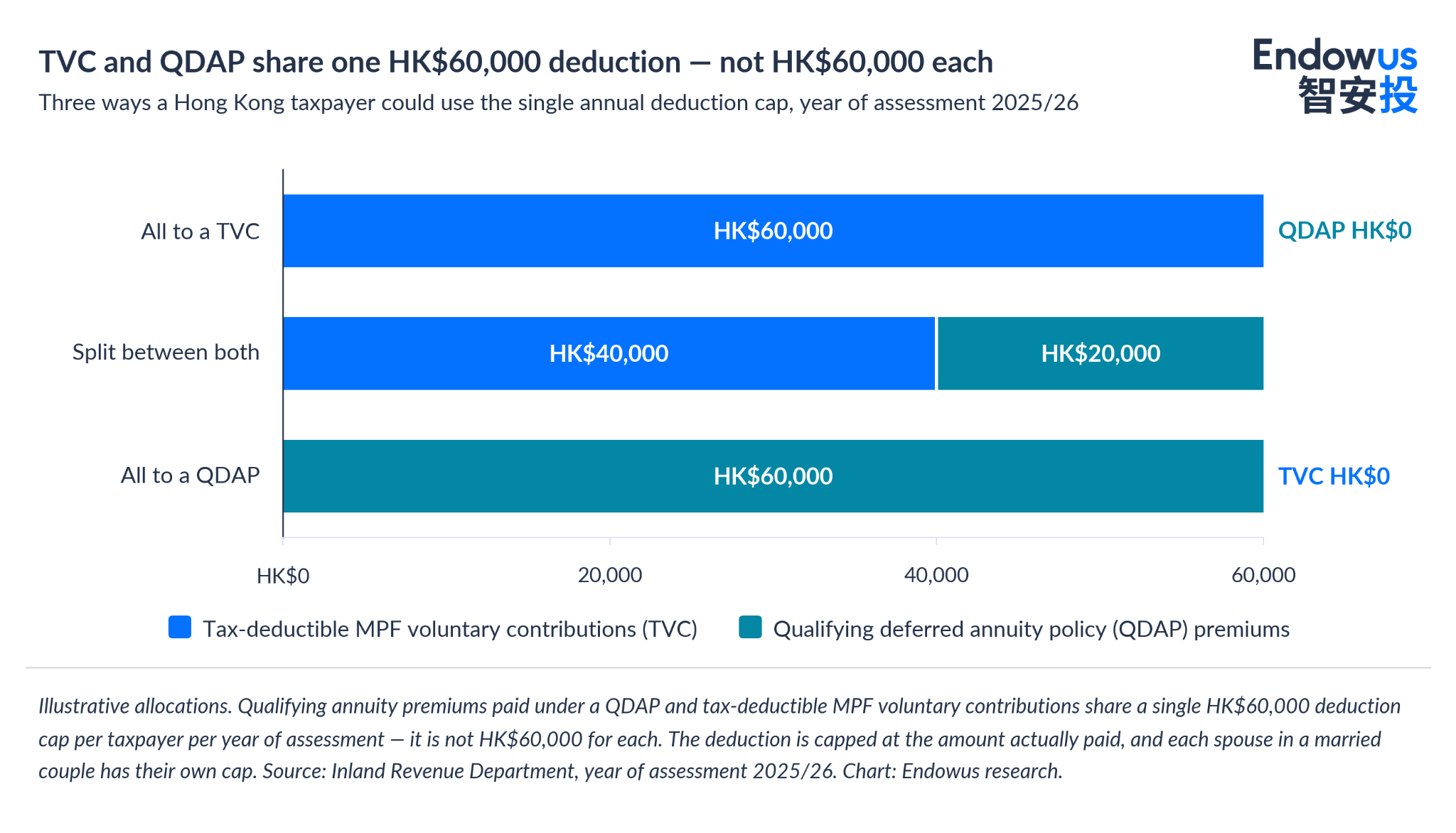
The most common misreading of the deduction is to believe it is cumulative, and can be doubled (60,000 to TVC, and the same amount for an annuity). In reality, a single HK$60,000 allowance per year of assessment covers a TVC and the premiums on a qualifying deferred annuity policy (QDAP) together. Where a taxpayer pays into both in the same year, the Inland Revenue Department (IRD) applies the deduction to the TVC first, and only the unused balance to the annuity premiums.
The mechanic is easier to see with figures. A HK$60,000 TVC exhausts the allowance, and no annuity premium is deductible that year. A HK$40,000 TVC leaves HK$20,000 of the allowance, against which up to HK$20,000 of annuity premiums may be claimed. A nil TVC leaves the whole HK$60,000 for annuity premiums.
A QDAP has no structural connection to the MPF. It is an insurance policy, certified by the Insurance Authority (IA) against its Guideline GL19 — which requires, among other conditions, total premiums of at least HK$180,000, a premium payment period of at least five years, an annuity period of at least 10 years, and payouts beginning no earlier than age 50. The two are linked only by the tax rule that groups them under a single deduction; this article describes that mechanic and takes no view on whether an annuity suits any particular reader.
The HK$60,000 ceiling neither reduces, nor is reduced by, the deduction for mandatory MPF contributions, which is separate and capped at HK$18,000 a year. More color on MPF contributions here and here.
Finally, the Voluntary Health Insurance Scheme (VHIS) deduction — up to HK$8,000 per insured person — is separate again, and falls outside the HK$60,000 cap entirely.
What the deduction is actually worth: HK$1,200 to HK$10,200
The saving on a TVC is the amount contributed multiplied by the marginal rate at which that income would otherwise have been taxed. Hong Kong levies salaries tax at progressive rates across five bands of net chargeable income — 2%, 6%, 10%, 14%, and 17%. A full HK$60,000 contribution therefore produces a different saving depending on the band in which the taxpayer’s marginal dollar sits.
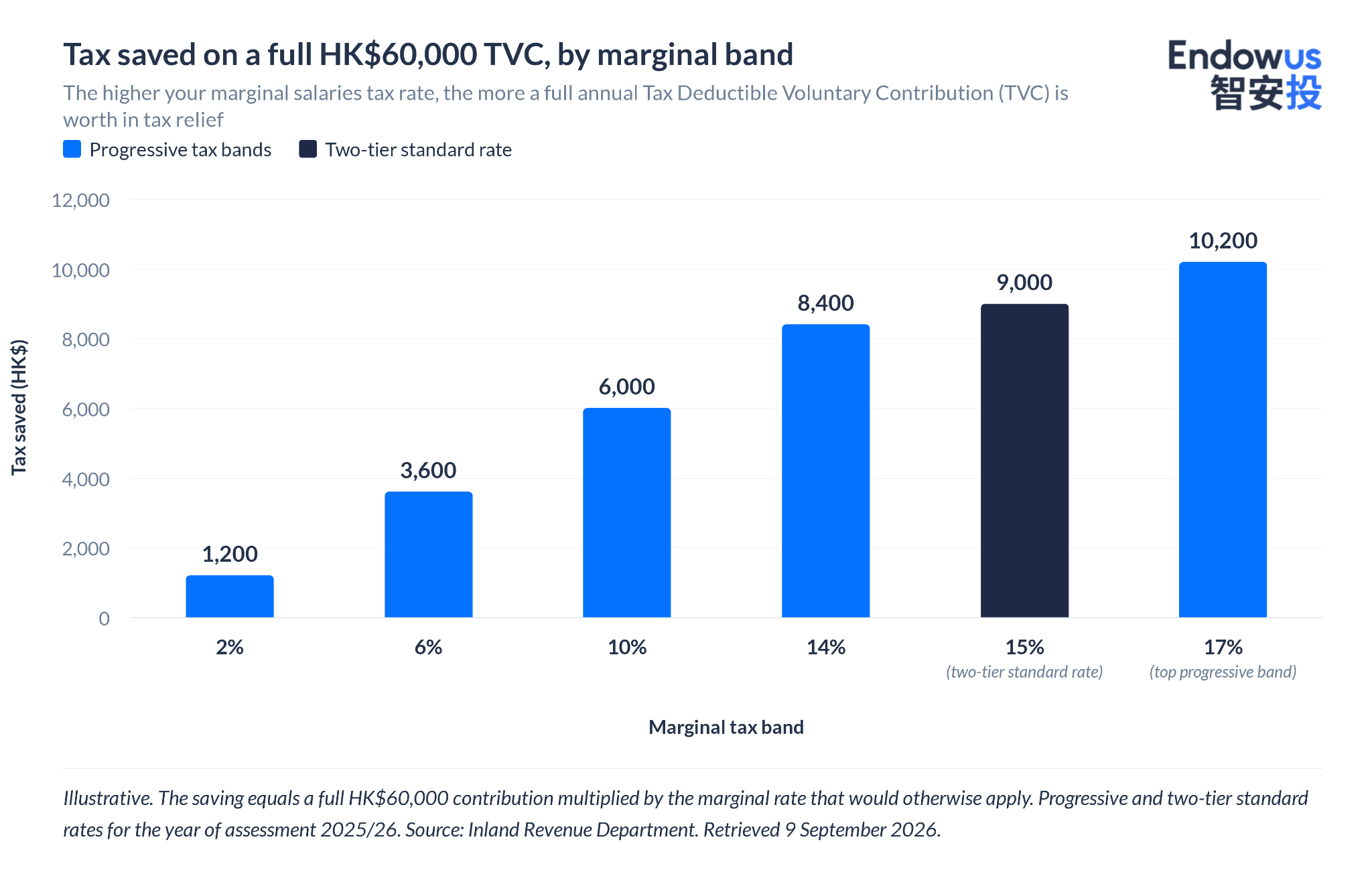
Two conditions must both hold for the HK$10,200 headline to apply. The contribution must be the full HK$60,000, where the MPFA’s illustrations assume 10% of income. And the displaced income must fall in the 17% band, which is reached only above a high level of net chargeable income — after the basic allowance of HK$132,000 for the year of assessment 2025/26, rising to HK$145,000 for 2026/27 under legislation gazetted in May 2026. A taxpayer contributing HK$30,000 at a 10% marginal rate saves HK$3,000, not HK$10,200.
Yet, the income condition turns out to be less restrictive than the headline suggests, though only for a taxpayer with no dependants. Once the basic allowance and the mandatory MPF deduction are worked through, gross annual income above roughly HK$410,000 — about HK$34,000 a month — is enough for the entire HK$60,000 TVC to sit inside the 17% band, not just its last dollar. That income level is common among Hong Kong's middle-to-high earners, not rare. So in practice it's usually the first condition — making the full HK$60,000 contribution — that keeps most contributors short of the full HK$10,200, not the second.
More in detail, a high earner assessed at the two-tier standard rate — 15% on the first HK$5 million of net income and 16% above, where that produces the lower bill — saves at that rate on the deducted amount rather than at 17%. And the figures are illustrative: an individual’s actual saving depends on the whole assessment, including allowances, elections, and dependants. Endowus is not a tax adviser; readers can estimate their own position using the IRD’s tax calculator, and should take professional advice.
The cost the headline omits: locked to 65, in a menu you did not choose
A TVC is locked until age 65, on the same limited early-withdrawal grounds as mandatory MPF benefits — among them permanent departure from Hong Kong, total incapacity, and terminal illness. The same sum invested outside the MPF carries no such restriction. For a contribution made in one’s thirties or forties, the deduction is exchanged for potentially three decades of illiquidity. For anyone rebuilding savings after a career break, that trade deserves particular scrutiny.
The early-withdrawal grounds are narrower than for many savings products, yet a TVC can also be withdrawn from age 60, provided the holder has made a statutory declaration to the trustee that they have permanently ceased employment or self-employment — an early-retirement route distinct from the standard preservation age. Balances of HK$5,000 or less, and benefits payable on death, sit outside the age-65 rule as well. None of this changes the core trade-off: for a contribution made in one’s thirties, the realistic horizon is still decades, not years.
In addition, a TVC can be invested only in the constituent funds of the scheme it is opened with. The contributor chooses the trustee, but from that point the investable universe is that scheme’s menu — which may or may not include low-cost, globally diversified options.
The deduction is a one-off; the fee recurs every year
A full HK$60,000 contribution saves between HK$1,200 and HK$10,200, a one-off advantage. The balance then sits in an MPF fund until age 65, paying that fund’s expense ratio every year in between. Over a multi-decade horizon, the gap between a low-cost fund and a high-cost one can exceed the one-off saving that prompted the contribution.
It is worth adding that in research on fund fees, the MPFA found no relationship between a fund’s expense ratio (FER) and its investment performance.
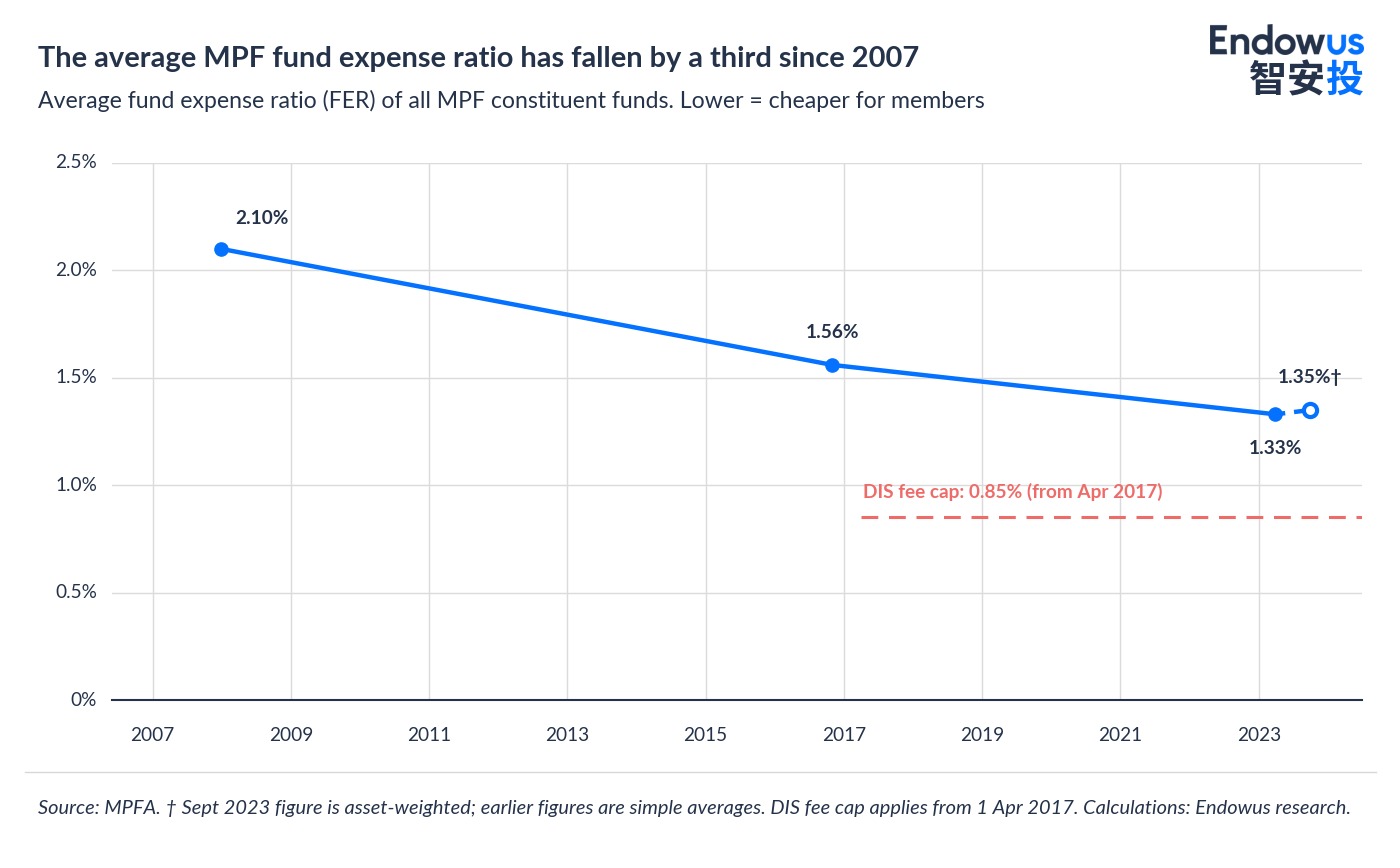
The average MPF fund expense ratio was 1.35% as at end-September 2023, down from 2.1% in 2007, when the ratio was first published — an asset-weighted figure that has fallen further as administration costs have dropped, from 58 to 37 and then to 29 basis points, following the completion of the eMPF Platform.
Within that average sits a wide range. The MPFA’s own Low Fee Fund List defines a low-fee fund as one with an FER at or below 1.3%, or a management fee at or below 1%; more than 30% of all MPF funds now qualify. The Default Investment Strategy (DIS), the standardised option available in every scheme, is capped by statute at 0.75% in management fees plus 0.1% in recurring out-of-goings for schemes on the eMPF Platform — a combined ceiling of 0.85% of assets.[12] Fund-level fees can be compared directly on the MPFA Fund Platform.[13]
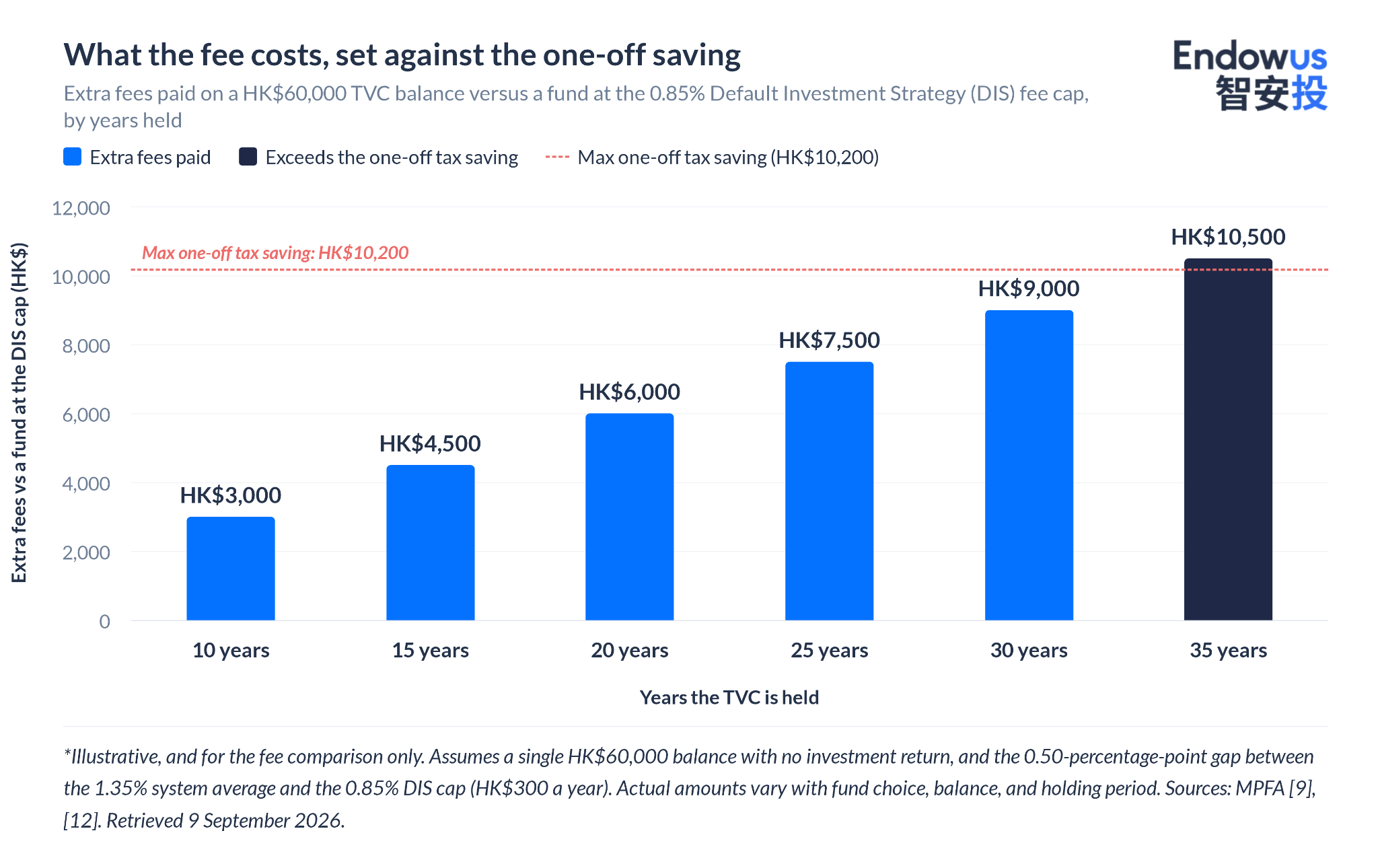
To isolate the effect of fees, set investment return aside entirely. On a flat HK$60,000 balance, the 0.50-percentage-point gap between the 1.35% system average and the 0.85% DIS cap costs HK$300 a year. Held for 35 years — the horizon facing a contributor in their early thirties — that is HK$10,500 in additional fees on a single contribution, more than the maximum one-off saving of HK$10,200. The illustration assumes no growth in the balance; on a rising balance the same percentage is charged on a larger sum each year, so the true gap is wider, and a menu’s costliest funds sit well above the average, widening it further still.
None of this argues against a TVC for the taxpayer whose marginal dollar genuinely sits in the 17% band and who directs the contribution into a low-fee fund. The one-off saving is then at its maximum and the recurring drag at its minimum. The corrective is aimed at the default framing — full saving assumed, fee ignored — not at the instrument.
If you contribute, contribute deliberately
If a TVC suits your circumstances, a few mechanics separate doing it well from doing it carelessly.
- The trustee is your choice, and need not be your employer’s. Select on cost and on the quality of the fund menu, not on which provider your payroll happens to use.
- More than one TVC account is permitted; the HK$60,000 cap applies to your total contributions across all of them, not to each account.[1]
- Balances are portable. A TVC can be transferred to another scheme at any time — now processed through the eMPF Platform — so a weak fund menu need not be permanent.[1]
- Timing is strict. Contributions count for the year of assessment in which they fall between 1 April and 31 March; a payment on 30 March counts for the year ending, one on 1 April for the year beginning.[1]
- Keep the trustee’s annual contribution summary; it is the figure you enter on your tax return (BIR60).
- Compare fees before you commit, using the MPFA Fund Platform. Our MPF guide covers how the wider system fits together.
One point of transparency about Endowus’s own position. Endowus HK does not offer a TVC account and cannot accept TVC contributions; a TVC is opened directly with an MPF trustee, or through the eMPF Platform. Where Endowus can help is with the money above the cap — the subject of the next section.
Above the cap: where the rest of the money goes
HK$60,000 a year is a deductible ceiling, not a retirement plan. For the earners most likely to contribute the full amount — those in the higher bands — the distance between accumulated MPF savings and a funded retirement is usually far greater than HK$60,000 a year can close. The decision of when to retire in Hong Kong turns on that gap as much as on any single allowance.
The uptake data suggest TVC remains a niche instrument rather than a solution to that gap: at end-December 2025, TVC accounts numbered 91,000 — a small fraction of the system’s 11.29 million accounts — despite six years of trustee promotion.[15] Money above the cap is different in kind. It attracts no deduction; but equally it carries no reason to accept a lock-in to age 65 or a scheme’s restricted menu. Once the deduction is exhausted, the case for keeping further retirement savings inside the MPF perimeter largely falls away. Outside it, the money can be invested with no lock-in, across a broader universe of funds, and at a cost the investor sets.
Investment implications
For a high-band taxpayer who was going to set the money aside in any case, and who then selects a low-cost fund, a TVC is a sound arrangement: a one-off deduction of up to HK$10,200 on savings already earmarked for retirement, held in a system whose equity and mixed-asset funds have delivered annualised net-of-fees returns of 5.0% and 4.5% respectively since inception, against inflation of 1.8% over the same period (provisional data to end-December 2025; past performance is not an indicator nor a guarantee of future performance).[14] We would not argue against the instrument. In our view, the decision that carries more weight over time is the fund rather than the deduction — and the MPFA’s own finding, that higher fees do not buy better performance, is the reason to treat fund cost as the first-order choice, not an afterthought.
For money above the HK$60,000 ceiling, the calculus changes. That money earns no deduction, so the deduction can no longer justify the MPF’s constraints. Retirement savings beyond the cap are, on balance, better held where they are neither locked to age 65 nor confined to a single scheme’s menu — invested instead across a globally diversified, low-cost portfolio matched to the investor’s horizon, whether funded from regular savings or a year-end bonus. This is where Endowus HK can help.
On the one hand, then, the TVC is a genuine, if modest, tax efficiency for the right taxpayer in the right fund. On the other, it is neither a retirement plan nor a reason to accept higher fees or a decade-spanning lock-in for capital that need bear neither. Investments outside the MPF, like those within it, can fall as well as rise, carry no capital guarantee, and may return less than invested. Past performance is not an indicator nor a guarantee of future performance.
Frequently asked questions
What is a TVC in Hong Kong?
A tax-deductible voluntary contribution is a separate MPF account you open in your own name with a trustee — not through your employer — and pay into voluntarily. Contributions are deductible against salaries tax, up to a shared annual cap. It is the only voluntary MPF contribution that carries a personal deduction.
How much tax does a TVC actually save?
The saving equals your contribution multiplied by your marginal tax rate. A full HK$60,000 contribution saves HK$1,200 at the 2% band, rising to HK$10,200 at the 17% top band. The HK$10,200 figure requires both the full contribution and top-band income. The figures are illustrative and depend on your full assessment.
Is the HK$60,000 cap shared with a deferred annuity, and how?
Yes. A single HK$60,000 allowance covers both your TVC and any qualifying deferred annuity (QDAP) premiums together — not HK$60,000 each. Your TVC is counted against it first, and only the unused balance is available for annuity premiums. So a full HK$60,000 TVC leaves nothing to deduct for an annuity that year.
What does a qualifying deferred annuity (QDAP) have to do with the MPF?
Structurally, nothing. A QDAP is an insurance policy certified by the Insurance Authority, not an MPF product. The two are linked only by the tax rule that places them under one shared HK$60,000 deduction. If you never buy an annuity, the QDAP side of the cap is simply irrelevant to you.
Can I withdraw a TVC before age 65?
Generally no. TVC balances are locked until age 65, on the same limited early-withdrawal grounds as mandatory MPF benefits — such as permanent departure from Hong Kong, total incapacity, or terminal illness. This lock-in is one of the costs of the deduction and is worth weighing before you contribute.
Does a TVC reduce the deduction for my mandatory MPF contributions?
No. The two are separate. Your mandatory MPF contributions carry their own deduction, capped at HK$18,000 a year, and it is unaffected by the HK$60,000 TVC-and-annuity cap. The two allowances sit side by side.
Can I open a TVC account with Endowus?
No. Endowus HK does not offer a TVC account and cannot accept TVC contributions; a TVC is opened directly with an MPF trustee, or through the eMPF Platform. Where Endowus can help is with the money above the cap — retirement savings beyond the HK$60,000 ceiling, invested in a globally diversified, low-cost portfolio matched to your horizon.
Disclaimer
The tax rates, contribution limits, and scheme parameters in this article are sourced from the Inland Revenue Department, the MPFA, the Insurance Authority, and GovHK, and are accurate as at 9 September 2026. These figures are reviewed annually and are subject to change; reconfirm them before acting.
Risk Warnings
Investment involves risk. Past performance is not an indicator nor a guarantee of future performance. The value of investments and the income from them can go down as well as up, and you may not get the full amount you invested. Rates of exchange may cause the value of investments to go up or down.
This article is not intended to be relied upon as a forecast or research or investment advice, and should not form the basis of any investment or other decisions. The information contained herein is not intended, and should not be construed, as any legal, tax, regulatory, accounting or financial advice. If you would like investment, accounting, tax or legal advice, you should consult with your own professional advisors regarding your individual circumstances and needs.
The information in this article may not be suitable for all investors. You are responsible for any action that you take or decision that you make in reliance on any content in this article, and you agree that Endowus HK Limited (“Endowus”) is not liable under any circumstances.
No invitation or solicitation
Neither the information, nor any opinion, contained in this article constitutes a recommendation, offer or solicitation by Endowus or its affiliates to you to buy or sell any securities, collective investment schemes or other financial instruments or services, nor shall any such security, collective investment scheme, or other financial instruments or services be offered or sold to any person in any jurisdiction in which such offer, solicitation, purchase, or sale would be unlawful under the securities laws of such jurisdiction.
This is not intended to be an invitation or offer made to the public to subscribe for any financial product or to enter into any transaction.
Accuracy of Information
Whilst Endowus has made reasonable efforts to provide accurate and timely information, there may be inadvertent delays, omissions, technical or factual inaccuracies or errors in any such information. Endowus does not warrant or represent that the information in this article is correct, accurate or reliable.
Opinions
Any opinion or estimate above is made on a general basis and none of Endowus, nor any of its affiliates, representatives or agents have given any consideration to nor have made any investigation of the objective, financial situation or particular need of any user, reader, any specific person or group of persons. Opinions expressed herein are subject to change without notice.
Any forward-looking statements, prediction, projection or forecast on the economy, stock market, bond market or economic trends of the markets contained in this article are subject to market influences and contingent upon matters outside the control of Endowus and therefore may not be realised in the future.
In presenting the information above, none of Endowus, its affiliates, directors, employees, representatives or agents have given any consideration to, nor have made any investigation of the objective, financial situation or particular need of any user, reader, any specific person or group of persons. Therefore, no representation is made as to the completeness and adequacy of the information to make an informed decision. You should carefully consider whether any investment views and products/services are appropriate in view of your investment experience, objectives, financial resources and relevant circumstances.
This article has not been reviewed by the Securities and Futures Commission of Hong Kong.
This article is issued by Endowus HK Limited, which is licensed by the Securities and Futures Commission of Hong Kong (SFC) (CE No. BQR225) to carry on business in Type 1 (Dealing in Securities), Type 4 (Advising on Securities), and Type 9 (Asset Management) regulated activities under the Securities and Futures Ordinance (Cap. 571).


.png)