.webp)
.webp)
.webp)
.webp)






- MPF contributions are currently capped at HK$3,000 per month, which is likely insufficient to fund a comfortable retirement in Hong Kong for most without additional investment.
- Because MPF funds are locked until age 65, investors may need a separate strategy for short- and medium-term financial goals such as property, education, and career transitions.
- A globally diversified investment portfolio outside MPF — started early, kept low-cost, and aligned to each goal’s time horizon — may be a reliable way to close the retirement savings gap.
- Click here to get started on your investment journey with Endowus today.
Hong Kong's MPF system is approaching HK$1.7 trillion in total assets, and 2025 delivered one of its best average net annual returns since 2017. By many measures, MPF is working — and it's a strong foundation. But a foundation is not a complete house.
The average MPF balance sits at around HK$347,500 per member — enough to cover roughly 16 months of modest retirement spending. Studies suggest that a Hong Kong retiree at 65 today may need approximately HK$7 million to last through a full retirement. That gap between what MPF delivers and what retirement actually costs is significant, and it doesn't close on its own.
So what can investors do about it? In this article, we examine why the gap exists, how large it really is, and the two key decisions that can help bridge it: investing consistently outside MPF to build your retirement savings, and investing purposefully toward financial goals with a much shorter timeline.
The good news: MPF performance is improving and costs are coming down
Total MPF assets reached an all-time record of approximately HK$1.67 trillion at the end of June 2026, according to latest data compiled by MPF Ratings, with the average balance up 7.21% since end-2025. Despite a -1.45% June dip, the system returned 7.81% in Q2 2026 — its best second quarter since 2020 — lifting the first-half return to 5.67%. Equity funds delivered around 16.0% net over the trailing 12 months, and the Core Accumulation Fund (DIS) has returned a respectable 6.4% annualised net since its 2017 launch.
MPF offers positive advantages: it builds savings, provides access to a range of fund options to most individuals, and ensures that a portion of every paycheque is invested for the future, fostering discipline. For many members, it is their first serious contact with capital markets investing, which has enormous value.
The common “complaint” by Hong Kong investors of MPF is the perceived high cost of investing. With the full roll out of the centralised eMPF platform in 2026, administration fees have dropped from previous 0.58% before the launch of the digital platform to 0.29% starting 1 April 2026. Many providers have also announced further reduction in management fees for fund options in their schemes this year.
Mind the gap: The retirement gap reality
While MPF may help Hong Kongers save with discipline and a long-term mindset, it is clearly not enough to be the sole solution for retirement.
A recent Desired Retirement Tracker survey by AIA (2025) found that 72% of respondents felt they lacked sufficient retirement reserves. This ends up causing a delay in retirement by - on average - 12.8 years. But most notably, nearly 60% of respondents had yet to establish a clear retirement savings plan.
A study by the Hong Kong Retirement Schemes Association (HKRSA) and WTW, as reported by the South China Morning Post, quantifies the gap directly. A woman retiring at 65 and living to 100 may need HK$7.1 million. A man retiring at 65 and living to 97 may need HK$6.6 million. At a monthly spending level of HK$20,000, the current average MPF balance would be exhausted within 16 months.
It is important to remember — these are not tail-risk scenarios — they describe the financial position of the average MPF member if no other action is taken.
Why the contribution cap creates a structural shortfall
MPF contributions are governed by the Mandatory Provident Fund Schemes Ordinance. Both employee and employer each contribute a standard 5% of monthly relevant income (unless both sides agree to add voluntary contributions), subject to a ceiling. The monthly relevant income cap is HK$30,000, which means the maximum combined contribution is HK$3,000 per month — HK$1,500 from the employee and HK$1,500 from the employer.
While there is news that the government is looking to upsize the relevant income cap by 33% to HK$40,000 later this year, lifting the monthly contribution cap from HK$4,000 per month.
Even with the upsized cap , a professional earning HK$100,000 a month would still only be contributing the same amount into MPF as one earning HK$40,000. Beyond the HK$40,000 ceiling, mandatory savings stop.
An employee contributing HK$3,000 per month, at the maximum contribution rate over 35 years, earning a hypothetical 5% annual return, would accumulate approximately HK$3.4 million. That falls materially short of the HK$6.6 to 7.1 million identified by the HKRSA and WTW study as the range required for a comfortable retirement. In fact, at the annual compounding rate of 5%, it would take more than HK$73,000 a year in savings - that is, in excess of HK$6,000 a month to reach HK$6.6 million.
The implication is straightforward: voluntary investment outside the MPF system is a necessity for anyone who wants to close the retirement gap.
Investing outside MPF: enter diversification
The case for investing outside MPF rests on two foundations: return potential and diversification.
MPF funds operate within a defined, regulated investment universe. That universe is appropriate for a mandatory scheme, but it is narrower than what a well-constructed investment portfolio would potentially include. Access to global equity markets, fixed income across a range of credit qualities and durations, and alternative asset classes is either limited or unavailable within MPF.
Investing outside MPF allows members to build a portfolio that is genuinely global, diversified across asset classes and geographies, and sized to their specific retirement objective. A low-cost, broadly diversified portfolio of index funds or institutional-quality active funds — held consistently over decades — is a potentially reliable mechanism available to retail investors for wealth accumulation over the long run. Past performance is not necessarily a guide to future returns, but the academic and empirical evidence for the return premium associated with patient, diversified equity exposure is robust.
Platforms such as Endowus provide access to institutional-share-class funds — the same vehicles typically reserved for large institutional investors — alongside 100% rebate of trailer commissions, which may reduce effective fund fees compared to standard retail pricing. Lower costs by definition compound over time in the investor’s favour.
Beyond retirement: The importance of segmenting your multiple goals
For millennials and Gen Zsavers, employment looks very different compared to their parents or grandparents. This generation no longer considers long employment tenures as the norm, and a fixed date for retirement as the ultimate goal. Instead, milestones are more flexible, which requires an additional pillar beyond MPF - where your balance is locked until age 65.
MPF funds cannot be used for a property purchase, your children’s education, an entrepreneurial venture, a career break, or any other goal that matters in the decades before you retire.
Treating everything outside MPF as a single undifferentiated pool of savings is a common and costly mistake. An investor who holds all their medium-term savings in equities may find that a market drawdown coincides exactly with the moment they need to access capital for a house deposit.
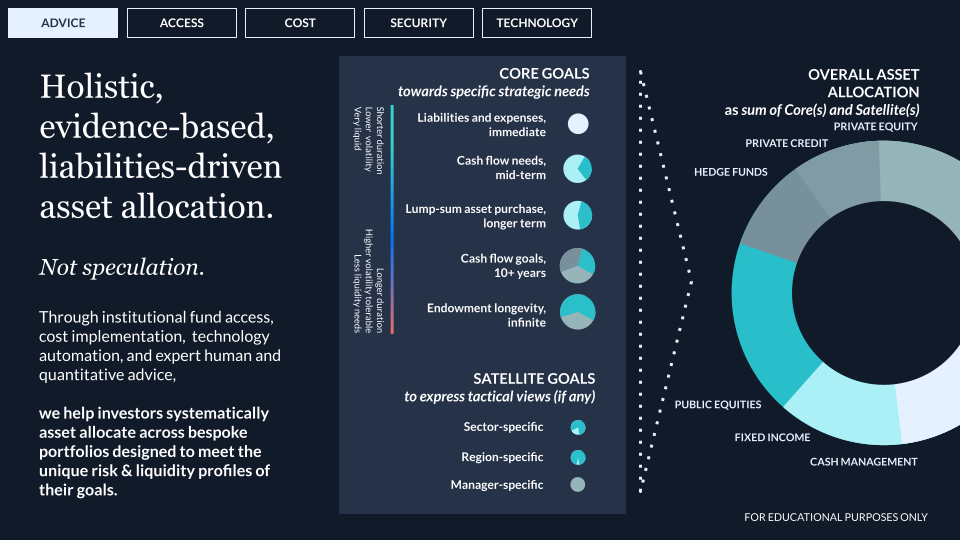
A structured financial plan identifies each goal, attaches a time horizon to it, and selects an investment strategy appropriate to that horizon.
Whether through Endowus or any other suitable platform, the key discipline is to invest with purpose: to know what each pool of money is for, when it will be needed, and what level of volatility is genuinely tolerable given that timeline.
How to invest and build portfolios towards your different goals
The retirement savings gap facing Hong Kong investors is not primarily a product of market risk or poor investment choices. It is a product of under-saving relative to the cost of retirement, compounded by the structural limitations of a mandatory scheme that was designed as a foundation, not a complete solution.
The actions that close this gap are available to most investors and do not require sophisticated market views. They require consistency, low costs, and a clear understanding of what each investment is working towards.
For long-term retirement savings beyond MPF, a globally diversified equity-weighted portfolio, held at low cost and maintained through market cycles, remains the most evidence-supported approach.
For shorter-term goals such as property purchase, children’s education, the priority is matching the risk profile of the portfolio to the time available and the consequences of a shortfall.
Endowus, for example, is one available platform that offers a unified account for both. Alongside allocating savings to their MPF, investors have the option to invest via Fund Smart — which provides access to over 400 funds across equity, fixed income, and multi-asset strategies from more than 100 global fund managers. You can start with our Flagship Portfolios which offers you a one-stop-solution to an expert-built, globally diversified low-cost portfolio starting at just HK$10,000. More advanced investors can DIY your own portfolios and tweak the portfolio allocations to suit your personal risk appetite, preference, and goals.
Retirement planning in Hong Kong goes far beyond MPF performance. True financial security requires a holistic strategy: planning for life goals, investing with purpose, and starting as early as possible. Speaking with a professional financial advisor can also help to bring clarity around your financial goals. Together you may be able to close your retirement gap for good.
Not sure how is the right portfolio or investment choice for you? Schedule an advisory call to get personalised advice from our team of SFC-licensed client advisors to guide you through your investment journey.
Read more:
- How much do you need to retire in Hong Kong?
- Plan for retirement with this simple checklist
- MPF Must-knows: Consolidation and Tax-deductible Voluntary Contributions (TVC)
Risk Warnings
Investment involves risk. Past performance is not an indicator nor a guarantee of future performance or returns. Projected performance or returns is not guaranteed to materialise. The value of investments and the income from them can go down as well as up, and you may not get the full amount you invested. Rates of exchange may cause the value of investments to go up or down. Individual stock performance does not represent the return of a fund.
General risk warnings relating to collective investment schemes
Before making an investment decision, you are reminded to refer to the relevant prospectus/offering document for specific risk considerations and related fees and charges. Funds are not a bank deposit and not capital guaranteed, and are subject to investment risks, including the possible loss of the principal amount invested. Some of the funds also involve derivatives. Do not invest in them unless you fully understand and are willing to assume the risks associated with them.
Opinions
Any forward-looking statements, prediction, projection or forecast on the economy, stock market, bond market or economic trends of the markets contained in this material are subject to market influences and contingent upon matters outside the control of Endowus HK Limited (“Endowus”) and therefore may not be realised in the future. Further, any opinion or estimate is made on a general basis and subject to change without notice. In presenting the information above, none of Endowus HK Limited, its affiliates, directors, employees, representatives or agents have given any consideration to, nor have made any investigation of the objective, financial situation or particular need of any user, reader, any specific person or group of persons. Therefore, no representation is made as to the completeness and adequacy of the information to make an informed decision. You should carefully consider whether any investment views and products/services are appropriate in view of your investment experience, objectives, financial resources and relevant circumstances. You may also wish to seek financial advice through a financial advisor or the Endowus platform and independent legal, accounting, regulatory or tax advice, as appropriate.
No invitation or solicitation
Nothing contained in this article should be construed as a solicitation, an offer to buy or sell, or recommendation, to acquire or dispose of any security, commodity, investment or to engage in any other transaction in any jurisdiction in which such solicitation, offer to buy or sell would be unlawful under the securities laws in such jurisdiction. No information included in this article is to be construed as investment advice or as a recommendation or a representation about the suitability or appropriateness of any advisory product or service; or an offer to buy or sell, or the solicitation of an offer to buy or sell, any security, financial product, or instrument; or to participate in any particular trading strategy. Investors should seek independent financial and tax advice before making any investment decision.
This advertisement has not been reviewed by the Securities and Futures Commission or any regulatory authority in Hong Kong.


.png)