.webp)
.webp)
.webp)
.webp)






- Passive income from investing is the yield your capital produces — dividends, coupons, and fund distributions — so reaching a monthly target depends mostly on how much capital you have invested.
- Dividend stocks and bonds can both pay an income: equities can grow and offer partial inflation protection but are more volatile, while bonds pay more predictable income but are sensitive to inflation and interest rates.
- Yield is not the same as total return, and you may not need yield at all — in Hong Kong, where individuals pay no tax on capital gains, dividends, or local bank-deposit interest, a portfolio can fund a regular income efficiently by selling from its capital growth.
Hong Kong savers who built an income plan around the Hong Kong dollar time-deposit rates of 2023 are now reinvesting their maturing balances into a very different market. Preferential new-fund time-deposit rates have eased to around 2.4% per annum, well below the levels on offer two years earlier — even though the Hong Kong Monetary Authority (HKMA) raised its Base Rate to 4.25% in September 2026, its first increase since 2023, tracking the US Federal Reserve through the currency peg.
This article argues that the right way to think about passive income is not "which asset yields the most", but "how much capital each level of income requires, and what you give up to reach it" — and that dividend stocks and bonds are best understood as complements rather than rivals.
It sets out what passive income means for an investor, how much capital a given monthly income actually takes, what dividend equities and bonds each pay and where each can disappoint, how the two compare on the dimensions that matter, and how the mix should shift with your time horizon.
What does passive income mean for an investor?
For an investor, passive income is the income your capital produces without selling the underlying asset: dividends from shares, coupons from bonds, and distributions from funds. Reaching a monthly target is therefore, first and foremost, a function of how much capital you have invested and the yield it earns.
How much capital does HK$10,000 a month actually take?
A target income divided by a sustainable yield gives the capital you need to generate that income. The sample table below shows the capital required to generate three different levels of monthly income, at four illustrative yields.
Clearly, a higher yield makes it easier to reach the goal. But moving to higher yields means accepting more risk to the overall capital, because in markets a higher yield is compensation for something — price volatility, credit risk, or a payout that consumes capital. That trade-off, rather than any single "best" yield, is the key topic.
What do dividend stocks actually pay — and when do they disappoint?
A dividend is a share of a company's profits paid to shareholders, usually twice a year in Hong Kong. The board decides whether to pay, and can cut or suspend the payout at any time. Increasingly, companies also return cash through buybacks; a buyback lifts per-share metrics and can support the price, but the shareholder realises the benefit only by selling, and market value does not always adjust as cleanly as the theory implies.
At the index level, the Hang Seng Index's dividend yield is 2.93% as of the latest factsheet at the time of writing. That yield reflects the composition of the local market: heavy in financials (HSBC, AIA, and other large mainland banks) and in internet and technology names such as Tencent, Alibaba, and Meituan, with a smaller cohort of high-growth companies that pay little or nothing. The Hang Seng TECH Index, dominated by such firms, yielded just 1.03% over the same period.
It is important to note that when the dividend-paying sectors do well, the income can be generous; when they do not, payouts and prices can fall together.
More in depth, dividend income is not guaranteed, and can always be reassessed. A payout ratio (the share of earnings paid out) that is too high leaves a company little room if profits fall, and a business that has trained investors to expect a high dividend may face a sharp sell-off if it cuts.
Intuitively, a dividend backed by growing profits is more durable than one financed by borrowing or by running down reserves. A share price also adjusts downward when a stock goes ex-dividend, so a payout transfers value from capital to cash rather than creating it. The useful question is not which share yields most, but whether the income is covered by earnings and the exposure is spread.
What two risks do bond investors most often miss?
A bond pays a fixed coupon and, for an individual bond held to maturity, returns your principal with the final payment. That perceived predictability is what makes bonds a natural basis for an income portfolio. Two risks, however, are easy to overlook.
The first is interest-rate risk. When rates rise, the market price of an existing bond falls, because its fixed future cash flows are discounted at a higher rate; the longer the bond's duration, the sharper that move (see our explainer on bond yields and duration). An investor who may need to sell before maturity is exposed to this even on a government bond.
The second is credit risk, i.e. the chance the issuer cannot pay. The market compensates for it with a spread, a higher yield over a comparable government bond, and that spread is not static: in the March 2020 stress the US high-yield spread widened to roughly 10.9% (ICE BofA index, via FRED), from low-single-digit levels weeks earlier. Calm is not the natural state of credit.
A third risk - typically overlooked - is reinvestment risk, and it is currently relevant for Hong Kong income investors. As the deposits of 2023 - which carried higher rates - mature, the proceeds may have to be redeployed at lower rates. The government's retail bonds illustrate the shift: the latest Silver Bond, aimed at older residents, carries a guaranteed minimum rate of 4.25% per annum — up from the 3.85% floor of a year earlier, but below the 5.00% that the maturing 2023 Silver Bond paid. Rates, however, rise and fall, and past performance is not a guarantee for future returns.
For most investors, a bond fund is a more practical route than assembling individual bonds, because it spreads issuer risk across many holdings. The trade-off is that a fund has no single maturity date: it buys and sells continually, and its price and income move with the bonds it holds and the level of rates.
How do dividends and bonds compare, side by side?
Hong Kong's tax treatment is unusually favourable for income investors. Under its territorial system there is no capital gains tax, no tax on dividends, and no tax on interest from deposits with authorised institutions in Hong Kong (Inland Revenue Department; Financial Services and the Treasury Bureau). Fund distributions and non-Hong Kong income can carry their own treatment, so confirm your own position with a professional adviser or the Inland Revenue Department.
Is yield the same as return?
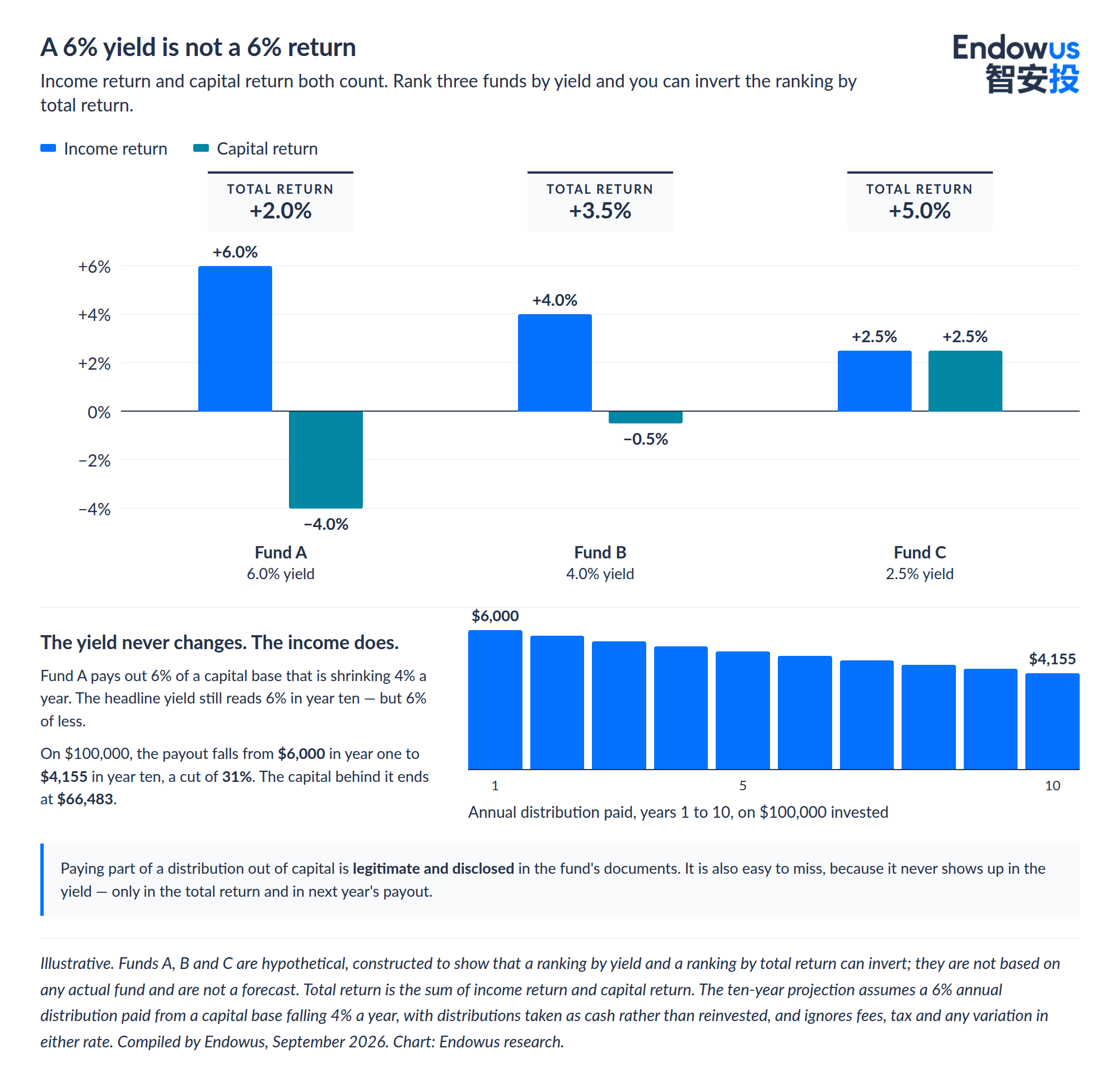
No. Total return is income plus the change in the capital's value (either a gain or a loss). Suppose a fund distributes 6% over a year while the value of its holdings falls 4%: the income looks healthy, yet the total return is roughly 2%, and the capital base that produces next year's income has shrunk. Some funds also pay part of their distribution out of capital rather than income, which flatters the headline yield while reducing the principal, a legitimate, disclosed feature that is easy to miss.
An additional overlooked topic is whether you may need yield to draw an income at all. A portfolio built for total return can fund spending by selling a small slice of capital when needed, basically a "homemade dividend". Because a share price typically falls when a dividend is paid, taking HK$10,000 in dividends or selling HK$10,000 of shares can leave you, before costs, in much the same position. In Hong Kong, with no capital gains tax and no tax on dividends, realising gains to fund income is as tax-efficient as receiving a distribution, and it lets you choose the timing and the amount rather than accepting whatever a company or fund decides to pay.
There are two sensible conclusions to draw from all this:
- An unusually high yield may reflect a genuinely higher-yielding asset, or simply be consuming capital.
- Income is a decision about cash flow, not about specific assets that offer it explicitly: what matters is the total return your capital earns, net of fees, rather than the form in which you draw it (capital gains, coupon, or dividend).
How should the mix change as you approach retirement?
A common mistake in income investing is aiming for payouts too early. An investor 20 years from retirement usually does not need income at all: reinvested total return compounds faster than payouts spent along the way, and tilting a young portfolio toward high-yield assets may sacrifice growth.
Moreover, selling to fund spending looks harmless while markets rise, but selling after a sharp fall locks in losses and can permanently shrink the capital that has to last — a danger known as sequence-of-returns risk. This is why income assets matter most in retirement: a buffer of bonds and steady distributions may let a retiree meet spending without selling growth assets at the wrong moment, leaving those holdings to recover.
Investment implications
For investors still accumulating, a globally diversified growth allocation such as the Endowus Flagship Portfolios may be better suited: a portfolio compounding through capital appreciation need not manufacture income at all, and gains can be realised — untaxed for Hong Kong individuals — if and when spending needs arise. Money needed within a year or two can sit in a lower-risk cash solution such as Endowus CashUp rather than being stretched for yield. For those at or near drawdown, the Endowus IncomeUp Portfolios are built to pay a regular monthly distribution, with current target payouts ranging from 4.0% to 5.0% per annum on IncomeUp Growth up to 6.5% to 7.5% per annum on IncomeUp Plus. Current payout targets are estimates only and are not guaranteed. Past performance is not a guarantee of future returns.
Dividend equities may offer income with a measure of inflation protection, at the cost of higher price volatility. Bonds may offer steadier, more predictable income, but their fixed coupons can lose real value to inflation and their prices fall when rates rise. A sound approach targets total return, net of fees, while holding enough of both to avoid selling growth assets at the wrong time to fund income.
Frequently asked questions
How much do I need to invest to generate HK$10,000 a month in Hong Kong?
It depends entirely on the yield you can sustainably earn. At a 3% yield you would need about HK$4 million, at 5% yield you would need HK$2.4 million. A lower capital figure implies a higher yield, and a higher yield implies more risk.
Are dividends taxable in Hong Kong?
For individual investors, no. Under Hong Kong's territorial tax system there is no capital gains tax, dividends are not taxed, and interest on deposits with authorised institutions in Hong Kong is exempt. Fund distributions and non-Hong Kong income can differ, so confirm your own position with the Inland Revenue Department.
Is a higher dividend yield always better?
No. A very high trailing yield may reflect a falling or flat share price rather than a generous, sustainable payout. What matters is whether the income is covered by earnings and whether the total return — income plus capital movement — holds up.
Are dividend stocks safer than bonds?
Neither is "safe"; they carry different risks. Dividend equities are more volatile in price and their payouts can be cut, while bonds offer steadier income (unless they’re in default) but lose real value to inflation and fall in price when rates rise. Most income investors hold both for that reason.
How can I start earning passive income from investments in Hong Kong?
Begin with your time horizon and the capital you can commit, then match assets to the job: growth assets while accumulating, more stable income assets as you approach drawdown, and a cash solution for money needed soon. A diversified fund portfolio spreads the risk that any single holding cuts its payout.
Disclaimer
Risk Warnings
Investment involves risk. Past performance is not an indicator nor a guarantee of future performance or returns. Projected performance or returns is not guaranteed to materialise. The value of investments and the income from them can go down as well as up, and you may not get the full amount you invested. Rates of exchange may cause the value of investments to go up or down. Individual stock performance does not represent the return of a fund.
General risk warnings relating to collective investment schemes
Before making an investment decision, you are reminded to refer to the relevant prospectus/offering document for specific risk considerations and related fees and charges. Funds are not a bank deposit and not capital guaranteed, and are subject to investment risks, including the possible loss of the principal amount invested. Some of the funds also involve derivatives. Do not invest in them unless you fully understand and are willing to assume the risks associated with them.
Opinions
Any forward-looking statements, prediction, projection or forecast on the economy, stock market, bond market or economic trends of the markets contained in this material are subject to market influences and contingent upon matters outside the control of Endowus HK Limited ("Endowus") and therefore may not be realised in the future. Further, any opinion or estimate is made on a general basis and subject to change without notice. In presenting the information above, none of Endowus HK Limited, its affiliates, directors, employees, representatives or agents have given any consideration to, nor have made any investigation of the objective, financial situation or particular need of any user, reader, any specific person or group of persons. Therefore, no representation is made as to the completeness and adequacy of the information to make an informed decision. You should carefully consider whether any investment views and products/services are appropriate in view of your investment experience, objectives, financial resources and relevant circumstances. You may also wish to seek financial advice through a financial adviser or the Endowus platform and independent legal, accounting, regulatory or tax advice, as appropriate.
No invitation or solicitation
Nothing contained in this article should be construed as a solicitation, an offer to buy or sell, or recommendation, to acquire or dispose of any security, commodity, investment or to engage in any other transaction in any jurisdiction in which such solicitation, offer to buy or sell would be unlawful under the securities laws in such jurisdiction. No information included in this article is to be construed as investment advice or as a recommendation or a representation about the suitability or appropriateness of any advisory product or service; or an offer to buy or sell, or the solicitation of an offer to buy or sell, any security, financial product, or instrument; or to participate in any particular trading strategy. Investors should seek independent financial and tax advice before making any investment decision. This advertisement has not been reviewed by the Securities and Futures Commission or any regulatory authority in Hong Kong.
Product Risk Rating
Please note that any product risk rating (the "PRR") provided by us is an internal rating assigned based on our product risk assessment model, and is for your reference only. The PRR is subject to change from time to time. The PRR does not take into account your individual circumstances, objectives or needs and should not be regarded as advice or recommendation to purchase, hold or sell any fund or make any other investment decisions. Accordingly, you should not solely rely on the PRR in making your investment decision in the relevant Fund.
Endowus HK Limited is licensed by the Securities and Futures Commission (CE No. BQR225) for Type 1 (Dealing in Securities), Type 4 (Advising on Securities), and Type 9 (Asset Management) regulated activities.


.png)