.webp)
.webp)
.webp)
.webp)






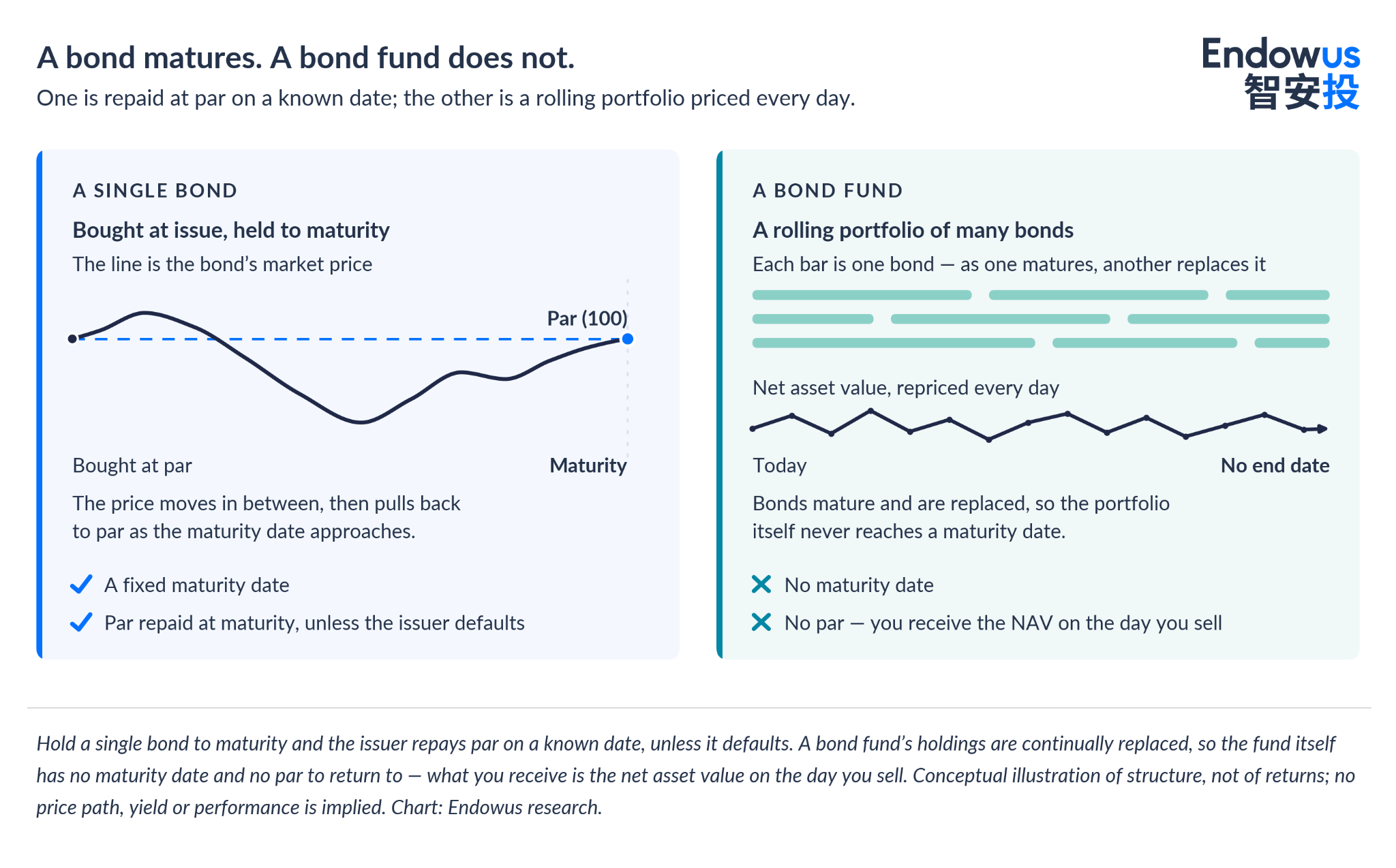
- A bond fund is not a bond: it has no maturity date and no par value to redeem at, so unlike a Silver Bond or a Treasury held to maturity, there is no point at which waiting returns your principal — you hold a rolling portfolio priced daily at its net asset value (NAV).
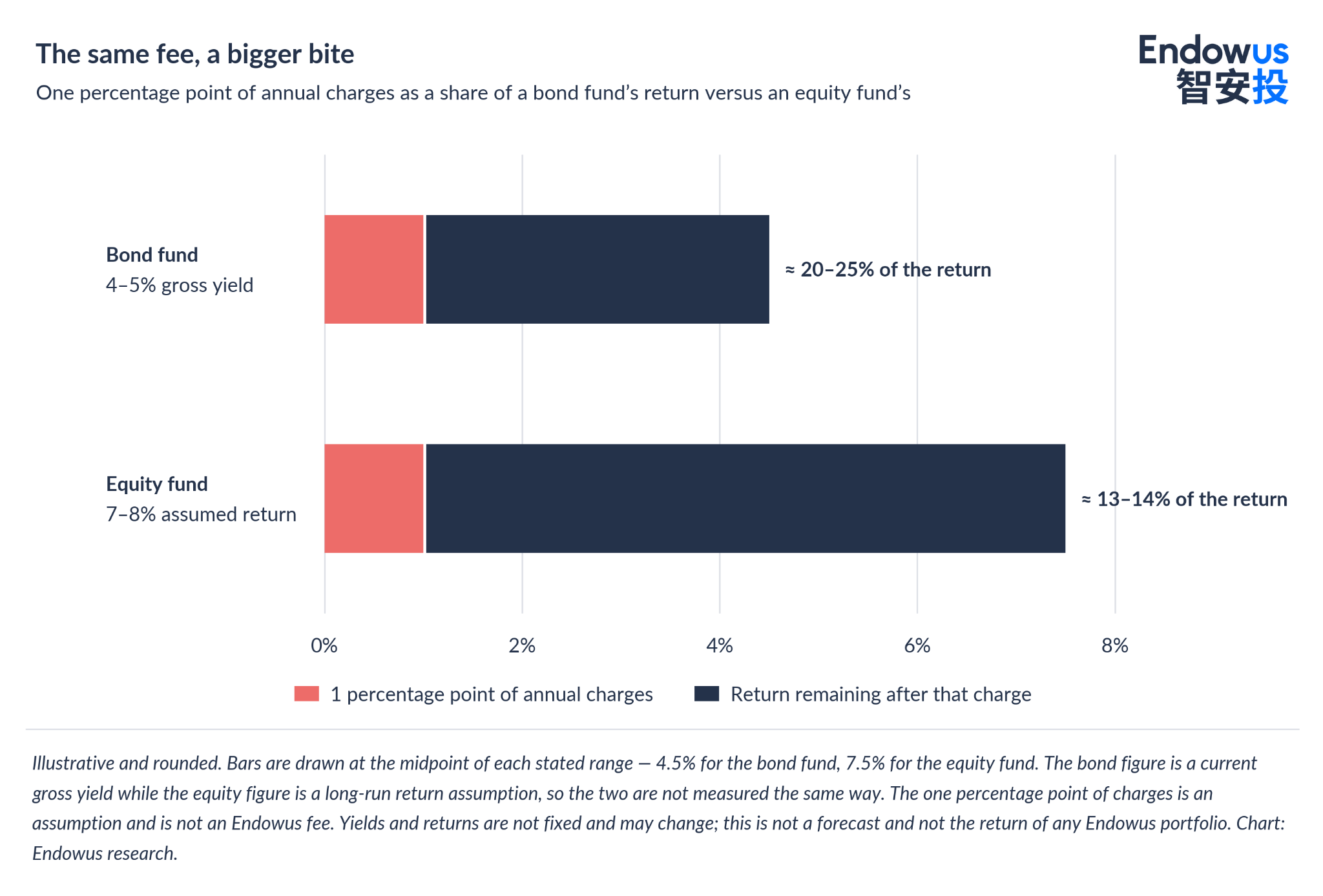
- Because fixed income yields less than equities, the same annual charge takes a larger share of your return: one percentage point of cost is roughly a fifth to a quarter of a 4% to 5% gross bond yield, against closer to an eighth of a 7% to 8% equity target (illustrative figures; yields and returns are not fixed).
- Duration, not the credit label, drives how much a bond fund's price moves when interest rates change: a fund with a duration of five may lose roughly 5% of its value for a one-percentage-point rise in yields, which is why a long-dated government bond fund can move more than a short-dated high-yield one.
Many Hong Kong investors may have bought a bond directly - a Silver Bond, or a US Treasury held to maturity - and come away with a clear mental model: you lend, you collect interest, and you get your principal back at the end. A bond fund looks like the same thing bought in bulk - just including different securities and potentially diversified. It is not.
This article makes two arguments. The first is structural: a bond fund has no maturity date and no par value to return to, so the certainty that makes a directly held bond feel like the predictable part of a portfolio does not carry over. The second is about cost: because fixed income yields less than equities, the same annual fee consumes a far larger share of your return - which is why what a bond fund charges matters more here than almost anywhere else in a portfolio.
What follows covers what a bond fund actually is, why it behaves differently from the bonds you may already own, the main types and what their labels mean, what they cost, the four yield numbers that are easy to mistake for your return, why duration explains sudden price moves, and the bond funds most Hong Kong residents already hold through the Mandatory Provident Fund (MPF) - before turning to how to read a factsheet and what all of this means for building a portfolio.
What is a bond fund?
A bond fund is a pooled portfolio of debt instruments - government bonds, corporate bonds, and similar securities - managed on investors' behalf and typically structured, in Hong Kong, as a unit trust. You buy units rather than a face value of bonds, and the fund is priced once each dealing day at its net asset value (NAV): the market value of everything it holds, divided by the units in issue. The Chinese term is 債券基金.
When you buy a bond, you own a specific claim: a fixed coupon, a known maturity date, and a face value - a “principal” - the issuer repays (provided it does not default). A bond fund owns hundreds of such claims at once, and the manager buys and sells them continuously - as issues mature, as strategy dictates, and as other investors put money in or take it out.
The MPFA describes a bond fund in simple terms: it is a vehicle that invests in bonds or debt instruments issued by governments, public bodies, banks, companies, or supranational agencies such as the World Bank, or institutions, such as the European Stability Mechanism. That breadth is a key feature. A single issue exposes you to one borrower (and the specific risk of that issue), while a fund spreads that exposure across many different issuers. Individuals may have difficulties diversifying fixed income exposure, as corporate bonds often trade in minimum denominations around US$200,000, which is steep for retail buyers.
Also key is the fact that bond funds typically never mature, as they buy and sell bonds to harness not just their yields, but potentially their capital gains too.
None of this makes a fund better or worse than a directly held bond, just different.
Why is a bond fund not a bond?
A Silver Bond or a US Treasury, if held to maturity, offers yearly coupons, and, on the maturity date, the principal at par regardless of what the bond traded at in between. In other words, even as the price of the bond changes throughout its life, at maturity the principal will always be paid at par - barring a default. Hong Kong's retail government bonds work exactly this way: the most recent Silver Bond carried a three-year tenor and is expected to return its principal at the end.
If you can hold to maturity, interim price swings should be treated as just noise.
In a bond fund, there is no maturity date, because the manager keeps rolling the portfolio - selling bonds before they mature and buying new ones - so there is no future point at which the fund converges on a fixed value. The fund typically manages their holdings by modifying them according to market conditions, macroeconomic factors, and fundamental analysis.
The NAV reflects today's market price of the underlying holdings, not what the manager paid for them, so a portfolio of perfectly performing bonds can still be marked down when market yields rise. And other investors' behaviour affects what you own: heavy redemptions can force a manager to sell holdings to meet them, crystallising losses for the investors who remain.
For the reader who wants the certainty of a maturity date and a par redemption, buying individual bonds directly is a legitimate route (Endowus's English-language compares fixed deposits to Silver Bonds, and Chinese-language guides are available on buying US Treasuries and on Silver Bonds). What a fund offers instead is diversification and institutional pricing.
What are the main types, and what do the labels mean?
Bond funds are usually sorted by what type of securities (government-issued, corporate, long-duration, short-duration, and so on) they hold and how much credit risk that implies. The labels reward close reading, because they encode the two forces that drive returns: the chance the borrower does not pay (credit risk), and the sensitivity of the fund's price to interest rates (which the next two sections take up).
Two points beyond this table. First, “high yield” is not a description of generosity; it means sub-investment grade — rated below BBB- or Baa3 by the major agencies — a higher assessed probability that the borrower does not pay. The higher yield is compensation for that risk, not a free enhancement. The IncomeUp model portfolio includes high-yield exposure.
Second, a fund can also be classified by how far the manager may deviate from a benchmark. A core fund tracks a broad benchmark closely. A core-plus fund holds a core with a sleeve of higher-yielding or off-benchmark positions. An unconstrained fund sets its own duration and credit exposure with no benchmark to anchor it.
Two clarifications on status. Bond exchange-traded funds (ETFs) do all of this in a listed, continuously traded wrapper; their mechanics sit in our ETF coverage rather than here. And authorisation is often misread: authorisation by the SFC is not a recommendation or endorsement of a fund, and does not guarantee its commercial merits or performance (IFEC). Where a strategy uses unconstrained or higher-risk exposures, the retail-versus-professional-investor boundary can matter; we cover who counts as a professional investor separately.
What does a bond fund cost, and why does the same fee hurt more here?
An SFC-authorised bond fund typically carries an initial (subscription) charge levied once when you buy; a management fee paid annually to the investment manager; and trustee, custodian, and administration fees. The recurring costs are bundled into a single figure on the factsheet — the ongoing charges figure (OCF), the fund's annual running cost as a percentage of assets.
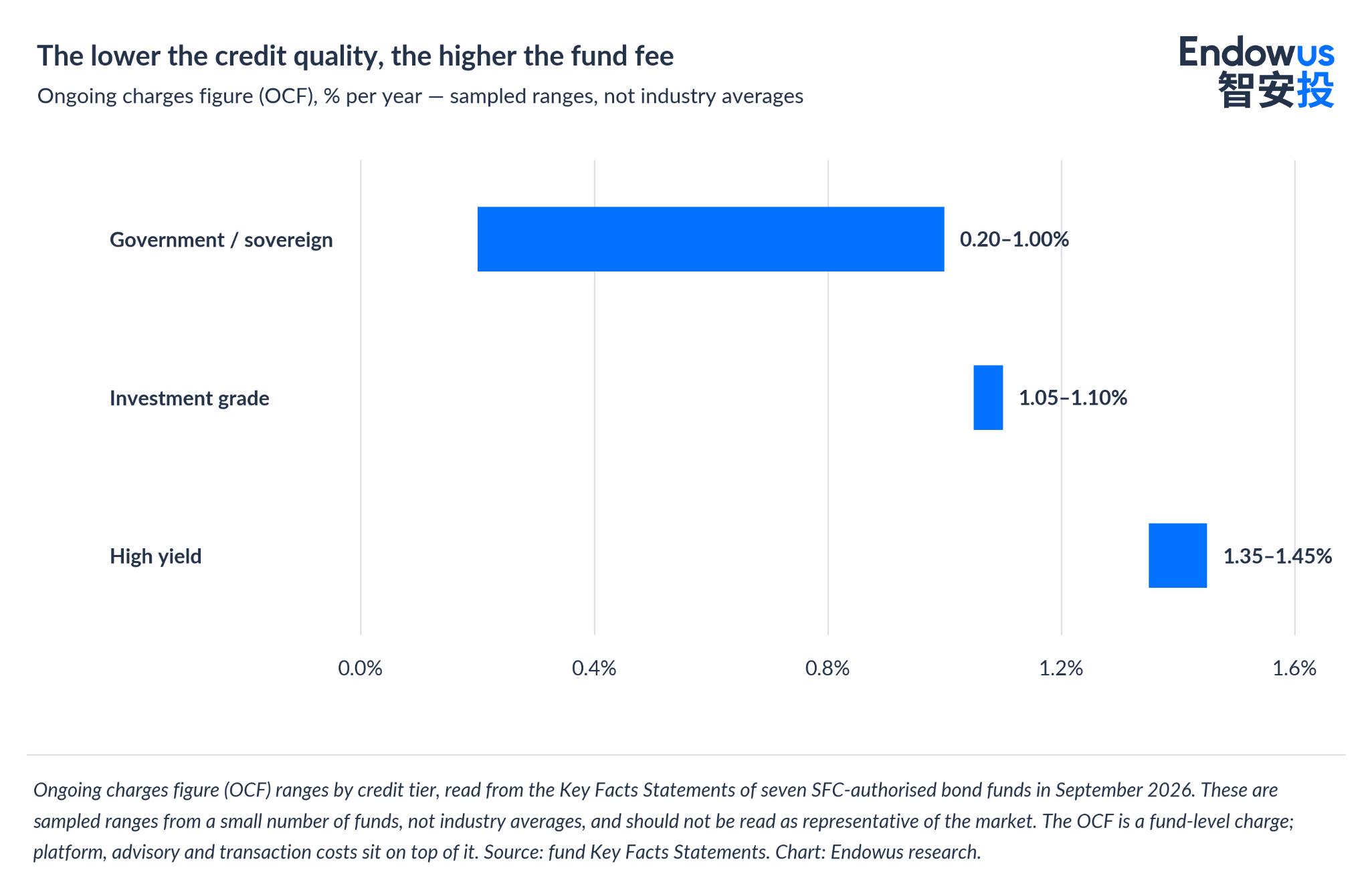
Across a sample of seven SFC-authorised bond funds' Key Facts Statements, the OCF varied systematically by credit tier. Government and sovereign funds ranged from roughly 0.2% a year for a passive, exchange-traded structure to around 1% for an actively managed global fund. Global and Asian investment-grade funds clustered near 1.05% to 1.1%. High-yield funds ran higher, roughly 1.35% to 1.45%, reflecting the research effort credit selection demands. Initial charges were commonly 3%, and as high as 5% on some share classes. These are sampled ranges, not an industry average, and not a recommendation of any fund.
But why is cost more relevant in bond funds? Take a fund with a gross yield of, say, 4% to 5% a year. One percentage point of annual charges removes roughly a fifth to a quarter of that income before you receive it. Higher potential returns in equity funds reduce the impact of total cost on your returns. These figures are illustrative and rounded — fund yields and returns are not fixed and change with markets — but the mathematical relationship holds.
There is a second cost most investors never see: the trailer fee. A portion of the management fee is commonly paid by the fund manager to whoever distributed the fund, for as long as you hold it, embedded in the fund's charges rather than shown as a separate line. Trailer fees are legal and disclosed; under the SFC's Code of Conduct, a distributor must disclose the maximum percentage of such monetary benefits it receives. The point is not that any intermediary acts improperly, it is that the trailer is a recurring drag you are entitled to know about, and one that compounds against the smaller return base fixed income starts from. This is precisely where institutional share classes and rebated trailers change the outcome by more than they would in an equity portfolio; we return to that in the implications.
Which yield number is your return, and which ones are not?
Fixed income presents at least four numbers that all look like “the return,” and none of them is. Pay attention:
The one to watch is the distribution yield. It tells you what the fund is paying out, not what you are earning. When a fund targets a payout, for instance, distributions may be paid partly out of capital. That is a return of your own money dressed as income: a positive distribution yield does not imply a positive total return, and paying out of capital reduces the NAV per unit accordingly. SFC-authorised funds must disclose when they distribute out of capital and make the composition available (IFEC). Read the distribution policy before you read the distribution yield.
What is duration, and why did the price move when rates did?
If a bond fund's price fell while the bonds inside it kept paying, duration is almost certainly the reason. Duration measures a bond portfolio's sensitivity to interest rates, and it is best treated as a rule of thumb: a fund with a duration of five may lose roughly 5% of its value for a one-percentage-point rise in market yields, and gain roughly the same on a fall. The relationship is inverse — prices rise when yields fall, and the reverse — and it is approximate. It holds well for small moves and degrades for large ones, and for bonds with embedded options, where the curvature the industry calls convexity pulls the true figure away from the straight-line estimate. For a deep-dive into duration, see our fixed income series here.
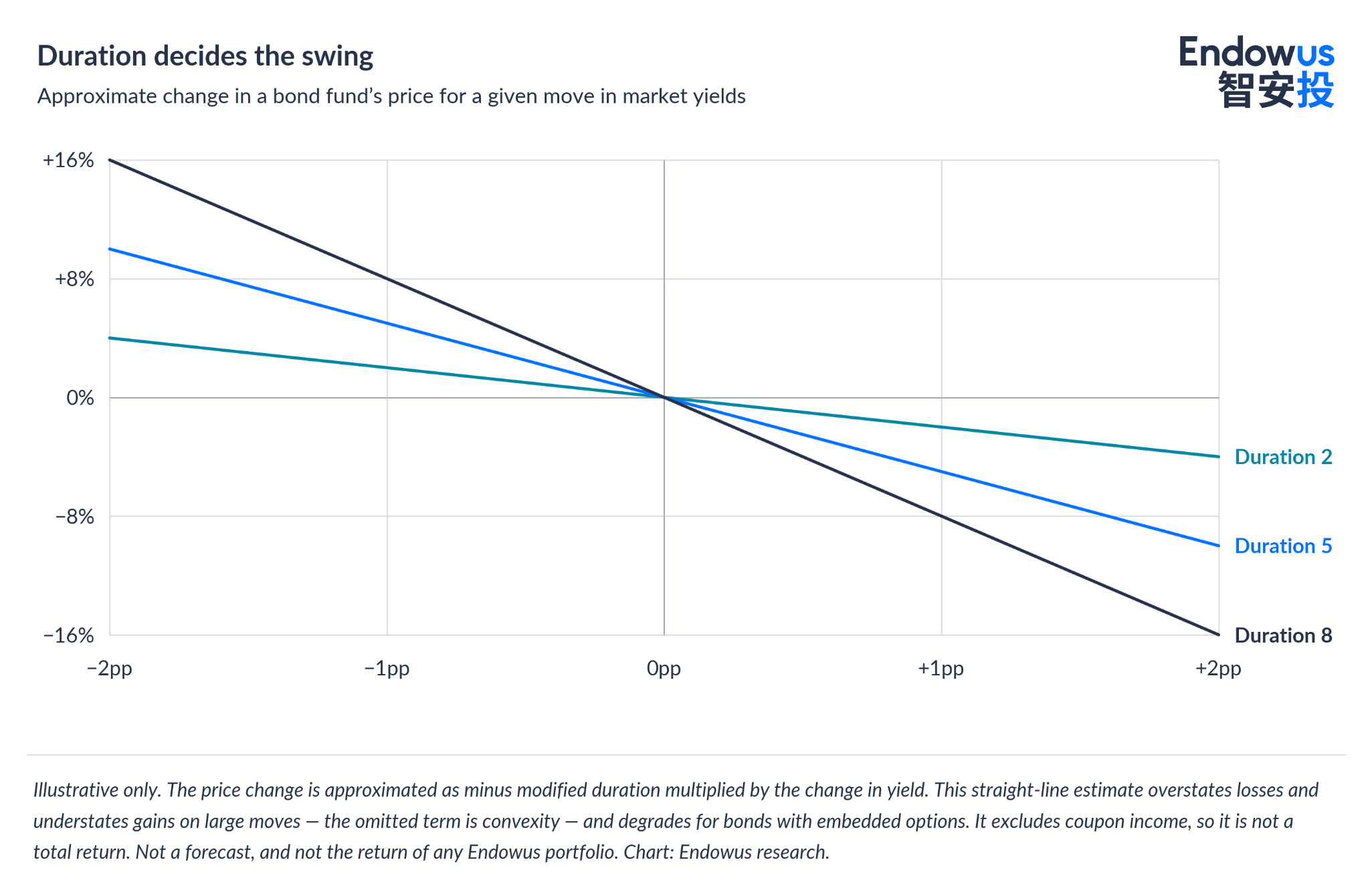
The practical consequence is that a government bond fund of the highest credit quality but a long duration can move more sharply when rates shift than a short-dated high-yield fund, because of its duration. This is the single number to check on a factsheet before buying. It is not that high-duration is bad for you, just that you need to be conscious of what type of sensitivity to interest rates your fund will have.
What about the bond funds you already own through the MPF?
Most Hong Kong residents already hold bond funds, whether or not they chose them: every MPF scheme offers them, and default and conservative options lean on them heavily. Under MPF rules, an MPF bond fund may hold only bonds meeting stipulated credit-rating or listing requirements, so these are investment-grade portfolios by construction — closer to the government and investment-grade tiers above than to high yield.
What varies is cost. The fund expense ratio (FER) is the MPF equivalent of the OCF, published on every scheme's fund fact sheet and on the MPF Fund Platform. MPF fund fees have fallen materially over the past decade, but bond-fund FERs still span a wide range and, on the whole, sit above comparable retail index funds — and the MPFA's own research is blunt that a higher fee does not imply a better return. Find the FER for the funds on your statement, and compare like with like.
When MPF savings become accessible and are withdrawn, they can be redeployed into a wider and often cheaper set of fixed-income funds than a scheme's menu allows — a portfolio-construction decision rather than a contribution one, and the point at which the cost discipline in this article starts to compound in your favour.
How do you read a bond fund factsheet?
A factsheet may answer all of your questions about the bond fund, if you know where to look. Five things are worth finding before you buy. Duration gives you the interest-rate sensitivity from the previous section. The credit-quality breakdown — the split across rating bands — tells you how much of the yield is compensation for credit risk. The ongoing charges figure is the annual cost. The yield figure is interpretable only once you check which measure it is and read its definition in the notes. And the distribution policy tells you whether income is paid out or accumulated, and whether it may come from capital.
But a factsheet rarely makes plain what your distributor is being paid to sell you the fund (the trailer discussed above). And where past performance is shown, it is typically gross of any initial charge you paid. Past performance, in any case, is not a guide to future performance or returns, and is not the basis on which to choose a fund. This mirrors how to read a Key Facts Statement more generally, which we cover in our unit trusts guide.
Investment implications
The through-line of this article is that fixed income rewards attention to structure and cost more than almost any other asset class, because its returns are typically lower and its risks typically less intuitive than the “bonds are the ballast” shorthand suggests. Two decisions follow.
The first is your goals. For bond-led income within a diversified portfolio, the IncomeUp model portfolio is built for the purpose; for readers who now know what to look at and want to choose their own funds, Fund Smart provides the selection; and the diversified Flagship portfolios hold fixed income as part of a broader allocation.
The second is cost. Endowus HK Limited charges an access fee of 0.1% to 0.6% a year, no sales or subscription fees, and rebates 100% of trailer fees back to you, from a minimum of HK$10,000. In our view, that structure matters more in fixed income than anywhere else in a portfolio, for the reason set out above: when the return base is a 4% to 5% gross yield rather than a 7% to 8% equity target, removing the sales charge and returning the trailer changes a materially larger share of what you keep. Bond funds carry market and credit risk and offer no capital guarantee; what an investor can control is the cost of accessing them.
Frequently asked questions
What is a bond fund?
A bond fund is a pooled portfolio of bonds and other debt instruments, managed on investors' behalf. You own units rather than a face value of a specific bond or specific bonds. It provides diversified fixed-income exposure that would likely be difficult and costly to assemble by buying individual bonds.
What is the difference between a bond fund and holding a bond to maturity?
A directly held bond has a maturity date and returns its principal at par if the issuer does not default. A bond fund has neither a maturity date nor a par value: the manager continuously rolls the portfolio.
Are bond funds a good investment now?
Whether a bond fund suits you depends on your circumstances, not on timing alone. Check three things, in order: duration, which sets its sensitivity to interest-rate moves; credit quality, which sets how much of the yield is compensation for risk; and ongoing charges, which are potentially a larger drag on fixed-income returns than on equities, due to typically lower returns. Match those to your horizon and risk tolerance.
Are fixed income securities risky?
Yes, in two distinct ways. Credit risk is the chance a borrower does not repay, and it is highest in sub-investment-grade (high-yield) funds. Duration risk is the sensitivity of a fund's price to interest-rate changes, and it surprises people more — a highest-quality government bond fund with long duration can fall further than a short-dated high-yield fund when yields rise. Neither risk disappears inside a fund.
What is the difference between equity and fixed income securities?
A share is ownership in a company, with returns from price appreciation and dividends, and no maturity. A bond is a loan to an issuer, with returns from interest and repayment of principal at maturity, ranking ahead of shareholders if the issuer fails. Fixed income is generally lower-risk and lower-return than equity.
What are fixed income securities?
Fixed income securities are debt instruments — bonds and similar — on which an issuer pays interest and repays principal at a set date. Issuers include governments, companies, and supranational bodies. They are held for income and diversification, and carry credit and interest-rate risk.
Do bond funds pay monthly income in Hong Kong?
Some do; distribution frequency varies by fund and share class, and distributing share classes pay income out while accumulating ones reinvest it. The choice between them is one many investors make without noticing. A monthly distribution is not the same as a return, and may include a return of capital. For a bond-led income portfolio, see IncomeUp.
Disclaimer
Risk Warnings
Investment involves risk. Past performance is not an indicator nor a guarantee of future performance or returns. Projected performance or returns is not guaranteed to materialise. The value of investments and the income from them can go down as well as up, and you may not get the full amount you invested. Rates of exchange may cause the value of investments to go up or down. Individual stock performance does not represent the return of a fund.
General risk warnings relating to collective investment schemes
Before making an investment decision, you are reminded to refer to the relevant prospectus/offering document for specific risk considerations and related fees and charges. Funds are not a bank deposit and not capital guaranteed, and are subject to investment risks, including the possible loss of the principal amount invested. Some of the funds also involve derivatives. Do not invest in them unless you fully understand and are willing to assume the risks associated with them.
Opinions
Any forward-looking statements, prediction, projection or forecast on the economy, stock market, bond market or economic trends of the markets contained in this material are subject to market influences and contingent upon matters outside the control of Endowus HK Limited (“Endowus”) and therefore may not be realised in the future. Further, any opinion or estimate is made on a general basis and subject to change without notice. In presenting the information above, none of Endowus HK Limited, its affiliates, directors, employees, representatives or agents have given any consideration to, nor have made any investigation of the objective, financial situation or particular need of any user, reader, any specific person or group of persons. Therefore, no representation is made as to the completeness and adequacy of the information to make an informed decision. You should carefully consider whether any investment views and products/services are appropriate in view of your investment experience, objectives, financial resources and relevant circumstances. You may also wish to seek financial advice through a financial advisor or the Endowus platform and independent legal, accounting, regulatory or tax advice, as appropriate.
No invitation or solicitation
Nothing contained in this article should be construed as a solicitation, an offer to buy or sell, or recommendation, to acquire or dispose of any security, commodity, investment or to engage in any other transaction in any jurisdiction in which such solicitation, offer to buy or sell would be unlawful under the securities laws in such jurisdiction. No information included in this article is to be construed as investment advice or as a recommendation or a representation about the suitability or appropriateness of any advisory product or service; or an offer to buy or sell, or the solicitation of an offer to buy or sell, any security, financial product, or instrument; or to participate in any particular trading strategy. Investors should seek independent financial and tax advice before making any investment decision.
This advertisement has not been reviewed by the Securities and Futures Commission or any regulatory authority in Hong Kong.
Endowus HK Limited (CE No. BQR225) is licensed by the Securities and Futures Commission to carry on Type 1 (dealing in securities), Type 4 (advising on securities) and Type 9 (asset management) regulated activities.


.png)