.webp)
.webp)
.webp)
.webp)





- An American Depositary Receipt (ADR) is a US-listed certificate that represents shares of a non-US company, letting Hong Kong investors hold names such as Alibaba, Tencent, or HSBC in a single US-dollar-denominated instrument.
- Because the ADRs of major Hong Kong companies trade in New York while the Hong Kong market is closed, many local traders watch the “ADR index” as an overnight signal for the next day’s open — though it is not a guarantee, since ADRs can trade at a significant discount or premium to the actual listed shares.
- For most long-term investors, a diversified US-market fund may offer cleaner and more efficient exposure than a self-assembled portfolio of individual ADRs, given single-name concentration risk, withholding tax, and holding costs.
Some of Hong Kong's most widely held companies trade in two places at once. Alibaba changes hands as 9988 on the Hong Kong exchange and, several time zones away, with the ticker “BABA” in New York.
So what exactly is the New York-traded financial instrument, and does it matter which one you own? The goal for this guide is to answer basic questions about ADRs, and help understand what are the advantages of a potential exposure versus acquiring the original stock. In an extremely simplified way, an ADR leaves the company's fundamental risk unchanged and adds a layer of wrapper risks related to the market where it is trading — liquidity, currency, premium, and structural/delisting — that belong to the receipt itself rather than to the underlying business.
In this piece, we will cover what an ADR is, how the structure works, which Hong Kong names are trading as ADRs in the US, how other regional technology giants such as TSMC and SK Hynix fit the same picture, why traders watch the overnight ADR index, how an ADR compares with the local share, and — most importantly — where ADRs fit alongside a diversified, goal-based exposure.
What are ADRs, and why Hong Kong investors keep encountering them
An American Depositary Receipt (ADR) is a certificate issued by a US depositary bank that represents shares of a company listed outside the United States. It trades on a US exchange, in US dollars, during US market hours, but it stands in for ordinary shares held on deposit in the company’s home market.
For Hong Kong investors, what is important to know is that a company such as Alibaba can be bought as its Hong Kong-listed ordinary share or as its US ADR. Both give you economic ownership of the same business. They are, however, separate securities that settle in different systems and trade at their own prices.
This is why the topic keeps surfacing. Several of Hong Kong’s largest companies carry a US listing, financial news quotes both prices, and the gap between them — the ADR premium or discount — is a routine talking point.
How ADRs actually work: sponsors, ratios, and the plumbing between Hong Kong and New York
Behind each ADR is a depositary bank that holds the underlying ordinary shares in custody in the home market and issues receipts against them in the US. When you buy an ADR, you own the receipt; the bank owns the shares on your behalf.
Two elements are key.
The first is whether a programme is sponsored or unsponsored. A sponsored ADR is set up with the company’s cooperation - Alibaba, HSBC, and JD.com fall into this group. An unsponsored ADR is created by one or more banks without the company’s direct involvement, which is common for names such as Tencent and Xiaomi.
The second is the ADR ratio, which tells you how many ordinary shares one ADR represents. The ratio is often not one-to-one. One HSBC ADR, for example, represents five ordinary shares, so its US price should be roughly five times the local share price, adjusted for currency.
ADR programmes also come in levels. Level I trades over the counter with light disclosure; Level II and Level III involve a full US exchange listing and stricter reporting. For everyday investors, the level mainly signals where the ADR trades and how much company disclosure sits behind it.
The major Hong Kong ADRs at a glance
The table below lists widely followed Hong Kong and mainland Chinese companies that trade both locally and as US ADRs. It is included for illustration only and is not a recommendation to buy, hold, or sell any security. ADR ratios and programme details are shown as at publication and may change, so confirm current terms with the depositary bank or your broker before acting.
Two patterns stand out. Sponsored, dual-primary listings such as Alibaba and JD.com tend to have the deepest disclosure and the tightest link between the two prices. Unsponsored ADRs such as Tencent’s exist mainly for US convenience and can have thinner liquidity and be less closely tracked.
Beyond Hong Kong: the Asian tech ADRs investors are watching
Hong Kong investors increasingly look beyond local names to the Asian technology leaders that anchor the global artificial intelligence (AI) supply chain. Two come up most often, and neither is listed in Hong Kong: Taiwan Semiconductor Manufacturing Company (TSMC) and SK Hynix. As with the Hong Kong names above, both are cited here as illustrative examples, not recommendations.
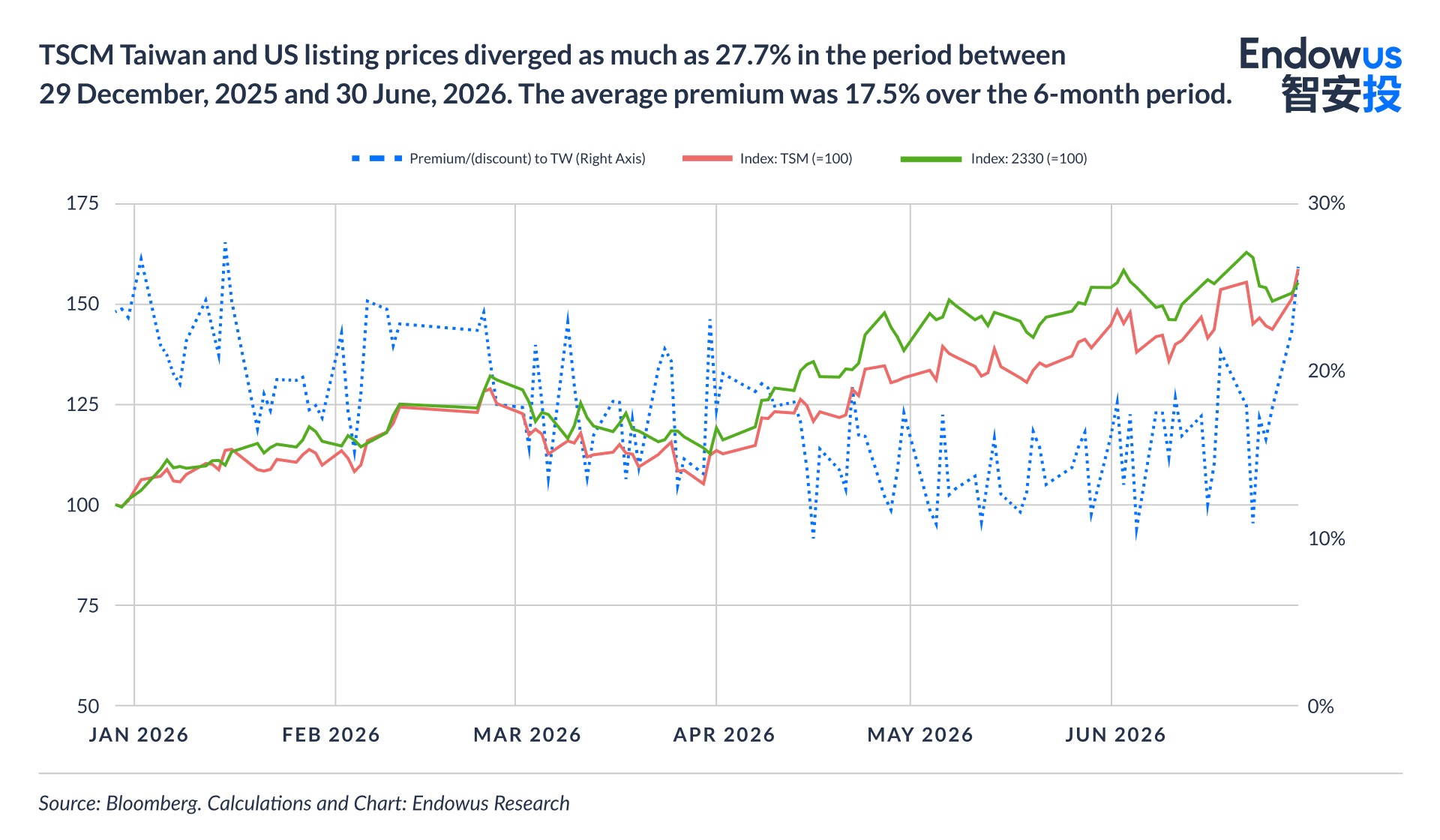
TSMC trades in Taipei as 2330 and in New York as an ADR under the ticker TSM, where one ADR represents five ordinary shares. The TSM ADR is notable because it has often traded at a significant premium to the Taiwan-listed shares (as seen in the chart further below).
More recently, SK Hynix listed on the Nasdaq under the ticker SKHY, in what was reported as the largest ADR listing on record at around US$26.5 billion. The US listing increased the availability of capital, pushing the ADR’s valuation to a (temporary maximum) ~51% premium over the original Korean share’s price.
Why Hong Kong traders watch the ADR index for tomorrow’s open
The US-listed ADRs of major Hong Kong names trade on US markets when Hong Kong is closed, and moves in those ADRs may be converted back into an implied Hong Kong price. Aggregated across the large index constituents, this produces what local traders call the ADR index, or the overnight (“night”) ADR reading.
The appeal is obvious. It offers a rough overnight read on where the Hong Kong market may open, hours before trading resumes. If US-listed Chinese ADRs sell off overnight, the ADR index points lower, and many traders treat that as an early warning.
It is, however, a signal rather than a guarantee. The implied level can be distorted by the ADR premium or discount, by currency moves between the US dollar and the Hong Kong dollar, and by thin overnight liquidity.
Why an ADR can trade at a premium or discount to the local share
An American Depositary Receipt and its underlying local share do not necessarily trade at the same price, as we’ve seen above. There are, however, differences between a sponsored and an unsponsored ADR in the magnitude of that price difference.
In a sponsored programme, the depositary bank permits conversion in both directions — ordinary shares deposited in exchange for new receipts, receipts cancelled in exchange for the underlying shares. When the receipt trades materially above fair value, a participant able to buy the cheaper local shares, deliver them to the depositary and sell the resulting receipts has a clear incentive to do so until the discrepancy is for the most part arbitraged away. The lower the frictional cost of that conversion, the narrower the gap the market tolerates.
Conversion fees, settlement delays and the limited overlap between Asian and US trading hours all slow the process, while restrictions on foreign ownership or on cross-border capital flows can suspend it entirely. Where the creation of new receipts is capped — as it is for several Asian issuers — the additional supply required to close a premium cannot readily be manufactured, and the premium may endure for years. Unsponsored programmes, which offer no orderly conversion route, exhibit the widest and most durable dislocations.
This invites the obvious question of whether a persistent premium can be captured. In practice it rarely can. Where conversion is straightforward, arbitrage closes the gap before most investors are able to act, which is why liquid dual-primary lines trade close to parity. Where a substantial premium persists, it reflects precisely the constraints described above, so a position established in anticipation of convergence carries no assurance of when — or whether — that convergence will occur, and may move further against the holder in the interim.
For the ordinary investor, the more useful interpretation is that a standing premium represents a cost incurred at purchase rather than an opportunity to be exploited.
The risks an ADR transfers, and the risks it adds
An ADR alters the overall risk profile of a holding while maintaining idiosyncratic risk intact — its exposure to earnings, management, competitive position and home-market regulation is identical to that borne by a holder of the ordinary shares.
- Liquidity, both on the supply and on the demand side. A receipt is a separate security with its own order book, and its depth need not match that of the home line. For sponsored programmes in large companies, liquidity is generally ample; for unsponsored or over-the-counter lines, spreads are wider and the capacity to transact in size is materially reduced. This risk is mitigated where conversion is available, since a holder unable to sell the receipt economically may convert into the more liquid local shares — but that recourse narrows precisely where issuance is capped or a programme is unsponsored. On the other hand, US-venue liquidity and accessibility (dollar settlement, options, easy access for investors who can't readily buy Taiwan directly, index/mandate demand) typically pulls demand into the ADR and pushes it to a premium. While excess ADR demand can be met by creating more receipts — deposit local shares, issue new ADRs — until the premium collapses to conversion cost, that supply response can be capped - such as by Taiwan's regulation of ADR issuance for TSMC - so the premium-closing direction of arbitrage is blocked.

As the previous example shows, Alibaba has enormous US demand too, yet average premium/discount tends to be close to 0 in the medium to long run (the chart shows an average premium close to 0 for the time between 29 December 2025 and 30 June 2026) — because conversion to local stocks is unconstrained and demand can get absorbed by new receipts. TSMC has the same kind of demand but capped issuance, so the ADR premium sat at an average ~17% for the period between 29 December 2025 and 30 June 2026. Same demand force; different supply constraint; opposite outcome.
- Currency. A receipt is priced, and its dividends paid, in US dollars, so a Hong Kong investor assumes exchange-rate risk between the US dollar and the currency in which they measure their wealth.
- Structural risk. A US listing brings the receipt within US regulatory reach, including audit-inspection and delisting provisions that have, at times, threatened the continued New York listing of Chinese companies. That exposure attaches to the receipt rather than to the underlying business, which is one reason a Hong Kong-listed line may represent the more resilient means of holding an otherwise identical company.
The tax treatment and holding costs of an ADR
Tax treatment is frequently misunderstood, and the misunderstanding usually concerns withholding. The relevant deduction is levied by the company’s home jurisdiction rather than by the United States, because a dividend paid by a non-US company is not US-source income even when it reaches the investor through a receipt traded in New York. Dividends from mainland Chinese companies are typically subject to a home-country withholding tax before distribution, whereas a United Kingdom-domiciled company such as HSBC currently applies none. Holding the receipt in place of the local share does not alter this liability.
Beyond tax, the receipt carries its own charges. Most programmes levy an ADR pass-through, or custody, fee, which the depositary deducts to meet administrative costs and which accrues against the holder’s return. Currency conversion imposes a further, recurring cost each time a dividend or a transaction passes through the US dollar.
Individually these costs may seem immaterial, but compounded over a long holding period they are not. For a Hong Kong resident whose income and expenditure are denominated in Hong Kong dollars, they tend to suggest that for locally listed companies, the share is the simpler instrument, and the receipt may be helpful in a portfolio that is already US-dollar-denominated, or where access to the local line is impractical.
When ADRs make sense in a portfolio, and when a fund makes more sense
These considerations should have an impact on portfolio construction decisions. A receipt is a legitimate means of expressing a considered, single-name conviction, particularly where the investor wishes to hold the position in US dollars or through a US account. Employed for that purpose, its costs and frictions are a reasonable price for convenience and access.
The difficulty arises when receipts are used to assemble broad market exposure one name at a time. This is where individual ADRs may work against the investor: a small number of large receipts may concentrate the portfolio in a few companies and sectors, layer currency and premium risk over that concentration, and levy a pass-through cost on each line. The exposure obtained tends to be narrower, and the frictions greater, than the objective warrants.
A diversified, fund-based approach addresses the same objective differently. A low-cost fund holding hundreds of companies may deliver comparable US or global exposure with materially less single-name risk and fewer instruments to administer. It does not remove market risk — no investment can — but it reallocates the risk taken from the fortunes of a handful of companies to the trajectory of a broad market. Past performance is not, in any case, a reliable guide to future performance or returns.
For Hong Kong investors, the practical conclusion is that receipts may be more suitable for specific, deliberate convictions - gaining exposure not just to the name but also to specific market conditions - while the core of a long-term portfolio is likely to be more efficiently built through diversified funds. Endowus HK constructs globally diversified, US-inclusive portfolios from institutional-class funds at low cost, and investors can assess how such portfolios align with their objectives on the Endowus platform.
Frequently asked questions
What does ADR stand for?
American Depositary Receipt. It is a certificate issued by a US depositary bank that represents shares of a non-US company, allowing that company’s shares to be traded on US exchanges in US dollars.
Are Hong Kong ADRs the same as the underlying Hong Kong-listed stock?
They represent economic ownership of the same company, but they are separate securities that trade in different currencies, on different exchanges, and at slightly different prices. The gap between the two is called the ADR premium or discount.
Can I buy Hong Kong ADRs through a Hong Kong brokerage account?
Yes, provided your brokerage gives you access to US markets. The ADR is bought like any US-listed stock — in US dollars, during US trading hours.
Do ADRs pay dividends?
Yes. Dividends are declared by the company, converted into US dollars by the depositary bank, and passed through to ADR holders, often after any home-country withholding tax and a small ADR pass-through fee.
What is the ADR index, and why do Hong Kong traders watch it?
The ADR index tracks the US-listed depositary receipts of major Hong Kong companies. Because these ADRs trade while the Hong Kong market is closed, they offer an overnight signal that many traders use to anticipate the next day’s open. It is a signal, not a guarantee.
What is the difference between an ADR and an ADS?
An American Depositary Share (ADS) is the unit of ownership, representing a set number of the company's underlying shares; an American Depositary Receipt (ADR) is the certificate that evidences those ADSs. In modern programmes one ADR typically represents one ADS, and the terms are used interchangeably in practice. The distinction arises chiefly in legal and regulatory documents, which refer to ADSs.
Can I profit from the ADR premium?
In practice, rarely. Where conversion is easy, arbitrage closes the gap before most investors can act — which is why liquid dual-primary names trade so close to fair value. Where a large premium persists, it usually signals that arbitrage is blocked — by caps on new ADR issuance, foreign-ownership limits, or conversion costs — so the premium can stay wide, or widen, for years.
1 An American Depositary Share (ADS) is the actual unit of ownership — the security that represents a set number of the company's underlying foreign shares. When you "buy the stock" in New York, what you own is ADSs. An American Depositary Receipt (ADR) is the negotiable certificate that evidences those ADSs — the physical/legal instrument the depositary bank issues. Think of it as the share-certificate to the ADS's share: the ADS is what you own, the ADR is the paper that proves it
2 Over-the-counter
Risk Warnings
Investment involves risk. Past performance is not an indicator nor a guarantee of future performance. The value of investments and the income from them can go down as well as up, and you may not get the full amount you invested. Rates of exchange may cause the value of investments to go up or down.
This article is not intended to be relied upon as a forecast or research or investment advice, and should not form the basis of any investment or other decisions. The information contained herein is not intended, and should not be construed, as any legal, tax, regulatory, accounting or financial advice. If you would like investment, accounting, tax or legal advice, you should consult with your own professional advisors regarding your individual circumstances and needs.
The information in this article may not be suitable for all investors. You are responsible for any action that you take or decision that you make in reliance on any content in this article, and you agree that Endowus HK Limited (“Endowus”) is not liable under any circumstances.
No invitation or solicitation
Neither the information, nor any opinion, contained in this article constitutes a recommendation, offer or solicitation by Endowus or its affiliates to you to buy or sell any securities, collective investment schemes or other financial instruments or services, nor shall any such security, collective investment scheme, or other financial instruments or services be offered or sold to any person in any jurisdiction in which such offer, solicitation, purchase, or sale would be unlawful under the securities laws of such jurisdiction.
This is not intended to be an invitation or offer made to the public to subscribe for any financial product or to enter into any transaction.
Accuracy of Information
Whilst Endowus has made reasonable efforts to provide accurate and timely information, there may be inadvertent delays, omissions, technical or factual inaccuracies or errors in any such information. Endowus does not warrant or represent that the information in this article is correct, accurate or reliable.
Opinions
Any opinion or estimate above is made on a general basis and none of Endowus, nor any of its affiliates, representatives or agents have given any consideration to nor have made any investigation of the objective, financial situation or particular need of any user, reader, any specific person or group of persons. Opinions expressed herein are subject to change without notice.
Any forward-looking statements, prediction, projection or forecast on the economy, stock market, bond market or economic trends of the markets contained in this article are subject to market influences and contingent upon matters outside the control of Endowus and therefore may not be realised in the future.
In presenting the information above, none of Endowus, its affiliates, directors, employees, representatives or agents have given any consideration to, nor have made any investigation of the objective, financial situation or particular need of any user, reader, any specific person or group of persons. Therefore, no representation is made as to the completeness and adequacy of the information to make an informed decision. You should carefully consider whether any investment views and products/services are appropriate in view of your investment experience, objectives, financial resources and relevant circumstances.
This article has not been reviewed by the Securities and Futures Commission of Hong Kong.


.png)