
Endowus Wealth Insights Report 2026: Singaporeans Care About Retirement, but Their Plans Are “Stuck in Draft”
Report shows 72% of respondents are not confident about retirement adequacy; greater access to AI tools and information alone is not turning into action
SINGAPORE, 12 AUGUST 2026 – Endowus, Asia's leading independent wealth advisor and investment platform, today released the 2026 edition of the Endowus Wealth Insights Report: Retirement Confidence in the Age of AI. Now in its fifth year, this year’s report surveyed 500 Singaporeans about their approach to retirement planning, AI tools and financial advice, and what builds confidence in achieving long-term retirement goals. The report found that Singaporeans do not need to be persuaded that retirement matters: 75% of respondents say a secure retirement is important - but only 28% feel their plans are on track to achieve it. The 47 percentage points gap suggests the real issue is not awareness, but execution. Many have done the research, but stalled between being informed and being invested.
A staggering 72% of the respondents are not confident that they are on track for their desired retirement, with a large majority of this group caught in this “uneasy middle”. This “uneasy middle” tends to be the mid-life, mid-asset majority: 35 to 44 years old and married with dependents, commonly referred to as the “Sandwich Generation”. This matters more now because Singapore is projected to reach super-aged status in 2026, when the share of residents aged 65 and above crosses 21%. As longevity rises and retirement stretches across more years, the cost of staying in “draft mode” becomes harder to ignore.
“The growing retirement confidence gap is not a motivation problem. It is a clarity problem,” said Samuel Rhee, Chairman and Group Chief Investment Officer of Endowus. “For years, the industry has mistaken more products, more forecasts, more tools for progress. People do not need more noise. They need personalised advice and a suitable plan they can understand and implement through market and life’s volatility. The real divide is between investors who are merely better informed, and investors who are truly better prepared. In a rapidly ageing Singapore, the cost of being unprepared for our long-term goals is dangerously rising, and Endowus is here to stand in that gap as a trusted advisor.”
The findings also challenge the assumption that access to more tools or sources of information increases confidence levels. On average, the number of sources that the Confident group uses is 2.58, 2.40 for the Uneasy Middle, and 2.43 for the Not Confident. Adding tools does not build more confidence, and may even generate more noise to reconcile.
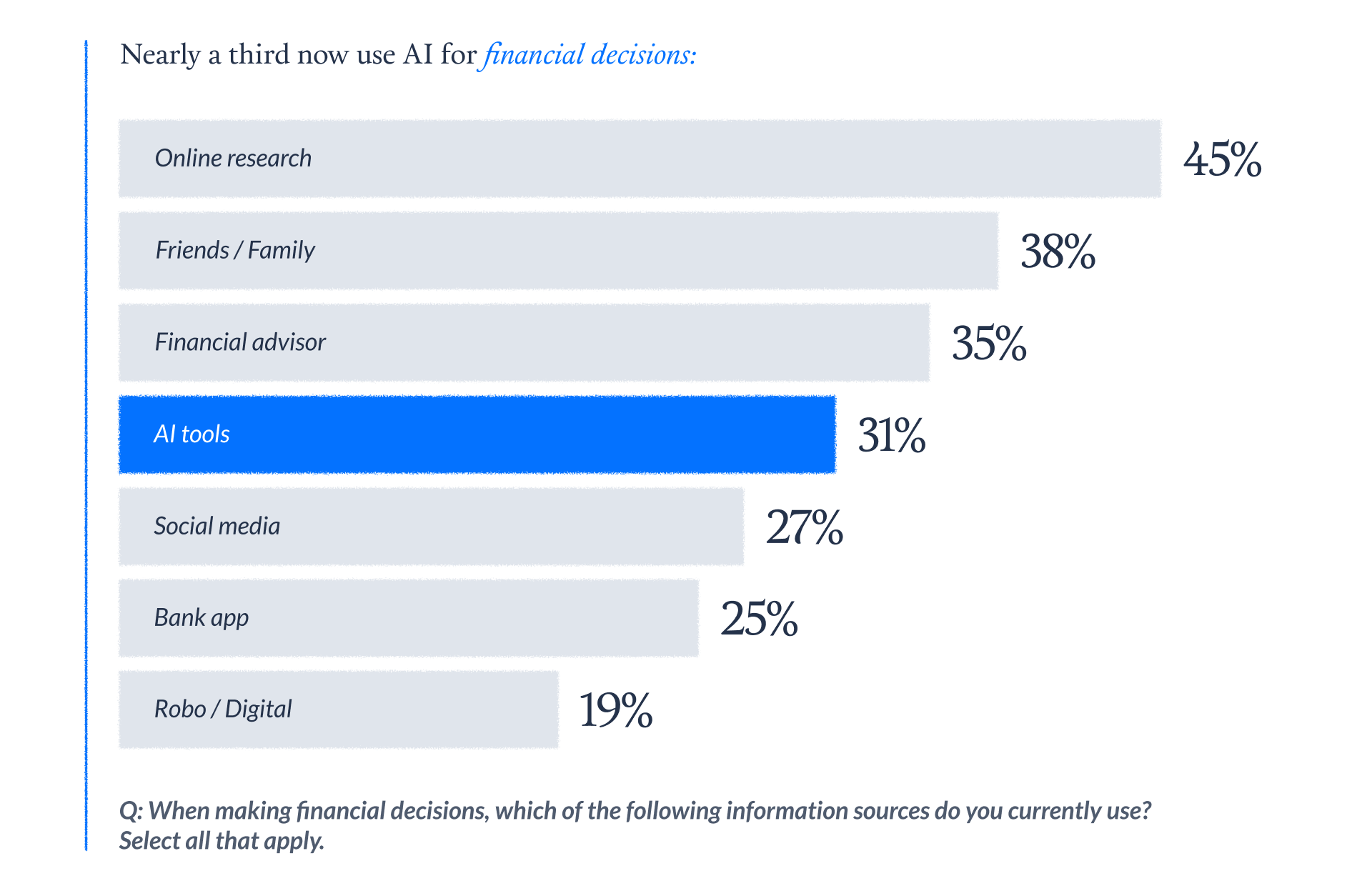
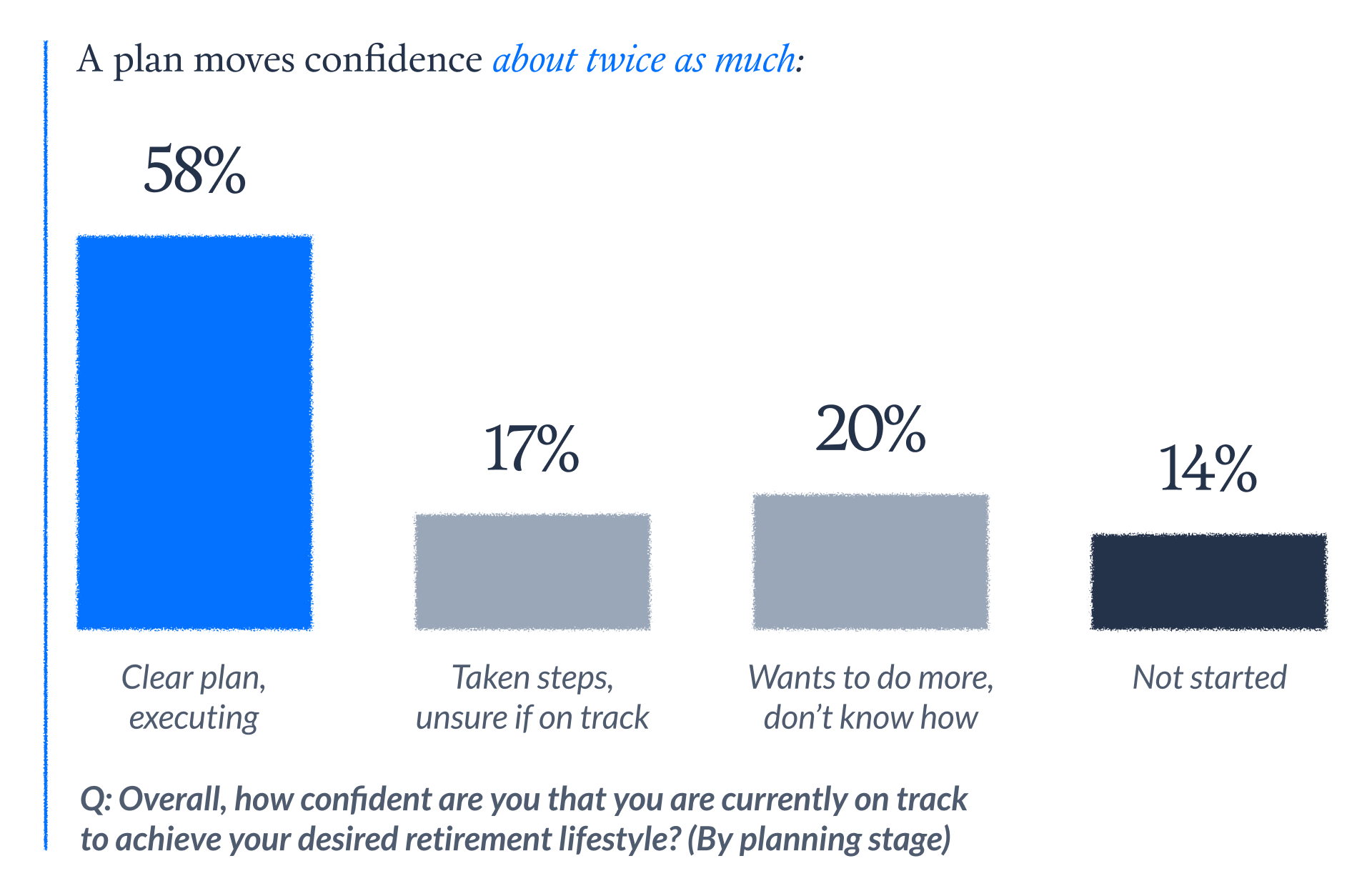
While 31% of respondents already use AI tools for financial decisions, that alone is not what separates the confident from the rest. The report found that confidence is not primarily determined by whether someone uses AI, a human advisor, both, or neither. Instead, confidence is strongest among people with a clear, executable plan:
- 58% of respondents who are confident to be on track to their desired investment have a clear and executing plan. The confidence level falls to a mere 14% for those who have not started.
- For those who have taken some steps but remain unsure if they are on track, the retirement confidence stands only at 17%.
This is where Endowus believes the industry needs a new model: a clarity architecture that combines the strengths of technology and human advice instead of treating them as competing alternatives.
Achieving retirement confidence requires real action
Getting “out of draft” takes more than AI. Singaporeans are already comfortable with using AI to conduct research, compare products and obtain financial information - 51% trust it for financial education and 52% for comparing products. When it comes to personalised advice, only 29% trust AI. For those who’d choose a human advisor over AI, 56% cite accountability as the top reason, while others cited family finances, sudden change and major life events as scenarios that they would prefer human advice over AI.
This validates the Endowus model, which is built on the full strength of both human expertise and technology. Technology can help improve client convenience, information transparency, compliance, scalability of excellence, and lower the cost to serve. Human advisors can help investors interpret trade-offs, pressure-test assumptions, define priorities and stay accountable when markets move or life changes.
Investors can define how they want to engage with their advisors, depending on the form of support they require:
- A Coach helps someone understand the fundamentals, overcome inertia and take the first step.
- A Curator filters an overwhelming range of information and volume of available information to focus on what's relevant and meaningful.
- A Translator simplifies complex financial concepts to better inform individuals of the trade-offs in their decisions.
- A Counsel provides objective perspectives to test assumptions and help investors strengthen their decisions.
A good advisor knows which role is needed at which moment. That flexibility matters because the report shows people are not simply looking for more conversation. Investors are looking for structured clarity to turn motivation into action.
“Retirement planning should not remain a draft people keep meaning to finish,” said Gregory Van, Chief Executive Officer of Endowus. “We believe technology, when used well, can remove complexity, increase transparency, and expand access to appropriate and intelligent solutions. This complements and scales the efforts by our human advisors to build an evidence-based and personalised wealth plan for our clients, giving them the clarity they can act on, to turn intention into action.”
Download the full Endowus Wealth Insights Report 2026 here.
_________________________________________________________________________________________________________________________
1 Refer to the Appendix - The Cost of Delay: How Starting Early Multiplies Your Wealth
APPENDIX: The Cost of Delay: How Starting Early Multiplies Your Wealth
Someone who starts investing at 30 instead of 22 – just eight years later – could retire at 65 with a nest egg roughly one-third smaller. Catching up could require them to save close to 36% of their income thereafter, with the cost rising further the longer they wait.
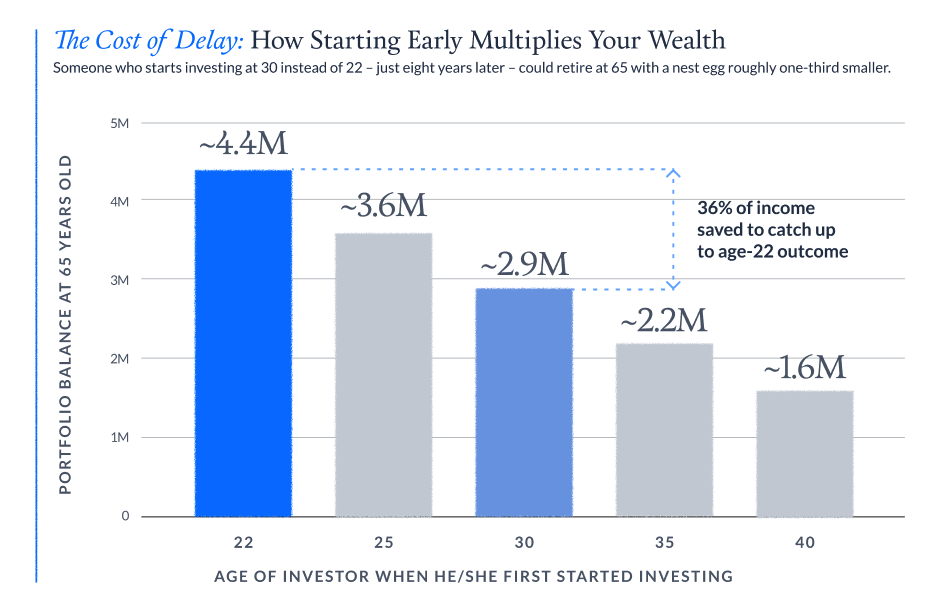
Note: The projection shown above is for illustrative purposes only and is based on a hypothetical investment model. Assumptions include: a starting monthly salary of S$3,400 at age 22; annual salary growth of 3.0%; an annual bonus equivalent to two months' salary; a baseline savings rate of 24%; an assumed annual portfolio return of 7.0% based on an illustrative portfolio comprising 80% equities and 20% bonds; and retirement at age 65. The scenarios differ only by the age at which investing begins (ages 22, 25, 30, 35 and 40 respectively). The model assumes regular monthly investing and does not account for taxes, fees, inflation, changes in employment, career breaks, or other individual circumstances. Past performance is not indicative of future results, and actual investment returns and outcomes may differ materially from those illustrated.
%20F1.avif)