


.webp)
.webp)
.webp)
.webp)






.webp)












%20(1).gif)

Register for the event
Endowus invites you to our exclusive event with Macquarie Asset Management, as we discuss unlocking opportunities in Infrastructure- a $1.3tn asset class.
This event is reserved for Accredited Investors (AIs) only. To register for the event, please indicate one of the following:
- For investors seeking to invest in the S&P 500 in Singapore at a low cost, Endowus offers two funds for cash, CPF, and SRS investing—the Amundi Prime USA Fund and BlackRock iShares US Index Fund.
- Singapore investors can invest in the S&P 500 through unit trusts or ETFs, but the fund structure matters—not all carry the same tax costs.
- US-listed funds come with a 30% dividend withholding tax, and US estate tax of up to 40% on amounts above US$60,000.
Investing in the S&P 500 index from Singapore is straightforward—but choosing the right fund can make a meaningful difference to the returns you get. Singapore investors can access S&P 500 exposure through ETFs or unit trusts, each with different cost structures, tax implications, and eligibility for CPF or Supplementary Retirement Scheme (SRS) savings.
This article explains what the S&P 500 is, how to invest in it from Singapore, and which fund options are available—including lower-cost alternatives that closely track the index.
What is the S&P 500 index?
The S&P 500 is a stock market index that tracks the performance of the 500 largest companies listed on US stock exchanges. Maintained by S&P Dow Jones Indices (S&P is short for Standard and Poor's), it has been the benchmark for US large-cap equities since 1957. Its largest components by index weight include Nvidia, Apple, Microsoft, Amazon, and Alphabet (Google).
This free-float adjusted, market-cap weighting means the index is regularly reviewed and reconstituted based on the number of shares available for public trading, representative of the largest US-listed firms. The larger a company's market capitalisation, the greater its weight in the index.
Jack Bogle, founder of Vanguard, pioneered individual access to the index in 1976, arguing that investors gaining exposure to a broad market index would harness better long-run returns than the ones buying individual stocks . The first S&P 500 fund was made available to retail investors that year.
How does investing in the S&P 500 index work?
The easiest way for a retail investor to "buy the index" would be through an exchange-traded fund (ETF) or unit trust that tracks the S&P 500.
Investors may earn not just the capital gains—that is, the returns from higher share prices, realised when the shares are sold—but also the dividends that these companies offer to their shareholders. Depending on how the fund is structured, dividends can either be distributed or reinvested.
The fund manager aims to track the S&P 500 index performance as closely as possible through various strategies:
1. Full physical replication
The fund buys all 500 stocks in the index, in the exact same weights as the index. If Apple is 7% of the S&P 500, the fund invests 7% of its capital in Apple shares. When Microsoft replaces a company in the index, the fund buys Microsoft shares while selling the replaced company’s ones.
This type of fund minimises tracking error—the gap between fund performance and index performance—because it mirrors the index like-for-like. The downside is transaction costs: every time the index rebalances or a constituent changes, the fund has to trade, which costs money and can be a drag on returns.
2. Sampling (or optimised replication)
The fund holds a representative subset of the index—for instance, 400 of the 500 stocks—chosen to mimic the index's overall behaviour (sector weights, factor exposures, risk characteristics). This incurs lower transaction costs, but potentially slightly higher tracking error because the fund doesn't perfectly mirror the index.
3. Synthetic replication (swap-based)
The fund doesn't actually buy any S&P 500 stocks. Instead, it enters a swap agreement with an investment bank: the fund pays the bank a fee, and the bank promises to pay the fund whatever the S&P 500 returns. The fund holds collateral (often a basket of unrelated stocks) to back the arrangement.
This may produce low tracking error—sometimes even slightly beating the index because of tax advantages. For Irish-domiciled UCITS funds tracking US indices, synthetic replication can avoid US dividend withholding tax entirely under certain treaty provisions, which is a meaningful edge.
The trade-off is the presence of counterparty risk: if the swap bank fails, there's a recovery process via the collateral, but it adds a layer of complexity that is not immediately obvious to retail investors. UCITS rules cap counterparty exposure at 10% to mitigate this.
Tax considerations of investing in the S&P 500 for Singapore investors
There are plenty of options for investing in the S&P 500 with cash that include US-listed ETFs, such as those with the ticker VOO, IVV, and SPY. Their main draws are high liquidity and low fees. Many low-cost brokerages also offer zero commissions for trades into the US markets.
However, foreign investors investing in US-listed securities, including US-listed ETFs, have to be mindful of estate taxes. Investment holdings exceeding US$60,000 are subjected to a 40% estate tax.
In addition, as a Singapore investor with no US tax treaty, there is a dividend withholding tax of 30% levied at the fund level for US-listed ETFs.
Read more: How to reduce taxes when you invest in US securities
How to invest in the S&P 500 at low fees
The table below shows the two unit trusts available on our fund platform, Fund Smart, can be invested in using cash, CPF Ordinary Account (OA) savings, or SRS funds.
The BlackRock iShares US Index Fund is a low-cost SGD-denominated fund that has a fund-level fee of only 0.08%, offering a cost-effective way to invest in the S&P 500. The synthetic replication of this fund also means that it does not pay any US withholding tax and is thus more cost-efficient than UCITS ETFs, of which dividends from S&P 500 stocks are still subject to 15% US withholding tax.
Endowus is the first digital advisor to enable investors to use their CPF savings to invest in S&P 500-equivalent exposure through the Amundi Prime USA Fund. It is an SGD-denominated unit trust that tracks Solactive GBS United States Large & Mid Cap Index, which covers approximately the largest 85% of the free-float market capitalisation, representing 413 companies among the S&P 500 components (as of 19 May 2026). The Solactive GBS United States Large & Mid Cap Index has a quasi perfect correlation to the S&P 500 Index*.
What else should you consider before investing in the S&P 500?
Few indices have matched the S&P 500's long-run track record. Since 1990, the index has delivered an average annual return of 13.4% in SGD terms.
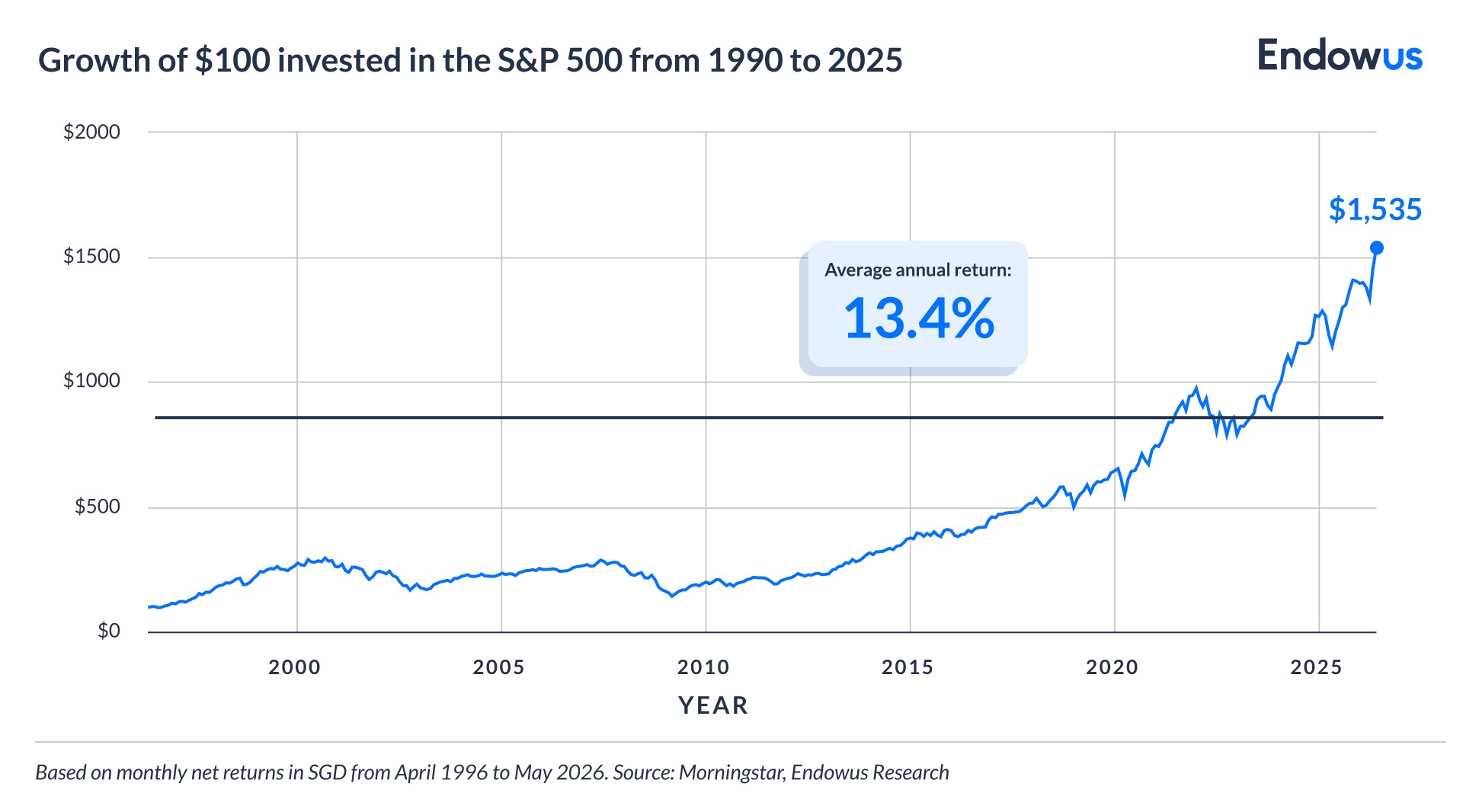
That performance has a structural explanation rooted in corporate earnings. According to Goldman Sachs Research, earnings growth was the most significant driver of the S&P 500's strong performance over 2014–2024. During this period, the index saw a 178% price gain, and nearly three-quarters of that gain was directly attributable to increased earnings.
Despite its recent strength, the S&P 500 has experienced periods of underperformance
Since 1998, US equities have not always led global markets. The record is more varied—and more instructive—than a decade of S&P 500 dominance may suggest.
From 2003 to 2007, a commodity supercycle powered by China's industrialisation lifted emerging market and Asia-Pacific equities well ahead of US indices for nearly four consecutive years. In the immediate aftermath of the Global Financial Crisis (GFC), APAC ex-Japan and emerging markets snapped back harder than the S&P 500.
The divergence that followed had distinct causes. The eurozone economy suffered a sovereign debt crisis from 2010, with mounting fears through 2011 and 2012 that the single currency area could break up. Japan remained mired in deflation and structural stagnation. The US, by contrast, had recapitalised its banking system earlier and more decisively. The Federal Reserve's quantitative easing (QE) programme—three rounds between November 2008 and October 2014—flowed through to corporate earnings and asset valuations.
Simultaneously, US technology companies were entering a long compounding cycle. Apple surpassed ExxonMobil in 2012 to become the world's most valuable company. Microsoft, Amazon, and Alphabet were scaling into global platforms with no comparable equivalents elsewhere. The result was a decade of S&P 500 outperformance—extended further by the artificial intelligence (AI) theme that became the primary market catalyst in 2023–2024.
That cycle may now feel like the natural order. History suggests it is not.
Invest in the S&P 500—and beyond
The case for US equities remains strong due to structural advantages —deep capital markets, a culture of innovation, and shareholder-oriented management.
However, investors should not be ignoring the growth happening elsewhere in the world. In SGD terms, $100 invested in an APAC ex Japan index fund between July 1998 to April 2026 would have grown to $907, while the same amount invested in the S&P 500 would have grown to just $684.
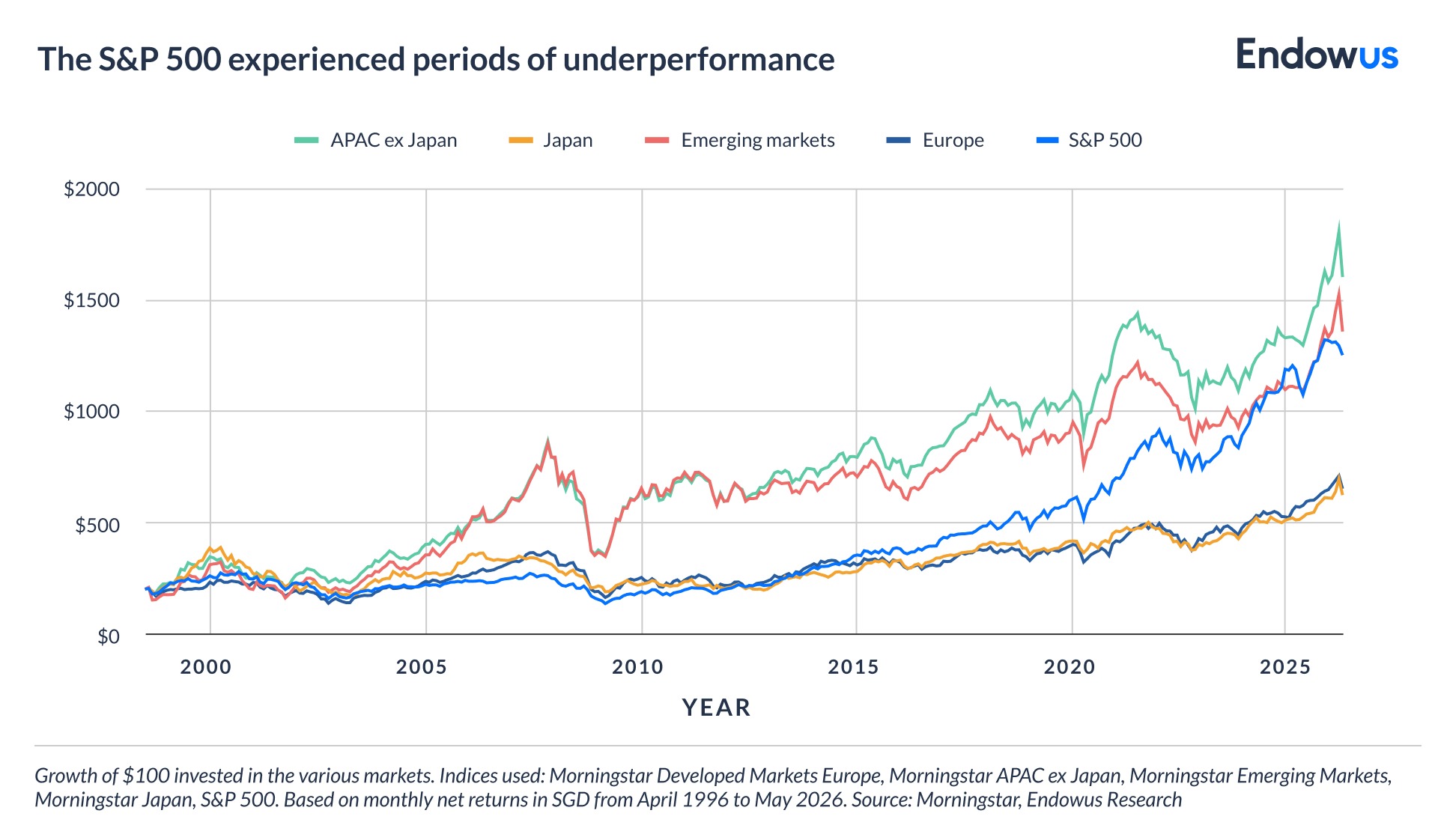
Our advice remains consistent that investors should be globally and sectorally diversified to capture opportunities as and when they emerge. Our Flagship Portfolios are designed for long-term, risk-adjusted market outperformance, constructed with global funds by our Investment Office.
For DIY investors seeking straightforward, low-cost exposure to US growth as a portfolio building block, the Amundi Prime USA Fund and BlackRock iShares US Index Fund—among the lowest-cost available in Singapore—are available on our fund platform, Fund Smart.
Frequently asked questions about investing in the S&P 500 from Singapore
What is the difference between an ETF and a unit trust for S&P 500 investing?
An ETF trades on a stock exchange throughout the day at market prices. A unit trust prices once daily at net asset value (NAV). Both can track the S&P 500. For Singapore investors, the more material differences are domicile, fees, and CPF/SRS eligibility.
Is the S&P 500 the same as the US stock market?
Not exactly. The S&P 500 covers the 500 largest US-listed companies by market capitalisation and represents approximately 80% of total US equity market value. It excludes mid-cap and small-cap companies, which means it does not capture the full breadth of the US market.
Can I use my CPF or SRS to invest in the S&P 500?
Yes. Through Endowus, you can invest your CPF Ordinary Account (OA) savings in the Amundi Prime USA Fund, which closely tracks the S&P 500. It is also available for investing through cash and SRS.
Do Singapore investors pay dividend withholding tax on S&P 500 funds?
It depends on where the fund is domiciled. US-listed funds carry a 30% withholding tax on dividends. Ireland-domiciled funds carry 15%.
The BlackRock iShares US Index Fund is synthetic and gains exposure to the US equity market through S&P 500 futures contracts, and hence does not have to pay the US withholding tax.
*Source: Morningstar, Endowus Research
Webinar: Investing in a better future: Through the lens of an equity investor

Why ESG investing should matter to Singaporeans

When you can’t see the forest for the trees: A holistic approach to asset allocation



%20F1(2).webp)

.webp)
.webp)






.webp)