Register for the event
Endowus invites you to our exclusive event with Macquarie Asset Management, as we discuss unlocking opportunities in Infrastructure- a $1.3tn asset class.
This event is reserved for Accredited Investors (AIs) only. To register for the event, please indicate one of the following:
- The AI build-out has turned capital expenditure (capex) into a key line in a hyperscaler's accounts, because the spending happens long before the revenue it is meant to generate. The result is potentially shrinking free cash flow (FCF).
- In the third-quarter 2026 reporting season, the market rewarded companies whose cloud growth outpaced their spending and punished those whose capex overwhelmed it, even when, in some cases, revenue and profit beat expectations.
- In our view, the implication for portfolios is not to abandon AI exposure but to prize diversification and balance-sheet quality, because the demand side of the AI story remains intact, while its financing has become the market's central fault line.
For most of the past three years, investors rewarded the technology giants for spending aggressively to capture the AI opportunity. In the autumn of 2026, there was a shift in thinking.
It appears that free cash flow has replaced revenue growth as the metric that moves these stocks. A company can beat on sales, beat on profit, and still fall sharply if its capital spending is seen to outrun the cash it generates. Understanding why requires going back to some accounting principles — because the mechanism, once grasped, can help explain the moves in technology shares over the past month.
This article explains what capex and free cash flow are, why the AI build-out has made the relationship between them so combustible, what the third-quarter 2026 earnings season revealed, and what it means for diversified portfolios.
What is capital expenditure (or capex)?
Capital expenditure is the amount spent by a firm to acquire or upgrade long-lived physical assets: in this case, data centres, land, power infrastructure, and semiconductors (chips). It is distinct from operating expenditure, the day-to-day cost of running the business.
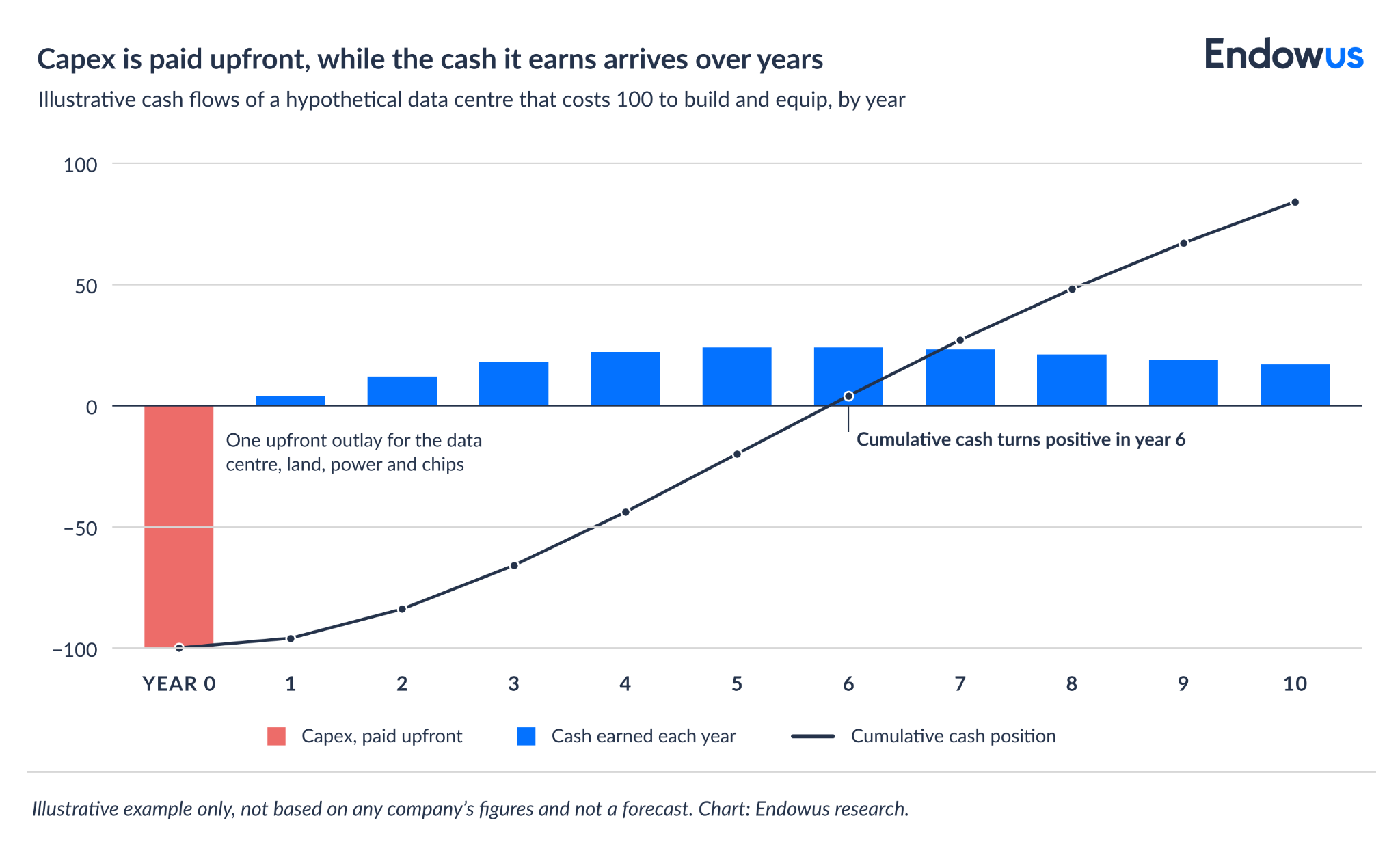
The critical feature of capex is timing. A hyperscaler pays for a data centre and its chips upfront, in a single bulk outlay, while the cloud and AI revenue that the facility is built to earn follows gradually over the years.
Enter “free cash flow,” or FCF. In simple terms, free cash flow is the cash a company generates from its operations after subtracting the capital spending needed to maintain and grow the business. It is the money genuinely left over — available to repay debt, return to shareholders, or reinvest. The formula may seem obscure - operating cash flow minus capital expenditure - but you do not need to memorize it.
The concept, however, is more important. When capex rises faster than the cash generated by the firm’s business activities, free cash flow shrinks - and can turn negative, meaning the company is spending more cash than its operations generate and must fund the difference by drawing down cash reserves (if there are any) or by borrowing. The AI build-out has forced some of the largest companies in the world into precisely that.
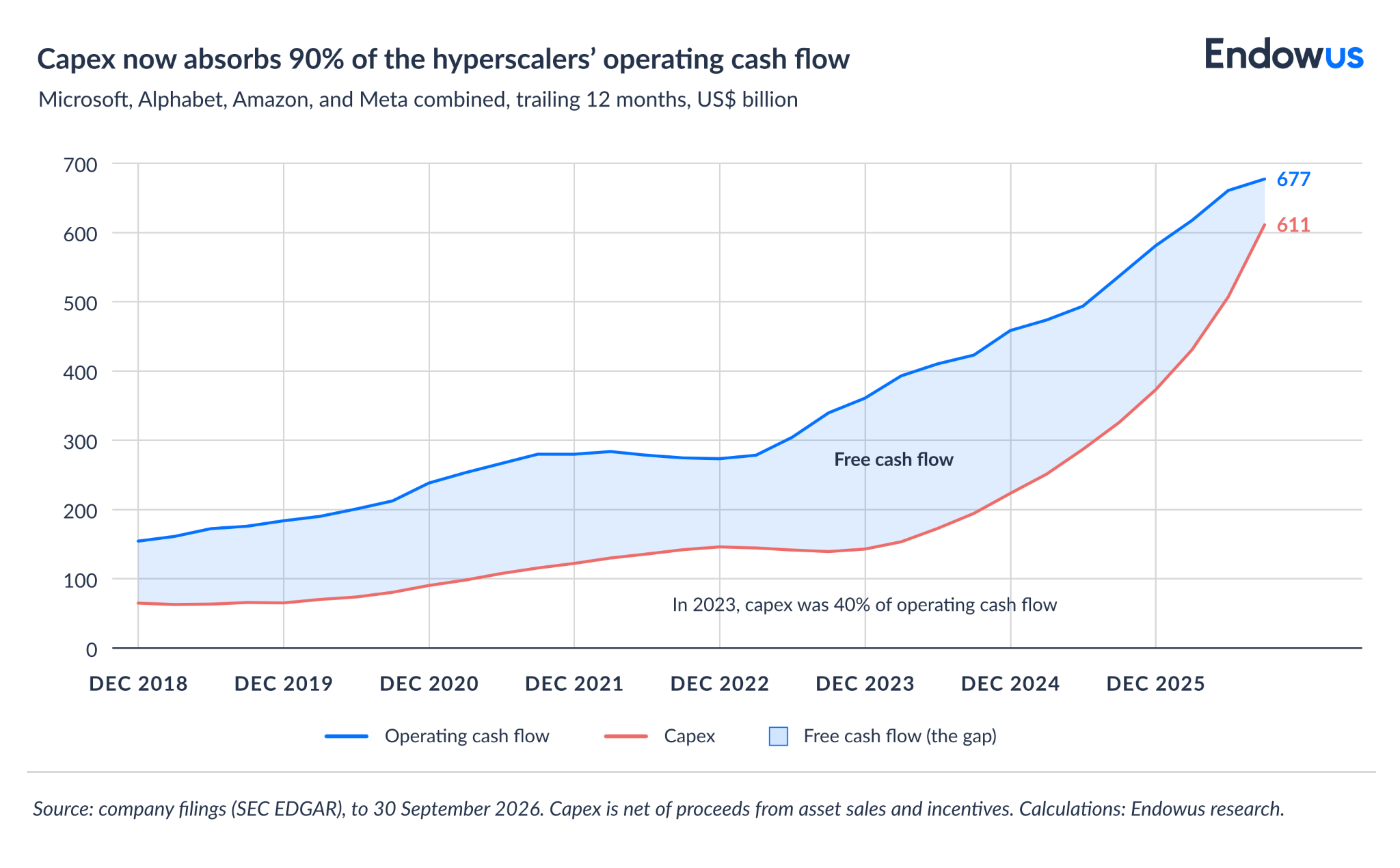
And while capex is normal, the market's tolerance for these massive investments by hyperscalers changed in 2026.
How is the build-up being financed?
The scale is telling. The five largest US hyperscalers, plus a specialist “neocloud” provider that rents out computing power, are on course for capital spending approaching US$1 trillion in 2027, according to Moody's Ratings as of October 2026. Individual guidance figures have climbed through the year: by its third-quarter 2026 results, one major hyperscaler had signalled that its 2027 capital spending would increase significantly — with some market estimates above US$300 billion — and disclosed more than US$1 trillion in total future purchase commitments and leases.
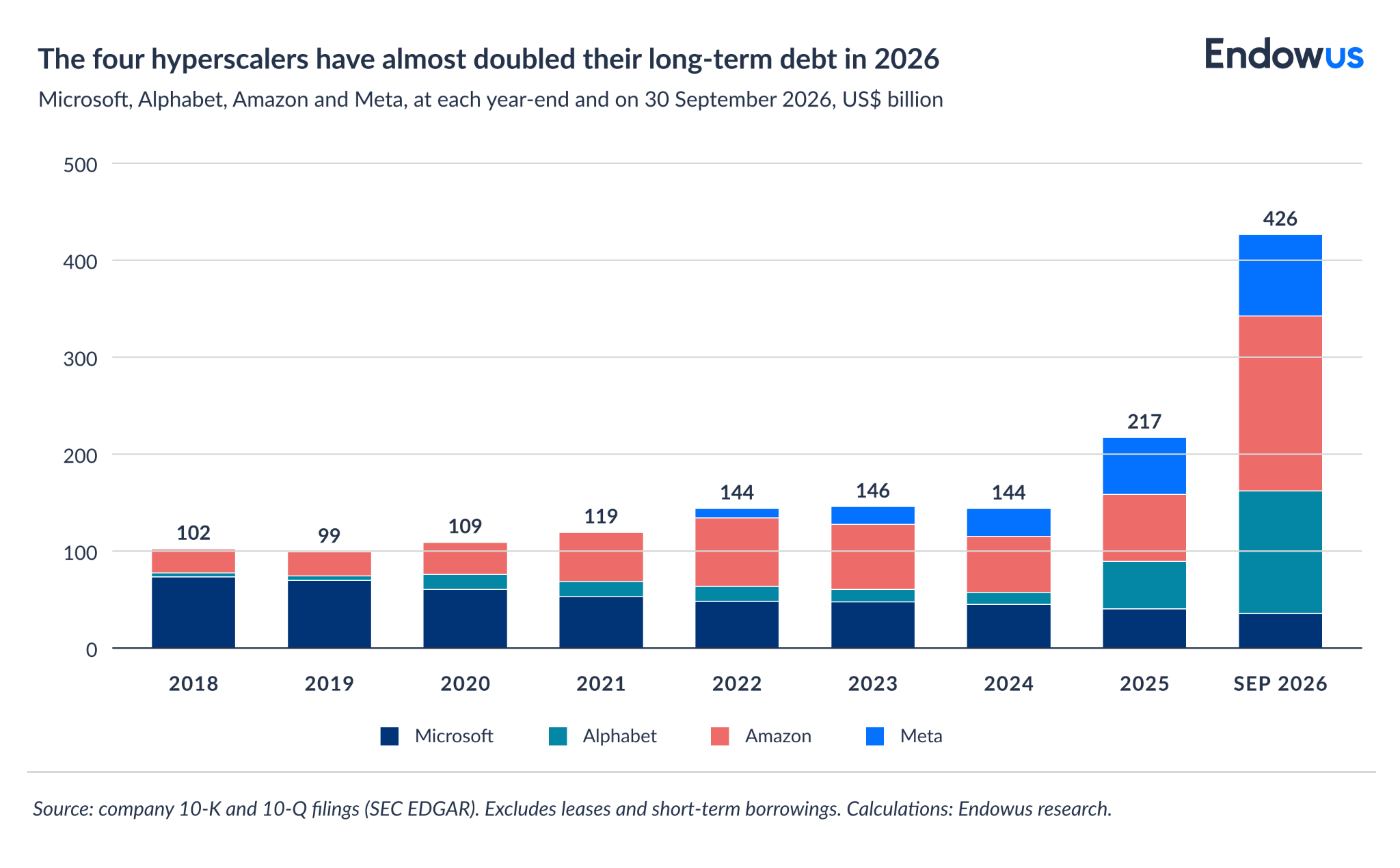
A growing share of this spending is being financed with debt, rather than internally generated cash. Through 2026, technology companies returned to the bond market at a record pace; by late October, US investment-grade bond issuance had surpassed its previous annual record, according to data compiled by Bloomberg, with much of it tied to the AI build-out. In addition, the financing has grown circular, with chipmakers, cloud providers, and model developers investing in, lending to, and buying from one another. Moody's has warned that these correlated exposures could weaken together in a downturn, and that a wave of loans maturing between 2027 and 2029 may test weaker borrowers as they refinance at higher rates.
There is a clear distinction when it comes to understanding the impact of all this spending. A build-out funded from operating cash flow impacts shareholder returns - spending today instead of paying dividends or accumulating reserves. A build-out funded by debt is a credit question, which means it impacts the cost of borrowing for that specific firm, and it is impacted by the trajectory of base rates.
What happened to hyperscalers in October 2026?
In late October 2026, when the largest technology companies reported, markets likely began looking at spending discipline. Demand, measured by cloud revenue growth, was strong almost everywhere. The three major cloud platforms each grew at rates ranging from the high-30s to above 100% year-on-year.
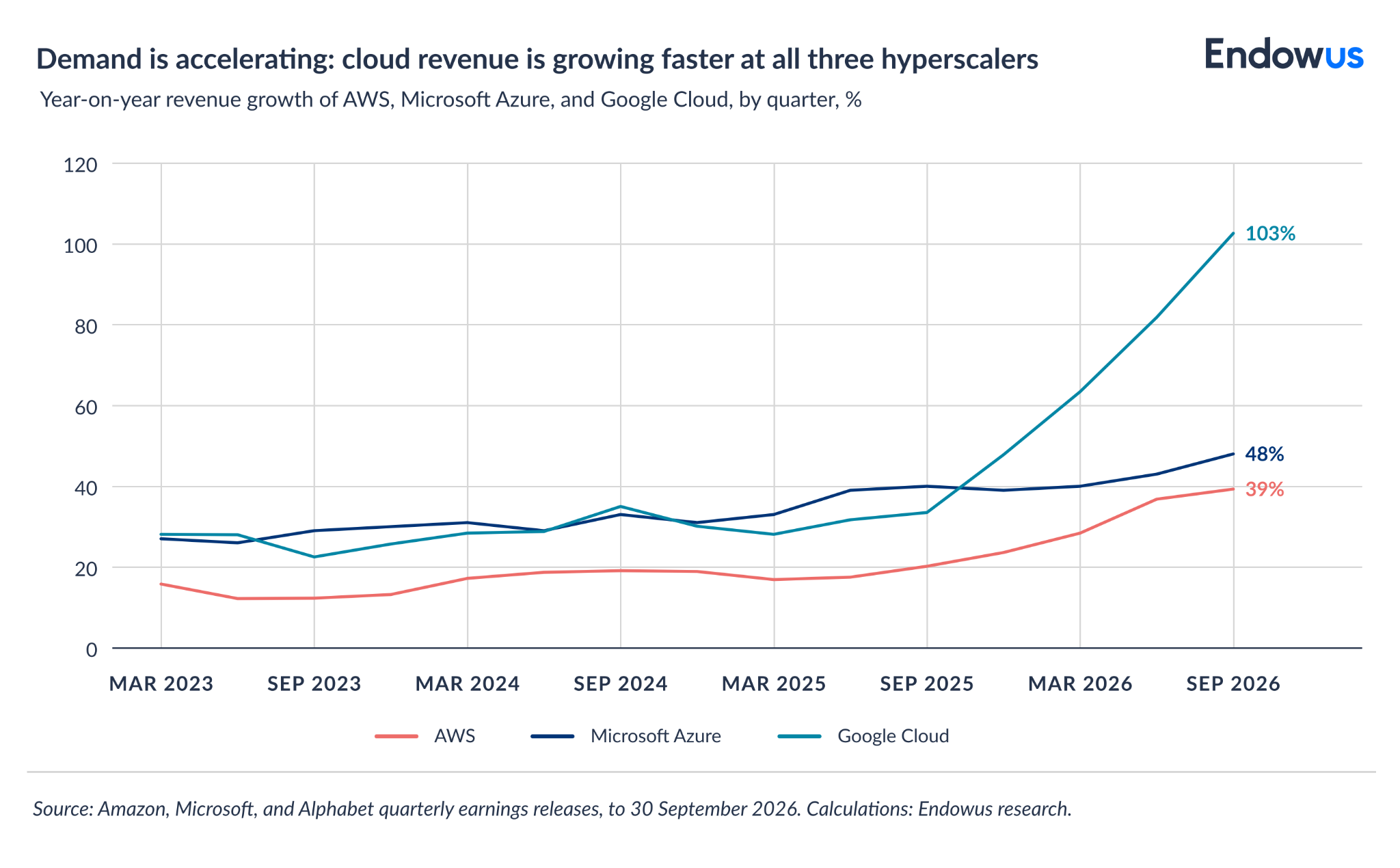
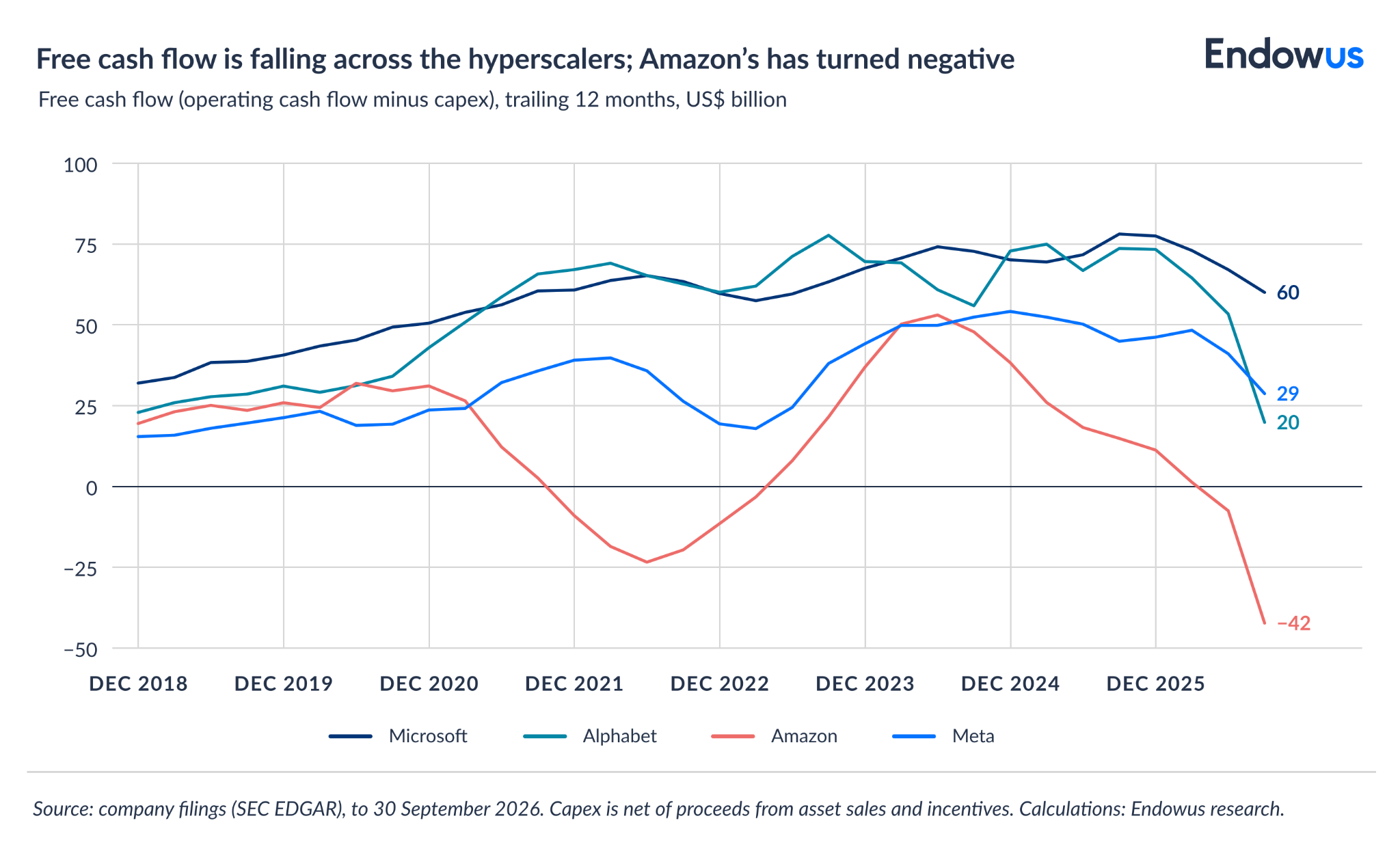
Instead, markets analyzed these companies and evaluated their spending discipline. One hyperscaler reassured investors by pairing cloud acceleration of roughly 48% with capital spending that came in below forecasts; its shares held up. Another reported cloud growth above 100% but missed revenue expectations in its search-led core business and signalled a significant rise in 2027 capex — and lost close to half a trillion dollars of market value in a single session, its worst day on record. A third saw its cloud division accelerate for a sixth consecutive quarter, yet its shares fell after it missed earnings and revenue expectations, with quarterly capital spending above US$77 billion and free cash flow at a deficit of roughly US$42 billion over the trailing twelve months.
The fundamental rule is that a company can be among the most profitable in the world on an accounting basis and still post deeply negative free cash flow, because capex is subtracted after profit. The question market participants appear to be asking is no longer “how fast is a company growing?” but “what is this growth costing this company, and can it be funded?”
What is likely to happen to hyperscalers going forward?
The bullish argument holds that today's heavy spending is the foundation of tomorrow's earnings, that cloud demand is accelerating precisely because the capacity is being built, and that negative free cash flow during a build-out phase is normal and temporary — the same pattern that preceded the dominance of earlier cloud franchises. On this view, the companies with the deepest balance sheets and the strongest operating cash flow may be able to outspend rivals, fund the build-out internally, and emerge with durable advantages.
The bearish argument, drawing on Gartner estimates published in October 2026, holds that data-centre owners collectively need revenue running into the trillions of dollars through the end of the decade simply to earn an acceptable return on what they are building. If revenue does not materialize, much of this spending may disappoint, which would have a significant impact on future valuations for companies most exposed to debt funding.
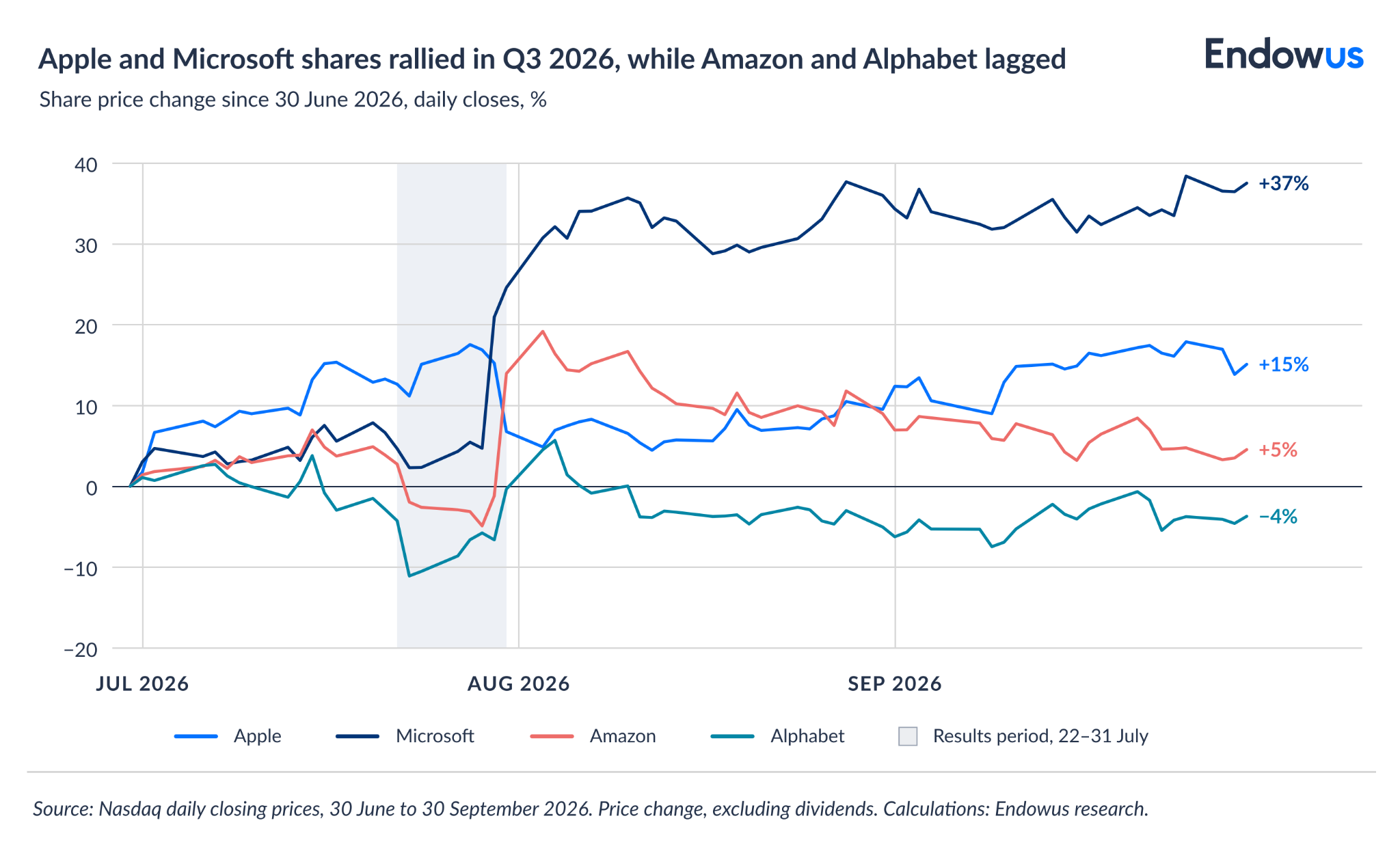
We do not think the debate needs to be solved one way or the other. The point is that the market appears to have become more discriminating, and that free cash flow and balance-sheet strength are now key for valuations.
Investment implications
While we refrain from making projections about hyperscalers' performance here, a few points are worth presenting to our readers.
First, diversification still matters. When market returns are concentrated in a handful of names, the index itself becomes less diversified than it appears. In our view, investors may wish to resist the temptation to add to concentrated mega-cap AI exposure simply because it has led for years, and to ensure instead that portfolios retain genuine breadth across sectors, factors, and geographies.
Second, quality and balance-sheet strength are the basis of fundamental stock analysis. In a world where the AI build-out is increasingly debt-funded and refinancing walls loom between 2027 and 2029, balance sheet strength may become a primary driver of relative performance.
Third, in our view, the demand side of the AI story remains intact. The cloud acceleration reported across the third quarter of 2026 was real, and the memory and infrastructure suppliers feeding the build-out have reported record results. An investor can believe in AI's long-run productivity potential and still conclude that the market had, for a time, mispriced the cost of capturing it.
Abandoning AI exposure altogether would mean betting against a demand trend that the hard data continues to validate. On the other hand, treating every AI-linked company as interchangeable may ignore the realities of balance sheet strengths. In our view, the resolution is diversified, quality-tilted exposure that participates in the theme without concentrating on the names most dependent on cheap capital and patient investors. Past performance is not necessarily a guide to future performance or returns.
Frequently asked questions
What is the difference between capex and operating expenses?
Capital expenditure buys long-lived assets (such as data centres and chips), and its cost is spread across the years in which the asset is used. Operating expenses are the ongoing costs of running the business, such as salaries and utilities, and are recognised as they are incurred. The AI build-out is overwhelmingly a capex story.
Why does negative free cash flow matter if a company is still profitable?
Profit is an accounting measure, and it can look healthy even as cash drains out of a business. The reason is timing. When a hyperscaler buys a server, it does not deduct the full cost from that year’s profit. It spreads the cost over the asset’s useful life — typically five to six years — as a depreciation charge. Free cash flow, by contrast, subtracts the full price in the year the cash goes out. Negative free cash flow means a company is spending more cash than it generates and must fund the shortfall from reserves or borrowing — which, at higher interest rates, carries real cost and risk.
Does negative free cash flow mean an AI company is in trouble?
Not necessarily. During a build-out phase, strong companies may deliberately run free cash flow negative to invest ahead of demand, and can fund it from large cash balances. The risk rises when the spending is debt-funded, the balance sheet is weaker, and the projected returns remain unproven.
How should this change the way I think about my portfolio?
It argues for breadth over concentration. In our view, maintaining diversified exposure across sectors and geographies, with a tilt toward quality and balance-sheet strength, is a more resilient way to participate in the AI theme than concentrating in a few mega-cap names trading on a single, volatile variable.
Forget your password? It's a good thing for your investments

The lesson of Hyflux: What water and diversification have in common

Free lunch: Diversification in investing is a gift