Register for the event
Endowus invites you to our exclusive event with Macquarie Asset Management, as we discuss unlocking opportunities in Infrastructure- a $1.3tn asset class.
This event is reserved for Accredited Investors (AIs) only. To register for the event, please indicate one of the following:
- A second property in Singapore carries heavy upfront costs: a Singapore citizen pays 20% Additional Buyer’s Stamp Duty plus Buyer’s Stamp Duty, about 23% of the purchase price on an illustrative S$1.5 million unit, before any rental income. A sale within four years also triggers Seller’s Stamp Duty of up to 16%.
- Gross rental yield can overstate the property’s return: after property tax at non-owner-occupied rates, holding costs, and financing, the net yield on a Singapore condominium may be smaller.
- As a source of retirement income, a property is a single, leveraged, and illiquid asset, so it is important to weigh the acquisition of a second home against a diversified portfolio, and in doing so an investors should consider that a lot of capital may already be allocated to a similar investment (their first home).
Singapore has built one of the highest home-ownership rates in the world, and property is the core of household wealth. According to the latest national figures, residential property accounts for about 43% of household assets — the single largest class on the household balance sheet. For most families, the home is not only where they live, but also their largest financial position.
Readers in their forties or fifties may have considered, or may be considering, whether a second property can produce income in retirement. Some may be even asking themselves whether they can use their first home to produce retirement income.
Our view is that a property is a single, leveraged, and illiquid asset, and those three features need to be taken into account. The final decision deserves a fair comparison with the alternative use of the same capital.
This article sets out what a second property can cost, how gross rent needs to be adjusted for expenses and taxes, how leverage cuts in both directions, how property and a diversified portfolio compare as sources of retirement income, and the liquid routes to real estate exposure that do not require owning a unit.
The household balance sheet already leans heavily on property
Home ownership in Singapore is near-universal, and residential property is the largest single asset held by most households, at roughly 43% of total household assets as at the fourth quarter of 2025 (Department of Statistics Singapore).
But a residential property bought through a mortgage is made up of equity (the slice of it that has been paid off already) and debt (the outstanding mortgage balance). So the amount of financial resources earmarked for housing is substantial.
Buying an additional unit - a second property - does not diversify a balance sheet that is already heavily concentrated in Singapore’s residential property. The same is true for the retiree whose wealth is tied up in a fully paid home. Both are “long” (they are exposed to) the same asset, in the same city, priced in the same currency.
URA’s data for the third quarter of 2026 show private residential prices up 1.4% over the quarter and rents up 1.3%, while developers sold 1,183 new units against 2,141 in the previous quarter; the HDB resale price index eased 0.1%, its third consecutive quarterly decline (URA and HDB, 23 October 2026). A reader in that market may wonder whether a window is opening or closing. We do not read the quarter either way. We use it only to make the case that the decision should rest on the structure of the asset, not on the direction of the last print.
What are the costs associated with purchasing and owning a second home in Singapore?
A large chunk of the cost of a second property is front-loaded, and for the most part non recoverable. As an illustrative example, for a private condominium priced at S$1.5 million, bought by a Singapore citizen who already owns a home, the buyer pays Buyer’s Stamp Duty, Additional Buyer’s Stamp Duty at 20%, and legal and valuation fees — and must fund a large share of the price in cash. This happens before any cash inflows (long before the property is rented).
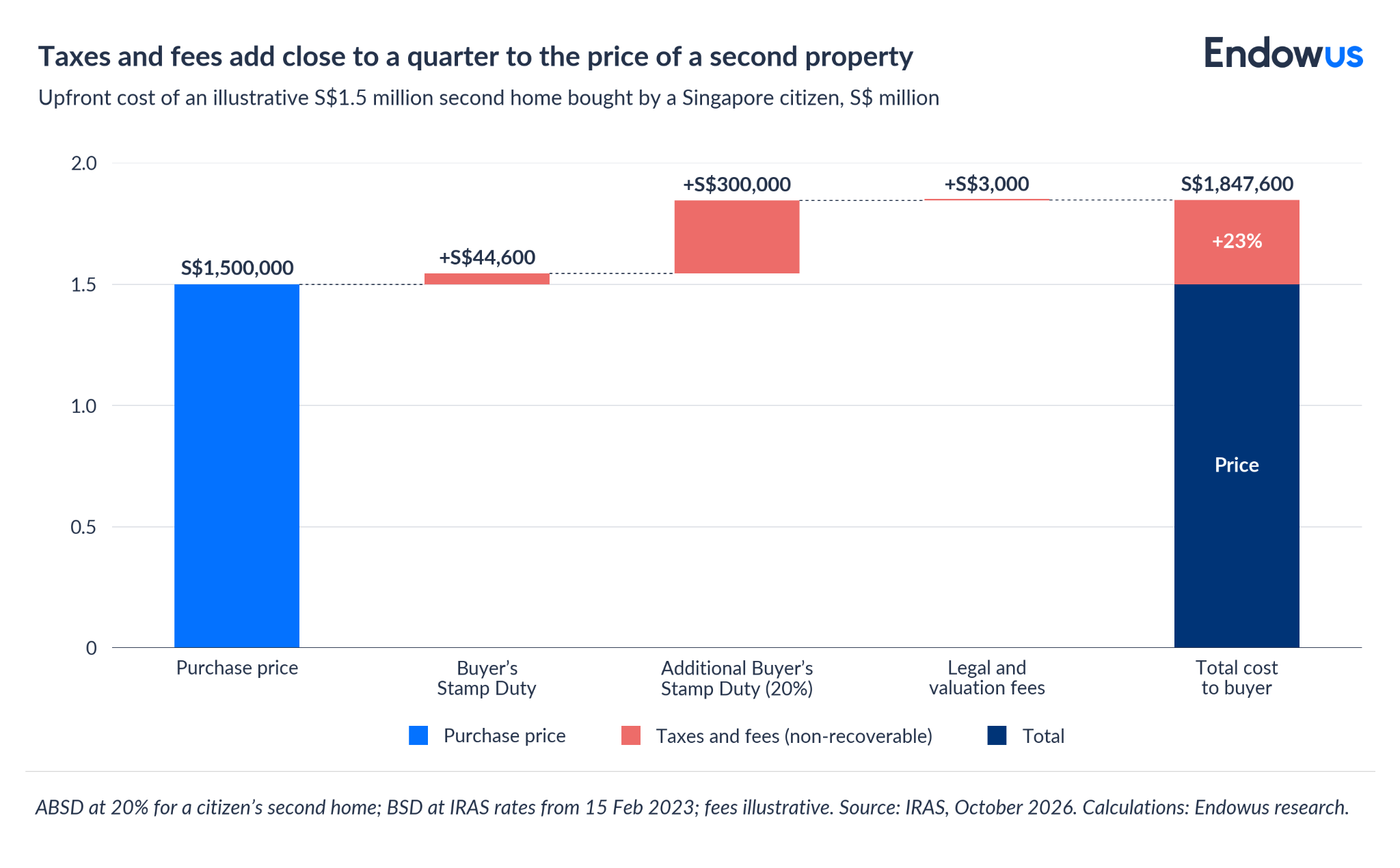
“Additional Buyer’s Stamp Duty” is the most expensive line item. For a Singapore citizen it is nil on the first residential property, 20% on the second, and 30% on the third and subsequent, unchanged since 27 April 2023 (as of October 2026). On a S$1.500,000 purchase, that is $300,000, on top of Buyer’s Stamp Duty of S$44,600. Both are due within 14 days and are typically paid in cash upfront, though eligible CPF Ordinary Account savings may be used to reimburse them, subject to CPF rules.
Financing is capped: a second housing loan is limited to 45% of value where the tenure is within the usual limits, with at least a quarter of the price paid in cash, and total debt servicing must stay within 55% of gross monthly income (as of October 2026). Central Provident Fund savings may cover part of the balance, but only after the member sets aside at least the Basic Retirement Sum — S$110,200 in 2026.
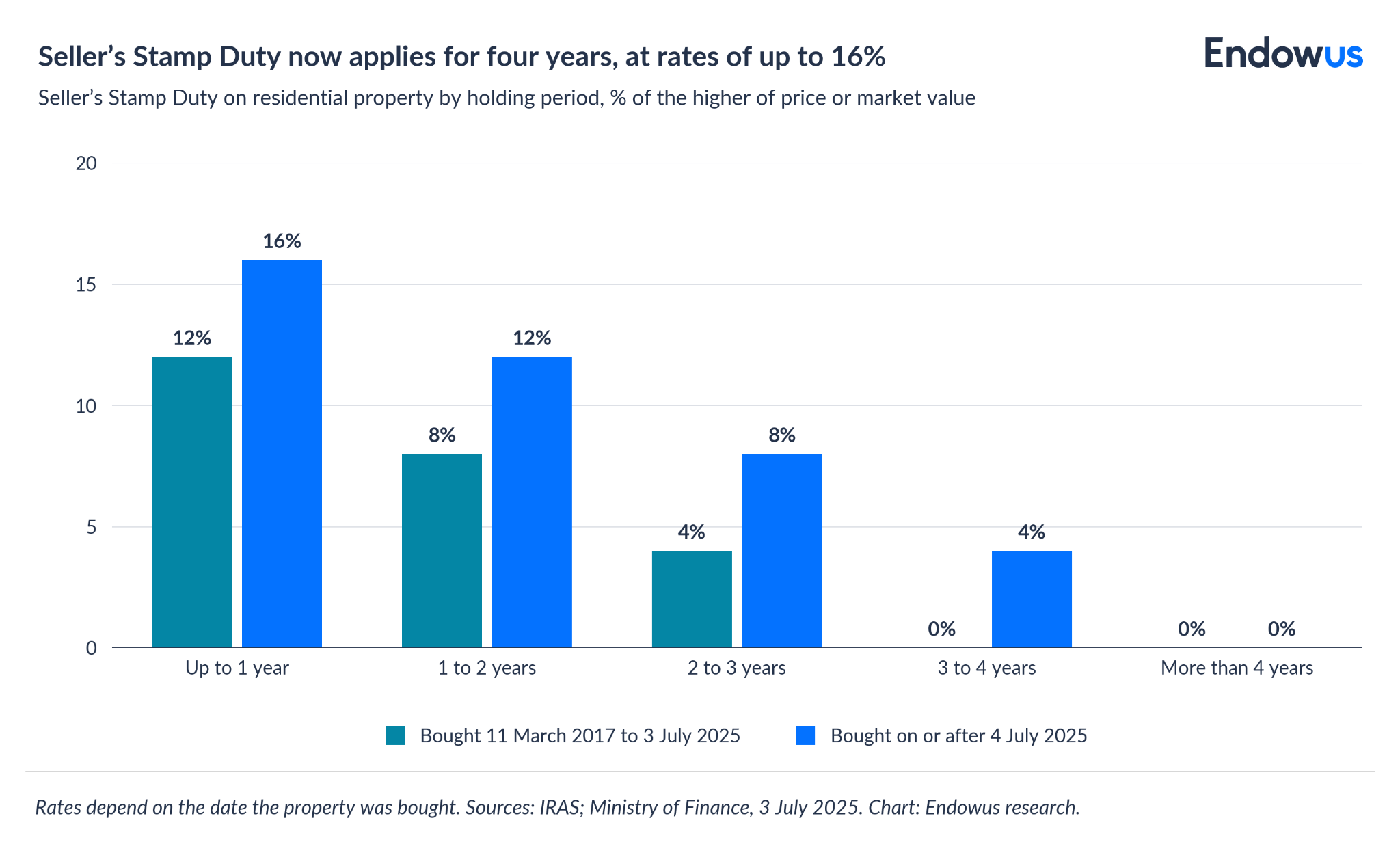
The exit is taxed, too. For residential property bought on or after 4 July 2025, Seller’s Stamp Duty runs at 16%, 12%, 8%, and 4% for a sale within the first, second, third, and fourth year, and it goes to zero only after four years. A second property therefore needs to be held for at least four years to avoid additional losses. Regulatory uncertainty adds an additional layer, as rules can change without much notice - the 2025 Seller’s Stamp Duty change took effect the day after it was announced.
Is rental yield equal to property return?
Gross rental yield (annual rent divided by property purchase price) is often quoted but not particularly useful, as what matters is net rental yield (what the owner keeps after the costs of holding the property). Net rental yield is gross yield minus property tax, maintenance, vacancy, agent fees, repairs, and financing costs.
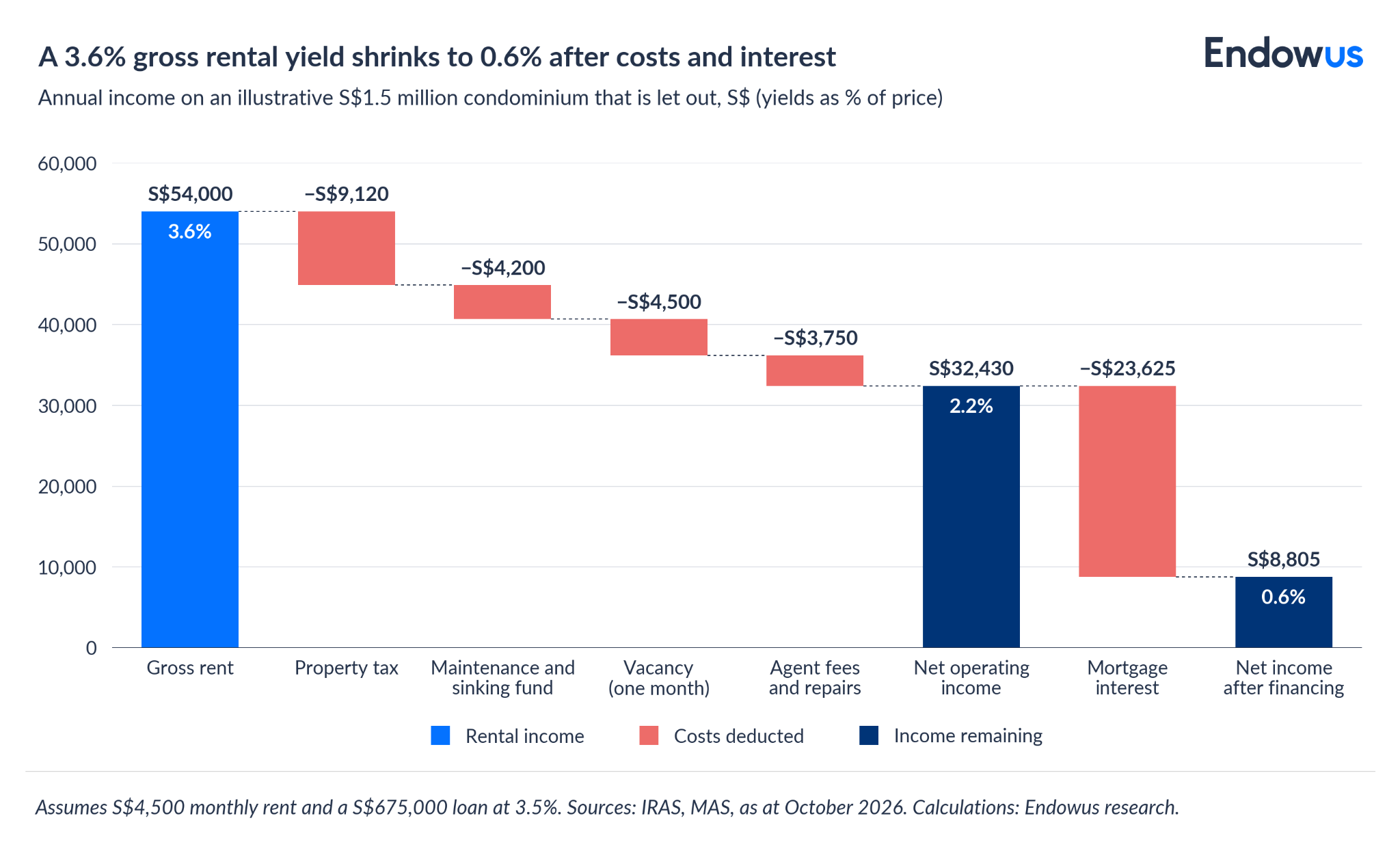
Property let to a tenant is taxed at non-owner-occupier rates, which run on a progressive scale from 12% to 36% of the property’s Annual Value (as of October 2026) — well above the owner-occupier rates. Maintenance and the sinking fund, periods between tenants, agent commissions on each let, and repairs all draw the yield down further, and that is before mortgage interest is factored in. On the illustrative unit, a gross yield of around 3% to 4% becomes a net yield closer to 2% once holding costs are taken out, and thinner still after financing.
The “2% rule” — an American rule of thumb that a rental property should earn monthly rent of at least 2% of its price — would require S$30,000 a month, or a 24% gross yield, on a S$1.5 million unit. No Singapore private condominium comes close. Singapore residential yields are modest, and the return case for property has rested far more on price appreciation than on income.
Does leverage increase or decrease returns?
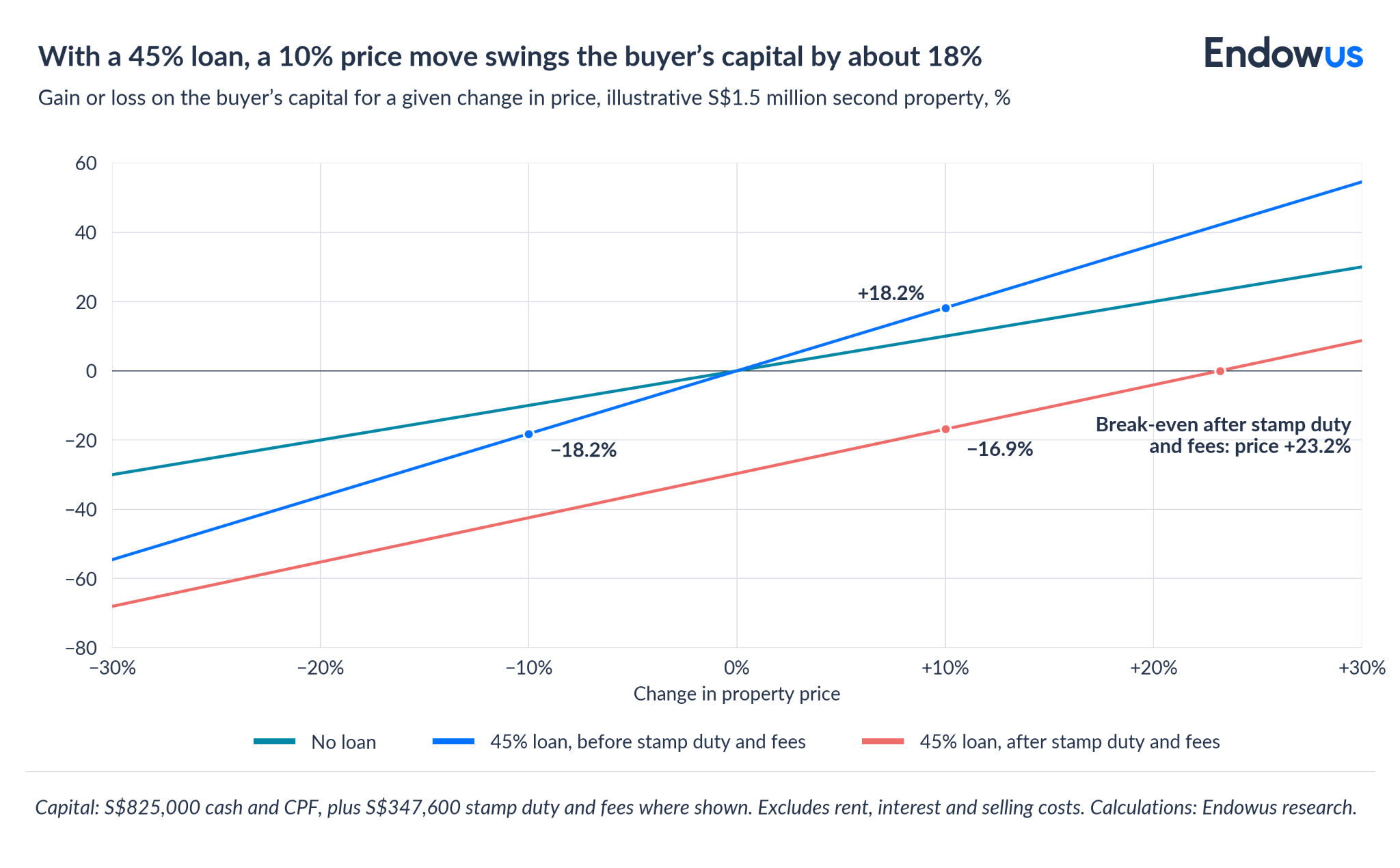
Leverage is the main reason property returns can look larger than the yield suggests, but it is also a reason to be prudent. In fact, real estate is an illiquid asset, and a debt-financed purchase can add leverage risk to the picture. Consider the illustrative S$1.5 million unit funded with a 45% loan of S$675,000 and S$825,000 of the buyer’s own cash and Central Provident Fund savings. A 10% rise in price adds S$150,000, a gain of roughly 18% on the S$825,000 down payment. Counting the approximately S$344,000 in stamp duties, the gain is about 13% of the capital deployed, and it still falls short of recovering those duties. A 10% fall subtracts the same S$150,000, a loss of roughly 18% on the down payment, before costs.
Interest rate moves can instead determine a decrease or increase in the net operating income. A one-percentage-point rise in the mortgage rate adds about S$6,750 a year in interest on a S$675,000 loan — enough to absorb a fifth or more of the net operating income from the yield example above. The effect runs the other way when rates fall. We take no view on the direction of rates here; the point is that a leveraged property carries interest-rate risk on top of price risk, and both land on a position that cannot be trimmed at the margin the way a portfolio can.
Can a property fund your retirement?
A rental property and a diversified portfolio behave very differently as sources of income at 65.
Rental income can be steady, but depends on a single tenant in a single unit, and an ageing unit on a shortening lease competes for tenants against newer stock. A property cannot be drawn down in parts: a retiree cannot sell one bedroom to fund one year of spending, so meeting an unexpected cost may mean selling the whole asset, at whatever price the market offers that quarter. Concentration compounds the problem — one asset, in one city, is the property version of home bias, which our work examines in the context of a whole portfolio. The 99-year private lease and the HDB lease both decay as the holding ages, and that decay accelerates in the later years precisely when the owner may be relying on the asset.
There is also a Singapore-specific feature that is directly related to how CPF is designed. If CPF savings were used to buy the property, proceeds from the sale must “refund” the principal withdrawn plus the accrued interest those savings would have earned had they stayed in the account. That refund is retirement money, not cash, a point thoroughly covered in our analysis of the CPF refund on sale. This means there is limited flexibility as to how it can be used.
A diversified portfolio can be drawn down flexibly, rebalanced as circumstances change, and sized against spending, but it carries market volatility and the sequence-of-returns risk that we addressed in our decumulation and 4% rule analyses.
The home you already own is a retirement asset too
A first home may in theory also be used to bolster retirement savings. Singapore provides specific ways to convert part of its value into income. Right-sizing to a smaller flat frees capital and, for eligible seniors, can attract the Silver Housing Bonus, a cash bonus of up to S$40,000 for those who move to a smaller flat and top up their Central Provident Fund Retirement Account. The Lease Buyback Scheme lets eligible HDB owners aged 65 and above sell part of their flat’s remaining lease back to HDB while continuing to live in it, with the proceeds topping up the Retirement Account for a CPF LIFE payout and a cash bonus of up to S$30,000 (HDB). Finally, renting out a spare room converts unused space into income without giving up the home.
Each of these approaches can help monetise your first home. The key point for retirement planning is that the home already owned is part of the asset allocation.
You can own real estate without owning a property
Owning a property is not the only way to own real estate. Real estate investment trusts and real estate funds give exposure to the same asset class (although typically - but not exclusively - REITs are invested in commercial and industrial rather than residential property) in a form that is more liquid, divisible, and diversified: it may require a smaller investment, and may offer daily pricing, with potential diversification across sectors and countries. For investors who already own Singapore residential property, these may be attractive features.
These are investments with their own risks. The capital invested in a real estate investment trust or fund is at risk, distributions are not guaranteed and may be cut, and listed real estate carries equity-market volatility, interest-rate sensitivity, and concentration in a handful of property sectors. For readers who want to understand the listed route, our guides to Singapore REITs, to choosing among them, and to real estate funds set out how each works.
Investment implications
The decision a reader faces is rarely property or portfolio in the abstract. In our view, the more useful question is how much of a household balance sheet one illiquid, leveraged, single-city asset should carry by the time income is needed — and for most Singaporeans that balance sheet already leans heavily on property before any second purchase is considered.
Three practical steps follow. Count the home already owned as part of the asset allocation, rather than setting it aside as “where we live”; it is usually the largest position in the portfolio. Test any second property against net yield, not gross, and against the retirement-income dimensions above — income stability, liquidity, concentration, lease decay, and the Central Provident Fund refund — rather than against a headline price trend. And build the liquid, diversified part of the portfolio that property cannot provide, so that spending in retirement does not depend on selling a whole asset in a single quarter; the related choice of whether to pay down a mortgage or invest sits alongside it.
On one hand, property offers real advantages that a spreadsheet understates: it enforces saving through a mortgage, it provides use value a portfolio cannot, and for many households owning a home is both sensible and achievable. On the other hand, a concentrated, leveraged, illiquid asset is at its least forgiving at the moment a retiree most needs flexibility, and the costs of entry and exit in Singapore are high enough to change the arithmetic before the first tenant arrives. A property decision of this size depends on personal circumstances, and you may wish to seek independent advice. Endowus offers access to the diversified, liquid building blocks for the side of the balance sheet that property cannot cover. As a reminder, investing carries risk, including the possible loss of the amount invested.
Frequently asked questions
Is property a good investment in Singapore?
It depends on leverage, costs, and holding period. Net yields after Additional Buyer’s Stamp Duty, property tax, and holding costs are modest, and a property concentrates wealth in one illiquid asset — so the answer turns on structure, not on the asset class alone. The comparison with a diversified portfolio above sets out how to weigh it.
What is the 2% rule for properties?
It is an American rule of thumb that a rental property should earn monthly rent of at least 2% of its purchase price. It does not translate to Singapore: a S$1.5 million unit would need S$30,000 a month, or a 24% gross yield, which no local private condominium approaches.
Is this a good time to buy property in Singapore?
We do not offer a market-timing view. A more durable way to decide is to test affordability within the 55% total debt servicing ratio, weigh the four-year Seller’s Stamp Duty holding period against your likely time horizon, and compare the net yield against the alternative uses of the same capital.
Can I use my CPF to buy a second property?
Yes, subject to conditions. Ordinary Account savings may be used for a second property only after the Basic Retirement Sum — S$110,200 in 2026 — is set aside, among other rules; the current conditions should be verified with the CPF Board. Our analysis of using CPF for property covers the mechanics.
Is property better than stocks for retirement income?
Neither is strictly better. Property can provide rent but offers poor liquidity and high concentration; a diversified portfolio allows flexible drawdown but carries market volatility. As a source of retirement income, the two are better weighed on those structural differences than ranked.
Why you should use your CPF to pay for your housing loan

Guide to using your CPF to buy housing

Webinar: Property outlook 2022 — Saving for your property and life goals