


.webp)
.webp)
.webp)
.webp)






.webp)












%20(1).gif)

Register for the event
Endowus invites you to our exclusive event with Macquarie Asset Management, as we discuss unlocking opportunities in Infrastructure- a $1.3tn asset class.
This event is reserved for Accredited Investors (AIs) only. To register for the event, please indicate one of the following:
- Asset-based finance is a potentially attractive opportunity within private credit. It differs from direct lending—currently the most popular private credit strategy—as debt is not repaid from a company’s cash flow, but from a single or multiple assets’ cash flows.
- A subset of ABF is consumer loans, which is a large, expanding investment space that includes assets such as securitised auto loans, student loans and credit card loans, alongside BNPL and payday loans.
- BNPL has only recently emerged as an opportunity set, as companies begin to improve customer assessments with the goal of eventually building a centralised database of borrowers modeled after the more established credit card, auto loans and student loans.
While direct lending has historically been the most popular private credit strategy, spread compression and crowding in a specific space (namely US corporates, with a focus on the software-as-a-service (SaaS) sector) pushed investors to recalibrate.
Managers started looking elsewhere—increasingly building new strategies targeting European firms.
Beyond direct lending, however, there is an additional, potential opportunity to harness an entirely different risk-return profile within the private credit space.
Enter consumer loans.
Consumer loans are credit facilities extended to individuals—including auto loans, credit cards, personal loans, student loans, and buy now, pay later (BNPL) installments—that are repaid from household income (rather than business cash flows).
This article dives deeper into the strategy, and on how it can allow investors to access returns with limited potential correlation to global stocks and bonds, and reduced correlation to direct lending.
Is direct lending more crowded, and why?
Direct lending—non-bank lending to mid-sized companies, usually senior secured and floating-rate—became popular for borrowers for a number of reasons. Because its terms are directly negotiated between a lender and borrower, they can be flexibly tailored to the specific situation, while the resulting relationship makes a potential restructuring less complex. In addition, the limited liquidity profile could unlock a potential illiquidity premium and expected lower volatility for an end investor with risk tolerance and a longer time horizon, compared to publicly traded bonds.
While the flexibility element remains, that premium—on average—appears to have narrowed. Brookfield's 2026 research puts the historical spread advantage at 220 to 350 basis points over comparable public credit. Since 2022 to 2023, it has averaged closer to 125 to 300 basis points, as competition among private lenders intensified. This was also due to an influx of retail money through so-called “semi-liquid”—a misleading definition as these funds typically offer limited quarterly redemption, not instant liquidity options—vehicles which, according to Morgan Stanley’s 2026 outlook, hold close to a third of the US$1 trillion US direct lending market.
The natural consequence of increased competition for deals has been the decrease of manager selection premium—according to Cambridge Associates, the total value to paid-in capital gap between top- and bottom-quartile direct lending managers had narrowed to just 0.1x during a decade of benign credit conditions.
None of this means direct lending is no longer an investment opportunity. It means the easy money—the money made by being early—has been made.
Some direct lending funds already diversify their allocation across different sub-asset classes, and others are chasing different geographies. As an example, the below pie chart—for purely illustrative purposes—mimics the potential exposure of a diversified private credit fund:
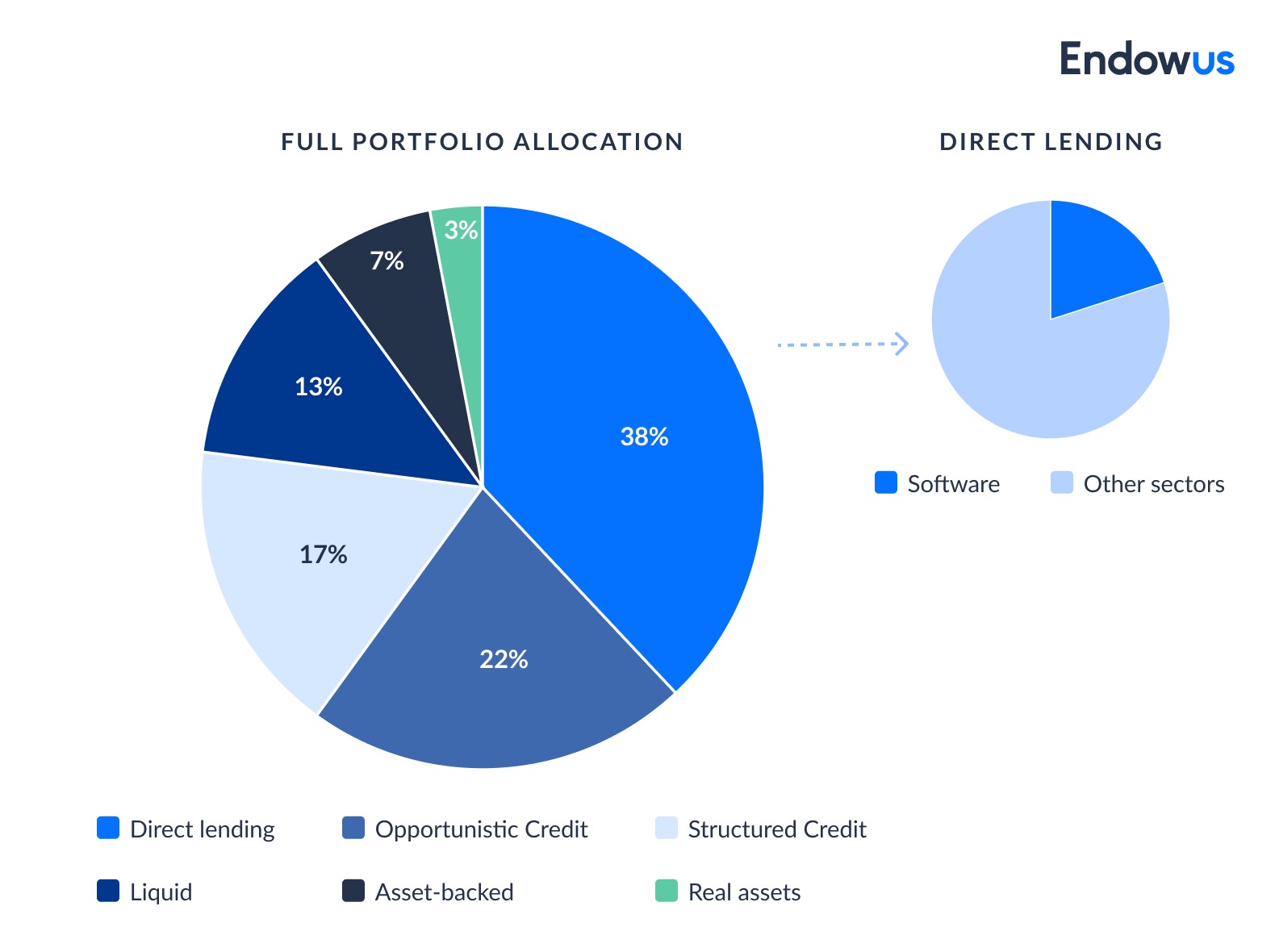
Among the sub-asset classes, consumer lending stands out for the potentially large opportunity set and for its limited correlation with business loans.
What is asset-based finance, and how does it relate to consumer lending?
Asset-based finance (ABF) and asset-backed securities (ABS) are two different structures through which investors can own exposure to cash flow-generating assets. Understanding the difference matters, because it determines how risk is managed, what protections investors have, and how most people in practice will actually access this market.
Both sit within the broader category of asset-based credit: financing backed by pools of cash-generating assets—consumer loans, mortgages, equipment leases, trade receivables—rather than a company's operating cash flow. That is the key distinction from direct lending, where repayment depends on the borrower's business performance.
Within asset-based credit, ABS and ABF work differently.
- ABS is a rated, broadly distributed bond issued by a bankruptcy-remote special purpose vehicle. The consumer loans are pooled, tranched, and sold to institutional investors; protections—waterfalls, subordination, reserve accounts, overcollateralisation—are embedded structurally at issuance and fixed for the life of the deal.
- ABF is a privately negotiated loan against a segregated asset pool. The lender retains active tools throughout the facility: borrowing base tests, advance rate adjustments, tighter eligibility criteria if collateral performance deteriorates.
Both structures isolate the asset pool from the originator's balance sheet. The difference is in the structure (securitisation vs direct relationship), degree of customisation (much higher for ABF loans) and the type of distribution—ABS tranches are typically broadly distributed, an ABF loan often has a single lender (or a lenders club).
Estimates vary, but growth has been consistent. KKR sized the global private ABF market at over US$6.1 trillion in 2025, against a pre-2008 global financial crisis (GFC) peak of roughly US$3.1 trillion, and projects up to US$9.2 trillion by 2029. The driver is—as with direct lending—bank retrenchment. Since the GFC, capital and liquidity rules have pushed banks to hold less consumer and small-business credit on their balance sheets, while US household debt has more than doubled over the same period, from roughly US$8 trillion in 2004 to over US$18 trillion in 2025, per KKR. Private capital has filled that gap.
According to With Intelligence's 2026 outlook, so-called “specialty finance”—much of it consumer- and asset-backed—drew US$37 billion in fundraising in 2025, more than the prior two years combined, and overtook direct lending as the most common new fund launch through the first three quarters of the year. Its own conclusion: asset-based finance “could challenge, or even overtake, the direct lending market.”
Why consumer loans behave differently compared to corporate credit
Consumer loans and corporate credit fundamentally differ in their risk drivers—one being consumer behaviour, the other being company earnings. More specifically:
- A direct loan to one company—repaid by the company’s cash flow—carries that company's risk, while an asset-dependent consumer loan pool typically spreads risk across thousands of borrowers, geographies, and income bands (credit card holders with different credit scores, for instance). Cash flows are generated by the assets, and track household repayment behaviour, rather than corporate earnings or sponsor decisions.
- Consumer loans also typically amortise, potentially carrying lower duration risk1. In addition, because principal is repaid gradually, not in one bullet payment at maturity, there is lower refinancing risk. This difference is one reason consumer credit has historically shown lower correlation to equities and corporate bonds, which tend to move together on the same macro triggers: central bank policy, geopolitics, earnings.
What is securitisation?
Securitisation is how institutional investors access this opportunity at scale. Loans are pooled into a special purpose vehicle and split into tranches. Senior tranches absorb losses last and pay steadier, lower yields; mezzanine and equity tranches sit lower in the waterfall and pay more for taking losses first. Overcollateralisation, excess spread, and subordination are the structural buffers built to absorb pool deterioration before it reaches senior noteholders.
The difference also changes how stress is identified and managed.
- In direct lending, deterioration typically surfaces through the corporate borrower—earnings declining, covenants tripping—and resolution depends on negotiation and business viability.
- In consumer loans, stress emerges through measurable changes in pool performance: delinquency rates rising, payment velocity slowing. Structural triggers are predefined and respond automatically, without relying on bilateral workouts or management cooperation.
BNPL's arrival in institutional capital markets
BNPL—short-term, often interest-free installment credit at the point of sale—is a relatively new asset within the consumer loans universe. Global gross merchandise value purchased through BNPL hit roughly US$560 billion in 2025, up 13.7% on the year, per PYMNTS Intelligence data cited in 2026 industry analysis.
BNPLs differ from traditional consumer loans because they are typically interest-free—consumers do not get charged for splitting the payment in installments—so yield comes from merchant fees at the point of sale. That makes cash flow for the end investors more sensitive to retail transaction volumes than to standard consumer credit metrics. BNPL also often skips traditional credit bureau reporting, relying on softer checks. The result is what industry research calls “phantom debt”: a borrower's exposure across multiple BNPL providers, invisible to any single lender.
Aside from generating potential hidden stress in the financial system, this would have typically made it harder to structure the different risk tranches for a consumer loan originator, as identifying prime borrowers from subprime borrowers was not possible due to lack of data.
Regulators have been moving to close that gap. The UK's Financial Conduct Authority brings most BNPL providers under formal supervision by mid-2026, with mandatory affordability checks and bureau reporting. The EU's Consumer Credit Directive II removes the reporting and checks exemption for short-term, interest-free instalment products. Closer to home, Singapore's BNPL Code of Conduct—developed by the Monetary Authority of Singapore and the Singapore FinTech Association since 2022—has an express prohibition on new loans for consumers who miss payments2.
Tighter regulation is likely to help investors, even if it raises near-term compliance costs for providers. Mandatory affordability checks and clearer disclosure improve the quality (and transparency) of the underlying pool—the same logic that has long applied to traditional consumer ABS through eligibility criteria and concentration limits.
In fact more recently, in 2025, Klarna partnered with Pagaya Technologies on a US$300 million bond backed by BNPL receivables, arranged by JPMorgan Chase and Apollo's Atlas SP unit. In that particular issuance, BNPL receivables were packaged into rated tranches, similarly to the auto loan and credit card asset-backed securities (ABS) that have underpinned consumer credit markets for decades.
Investment implications
For accredited investors, consumer-facing asset-based finance should be seen as an opportunity for potential diversification as it exposes them to a different category of borrowers, different macro drivers, and different points in the cycle. Direct lending tracks corporate earnings, sponsor activity, refinancing conditions. Consumer and BNPL-linked credit is sensitive to changes in household income, employment, retail spending.

Tranche selection matters more than the asset class label. Senior tranches in consumer ABS offer capital preservation broadly comparable to investment-grade credit. Mezzanine and equity tranches carry meaningfully higher risk for higher yield.
Most individual investors will access this through funds and platforms, not direct securitisation purchases. As with any private market allocation, manager selection—underwriting track record, workout capability, transparency on portfolio composition—does more work than the asset class label.

Frequently asked questions
Is consumer lending the same as buy now, pay later (BNPL)?
No. Consumer lending is the broader category: auto loans, credit cards, personal loans, student loans, plus newer products like BNPL. BNPL is a fast-growing subsegment, marked by short maturities, often-interest-free terms, and typically looser—but in the process of becoming stricter—underwriting at origination.
Why has direct corporate lending become more crowded?
Retail-accessible, semi-liquid vehicles brought a wave of new capital into a market with a limited pool of suitable middle-market deals. Cambridge Associates (2026) ties resulting spread compression and weaker lender protections directly to this dynamic in the US core and upper middle market.
Does consumer lending carry less risk than direct corporate lending?
Not necessarily—different risk, not lower risk. Pooling diversifies away single-borrower exposure, but the pool stays sensitive to employment, consumer spending, and rates. Subprime-heavy pools and newer products like BNPL or payday loans carry materially higher credit risk than prime auto or credit card receivables.
How is BNPL credit risk assessed if it bypasses traditional credit bureaus?
Many BNPL originators use alternative data—transaction history, platform repayment behaviour, increasingly machine learning models—instead of full bureau-reported credit history. Regulatory reforms moving through the UK, EU, and other markets through 2026 are pushing providers toward standard affordability checks and bureau reporting, which should improve transparency over time.
Can retail investors in Singapore access consumer loan securitisation directly?
Usually not directly. Institutional investors—banks, insurers, private credit funds—hold most securitisation tranches. Individual investors in Singapore typically gain exposure through funds, ABS-focused vehicles, or platforms that hold these instruments.
1Duration measures the weighted-average time until cash flows are received, weighted by the present value of each cash flow. A bullet structure concentrates the largest cash flow (full principal) at the final maturity date, so a large share of the bond's value-weighted timing sits right at the end of the term. An amortizing structure returns principal throughout the life of the instrument, so investors receive cash earlier on average—which pulls the weighted-average timing, and therefore duration, shorter.
2“We will suspend further access to your BNPL limit if you fail to meet your outstanding instalment payment obligations. This means that you will not be able to use your BNPL account to make any additional purchases.”
Why are more family offices setting up in Singapore?

Webinar: Introduction to the art market
.jpg)
How alternative investments can fit into your portfolio



%20F1(2).webp)

.webp)
.webp)






.webp)