


.webp)
.webp)
.webp)
.webp)






.webp)










%20(1).gif)

Register for the event
Endowus invites you to our exclusive event with Macquarie Asset Management, as we discuss unlocking opportunities in Infrastructure- a $1.3tn asset class.
This event is reserved for Accredited Investors (AIs) only. To register for the event, please indicate one of the following:
- A venture valuation is calculated by multiplying the price of newly issued shares by the total number of shares after the latest funding round (“post-money”).
- Rather than valuation per se, the key metrics is the preference stack—liquidation preferences and anti-dilution clauses—which determines who is actually paid, and how much when a liquidity event happens. The same ownership stake can produce materially different outcomes from an identical exit.
- Beyond exits, down rounds—rounds of funding at lower valuations compared to previous ones—are an instance where such protection clauses come into play. Down rounds have been more common in 2024 compared to 2022 as rates rose and capital became scarcer.
In venture capital, there is a major difference between valuation and the return potentially earned by any individual holder, which is mainly determined by the preference stack sitting beneath it. Two companies carrying the same valuation can distribute wildly different amounts to the same shareholder, depending on terms agreed long before an exit.
This has been particularly relevant after the venture capital freeze of 2023 and 2024, when availability of capital substantially decreased and funding terms and conditions became more cumbersome for founders. A preferred liquidation clause, for instance, is incredibly relevant if a company exits at a disappointing price. Similarly, an anti-dilution clause is typically activated in the event of a “down” round, a capital raise at a valuation lower than the previous ones.
What follows works through the mechanics in sequence—how a valuation is constructed, how liquidation preferences convert it into a distribution, and how anti-dilution clauses turn a down round into a transfer of ownership—before turning to what all of this means for holding private-market exposure in a portfolio.
How the headline valuation is constructed
A venture valuation is imputed by taking the price per share agreed in the most recent round and multiplying by the fully diluted share count (the so-called “post-money valuation"). The price is set by a handful of investors negotiating bespoke terms, and it is then extended, uncritically, to every share in the capital structure.
We will not go into how venture capital fund managers determine the right valuation for a company that has limited revenues, if any, and negative cash flow. Suffice it to say that it reflects the probability-weighted projected price at exit, discounted by the number of years that are estimated to be needed before the liquidity event. The discount rate used is a variable, and depends on prevailing financial conditions—which is relevant for what we are trying to untangle here.
But that number just reflects a particular point in time, as well as the manager’s (or the founder’s) bargaining power. That, in turn, is determined by the supply and demand of capital in both the entire system, and for the company per se. It is intuitive that if capital is scarce, it’ll likely be more expensive—valuations will be lower. On the contrary, all things equal, if the company is doing exceptionally well its pull for venture capital (VC) will be substantial, which would likely generate more generous funding conditions and thus higher valuations.
But even that can be tricky. For VCs, negotiating terms and conditions goes beyond valuation and stake. More important for managers is protection—from dilution, from downside, from other VCs.
These negotiations involve several clauses that are considerably more important than just ownership, which further blurs the numbers when it comes to assessing valuation from the price of the latest stock issuance.
The most rigorous work on this point quantifies the gap directly. Modelling the contractual terms of 135 US unicorns within an option-pricing framework, Gornall and Strebulaev (Journal of Financial Economics, 2020) found reported post-money valuations averaged 48% above fair value, and that common shares were overvalued by 56%. On their adjusted estimates, nearly half the companies in the sample would not have cleared the US$1 billion threshold at all. The authors also cite survey evidence that 91% of venture capitalists considered unicorns overvalued—the people setting the marks did not treat them as prices.
How liquidation preferences impact distribution
Beyond the issue of whether the current valuation really reflects the company’s “fair value”—whatever this means for early stage companies—the difference between preferred and common stock is incredibly relevant at exit.
The so-called “liquidation preference”—one of the “protective” contractual terms for venture capital investors—grants the preferred holder an either/or right at exit: either take a fixed sum—the invested capital plus any accrued dividend—or convert to common stock and take the compensation for the ownership percentage, whichever is greater. Formally, this is a debt-like claim bundled with a call option on the equity, and the holder exercises whichever leg pays more.
Let the invested capital be I, the accrued dividend D, and the ownership fraction %INV. The holder converts only when the as-converted value exceeds the preferred claim:
%INV × X > I + D → CT = (I + D) / %INV
where X is the exit value and CT is the conversion threshold. Below it, the investor takes the fixed claim; above it, the investor converts. Consider a 25% stake bought for US$2 million with an 8% accruing preferred dividend, so the preferred claim is US$2.16 million at year 2. The conversion threshold is US$2.16m ÷ 0.25, or US$8.64 million. This means if the exit price is below US$ 8.64 million, the owners of common stock—mostly the founders—will receive less than their share, as the investors’ preferred claim will be higher than their 25% stake, which in turn will push them to avoid the conversion.
Beyond that threshold, the investor’s stake will be higher than the liquidation preference, which will make it more convenient for the investor to do the conversion.
Two variations move the threshold decisively against the founder. A multiple preference returns the capital M times over, so the claim becomes M × I + D and the threshold rises accordingly. A participating preference—the “double dip”—pays the fixed claim and then shares in the residual, so that CFINV = PT + (X − PT) × %INV. The investor never gives up the preference, and the “either/or” becomes “both.”
The chart below plots the investor's cash flow against exit value under three structures, holding ownership and capital constant. The distance between each line and the 45° reference is value that accrues to the preferred holder rather than to common shareholders. Structure, not the headline number, allocates the proceeds.
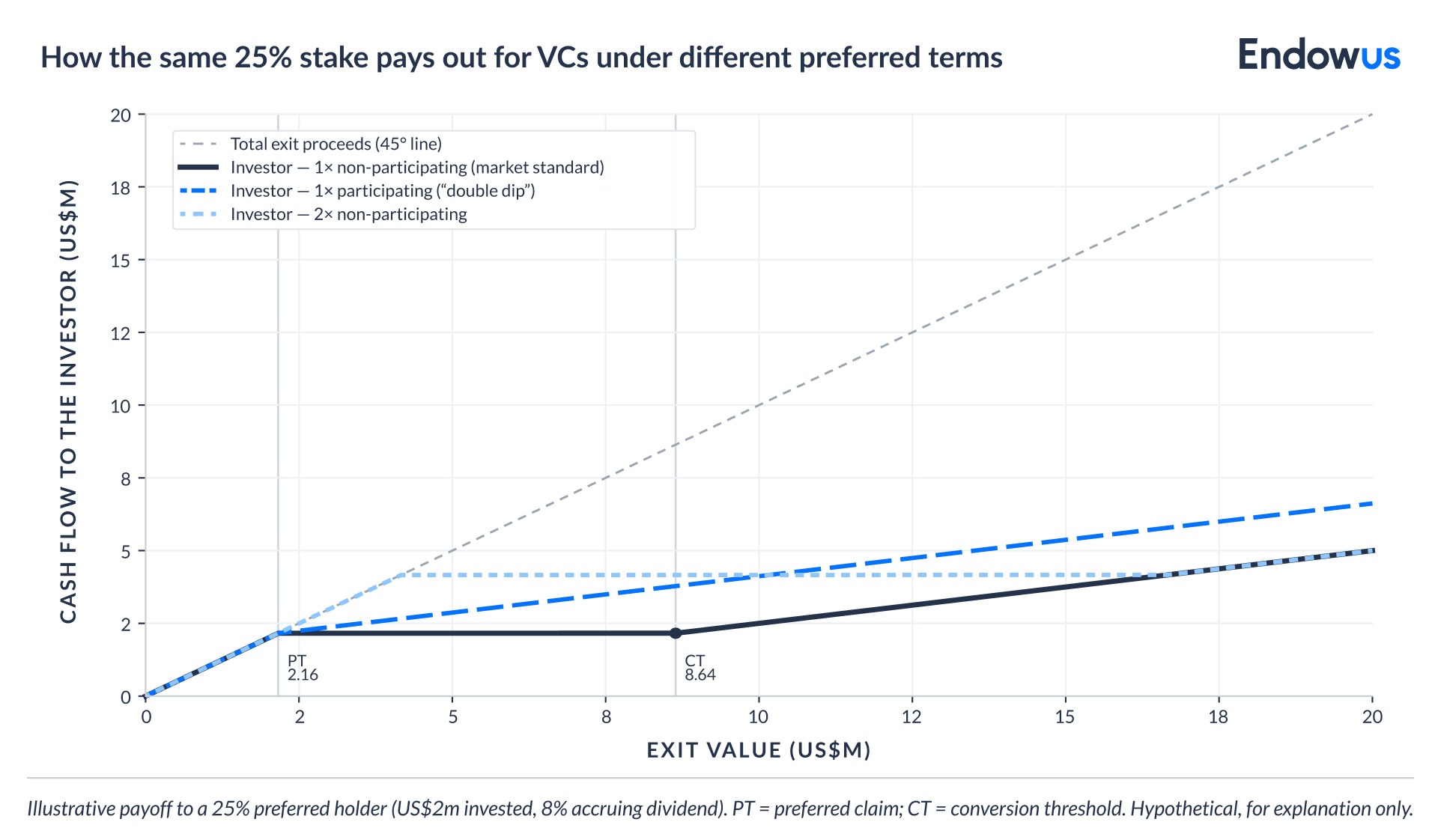
The reading is instructive. Under the current market-standard 1× non-participating term (navy), the investor is flat at the preferred claim across a wide band of “modest” exits, and only rejoins the ownership line above the conversion threshold. Under 2× (dotted), that flat band extends much further, so the founder receives nothing beyond the residual until a far higher exit. Under participation (teal), the investor's line sits permanently above the standard case. The same 25% stake, three different economic outcomes.
What is a down round?
A down round is a financing round in which a company issues new shares at a lower price per share than in its previous round. The comparison is always to the prior round's price per share—so a down round is a fall relative to that specific earlier benchmark, not to some general notion of value.
Down rounds tend to cluster around a few conditions:
- The most likely one is market-wide repricing. When the environment that set earlier valuations changes—rising interest rates, compressing public-market multiples for comparable companies, a broad pullback in risk appetite—the prices agreed 18 to 36 months earlier are no longer viable. But that repricing may not happen for a few years, since a private company only reprices when it next raises money. Consequently, a wave of down rounds often reflects earlier vintages finally catching up to a changed market.
- Company-specific underperformance can also be the culprit—missing growth targets, a weaker competitive position, or a longer projected path to profitability, so that investors will only fund the company at a lower price than before.
- Running low on cash with no better option matters too. A company that needs capital and can't secure an up round or a flat round may accept a down round rather than run out of money—the alternative (insolvency) being worse. Bridge financings and delayed raises frequently precede them.
More investor-friendly conditions compound the effect: when capital is scarce, new investors may have more leverage to set both a lower price and more protective terms.
The inference is clear. If you’re a founder, managing funds conservatively is key, especially if the funding was obtained at particularly favourable terms, in “good times.” For investors, the cycle is exactly the opposite—when market or company idiosyncratic conditions deteriorate, their dollars may buy them more equity, or will get them better terms (or both).
Anti-dilution clauses make a down round a transfer of ownership
A down round matters, in the technical sense, because it can activate different forms of protection for earlier investors who “entered” at a higher valuation. That is, if these investors were shrewd enough to include protection when they allocated capital in previous rounds.
The most important one is the “anti-dilution clause,” which retroactively adjusts the conversion price of earlier preferred shares when a subsequent round is priced lower, issuing the protected holder additional common shares to compensate for the mistimed entry. The two standard forms differ only in severity.
The broad-based weighted-average adjustment—the market norm—resets the earlier conversion price in proportion to both the discount and the size of the new issue:
NCP = OCP × (A + B) / (A + C)
where OCP and NCP are the old and new conversion prices, A the fully diluted shares outstanding before the round, B the new money divided by the old price, and C the new money divided by the new price. The full-ratchet form dispenses with the weighting entirely and resets the earlier price to the new, lower price—a far larger adjustment. Full-ratchet remains rare in normal conditions but reappears selectively in distressed rounds.
The decisive question is incidence: who absorbs the adjustment. The extra shares issued to protected holders dilute everyone without the clause. Founders and employees hold common stock and carry no such protection, so they bear the reset twice over—once through the new capital raised, and again through the top-up handed to the protected preferred.
A down round is the moment latent contract language becomes a live reallocation of ownership away from the operating team, which is why executing one is as much a retention problem as a financing problem.
In fact this is the most underappreciated element of down rounds.
The market has repriced, and terms have hardened selectively
The cyclical backdrop determines whose leverage prevails at the negotiating table. The 2021 peak was extreme: global venture investment reached a record US$621 billion, more than double the prior year. But as policy rates rose in 2022, the listed high-growth technology multiples that anchor private marks compressed sharply, and private valuations followed—though only with a lag, at the next financing event. The down rounds of 2023 and 2024 are, in large part, 2021 valuations meeting a repriced public market.
As capital tightened, terms shifted toward investors—though less uniformly than the headlines suggest. The clearest movement was in seniority and in pay-to-play provisions, not in a wholesale migration to multiple or participating preferences, which remained a minority of deals. The table summarises the shift
The market standard held at 1× non-participating throughout the downturn. What changed was the incidence of senior preferences—new money ranking ahead of earlier money—which rose from roughly 30% of deals in 2022 to 47% in 2023 (Fenwick; Aumni), and pay-to-play mechanics, which reached around 9% to 10% of deals through 2024 and 2025 (Cooley). These are precisely the terms that redistribute proceeds in a weak exit, and their spread is the more telling signal.
Investment implications
For Accredited Investors allocating to venture capital, it is important to understand these dynamics. It is also worth noting that the fund manager they are investing in is likely to have some of these clauses in place in the event that further funding rounds may undermine their position.
Three main points need to be retained:
- First, reported private valuations should be read as negotiated, stale marks rather than live prices. The longer the time elapsed from the last round, the less relevant these numbers become. Because a private position is re-evaluated only when the company next raises, and reported with a lag, a valuation that has not moved may simply have not yet been tested. This lag flatters measured volatility and can overstate diversification benefit—a point worth carrying into any allocation that leans on private marks for stability.
- Second, in private markets the terms of access are part of the asset. Two vehicles holding the same underlying company on different share classes may deliver materially different outcomes from an identical exit. Due diligence that stops at the headline valuation, and does not reach the preference stack, is incomplete.
- Third, and in my view most importantly, this is an argument for diversified, professionally structured exposure in this space. Everyone may get excited about a single late-stage name with public recognition—and recent hype about IPOs may spur demand for high-growth, late-stage private companies. But successful venture capital relies on careful vetting and complex negotiated terms that most end investors never see; a diversified, institutionally structured allocation spreads that idiosyncratic term risk.
To sum up, the current wave of down rounds is less alarming than it looks: much of it is the arithmetic of repricing a singular 2021 vintage, and the market standard on terms has held. That said, the hardening of seniority and pay-to-play provisions post-2022 peak is a real shift in how future losses will be shared, and it needs to be taken into account precisely because it won’t be featured in valuation headlines.
<divider><divider>
1 https://carta.com/data/down-rounds-2023/, https://carta.com/data/late-stage-lull-2024/, https://carta.com/data/state-of-private-markets-q3-2025/
2 https://www.cooley.com/news/insight/2024/2024-05-02-q1-2024-venture-financing-report https://www.cooley.com/news/insight/2022/2022-02-03-venture-financing-report-q4-2021
3 Fenwick: https://assets.fenwick.com/documents/Silicon-Valley-Venture-Capital-Survey-Fourth-Quarter-2022.pdf; Aumni: https://www.aumni.fund/blog/atypical-liquidation-preference-rights-on-the-rise and https://www.aumni.fund/venture-beacon
4 https://www.cooley.com/news/insight/2025/2025-02-07-q4-2024-venture-financing-report
5 https://www.cooley.com/news/insight/2024/2024-10-25-q3-2024-venture-financing-report; https://www.cooley.com/news/insight/2025/2025-02-07-q4-2024-venture-financing-report
6 A pay-to-play provision is a clause that requires existing investors to participate in a company's next financing round—typically by investing their pro-rata share of the new round—or else lose some of the preferential rights attached to their shares. The name captures the mechanic: to keep "playing" (retaining your preferred rights), you have to "pay" (put in fresh capital).
How hedge funds can help you ride through market volatility

Is wine a good investment? The liquid illiquid asset

How US private credit can endure downturns
.jpg)


%20F1(2).webp)

.webp)
.webp)






.webp)