


.webp)
.webp)
.webp)
.webp)






.webp)












%20(1).gif)
Register for the event
Endowus invites you to our exclusive event with Macquarie Asset Management, as we discuss unlocking opportunities in Infrastructure- a $1.3tn asset class.
This event is reserved for Accredited Investors (AIs) only. To register for the event, please indicate one of the following:
- A carry trade funds a position in a low-yielding asset or currency and invests the proceeds in a higher-yielding one, aiming to capture the difference in yield.
- Carry can be profitable for long stretches because a low-yielding funding currency does not always weaken as economic theory predicts, but the return profile is skewed towards many small gains and occasional sharp losses.
- The August 2024 unwind of the Japanese yen carry trade, when Japan's Topix index fell 12% in a single day, shows how quickly a crowded, leveraged carry position can reverse and spill into global markets. More recently, the US and Japan coordinated an intervention to stop the yen’s depreciation.
Interest rates differ from one country to the next, and from one point on the yield curve to another. Wherever they differ, the same opportunity appears: borrow where money is cheap, and invest where it earns more. That trade has a name — the carry trade.
The carry trade is one of the oldest and most widely used strategies in global markets, and understanding it explains a surprising amount of otherwise puzzling market behaviour. Its appeal and its danger share a single source: it pays a steady premium for bearing a risk that appears rarely, but severely.
This article explains what a carry trade is, how covered and uncovered interest rate parity explain why it can pay, the forms it takes beyond currencies, and the risks worth understanding even for investors who never run one.
What a carry trade is, in plain terms
A carry trade funds a position by borrowing at low rates and invests where the yield is higher. The return is the difference between the two yields, plus or minus any change in the price of the asset bought. The asset borrowed is the funding leg; the asset bought is the target.
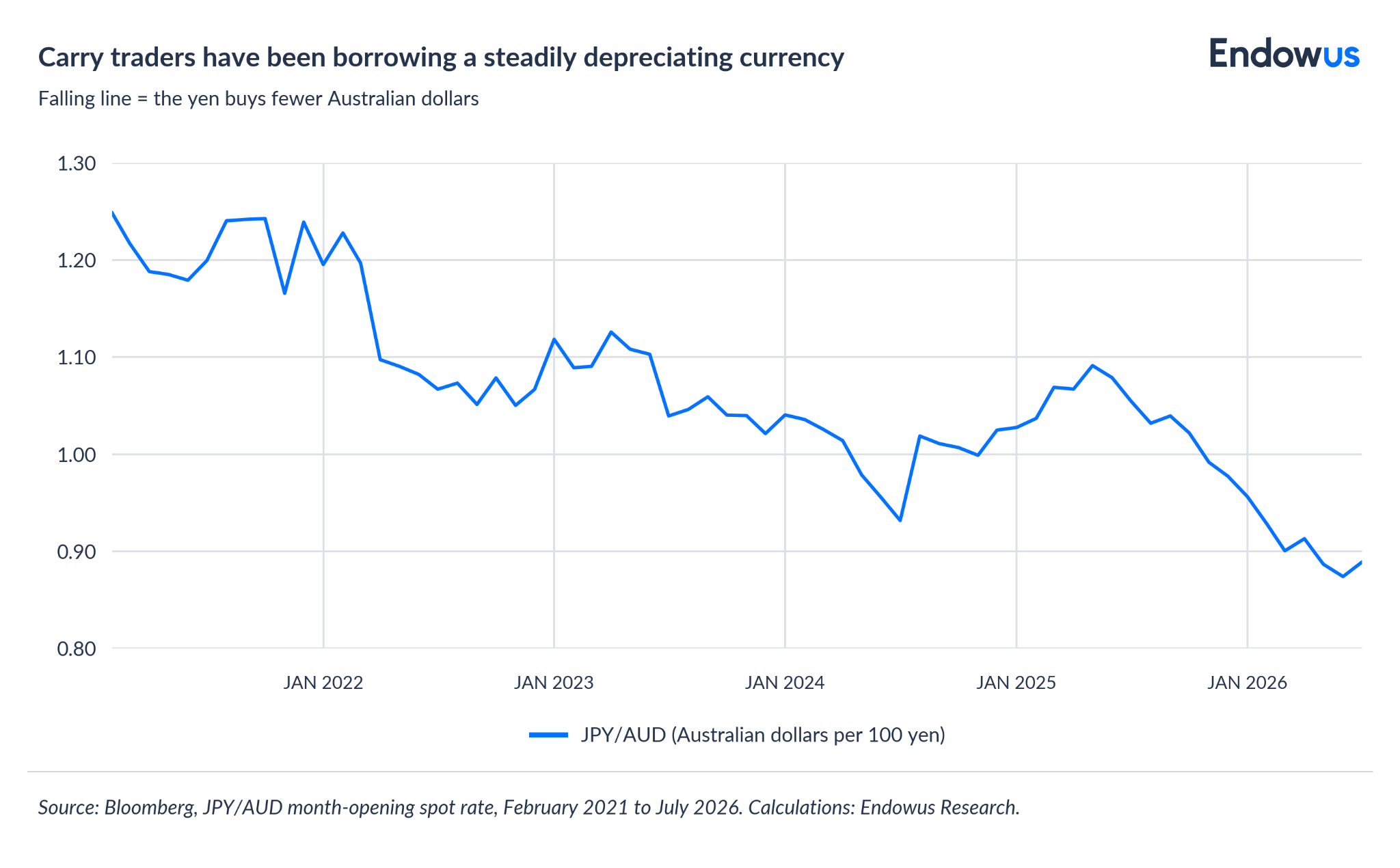
The classic version is a currency trade. An investor borrows a low-interest-rate currency — historically the Japanese yen or the Swiss franc — and invests in a higher-interest-rate currency. That borrowed currency is called the funding currency.
There are two key factors in a carry trade:
- a sustainable interest rate differential and,
- the expectation that the funding currency does not appreciate (as the obligation to settle the debt in borrowing the cheap funding currency remains)
A simple, illustrative example shows the mechanics. Suppose an investor borrows yen at 0.5% and invests in an Australian-dollar asset yielding 4.0%. The gross carry is 3.5% a year before any currency move. Adding borrowed money, or leverage, raises the return on the investor's own capital — but a 3.5% strengthening of the yen may erase a full year of that carry, and leverage would multiply any further loss. The figures here are illustrative only.
Why the carry trade works when theory says it should not
An investor can typically hedge the exchange-rate risk with a forward contract — an agreement made today to convert the currency back at a set rate later. Covered interest rate parity (CIP), a no-arbitrage relationship that holds tightly in normal conditions, prices that forward so as to cancel the interest-rate advantage almost exactly, leaving a hedged trade with little to gain.
Uncovered interest rate parity (UIP) is the corresponding economic hypothesis: that the expected change in the spot rate will offset the interest-rate differential, so the funding currency should appreciate by roughly the interest advantage, with that expected appreciation reflected in the forward rate. That appreciation would, in theory, eliminate the “carry” returns.
But UIP seldom holds in practice. The funding (low-yield) currency often fails to appreciate — indeed, high-yield currencies have tended to appreciate a little on average — a gap economists call the forward premium puzzle, which they attribute to the potential losses from sudden reversals caused by - for instance - changes in monetary policy.
Carry is a general concept, applied beyond currency trading
The concept of carry applies to several other asset classes. In fixed income, an investor may hold longer-dated debt to earn a higher yield and benefit as the bond "rolls down" the curve towards maturity. In commodities, carry turns on the shape of futures prices: "backwardation", where near-term prices sit above later ones, offers positive carry, while "contango" does the reverse.
There is even carry in volatility, where an investor earns a premium for selling insurance-like protection. The common thread is simple: carry is the return an investor earns if prices do not move at all.
How does carry appear in Singapore’s currency system?
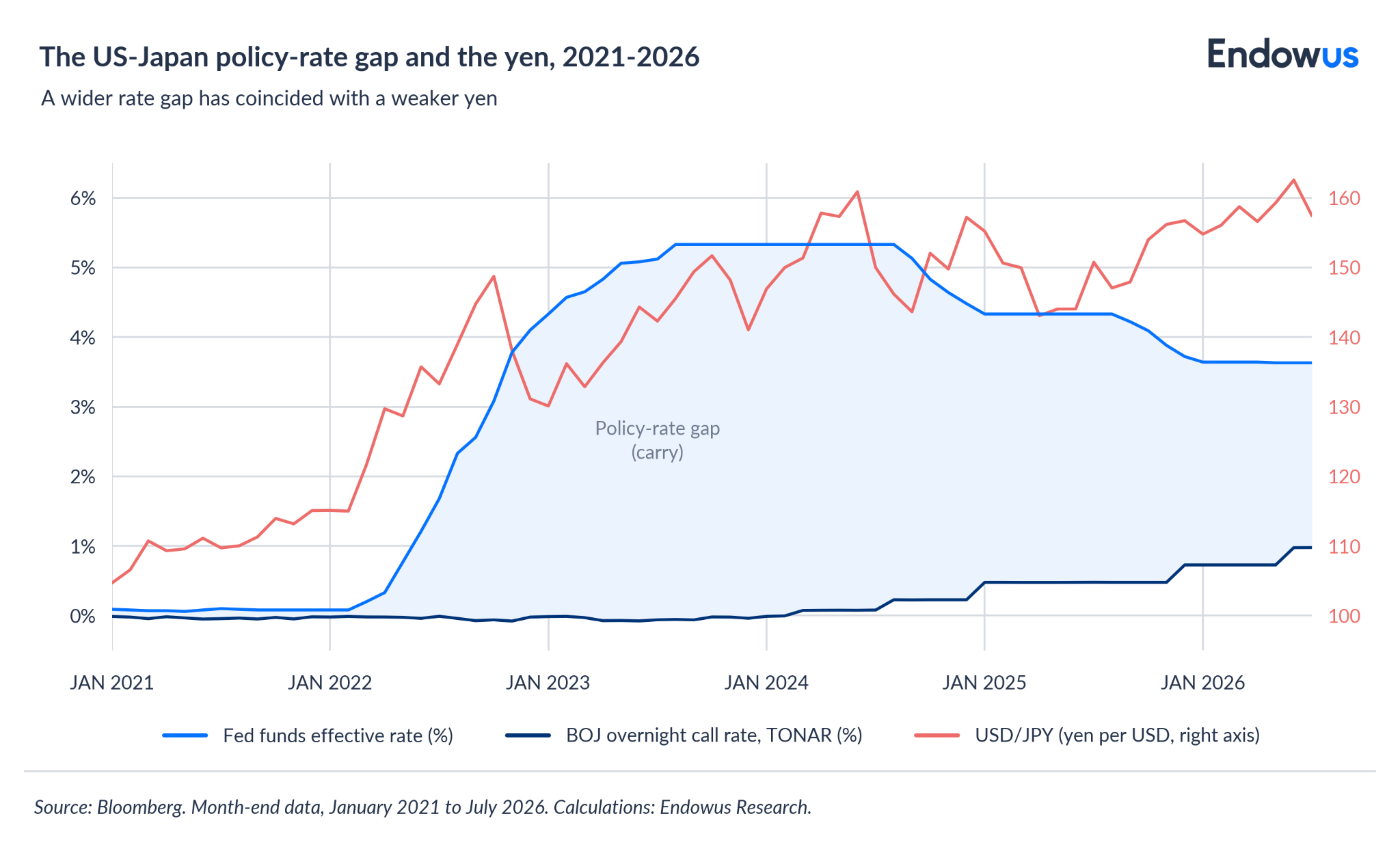
Like the yen, the Singapore dollar also carries a rate differential against the US dollar — on 11th August 2026, the daily Singapore Overnight Rate Average (SORA) stood at 1.37% p.a., versus 3.64% p.a. for its US equivalent (SOFR). In principle, this spread could support a similar carry trade.
In practice, however, SGD is an exotic currency and lacks liquidity depth. The yen is one of the five constituent currencies in the IMF's Special Drawing Rights basket and is held as an official reserve currency by central banks worldwide, which underpins deep, liquid two-way markets. Thinner markets mean SGD may become prone to sharp, disorderly moves if trading volume substantially increases, which would raise the execution and unwind risk of any leveraged position funded in the currency. Therefore, using SGD as a funding currency for carry trades is not a popular strategy among institutional investors.
What is the main risk of a carry trade? A sudden, crowded unwind
Carry's return profile can be lopsided. The Bank for International Settlements has described it as picking up small, steady gains in calm markets while facing steep losses when turbulence arrives. Many carry trades share the same crowded positions, so a reversal can feed on itself.
The history is instructive. During the 2008 crisis, as the yen carry trade unwound, the currency strengthened sharply against the US dollar. More recently, the Bank of Japan raised its policy rate to around 0.1% on 31 July 2024; within days, on 5 August 2024, Japan's Topix index fell 12% in a single day and volatility spiked worldwide, before markets stabilised within the week.
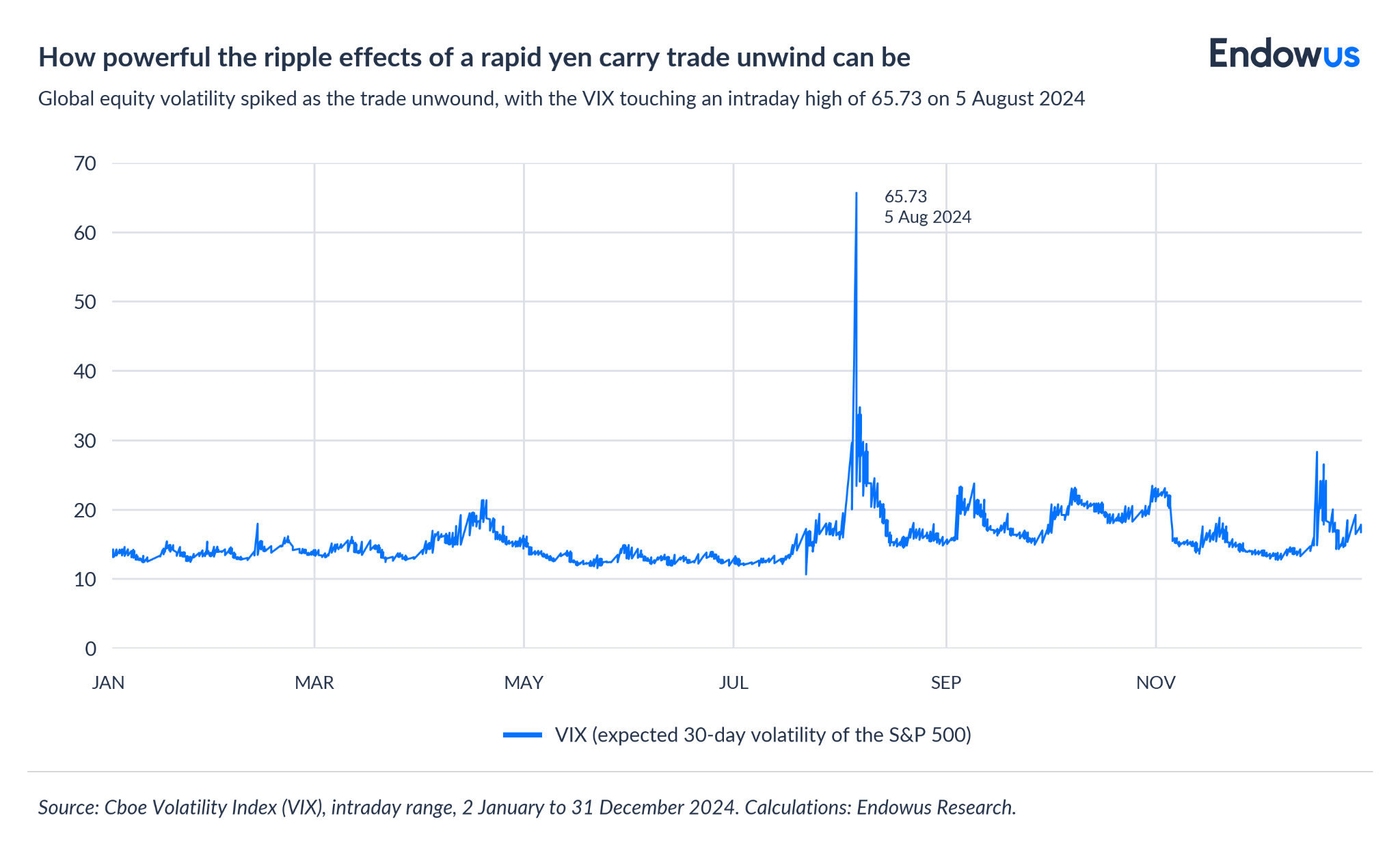
These episodes spread because cheap funding had financed positions far beyond the currency itself, including global equities and bonds. When the funding currency strengthens, investors sell those other assets to repay the loan, and the stress travels across markets. Past market events are not necessarily a guide to future outcomes.
To evaluate how attractive and risky a carry trade is, the carry-to-risk ratio — the US-Japan rate differential divided by implied JPY volatility — measures reward per unit of currency risk in a carry trade. Risk rises and attractiveness reduces as the ratio falls toward zero, which happens when the rate gap narrows: from 2020-2022, when the Fed held rates near zero and the gap disappeared, and again in July 2024, when the BOJ's first rate hike to positive territory (a previous March 2024 hike had ended a long period of negative rates) in decades compressed it from the other side. Leverage amplifies this risk further, since most carry trades are built on borrowed capital, turning modest moves into potentially outsized losses.
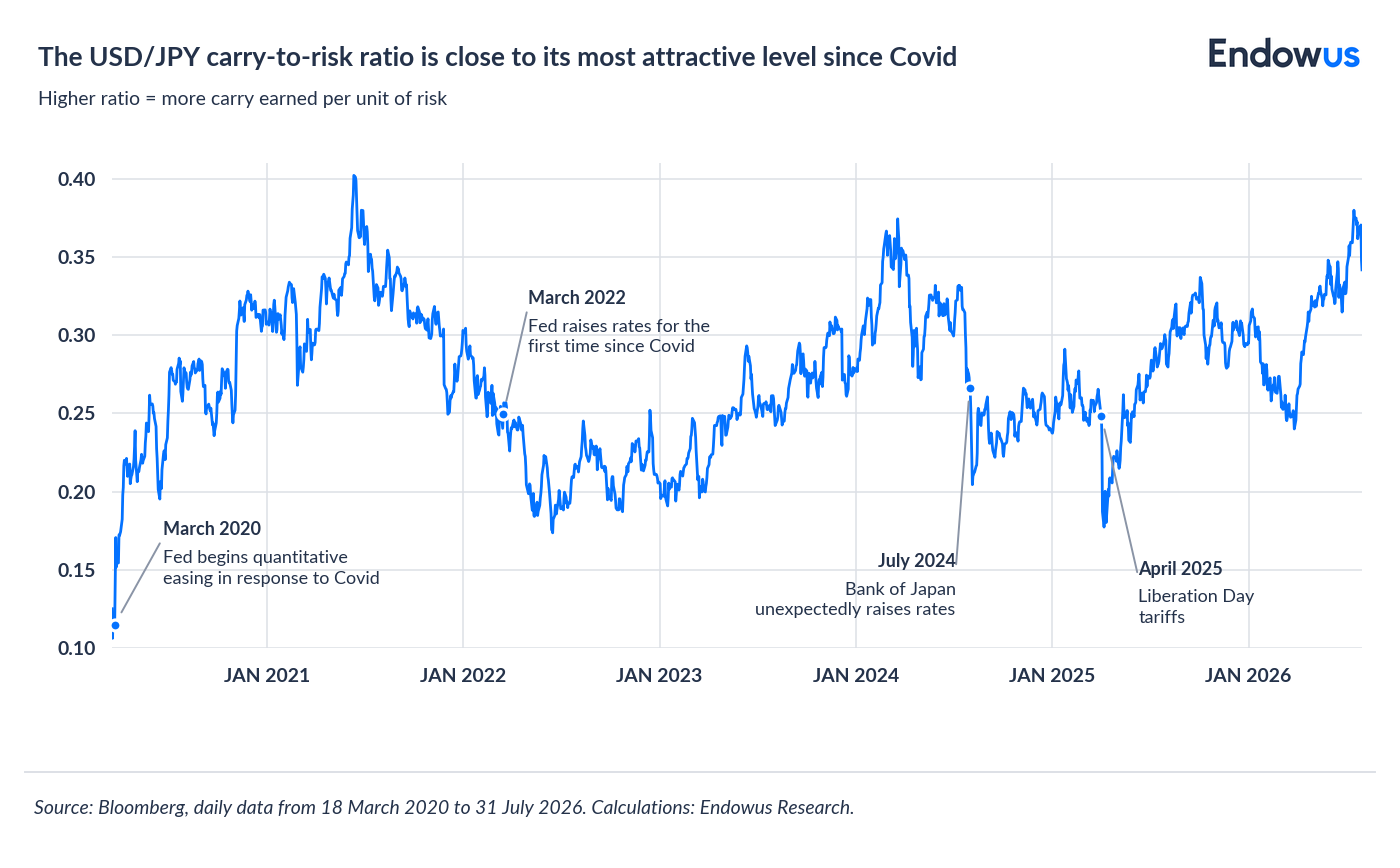
Not every rate differential can be easily exploited: how government intervention can potentially unwind carry trade
On 30 July 2026, the Japanese Ministry of Finance sold US Treasuries in the open market to raise dollars, then sold those dollars to buy the equivalent of approximately $59 billion in yen — hoping to halt the currency's continued depreciation. The operation was completed within a single day, and the yen appreciated sharply, gaining roughly 2% to 2.6% against the dollar. In this specific case, the rebound proved short-lived, as the dollar recovered the next day because investors continued to expect further yen depreciation.
Subsequently, the US and Japanese Treasuries conducted their first joint yen-buying intervention since 1998. The New York Fed, on behalf of the US Treasury, sold euros from the Exchange Stabilization Fund (ESF) to buy $5 billion to $10 billion worth of yen.
Note that the magnitude of the exchange rate move may not be proportional to the scale of the central banks' yen purchases. The fluctuation reflects investor expectations following the central banks' actions, more than the size of the intervention itself.
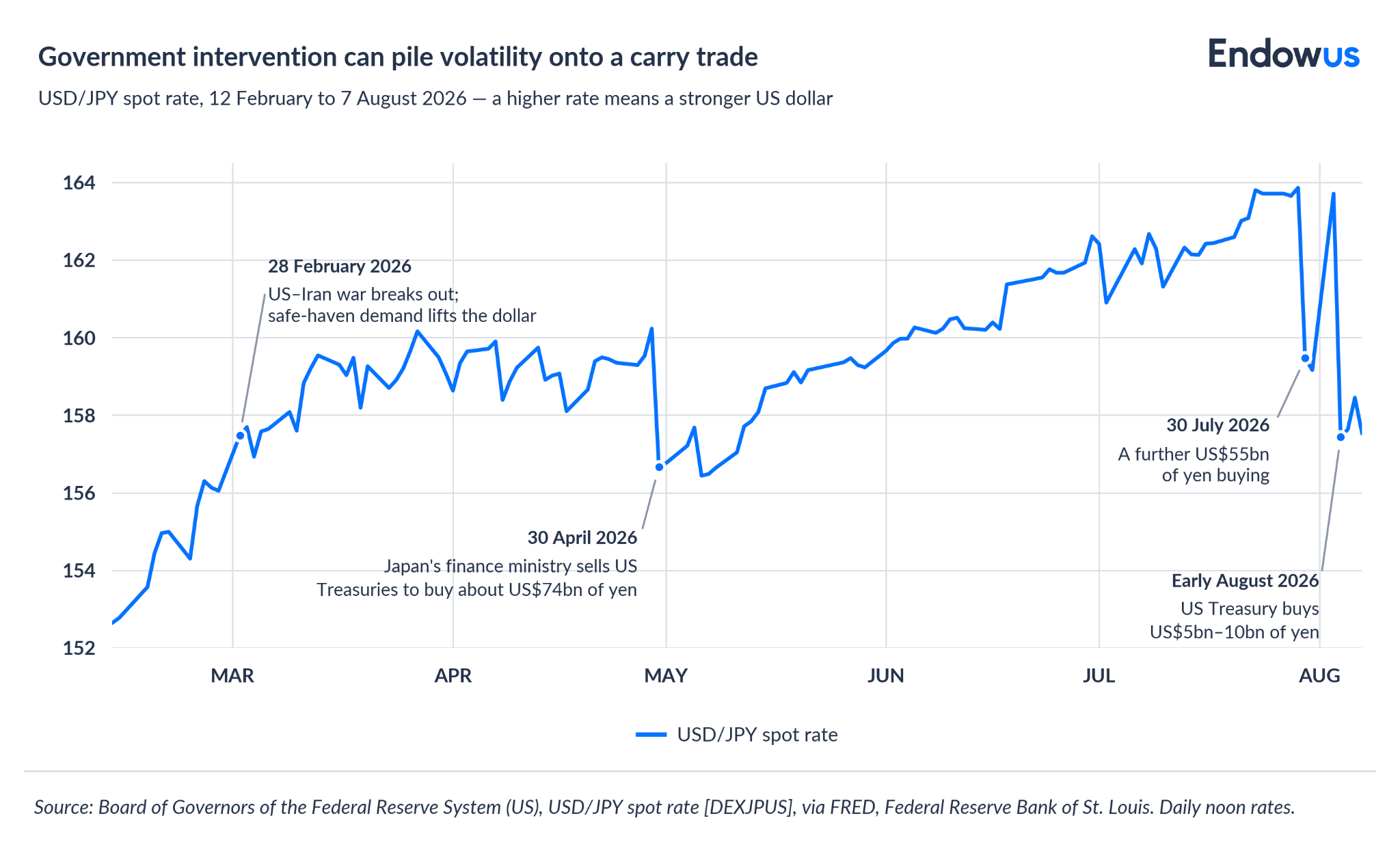
The rationale behind the joint intervention was twofold. First, Japan is the largest foreign holder of US Treasury securities, and continued dumping of Treasuries to fund yen purchases risked triggering a liquidity crisis in the US Treasury market. Second, sustained yen depreciation threatened to drag down the currencies of other export-oriented Asian economies — particularly South Korea — raising fears of a potential regional contagion reminiscent of the 1997–98 Asian Financial Crisis.
For the JPY/USD carry trade, this may materially raise the “risk” side of the equation. Coordinated intervention signals that policymakers will actively defend the yen against further depreciation, introducing sudden appreciation risk that can potentially trigger rapid, disorderly unwinds — as already seen when carry positions unwound sharply.
If the policy intervention is implemented, traders may have to deal with lower attractiveness and higher volatility for the trade.
What is an obstacle to carry trade?
Governments and central banks generally dislike their currency becoming a popular carry-trade base, since the resulting capital flows can destabilize the exchange rate and potentially erode independent monetary policy.
Although the Chinese yuan has maintained a lower interest rate than the US dollar since 2022’s Fed rate hike cycle, carry trades between the two currencies remain difficult to execute. China blocks this structurally, through strict controls on cross-border capital movement.
Why this matters even if you never run a carry trade
Carry dynamics move the markets an ordinary investor already holds, so recognising them helps make sense of sudden, seemingly disproportionate price swings.
In Singapore, that profile can appear in dual currency investments, some structured notes, and strategies that write options or sell volatility for income. It may also sit inside funds holding higher-yielding emerging-market or local-currency debt. None of these is inherently unsuitable — but the yield on offer may be compensation for a risk that has not yet shown up.
So the question to ask of any product offering an unusually attractive yield is not how much it pays, but what it is being paid to bear.
Investment implications
Carry-like risk is embedded in more portfolios than investors often realise, and it tends to look attractive in calm markets precisely because its cost appears only in rare, sharp episodes.
On one hand, carry strategies may deliver steady, positive returns through long periods of market calm. On the other hand, those returns compensate for a real and recurring risk of sharp loss, and leverage may turn a manageable setback into a damaging one. The two cannot be separated.
Frequently asked questions about carry trade
What is the simplest example of a carry trade?
Borrowing a low-interest-rate currency and investing the proceeds in a higher-interest-rate currency or asset. The investor keeps the difference in yield, as long as the exchange rate does not move sharply against them.
What is the difference between covered and uncovered interest rate parity?
Covered interest rate parity applies when the currency risk is hedged with a forward contract; arbitrage keeps the forward rate priced so that no risk-free profit remains. Uncovered interest rate parity applies when the position is left unhedged and relies on expected exchange-rate moves; it often fails in practice, which is what gives an unhedged carry trade its return.
Why is the Japanese yen so often the funding currency?
Japan kept interest rates very low for many years, which made borrowing in yen cheap. That low funding cost is what made the yen a popular currency to borrow and sell in order to invest elsewhere.
Can investors in Singapore be exposed to carry without realising it?
Yes. Certain foreign-currency deposits, high-yield currency products, and structured products carry embedded interest-rate or volatility exposure that behaves like a carry trade, even when it is not labelled as one.
What ended the August 2024 unwind so quickly?
Markets stabilised within the week as volatility subsided and positioning adjusted. The episode was sharp but short-lived, and it is a reminder that carry unwinds can be violent even when they prove brief.
Webinar: Investing in a better future: Through the lens of an equity investor

Why ESG investing should matter to Singaporeans

When you can’t see the forest for the trees: A holistic approach to asset allocation



%20F1(2).webp)

.webp)
.webp)






.webp)