


.webp)
.webp)
.webp)
.webp)






.webp)












%20(1).gif)
Register for the event
Endowus invites you to our exclusive event with Macquarie Asset Management, as we discuss unlocking opportunities in Infrastructure- a $1.3tn asset class.
This event is reserved for Accredited Investors (AIs) only. To register for the event, please indicate one of the following:
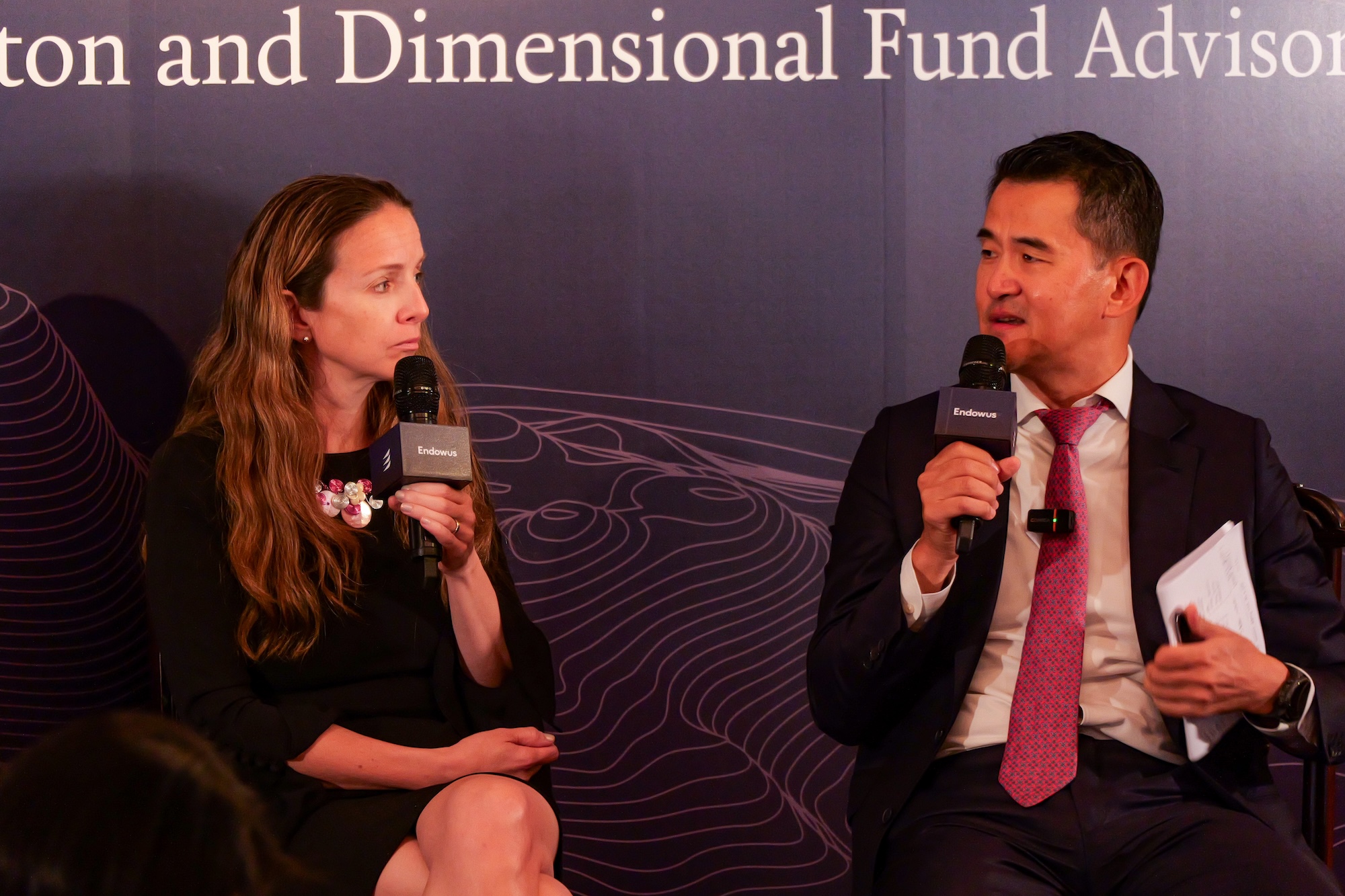
Our Chief Investment Officer, Hugh Chung, sat down in a conversation with Dimensional Fund Advisors' Co-CIO, Savina Rizova, and Head of APAC Ex-Japan, Joel Kim.
Hugh Chung: Factor investing is a term you hear everywhere now — Bloomberg, CNBC, as well as other financial news channels. But Dimensional doesn't actually describe itself that way. Savina, can you explain what factor investing really is, and why you prefer to talk about evidence-based investing instead?
Savina Rizova: We like to be precise with our words, and that's exactly the issue. Factors in investing are simply characteristics or drivers of returns that are common across a group of stocks — for example, an industry factor, a country factor. But not all factors carry an expected positive reward. Investing in a given sector or region doesn't necessarily mean you'll do better than a global portfolio. That's why at Dimensional we talk about premiums — factors that should actually bring you a positive reward.
The building blocks we focus on trace back to Bob Merton's intertemporal Capital Asset Pricing Model from 1973 — over fifty years ago — which established that investors should be compensated for bearing systematic risks they cannot diversify away. From that theoretical foundation, Eugene Fama and Kenneth French identified two premiums in equities: size and value. Lean toward smaller, “cheaper” companies, and over the long term you tend to have higher returns. We later extended the model to include profitability and investment — how aggressively a company grows its assets.
The reason we call it evidence-based investing is that theory alone isn't enough. You want to see that what theory predicts actually shows up in the data. And it does — across a hundred years of US market data, across developed markets going back to the seventies, across emerging markets from the nineties. Smaller companies outperform larger ones, value outperforms growth, higher profitability outperforms lower profitability. On average, over time, across markets.
Think of it like buying an apartment in Hong Kong. What you're willing to pay depends on what rent you expect to receive and the discount rate you apply. It's the same logic with stocks — expected return is determined by what you pay today relative to what you expect to get in the future. The premiums we focus on are proxies for exactly those two things.
Hugh: The performance has been strong over recent years, but there have been difficult stretches — growth outperforming value, large caps outperforming small. If the ideas are publicly documented and anyone can download the papers, what's the secret sauce? How do you stay the course?
Savina: You've quietly embedded two questions in one. The first is about the volatility of premiums. The reward exists precisely because the premiums are volatile — they carry systematic risk, which means they're not positive every single day or every single year. Value has underperformed growth in the US for most of the last twenty years. That's not an anomaly. That's the nature of a risk premium. On average, over long periods, across markets, they're positive. But not always and not everywhere.
So the first thing you have to do is educate. One of the first slides we show at conferences is: yes, there are rewards — but there will be periods of underperformance. Setting that expectation honestly is foundational. If you focus on a single premium over one year, your chance of outperforming the S&P 500 is around sixty percent. If you combine three major premiums — size, value, and profitability — over five years, that rises to around eighty percent. Time horizon and diversification across premiums and geographies are the tools.
But beyond the ideas themselves, investing is like any other business — it's about the team, the process, and the implementation. The premiums are publicly known. What isn't easily replicated is forty-five years of actually building portfolios around them: designing them to capture premiums when they show up, managing costs and risks, using price momentum as a short-term trading signal, thinking about every corporate action and every execution decision. Investing has three dimensions — expected returns, risk, and cost. We think about the tradeoffs across all three, every day, in every portfolio.
Hugh: What does all of this mean for the individual investor? There's always a temptation to pick stocks — especially in a market like Korea, where two companies drove most of the returns. How should investors think about factor investing against stock-picking or fundamental analysis?
Joel Kim: To boil it down: it's about getting rewarded for the risk you take, and avoiding things we know don't work. By the way, I spent twenty years doing things I now say don't work — calling markets, picking stocks. The ideas behind what Dimensional does are not secret. You can download the papers. What took forty-five years to build is the implementation — the actual, daily work of translating what exists in data and theory into portfolios that perform.
Good investment behavior, at its core, means staying diversified, maintaining a long-term horizon, and not trying to time markets. You might get the exit right once. Getting back in is another matter. The evidence on market timing and stock-picking is not encouraging.
Savina: We crave action as humans. And many people bring the logic of their professional lives into investing — if I work harder, study more, build a better tool, I'll do better. I have a neighbor, a very successful entrepreneur, who built his own API to track companies. I was polite in my conversation with him. But he'd be far better off building another company, which is what he's actually good at, than trying to outperform Millennium, which has more people than Dimensional, all focused on finding investment opportunities.
You might get lucky once or twice. But do you really want to be staring at a screen every night, wondering how your stock did? Most people here have much better uses for their time and energy. I check my own balance once a year. I don't follow the market daily. That peace of mind — and the focus it frees up — is itself a form of return.
The data supports this. Since the Jensen study of the 1970s, which looked at active managers going back to the 1920s, the evidence has been consistent. Over the last twenty years in the US — where fund data is comprehensive and free of survivorship bias — fewer than half of active funds have survived, and fewer than twenty percent have beaten their benchmarks. Dimensional's equivalent numbers: one hundred percent survivorship, eighty percent outperforming their benchmarks. The difference isn't magic. It's systematic focus on reliable drivers of return, and rigorous implementation.
Hugh: Dimensional is one of the very few asset managers in the world that pays no distribution rebates. That's unusual, especially in Asia. Joel, can you explain the philosophy behind that — and what it means in practice?
Joel Kim: This model is far more familiar outside Asia. The core belief is that investors are better off with good advice — ideally conflict-free advice — and the deliberate choice is to be a B2B firm, working with advisors like Endowus who do the client-facing work. The way fund distribution typically works in Asia is that the manager pays a sales commission out of the fee. It may work. But there's an obvious risk that products get distributed for the wrong reasons. Our choice is to work only with firms that are philosophically aligned — firms that want to keep advice as clean as possible.
Savina: Evidence-based advice as an industry in the US started in the nineties. A lot of disillusioned advisors left the big banks and wirehouses — disillusioned by what they saw happening to their clients — and wanted to build something independent. That's the RIA industry, and it's now enormous, still growing, and highly profitable precisely because it's the right way to do things. All three parties — the manager, the advisor, the client — are compensated by growing assets. The interests are aligned.
We're seeing the same shift in Europe — the UK, Germany, Austria. Asia will get there. The path may be different: regulation can accelerate it, as it has in some markets. Or it comes from clients who've had a good experience and simply won't go back to the old way.
Joel Kim: Singapore is an interesting test case. With the pension regulator capping fees at fifty basis points on what's likely to be launched, the commission-based model simply doesn't work in that context. That may be the nudge that changes things.
Hugh: Closing thoughts — what do you want clients to take away?
Savina: Two things. First: there is massive uncertainty in investing, and people consistently underestimate it. Investing is not physics or chemistry, where you discover a pattern and it repeats reliably. Returns are driven by both expected returns and unexpected shocks — and by definition, shocks are unpredictable. The fact that someone predicted something correctly once tells you almost nothing about whether they'll do it again. Tune out the noise. Ask not whether a manager performed well recently, but whether the process is sound and likely to repeat. Second: incentives matter. This is the core insight from the Chicago School. Whatever incentives you put in place, people follow them. If the incentives are misaligned, you get churning, as well as products designed around revenue instead of outcomes. If the incentives are clean, you get something that actually works for the client.
Joel Kim: It took me a year after joining Dimensional to be able to talk comfortably about what we do. So I don't expect everything to be clear immediately. What I'd say is that what most people who work with us come to appreciate isn't always the performance itself — it's the academic rigor, the intellectual honesty, and the genuine focus on client outcomes. One small thing that captures that: we don't have a product development team in the traditional sense. We don't scan for trends and build products to catch them. When we launch something, it's because clients like Endowus identified a genuine need. And in forty-five years of launching funds, we haven't closed a single one. Not because we're stubborn — but because the underlying philosophy doesn't change with fashion. Long-term outcomes. Evergreen solutions. That's the business.
Webinar: Investing in a better future: Through the lens of an equity investor

Why ESG investing should matter to Singaporeans

When you can’t see the forest for the trees: A holistic approach to asset allocation



%20F1(2).webp)

.webp)
.webp)






.webp)