- Index providers assign the “emerging” label based on market accessibility, not national wealth, which is why two advanced economies, Taiwan and South Korea, are considered “emerging” by one widely used index family.
- Emerging market (EM) equity index funds tend to be concentrated: Taiwan and South Korea make up close to half of the exposure, and three semiconductor companies add up to more than 28%, as at 31 October 2026.
- Whether a portfolio invested in a global equity index fund is exposed to EM depends on how that specific index fund is constructed. Given the size of some EM companies, that exposure may be meaningful within a global fund.
Since “emerging markets” is primarily a financial industry term, it is not surprising that index providers, rather than economists, decide which countries are labelled as such.
The classification turns on how freely foreign capital can move through a market, which is why two advanced economies feature significantly in some widely used EM equity indexes. The consequence is that the index behind a mainstream emerging-markets fund was close to half Taiwan and South Korea as at 31 October 2026, and three semiconductor companies made up more than 28% of it.
This article’s goal is to clarify what defines a market as “emerging,” what an EM equity index typically holds, and what happens when a country is “reclassified.” We will also explore the question of whether a global portfolio already carries EM exposure, the risks specific to the asset class, and the ways to invest in EM equities from Singapore.
What defines a market as “emerging”?
Index providers assign a market to the developed, emerging, or frontier tier by its accessibility to foreign institutional investors; national income is, at most, a threshold criterion, but does not alone guarantee that a country is placed within the “developed” category. FTSE Russell describes its own framework as grounded in accessibility and scores each market on regulation, foreign-ownership limits, capital repatriation, foreign-exchange market development, minority-shareholder treatment, and the reliability of trading, settlement, and custody.
There are three providers running these classifications — FTSE Russell, S&P Dow Jones Indices, and MSCI — and index funds can choose which one they use.
South Korea is a telling example. FTSE Russell has classified it as developed since September 2009 and S&P Dow Jones Indices since 2001, and the IMF counts it among 43 advanced economies, yet a different index family keeps it in emerging markets and the funds tracking that family hold it at roughly a fifth of assets.
What an index-tracking emerging-markets fund holds today
The most reliable description of the asset class is the factsheet of a large fund that tracks it. The figures below are the weights of the index tracked by the Amundi Core MSCI Emerging Markets fund, as published on its factsheet as of 31 October 2026. Because the benchmark index is capitalisation-weighted, prices move these weights every month (and the tracking index needs to adopt the new weights), so the table may be dated as of the time of this article. Regardless, it is a useful snapshot for investors to understand the nature of an EM equities exposure. The fund is named as the source of the data, for illustration only; this is not a recommendation to buy or sell the fund or any security shown.
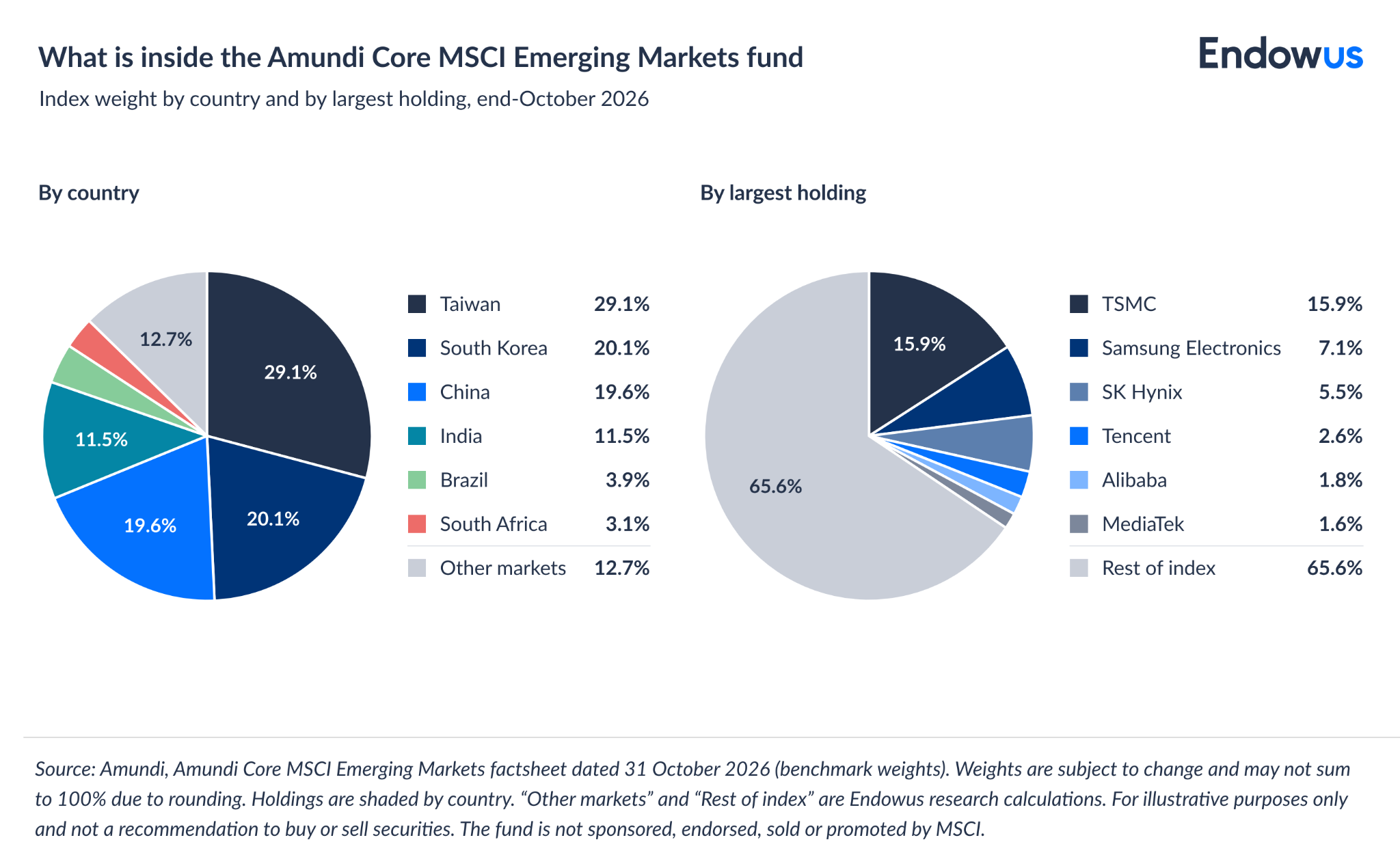
Taiwan and South Korea together account for close to 50% of the index as of October, the four largest countries for about 90%, and the three largest constituents — all semiconductor manufacturers — for more than 28%. TSMC alone, at 15.9%, outweighs the entire India allocation.
How do index weights impact passive exposure?
The index is capitalisation-weighted, so each constituent’s share follows its market value, and relative price performance alone is enough to shift them. An index fund then holds the securities in those proportions, so the change reaches the investor without any manager deciding it.
That arithmetic accounts for the shift of the past five years. In FTSE Russell’s emerging index, China’s weight reached about 44% in 2020 and had fallen to roughly a third by the end of 2025, as Chinese equities lost relative capitalisation and Taiwan and India gained it; in the index above, China now stands near a fifth. The two series are not strictly comparable, since FTSE Russell counts South Korea as developed and so divides by a different base, but the direction is the same under every provider.
The move has been large enough to create “emerging markets ex-China” as a fund category in its own right. Once the largest country is removed, the index weight of the remaining countries automatically increases, Taiwan and South Korea first among them.
What is a “reclassification” and why it triggers market moves
Reclassification is the operation through which a country is assigned to a different tier - for instance, from developed to emerging, or from emerging to frontier. . When a provider moves a country between tiers, every fund tracking the affected index must buy or sell that country’s shares on the effective date to match the new constituent list, whatever its manager thinks of the market.
FTSE Russell’s September 2026 review, published on 6 October 2026, shows the process at work. Greece moved from advanced emerging to developed, Vietnam from frontier to secondary emerging, and Nigeria from unclassified to frontier, while Oman joined the watch list for possible promotion. Providers announce such moves months ahead and often phase them in in order to ensure orderly trading, but that is not an optional course of action.
The implication for a fund holder is that the composition of an emerging-markets index can change on a date set by a provider’s committee. South Korea is the standing example: two of the three main providers call it developed, yet the third still includes it in the EM tier. .
Can you own emerging market exposure even when invested in global equities?
The short answer is - yes. Many investors hold EM equities when they allocate to a diversified global equity fund. The index named on the global fund’s factsheet as the benchmark - if the fund is tracking it - is a good indication of whether EM equity exposure is there. For instance, if the benchmark is a developed-markets index, the index fund may not be investing in emerging markets at all, whereas an all-world or all-country index may add them at market weight — currently about 10% of a broad all-world fund. This is purely illustrative, however. Reading the factsheet, and finding out about the benchmark, is a way to confirm what names the fund is invested in.
An all-world fund delivers both types of exposures at market weight in a single decision, whereas holding emerging markets as a separate allocation allows the weight, the index definition, and the manager to be set deliberately.
What are the risk drivers of emerging markets equity?
Emerging markets may add specific risk drivers that a developed-markets portfolio either lacks or carries in smaller measure.
- Currency. An SGD investor in an unhedged fund holds the underlying currencies outright — typically the Taiwanese dollar, Korean won, Chinese renminbi, and Indian rupee — so exchange-rate moves add a layer to returns that is uncorrelated with share prices; see currency exposure and hedged share classes.
- Market access and capital controls. Providers test whether foreign capital can enter and leave freely, and a market that imposes controls can be downgraded, which forces index funds to sell.
- Governance and state ownership. State-linked companies are more common, and minority-shareholder protections vary by jurisdiction.
- Concentration. Four countries make up about four-fifths of the index and one company about a sixth, so the diversification the name implies is narrower than it appears.
- Classification risk. A reclassification changes what a fund holds on a date set by the provider, as the previous section showed.
The standard case for the asset class rests on faster economic growth - the controversial EM “catching up” argument, which states that EM growth and productivity is higher than current developed market levels - but economic growth and equity returns are not always correlated. Past performance is not necessarily a guide to future performance or returns. Adding emerging markets changes portfolio risk drivers, and diversification does not prevent loss.
How Singapore-based investors can gain exposure to EM equities
An investor in Singapore can typically reach the asset class by four routes.
- A global fund that already includes emerging markets. An all-world fund carries the asset class at market weight - which may be a simple way to invest since you can get developed plus emerging market exposure in one holding and at one fee.
- A dedicated emerging-markets fund, index or active. An EM focused index fund - benchmarked against one of the EM equities indexes - can deliver the index’s current shape at low cost; an active fund may increase tracking error in search for opportunities, but will likely charge a higher fee for doing so. Both strategies are available in Singapore-dollar share classes on the Endowus platform.
- An emerging-markets exchange-traded fund (ETF). This may add costs from brokerage, currency conversion, and bid-offer spread. A US-listed ETF also potentially exposes a Singapore investor to 30% US withholding tax on distributions, because no US–Singapore tax treaty exists; an Ireland-domiciled UCITS ETF, such as the ones offered on the Endowus platform, may help avoid that layer.
- A single-country fund. This concentrates on one market, such as China or India, providing country-specific exposure, typically for a tactical sleeve of one’s portfolio.
Funding source is part of the cost. Some emerging-markets funds on the platform accept cash, Central Provident Fund (CPF) Ordinary Account savings, or Supplementary Retirement Scheme (SRS) money; others accept cash only. Investing CPF savings means giving up the guaranteed CPF interest on that amount and taking on investment risk, including the possible loss of capital. A current shortlist of the funds Endowus hosts appears in a diversified portfolio of ex-US funds and on the Fund Smart list, and the case against single-market concentration is made in home bias in investing for Singaporeans. The debt side of EM exposure is covered in Emerging market debt explained.
Investment implications
There are some decisions a Singapore-based investor needs to take when picking the type of EM equities exposure he wants to gain. The first is whether the exposure already exists: a global fund tracking an all-world index carries EM equities at market weight, while one that tracks a developed-only index does not. Understanding the benchmark before investing is key to obtaining the desired type of exposure.
The second is whether to diverge from the index exposure. A capitalisation-weighted EM equities index fund, benchmarked on an EM equities basket, may deliver a portfolio that is concentrated in four-fifths four countries and one-sixth a single company. An investor who wants a different shape can change the index definition, as an ex-China fund does, or pay an active manager to depart from it; in both cases the fee and the tracking difference are an additional price to pay.
The third is sizing. Because the allocation concentrates country and currency risk, and because its composition can move on a provider’s calendar rather than the market’s, its weight in a portfolio should reflect capital that can stay invested through those swings.
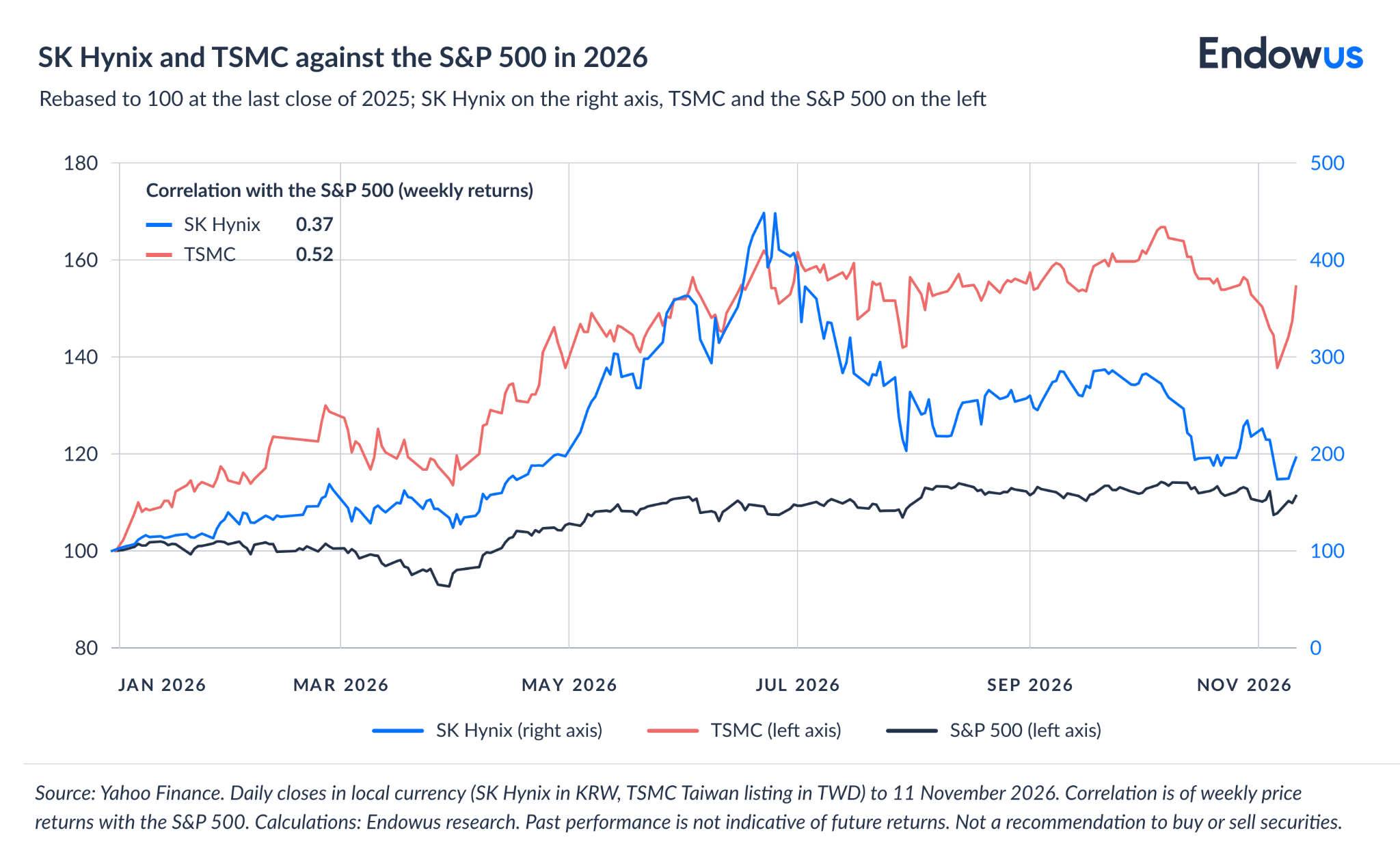
In our view, the right question to ask is not whether emerging markets are attractive but whether the exposure is the desired one. For investors who prefer the regional allocation to be set within a diversified whole, the Endowus Flagship Portfolios hold it as part of a global allocation; for those who want a deliberate tilt, Fund Smart allows a specific emerging-markets fund to be added.
On one hand, emerging markets provide access to large, profitable companies and to a different set of economic fundamentals compared to developed-market indices. Emerging market economies may have asynchronous cycles compared to developed economies, and their equities may be able to provide diversification within a broad-based global equity allocation. However, because of the composition of the benchmark, index tracking funds may be concentrated in a few countries and currencies. It may be a prudent course of action to speak to your financial advisor about your EM allocation and find out what companies, countries and geographies you have allocated to, so you can shape your exposure according to your needs, risk profile, and time horizon.
Frequently asked questions
Is Singapore an emerging market?
No. FTSE Russell and S&P Dow Jones Indices classify Singapore as a developed market, and the IMF lists it as an advanced economy.
Which countries are considered to be emerging markets?
The list varies by provider. When it comes to equities, the largest by index weight are typically Taiwan, South Korea, China, and India, which together make up about four-fifths of a typical emerging-markets index as at 30 September 2026.
Why are Taiwan and South Korea still classed as emerging?
Because classification turns on market accessibility rather than income. Both are advanced economies in the IMF’s grouping, and FTSE Russell and S&P Dow Jones Indices already classify South Korea as developed; one index family still places both in emerging markets, so the funds tracking it hold the two at about half of assets combined.
Does a global index fund include emerging markets?
Only if the index it tracks does. A developed-markets or narrow “world” index may hold no EM equities exposure; an all-world or all-country index may include them at market weight.
Are emerging markets a good investment?
That depends on what the portfolio already holds. The asset class adds exposure to companies and economies outside developed-market indices, at the cost of concentration in a few countries, several unhedged currencies, and a composition that a provider can change; the answer is a sizing decision, not a verdict.
What happens to my fund if a country is reclassified?
The fund must buy or sell that country’s shares to match the new index on the effective date. Providers typically announce the change months in advance and may phase it in.
What is the best emerging-markets ETF?
There is no single answer, and none is recommended here. The decisive questions are which index the ETF tracks, which provider’s classification that index uses, its cost, and its domicile, which determines withholding tax for a Singapore investor.
Webinar: Investing in a better future: Through the lens of an equity investor

Why ESG investing should matter to Singaporeans

When you can’t see the forest for the trees: A holistic approach to asset allocation