


.webp)
.webp)
.webp)
.webp)






.webp)












%20(1).gif)

Register for the event
Endowus invites you to our exclusive event with Macquarie Asset Management, as we discuss unlocking opportunities in Infrastructure- a $1.3tn asset class.
This event is reserved for Accredited Investors (AIs) only. To register for the event, please indicate one of the following:
- Endowus Core Flagship portfolios saw some dispersion in relative performance between equities and fixed income in Q3. The Flagship 100% Equity Portfolio gained 0.3% during the quarter and outperformed the global equities benchmark, which fell 0.1%. The Flagship 100% Fixed Income Portfolio fell 3.9% and underperformed the global fixed income benchmark (-3.2%).
- Income Portfolios pulled back as global bonds struggled. Stable Income fell 3.8%, finishing the quarter slightly behind the broader credit market (-3.7%). Higher Income declined 2.4% but outperformed the 20-80 benchmark which fell 3.0%. As for Future Income, it declined 1.8% and outpaced the 40-60 benchmark (-2.3%).
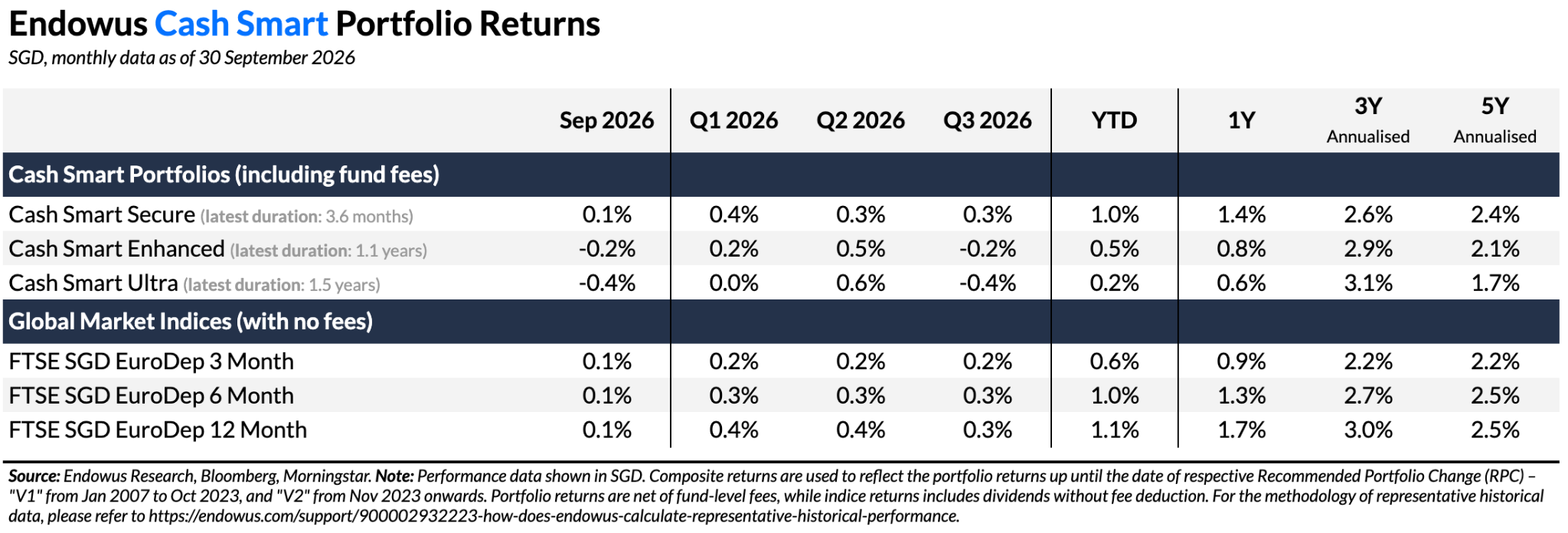
- Cash Smart Portfolios performed according to their respective risk levels. Cash Smart Secure continued to provide a stable source of returns, ending the quarter up 0.3%. On the other hand, Cash Smart Enhanced and Cash Smart Ultra ended the quarter down slightly, falling 0.2% and 0.4% respectively.
- For more on the market insights, click here.
Endowus Flagship Portfolios—Cash/SRS
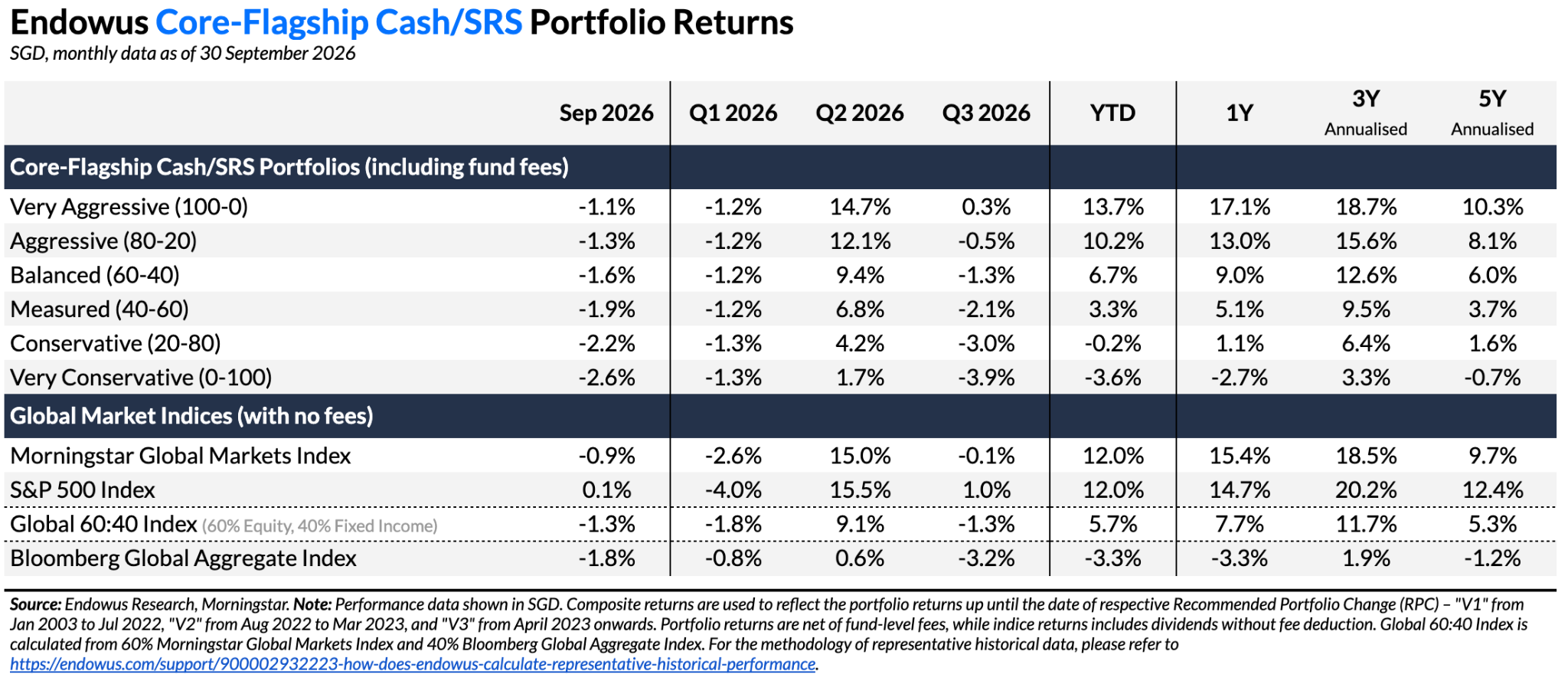
Key performance highlights:
Despite lingering geopolitical tensions, sticky inflation, and shifting rate expectations, equities exhibited resilience in Q3 2026. Notably, robust earnings growth and strong AI-related capital expenditure continued to be the main drivers of performance. The other key event was performance rotation, as growth stocks trailed value stocks, and developed markets outpaced emerging markets. Overall, global equities ended the quarter with a slight, 0.1% decline.
The Flagship Cash/SRS 100% Equity Portfolio gained 0.3% in the quarter. It outperformed its benchmark, driven mainly by its overweight to Japanese stocks, which performed strongly as continued corporate governance reform efforts provided a tailwind. The Portfolio also benefited from its structural overweight to value stocks through Dimensional funds, though these relative gains were more than offset by its overweight to small cap stocks.
Within the Portfolio, the Dimensional Pacific Basin Small Companies Fund was the best performer, ending the quarter up 4.7%, helped by its overweight to Japanese stocks. The weakest performer was the Amundi Core MSCI Emerging Markets Fund, down 2.5%. The Fund passively tracks the emerging market index and struggled as investors rotated out of semiconductor stocks into software.
Global bonds came under pressure as yields rose on sticky inflation and solid growth. The Fed raised its policy rate and signalled the possibility of further tightening. At the same time, growing competition for capital pushed Treasury yields higher, as companies increased debt issuance to finance their AI buildout. Government bonds detracted, with longer duration bonds falling more sharply. In credit, investment grade bonds underperformed government bonds amid rising yields and wider credit spreads, while high yield credit outperformed from higher carry and shorter duration. Overall, global bonds fell 3.2% during the quarter.
The Flagship Cash/SRS 100% Fixed Income Portfolio fell 3.9%, underperforming the global fixed income market, weighed down by its overweight to credit and emerging market bonds.
Within the Portfolio, the iShares Global Aggregate 1-5 Year Bond Index Fund was the best performer, down 1.3% helped by its shorter duration. The weakest performer, the iShares Emerging Markets Government Bond Index Fund, fell 5.2% as emerging market bonds declined; being unhedged, it was further hurt by USD depreciation against SGD.
Endowus Flagship Portfolios—CPF
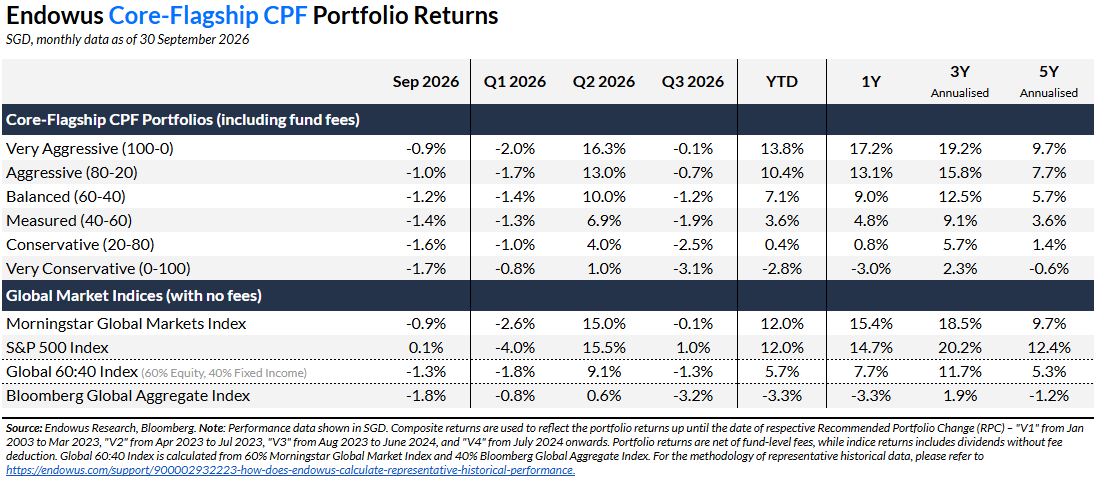
Note: The Flagship CPF Portfolio allocations were updated in July 2024 with three new funds from Dimensional.
Key performance highlights:
The Flagship CPF 100% Equity Portfolio fell 0.1% in Q3 2026, performing in line with the broader global equity market. It benefitted from its overweight to US equities, which posted robust gains on resilient consumer spending and the rebound in software stocks. This was offset, however, by the Portfolio’s overweight to emerging market stocks.
Within the Portfolio, the Amundi Prime USA Fund was the strongest performer, up 1.1%. The weakest was the Schroder Global Emerging Markets Opportunities Fund, down 3.1%, held back by headwinds in emerging-market equities, compounded by weaker stock selection.
The Flagship CPF 100% Fixed Income Portfolio fell 3.1%, slightly outperforming the broader global fixed income market (-3.2%). It benefited from shorter-duration exposure through the UOB United SGD Fund, the best-performing fund, which declined 0.7%. The weakest performer was the Dimensional Global Core Fixed Income III Fund, down 4.2%, which lagged on its overweight to credit.
Endowus ESG Portfolios
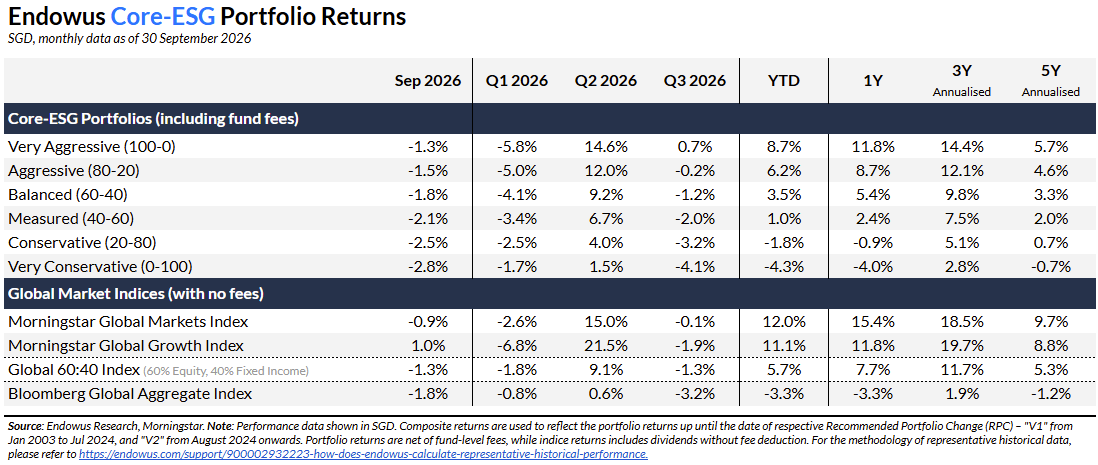
Key performance highlights:
In Q3 2026, the ESG 100% Equity Portfolio delivered a 0.7% gain and outperformed the index by 0.8%, with the majority of holdings contributing to returns. Growth stocks lagged the broader market over the quarter, artificial intelligence leaders sold off sharply in July, and rising oil prices favoured value and commodity-linked sectors.
Against that backdrop, the Schroder Global Sustainable Growth Fund was the quarter’s standout contributor, while the Goldman Sachs Enhanced Index Equity funds, Nordea Global Sustainable Stars, and Mirova Global Sustainable Equity each added incrementally to performance. Schroder’s result reflected stock selection rather than style. The primary drag came from the KBI Global Sustainable Infrastructure Fund which, as in Q2, detracted despite its smaller allocation. Persistent pressure on infrastructure valuations from elevated real interest rates weighed on KBI, while renewed US dollar strength and softening growth momentum across Asia and China suppressed risk appetite for the regional and EM mandates, limiting their ability to add value this quarter.
The ESG 100% Fixed Income Portfolio fell 4.1% and underperformed the global fixed income benchmark. The PIMCO GIS ESG Income Fund was the main detractor. The macro backdrop substantially deteriorated as a hawkish reassessment of rate expectations driven by resilient economic data and renewed inflationary pressures pushed yields higher across developed markets. Credit spreads offered little buffer, widening in tandem with the rate move and leaving the portfolio with limited shelter across both its duration and credit exposures.
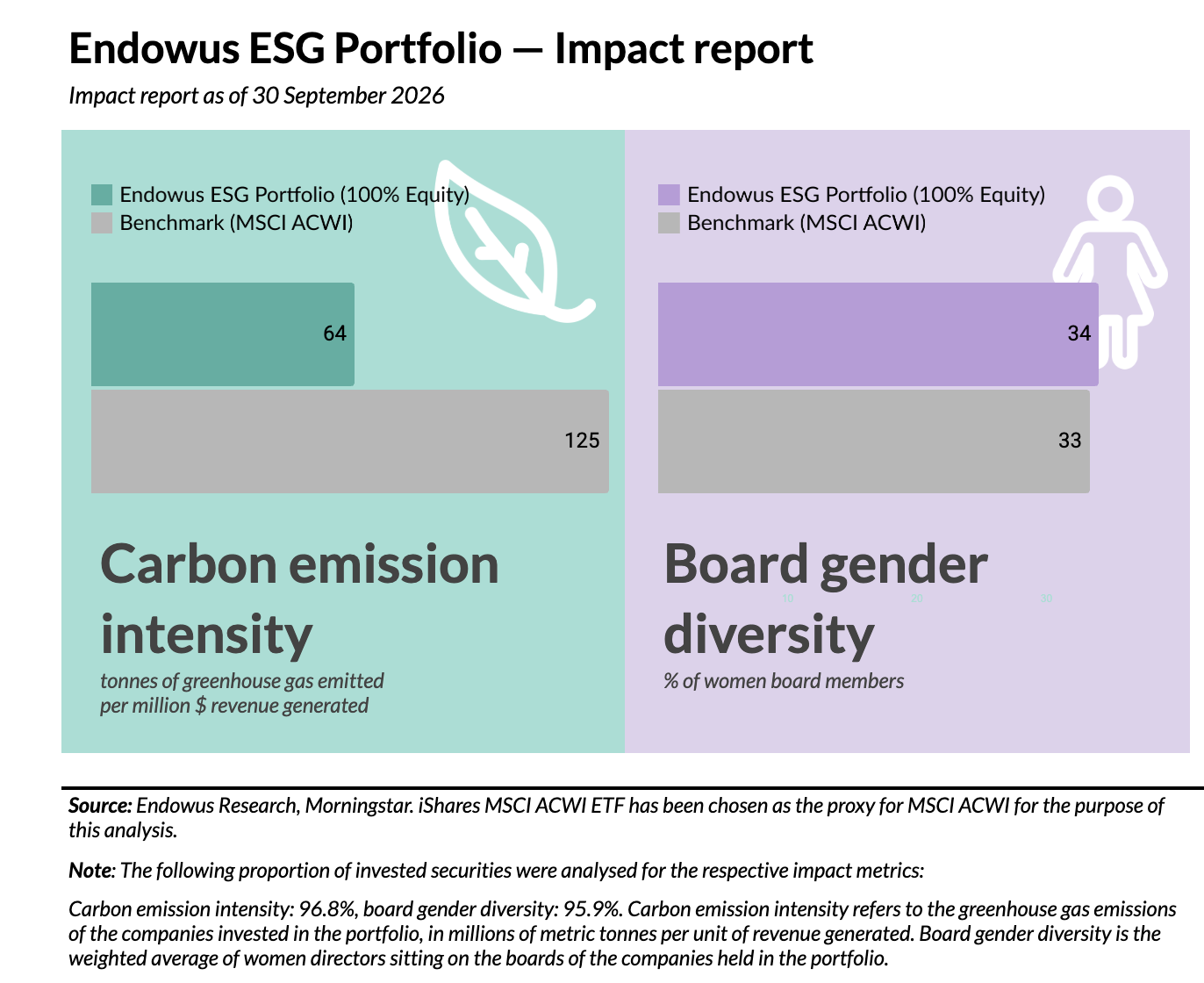
The Endowus ESG Portfolios not only focus on financial returns but also on promoting positive societal and environmental impact. We are committed to being responsible stewards of capital, as demonstrated by our active review of ESG data to inform our investment decisions.
For instance, the ESG 100% Equity Portfolio aligns better with the United Nations Sustainable Development Goals compared to the broader equities market, showcasing lower greenhouse gas emissions and enhanced board gender diversity compared to the global equities.
Our ESG 100% Fixed Income Portfolio also emphasises investments that contribute to environmental sustainability and social well-being.
The PIMCO GIS Climate Bond Fund allocates over 75% to green bonds. The PIMCO GIS ESG Income Fund tilts towards companies or issuers with positive ESG characteristics, seeks a lower carbon footprint and actively engages issuers. The Allspring Climate Transition Global Investment Grade Credit Fund targets to decarbonise the Fund by 2050 and excludes securities exposed to ESG risks.
Endowus Factor by Dimensional Portfolios
Key performance highlights:
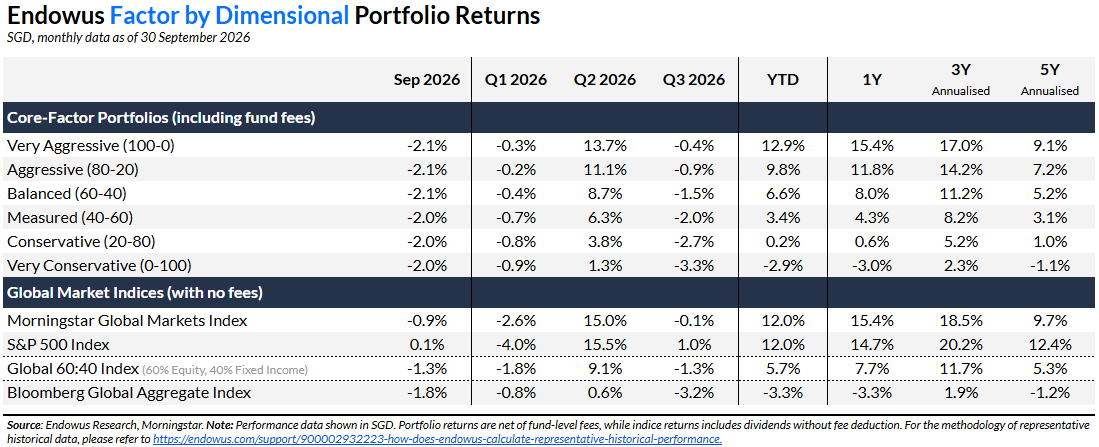
The Factors 100% Equity Portfolio declined 0.4% in Q3 2026, underperforming the global equity benchmark (-0.1%). While the Portfolio benefitted from its overweight to value stocks, relative performance was dragged down by its overweight to small cap stocks, which struggled against their large cap counterparts. The Portfolio’s overweight to emerging market equities added to the underperformance.
Within the Portfolio, Dimensional Pacific Basin Small Companies Fund was the strongest performer. The Fund ended the quarter up 4.7%, with gains mainly driven by its overweight to Japanese equities. The weakest performer was the Dimensional Emerging Markets Large Cap Core Equity Fund, down 2.3%, held back by its focus on emerging market equities.
The Factors 100% Fixed Income Portfolio fell 3.3% in the third quarter, slightly underperforming the global fixed income benchmark (-3.2%). The Portfolio benefitted from its shorter duration, though this was more than offset by its overweight to credit. The Dimensional Global Short Fixed Income Fund was the best performer, down 1.5%, helped by its shorter duration and lower credit exposure. The Dimensional Global Core Fixed Income Fund was the weakest performer, down 4.1%, mainly due to its longer duration and larger credit exposure.
Endowus Satellite Portfolios
Launched in November 2021, the Endowus Satellite Portfolios are designed to supplement the core portfolios and offer clients specific exposure to opportunities in selected regions, themes, asset classes, and trends.
In taking a core-satellite approach, most investors should allocate the bulk of their assets to the core portfolios.
China Equity Portfolio

Key performance highlights:
Having outperformed in the first two quarters of the year, the China Equity Portfolio fell 10.2% in Q3 2026, underperforming the Morningstar China All Cap Index, which gained 1.8%. Performance was dragged down by the portfolio’s overweight to onshore A-shares, which underperformed their offshore counterparts. In particular, AI-related names faced headwinds from weakening investor sentiment as earnings expectations declined, while enthusiasm for offshore shares grew during the quarter, as these companies tend to be less exposed to AI hardware.
Within the Portfolio, the Fidelity China Focus Fund was the best performer, up 2.7%, helped by its lower exposure to onshore equities compared to its peers. The weakest performer was the T. Rowe Price Funds SICAV - China Evolution Equity Fund, down 14.1%, held back by its focus on A-shares and stock selection within technology names, though it had contributed significantly to portfolio gains in 1H26.
Megatrends Portfolio
Key performance highlights:
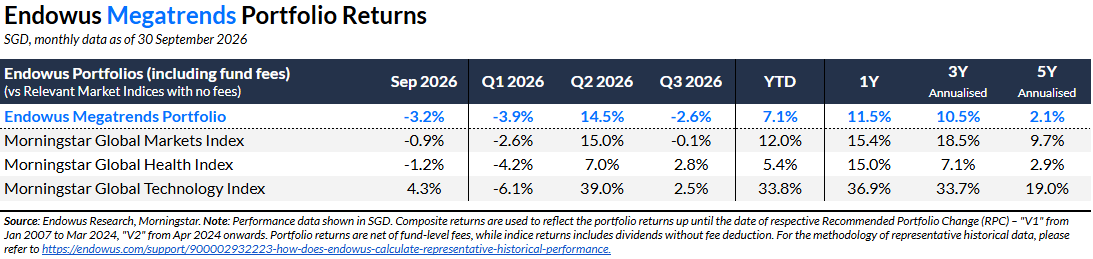
The Megatrends portfolio underperformed the global equity benchmark in Q3 2026 as thematic headwinds led to negative performances for most underlying funds. Through the first two months of the quarter, it tracked the benchmark roughly in line, with a strong August offsetting a weaker July. However, September accounted for the bulk of the portfolio’s underperformance, as several funds suffered sharp drawdowns.
GMO Climate Change and Janus Henderson Biotech were the main detractors. The clean energy segment was under pressure in July and September, as traditional oil and gas found favour, and higher base rates weighed on the longer-duration nature of renewables. A majority of the GMO Climate Change Fund’s top ten holdings declined in September.
Biotech also had a weak third quarter, though with a significant divergence in returns. A smaller group of stocks perceived to benefit from AI-related tailwinds rallied strongly, while other higher-quality companies lagged. For Janus Henderson Biotech specifically, several of its highest-conviction holdings struggled despite continued clinical and commercial progress, highlighting that their stock selection remains intact despite the underperformance this period.
NB Global Equity Megatrends (GEM) and Mirova AI and Robotics were the two funds to generate positive performances. NB GEM’s stock selection held out well, while Mirova AI and Robotics’s technology names such as Microsoft proved more resilient.
Technology Portfolio
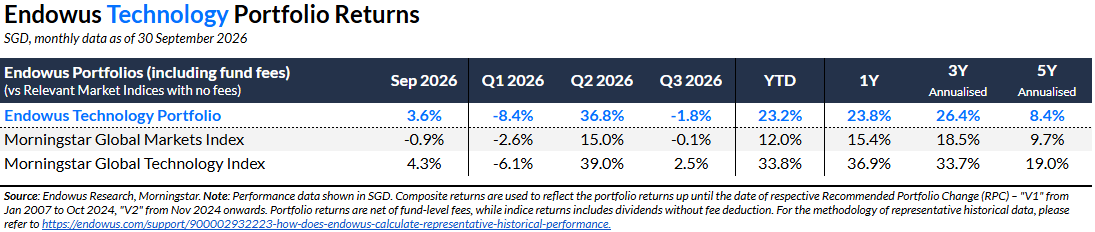
The Technology Portfolio fell 1.8% in Q3 2026. This compares with the Morningstar Global Markets Index, which was broadly flat (-0.1%), and the Morningstar Global Technology Index, which rose 2.5% during the same period.
The Fidelity Global Technology Fund, the largest holding at 30%, rose 3.6%. The Portfolio nonetheless underperformed the Global Tech Index, as the other five funds were held back by their exposure to AI infrastructure and hardware, which fell sharply in July. This reverses the Q2 pattern, when those five funds outperformed the index while the Fidelity Global Technology Fund lagged.
The Fidelity Global Technology Fund outperformed the tech index in July on its underweight to the semiconductor sector, which saw the sharpest pullback in tech. It instead holds an overweight to software, with exposure to mission-critical software companies that may be able to monetise AI features and functionality.
Blackrock Next Generation Technologies was the weakest fund, down 9.3% (though still strong YTD), on its high beta, overweight to semiconductors and underweight to software. The semiconductor sector underperformed software by around 25% in July, reversing part of the gap built up in 1H26. JPM US Technology Fund also underperformed (-5.8%) given its greater exposure to smaller tech companies as large cap tech outperformed in Q3.
Endowus Real Assets Portfolio

Key performance highlights:
The Endowus Real Assets portfolio posted a negative return for the third quarter, as a strong showing from natural resources and commodities was not enough to offset the declines in real estate and infrastructure.
Rising bond yields, and their knock-on effect on mortgage rates pressured real estate valuations, while infrastructure equities were also hit, due to the longer-duration nature of both asset classes. The Janus Henderson Global Property, Nordea Global Real Estate and KBI Global Infrastructure funds each declined by about 7% over the quarter, while M&G Global Listed Infrastructure was more resilient, down 4.4%, as positive returns in July and August offset September’s losses.
The Ninety One Global Natural Resources and PIMCO GIS Commodity Real Return rose more than 9.6% and 12.5%, respectively, as traditional energy equities rebounded from their sharp Q2 decline. This reversal was driven primarily by renewed tensions in the Middle East as well as Ukrainian strikes on Russian infrastructure, which led to a surge in oil prices.
Endowus Income Portfolios
Key performance highlights:
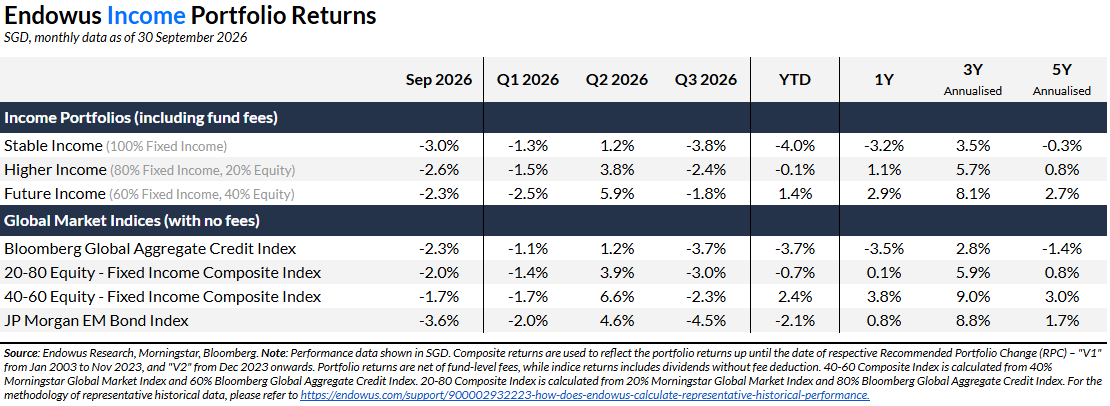
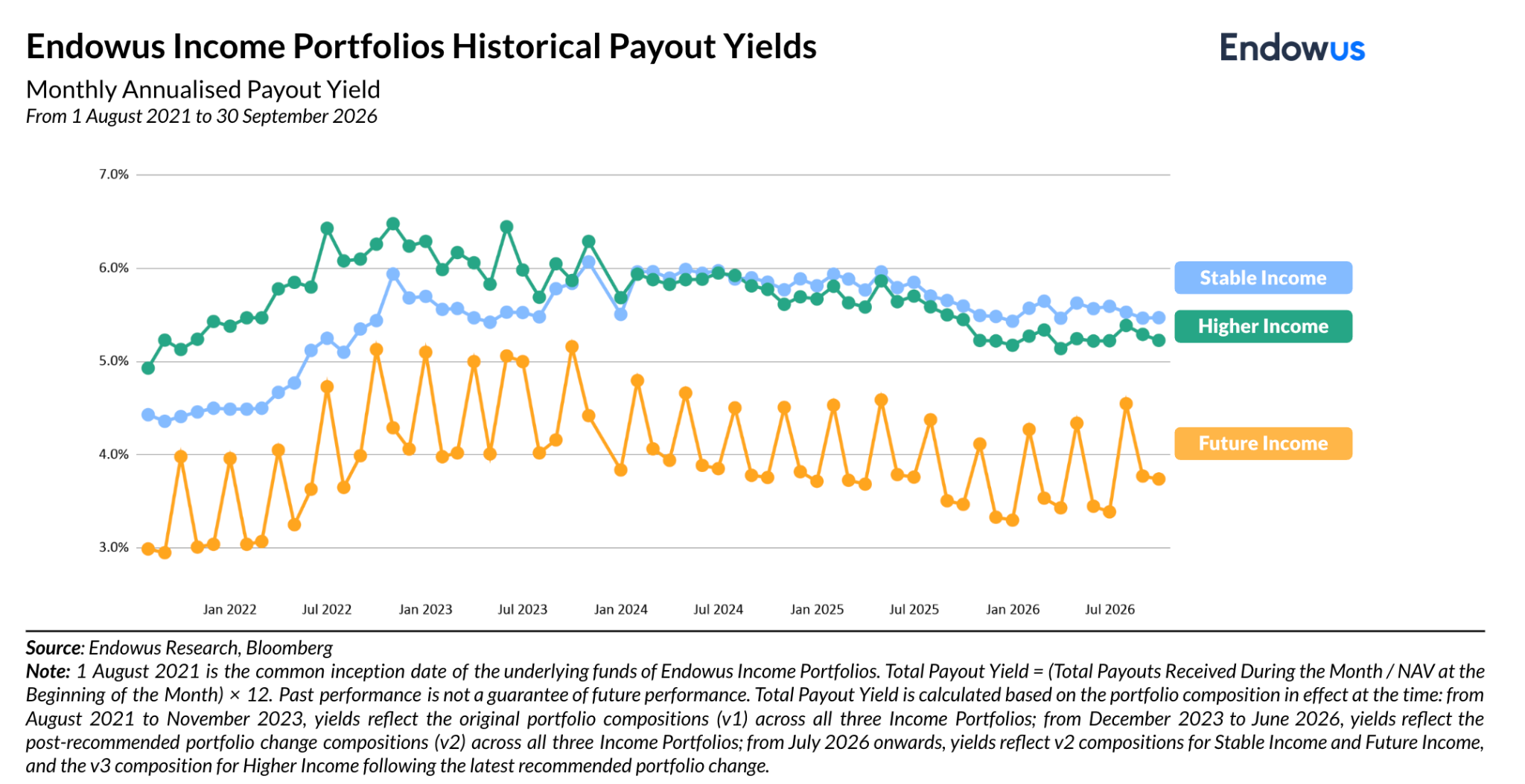
The Stable Income Portfolio declined by 3.8% in Q3, slightly lagging the broader credit market. This was primarily driven by the portfolio's duration positioning. The main relative detractors were the flexible income funds with longer duration exposure, such as the AB American Income Fund (-5.1%) and PIMCO GIS Income Fund (-4.7%). Conversely, the Neuberger Berman Emerging Markets Short Duration Bond Fund (-1.8%) helped cushion overall performance due to its shorter duration allocation.
The Higher Income Portfolio fell by 2.4%, outperforming its 20-80 benchmark. The fixed income sleeve outperformed the broader credit market due to its tilt toward high-yield bonds, which proved more resilient during rate-driven fixed income market weakness given their shorter duration profile. The equities sleeve also outperformed the broader equity market, benefitting from its tilt to high-dividend and value-oriented names; value style outperformed growth as bond yields rose sharply. The top contributor was the JPM Emerging Markets Dividend Fund (+2.4%), while the BlackRock BSF Global Real Assets Securities Fund was the main detractor as listed real assets faced headwinds from rising yields.
The Future Income Portfolio declined by 1.8%, outperforming its 40-60 benchmark. While the fixed income sleeve slightly underperformed the broader credit market due to duration headwinds similar to those in the Stable Income Portfolio, the equity component outperformed global equities thanks to its allocation to low-volatility and high-quality companies. The top contributor was GMO Quality Investments (+3.0%) while the BlackRock BGF European Equity Income Fund (-2.7%) was the primary detractor, as European equities lagged global peers amid investor concerns over earnings momentum, the European Central Bank's rate-hiking cycle, and the impact of rising yields on valuations.
Latest portfolio update:
In September 2025, we revised the target payout of the Higher Income Portfolio downwards to 5–6%. The increase in hedging costs between the SGD and USD has caused certain fund managers to lower their payouts, impacting overall payout levels across all three Income Portfolios. This in particular caused the Higher Income Portfolio's payout yield to dip below its prior target range. In light of the prevailing interest rate cycle, we believe it is prudent to maintain this lower target payout range.
Investment-grade flexible income funds continue to generate income comparable to high-yield funds in the current environment, where high-yield credit spreads remain particularly tight. As a result, the Higher Income Portfolio's payout yield is currently similar to that of Stable Income. However, it is important to note that the Higher Income Portfolio has delivered stronger growth in total return than Stable Income, thanks to its prudent addition of credit and equity risk. This means that after receiving income distributions, investors in the Higher Income Portfolio have seen a stronger increase in their invested capital.
In line with our commitment to continuously improve the portfolios, we have made targeted fund selection upgrades to the Higher Income Portfolio in June 2026. These changes replace a number of funds with higher-quality alternatives that we believe will deliver better risk-adjusted total returns over time, while maintaining the same target payout of 5–6% per annum and the same overall asset allocation (80% fixed income, 20% equities). For more detailed information on the portfolio change, please refer to this article. Portfolio statistics from July 2026 onwards for Higher Income Portfolio will reflect the latest allocation post recommended portfolio changes.
Endowus Cash Smart Portfolios
Key performance highlights:
The Cash Smart portfolios delivered mixed returns in Q3 2026.
The third quarter of 2026 saw US rates continue to sell off, with bond yields rising through September. The ongoing US-Iran conflict pushed energy prices sharply higher, raising inflation concerns and prompting hawkish responses from major central banks. For the first time since 2023, the US Federal Reserve raised the Federal Funds target range by 25 bps to 3.75%-4.00% in September, citing still-high inflation and signalling that further hikes could follow. On the credit side, credit spreads widened, with US investment-grade wider by 8 bps and US high yield by some 37 bps.
Similarly, SG rates rose across the curve, as pressure from rising global rates and inflation concerns fed through into the SGD bond markets. The 3m SORA rose 15bps to 1.23%, while longer maturity SG government bonds sold off as well. Cash Smart portfolios, with a very low duration profile and low rate sensitivity diverged in performance between Secure and Enhanced/Ultra during the quarter.
Cash Smart Secure closed Q3 2026 up 0.3%, supported by consistent monthly returns from July to September. The two underlying funds in the portfolio, Fullerton SGD Cash Fund and LionGlobal SGD Enhanced Liquidity Fund, delivered steady positive returns during the quarter through their portfolios of cash deposits and money market securities. Secure remains a relatively safer option within the Cash Smart suite for investors seeking to preserve capital while generating short-term yield.
Cash Smart Enhanced closed Q3 2026 down 0.2%. The UOB United SGD Fund was the weakest performer, down 0.7%, as its short-duration bond holdings faced headwinds from rising SG rates. The other two cash/money market funds delivered steady, positive returns during the quarter. The Enhanced portfolio takes on slightly more credit risk than Secure with its higher exposure to short duration bonds.
Cash Smart Ultra declined 0.4% in Q3 2026. Short duration bond funds underperformed, while the money market and cash funds returned steady, positive returns. The worst performance came from PIMCO GIS Low Duration Income fund, where it fell 2.0% due to its higher exposure to US rate volatility. Other short duration funds also fell, though to a lesser degree given their higher exposure to Asian and SGD credits, which held up comparatively better. With a higher added risk than Enhanced or Secure, Ultra has the potential to produce higher returns. Subject to their investment objectives and risk tolerance, investors seeking to largely avoid exposure to market volatility may consider switching to lower-risk portfolios such as Secure or Enhanced.
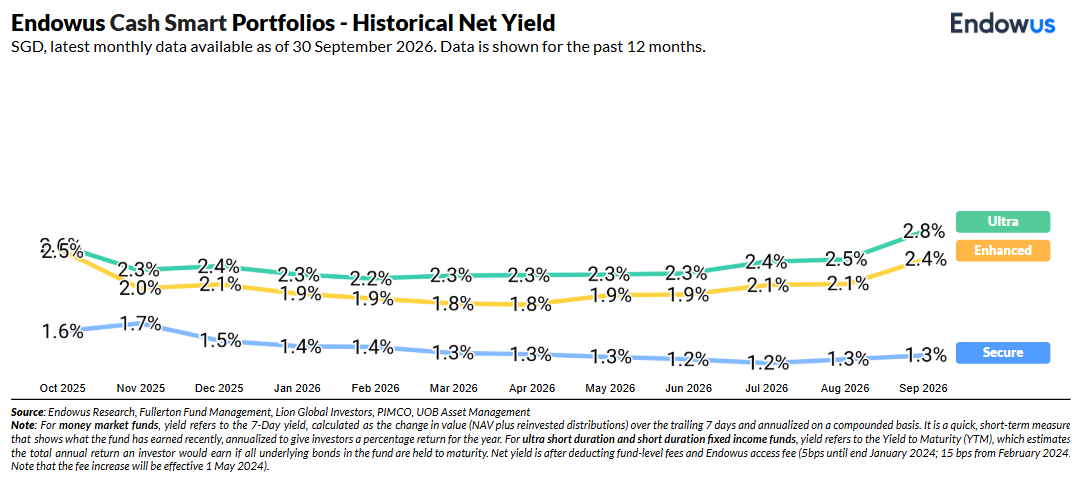
Cash Smart Portfolios, primarily exposed to USD and SGD market rates, are beginning to show a slight pickup in yields given recent rate movements. Given the varying levels of duration and credit risk across the portfolios, investors are encouraged to review their investment goals and assess whether their current Cash Smart Portfolio remains aligned with their needs.
Endowus Q1 & March 2025 Portfolio Performance Review

Endowus Q3 2024 Performance Review

Endowus Q2 2024 Performance Review
.jpg)



%20F1(2).webp)

.webp)
.webp)






.webp)