


.webp)
.webp)
.webp)
.webp)






.webp)












%20(1).gif)
.jpg)
Register for the event
Endowus invites you to our exclusive event with Macquarie Asset Management, as we discuss unlocking opportunities in Infrastructure- a $1.3tn asset class.
This event is reserved for Accredited Investors (AIs) only. To register for the event, please indicate one of the following:
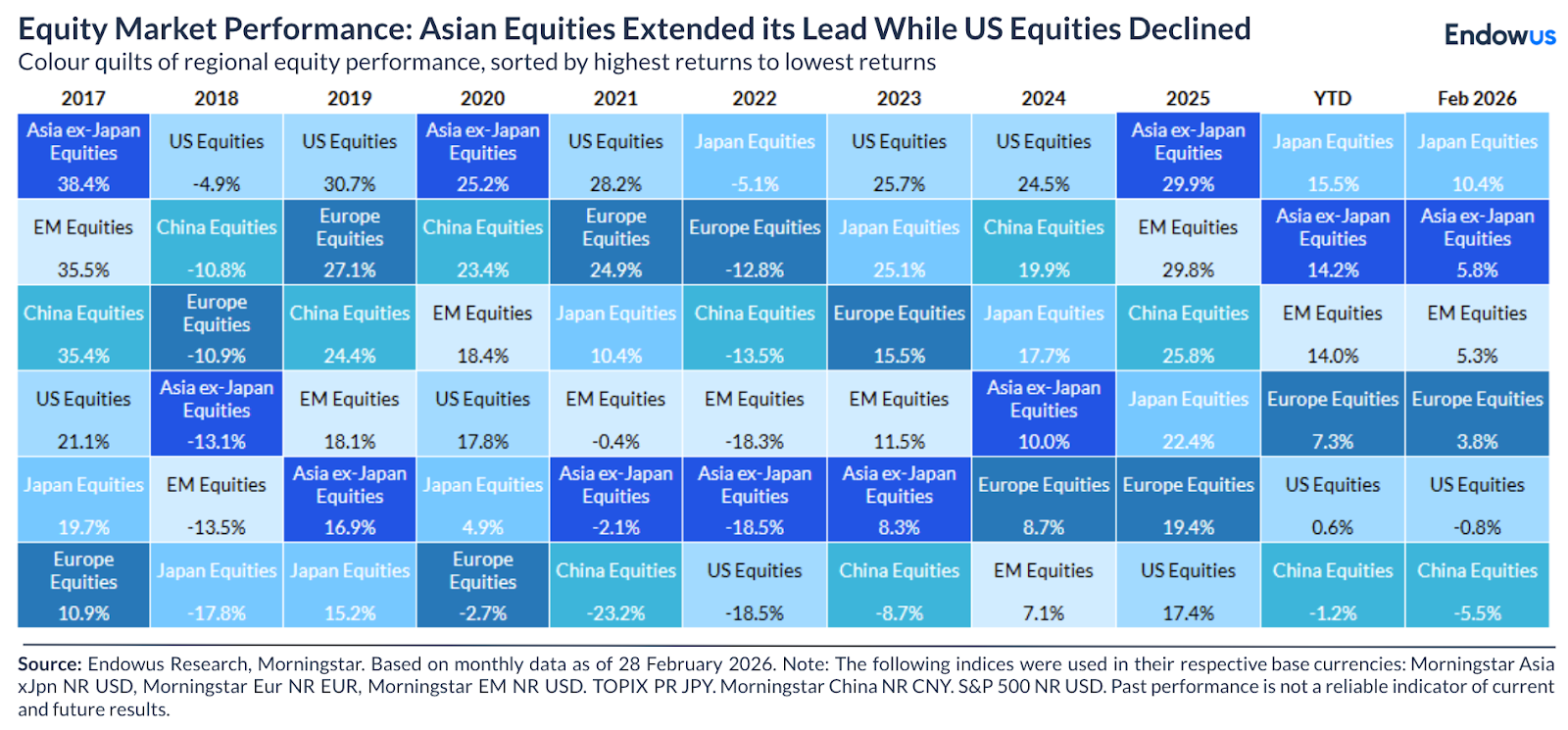
February saw the continuation of the non-US equity outperformance theme that dominated 2025 and carried into January, but with a notable shift in leadership within emerging and developed markets. While EM equities as a whole posted more modest gains compared to January's explosive 8.3% return, Asian markets surged on the back of two landmark political events: Japan's historic snap election, and continued momentum in Northeast Asia's semiconductor complex.
The big story of the month was Japan. In one of the most decisive electoral results since World War II, Prime Minister Sanae Takaichi's Liberal Democratic Party secured a two-thirds super-majority in the lower house, winning 316 of 465 parliamentary seats.
The market reaction was swift and powerful. The Nikkei 225 surged nearly 4% on the day of the result, crossing 57,000 for the first time, as investors priced in accelerated implementation of her pro-growth agenda: fiscal stimulus, a potential two-year food tax suspension, higher defence spending, and strategic investment in AI, semiconductors, and energy. The "Takaichi trade"—stronger equities, steeper Japanese government bond (JGB) curve, weaker yen—was firmly in motion by mid-month.
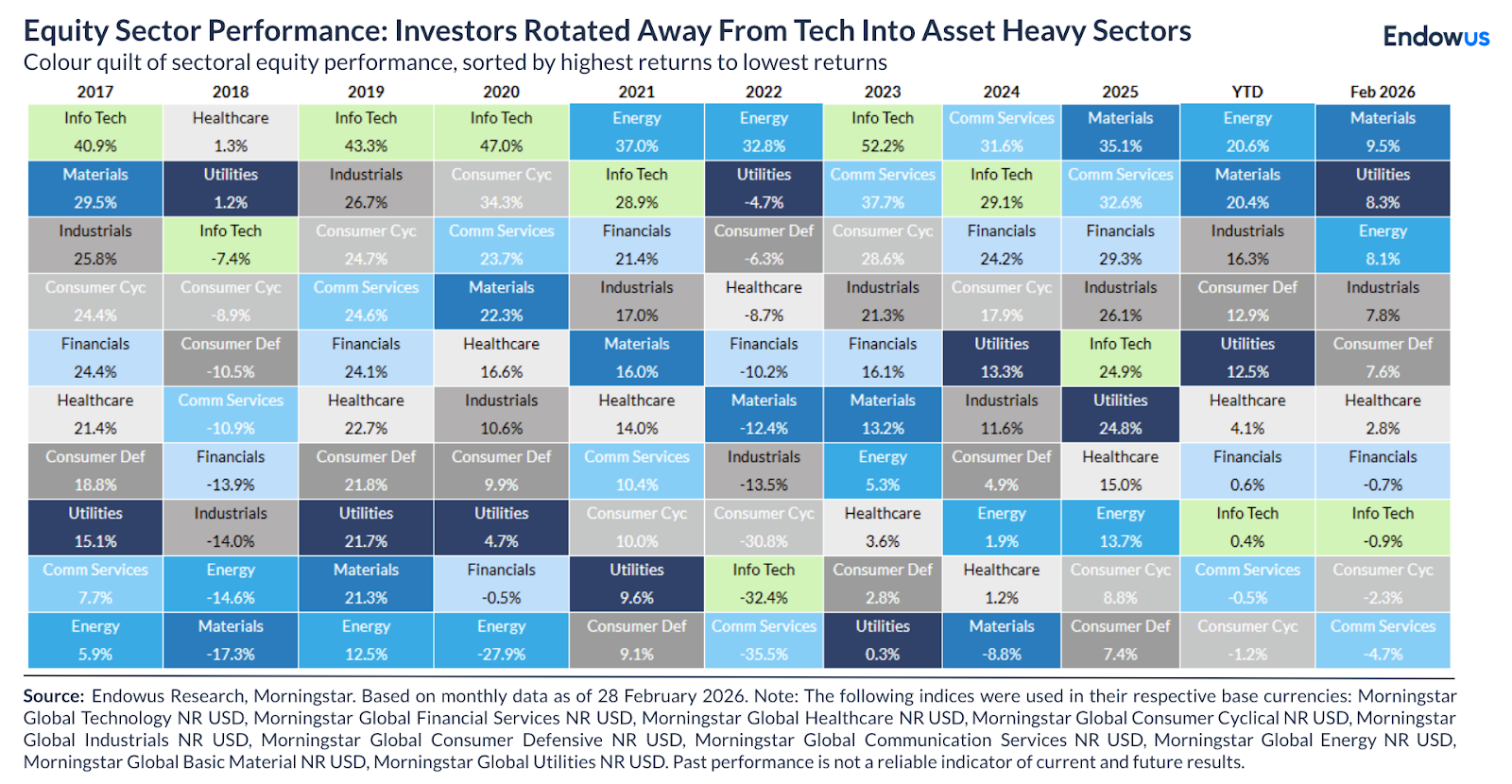
On the US equity side, February was a notably weaker month. The S&P 500 declined approximately 0.9%, with the NASDAQ falling harder on AI-related concerns. Technology and financials—last year's biggest winners—were among the worst performers, as investors rotated into energy, materials, and consumer staples.
A surprise reacceleration in the January PCE inflation data (released on February 27) triggered a broad risk-off sell-off to close the month, reinforcing the narrative of sticky inflation and slower easing. Global equities still managed a positive return of approximately 1.6% for the month, thanks to the strong performance of non-US equities.
By sector globally, technology and hardware led in Asia while energy, materials, and industrials continued their relative strength in Western markets. The AI theme evolved in February: hardware and semiconductors remained firm, buoyed by Japan's strategic investment commitments and continued demand from hyperscalers, while software and SaaS faced renewed pressure from valuation concerns and growing fear of AI-driven business model disruption. The rotation from "AI enablers" to "AI adopters" continued as a key debate in markets.
Global equity
By region, Japan and Korea were the standout performers for February. The Nikkei hit multiple record closes throughout the month on the back of the Takaichi landslide, with investors broadening their attention from initial "Takaichi trade" winners (exporters, cyclicals, financials) to a wider basket including AI, semiconductors, defence, and renewables.
KOSPI showed two consecutive months of 20%+ returns, largely driven by semiconductors, and also other major sectors. In March, however, KOSPI showed enormous volatility following the US-Iran war, suggesting there may have been some FOMO buying in KOSPI leading up to February.
European equities held their ground, though performance was more mixed than in January. The consensus view of European equities as a "value alternative" to the expensive S&P 500 continued to attract flows, supporting a strong year-to-date performance relative to US large caps.
US equities lagged the global pack. While the early part of the month saw some recovery in tech names from January's volatility, the late-February PCE shock triggered the S&P 500's steepest single-day decline in months. Value outperformed growth, and mega-cap technology concentration risk came back into focus. Small and mid-cap names held up better than large-cap growth on a relative basis.
By sector, energy continued its strong run as Middle East tensions kept oil prices elevated through much of the month before some softening on OPEC+ supply news. Materials remained firm, supported by gold and silver's continued upward momentum following the wobble in late Jan. Industrials held on to their broadening leadership theme.
In contrast, information technology was under pressure from AI disruption fears, particularly in software and SaaS, while financials also underperformed amid concerns about BDC credit quality and loan books concentrated in tech and software businesses.
Global fixed income
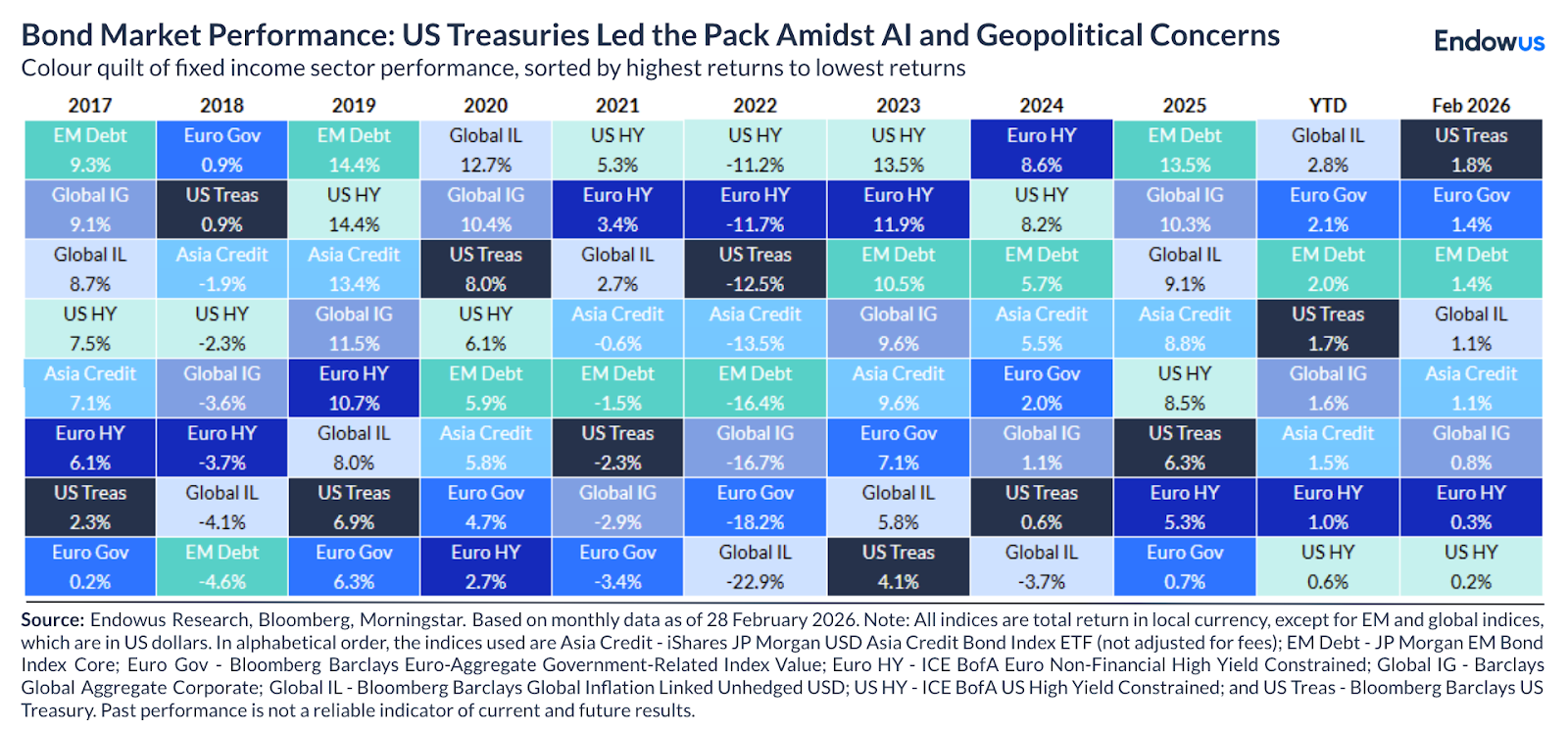
The fixed income picture in February was more constructive than January, primarily because Treasury yields fell rather than rose. The 10-year US Treasury yield declined from approximately 4.24% at end-January to close the month at 3.9%, reflecting a rally in safe-haven assets in the second half of the month amid the risk-off move triggered by late-breaking Middle East tensions. The 2-year yield also fell around 15 basis points to approximately 3.4%.
Investment grade and high yield credit held up well in aggregate, supported by tight spreads and solid corporate balance sheets. However, credit spreads did widen modestly in the final days of the month as the equity sell-off and AI-related business model concerns, particularly around software and BDC portfolios heavy in tech lending, prompted a degree of risk-off repositioning.
EM debt continued to post solid numbers, supported by constructive global growth projections and ongoing appetite for carry in a world where EM central banks retain meaningful room to cut rates.
Commodities
Commodities were broadly flat for February—a sharp deceleration from January's exceptional 10% monthly gain. The key dynamic was divergence: precious metals continued their strong run while oil was more volatile, and ultimately softer as OPEC+’s production increase announcement kept a lid on prices even with brewing geopolitical uncertainty. Since the US-Iran war, however, Brent has spiked sharply higher on uncertainty of supply disruption from the Strait of Hormuz.
Gold gained a further 7.8% in February, reaching above US$5,200/oz and extending its year-to-date gain to approximately 22%. The drivers were consistent with prior months.
The USD found some support in February, posting its first monthly gain since October 2025, partly a function of safe-haven demand at month-end and some recalibration of rate cut expectations following the PCE surprise.
Webinar: Travel, market and crypto bubbles
.png)
We are heading into bubble trouble

Endowus 2020 review and 2021 outlook



%20F1(2).webp)

.webp)
.webp)






.webp)