


.webp)
.webp)
.webp)
.webp)






.webp)










%20(1).gif)

Register for the event
Endowus invites you to our exclusive event with Macquarie Asset Management, as we discuss unlocking opportunities in Infrastructure- a $1.3tn asset class.
This event is reserved for Accredited Investors (AIs) only. To register for the event, please indicate one of the following:
- Singapore has become one of Asia’s densest concentrations of private wealth, with an estimated 244,000 US-dollar millionaires and 7,171 ultra-high-net-worth individuals, though headline counts vary by publisher because each measures wealth on a different basis.
- High net worth wealth management differs from the mass-market offering across five dimensions — product access, service model, breadth of planning, dedicated advice, and fees.
- For high-net-worth investors, the practical priority is institutional-quality access, transparent fees, genuine diversification and a human element that complements technological efficiency.
Wealth in Asia has never been more concentrated. The number of resident millionaires, single-family offices, and private banks competing for their business has risen sharply over the past decade.
Yet the phrase “high net worth wealth management” has quite the ambiguous meaning, as in, it is hard to figure out what level of wealth it refers to and how to exactly understand what sets it apart from normal levels of service.
What separates it from the mass-market offering can be typically access to private markets, discretionary portfolio management, and planning that reaches beyond investments into tax, succession, and estate. This article argues that those building blocks — not a private bank’s name — are what a high net worth investor should evaluate.
The sections below set out how many high net worth individuals Singapore now has, what the term means, where they invest, how the main service models work, and how the offering differs, in substance, from mass-market wealth management.
Singapore has become one of Asia’s densest concentrations of private wealth
Singapore’s private-wealth base has expanded quickly. UBS counted 244,000 US-dollar millionaires in the country as at the end of 2025, alongside 27,000 adults in the US$5m to US$100m wealth band. Knight Frank, which uses a US$30m threshold, put the population of ultra-high-net-worth individuals (UHNWIs) at 7,171 in 2026, up 55% from 4,642 in 2021.
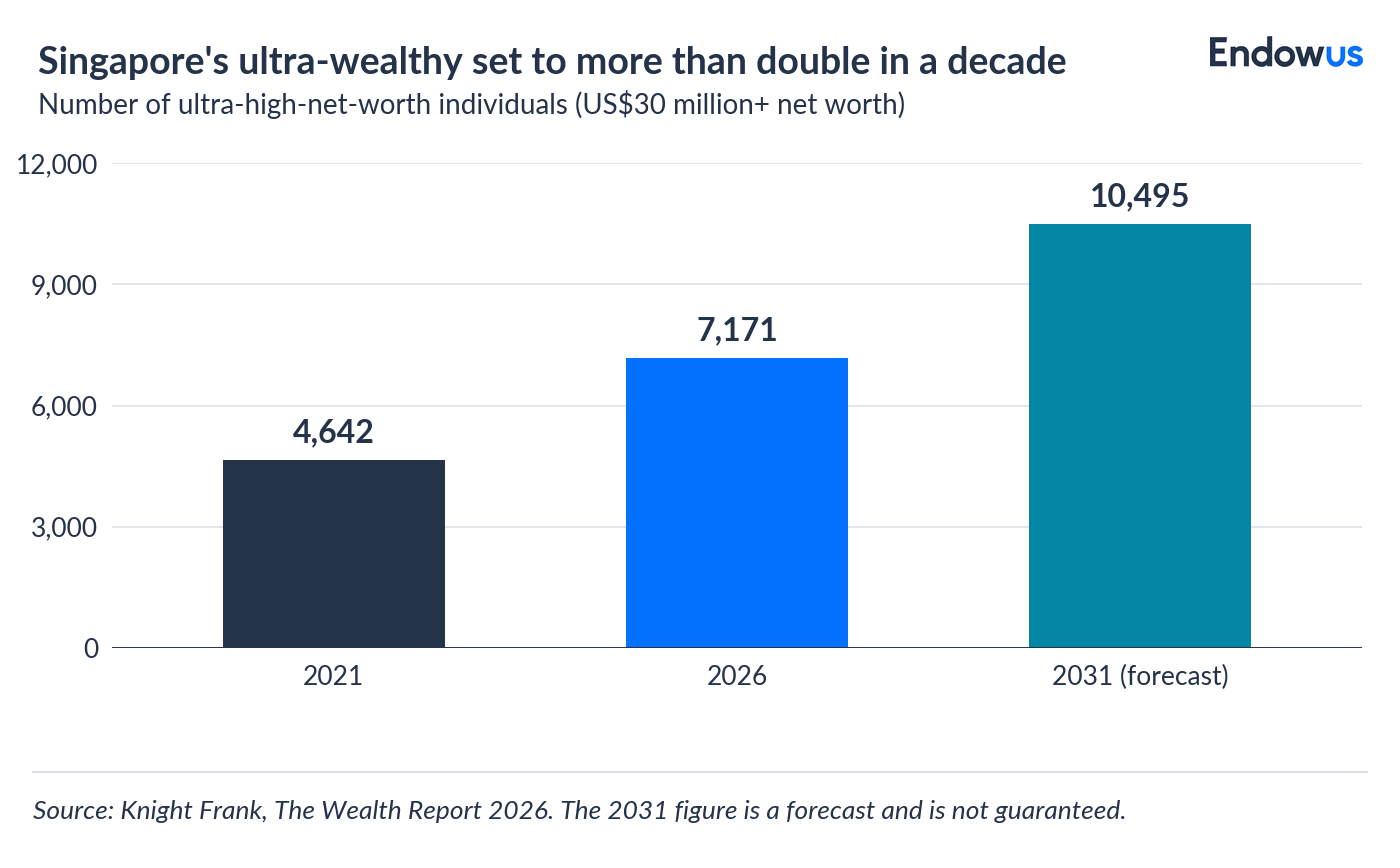
Before reading too much into these numbers, there is no official count of millionaires; the figures come from private wealth-research firms, with differences in measurements used depending on the firm. UBS counts total net wealth, including property; Capgemini counts investable assets and excludes the family home; Knight Frank includes homes in its net-worth threshold. The counts are therefore not directly comparable.
UBS notes that even its different editions are not directly comparable, because it periodically revises its data and method; on a consistent basis within its 2026 report - applying the 2026 method to its 2025 report - Singapore’s millionaire count rose by around 2% over the year. But a headline fall or rise can reflect a change in method rather than a change in real wealth.
What “high net worth” actually means, and why the threshold matters
“High net worth” has no single legal definition. In industry usage, a high net worth individual (HNWI) holds at least US$1m in investable assets — cash, securities, and funds, but not the family home — while an ultra-high-net-worth individual clears US$30m.
Singapore does, however, have a regulatory threshold that governs which products an investor can be offered: the accredited investor. Under the Securities and Futures Act, an individual qualifies with net personal assets above S$2m, of which no more than S$1m may be the primary residence, or net financial assets above S$1m, or income of at least S$300,000 in the preceding 12 months.
The regime is opt-in. A financial institution must first treat an eligible client as a retail investor, with the full set of safeguards, before that client can choose to be treated as accredited.
Accredited investors can be offered private-market funds, hedge funds, and other structured products that retail investors cannot access, but they also receive fewer regulatory protections, because the rules assume a greater capacity to bear and assess risk. Access and protection move in opposite directions.
Where high net worth individuals invest
High net worth portfolios differ from retail portfolios most clearly in the weight they give to private markets and alternatives. As of January 2025, Capgemini estimated that HNWIs held roughly a quarter of their financial assets in cash, a fifth in real estate, and the rest across fixed income, equities, and alternatives. The 15% invested in alternatives is a substantial share of the portfolio, but it includes hedge funds - which are typically liquid products - so it is hard to gauge how much money is allocated to private markets.
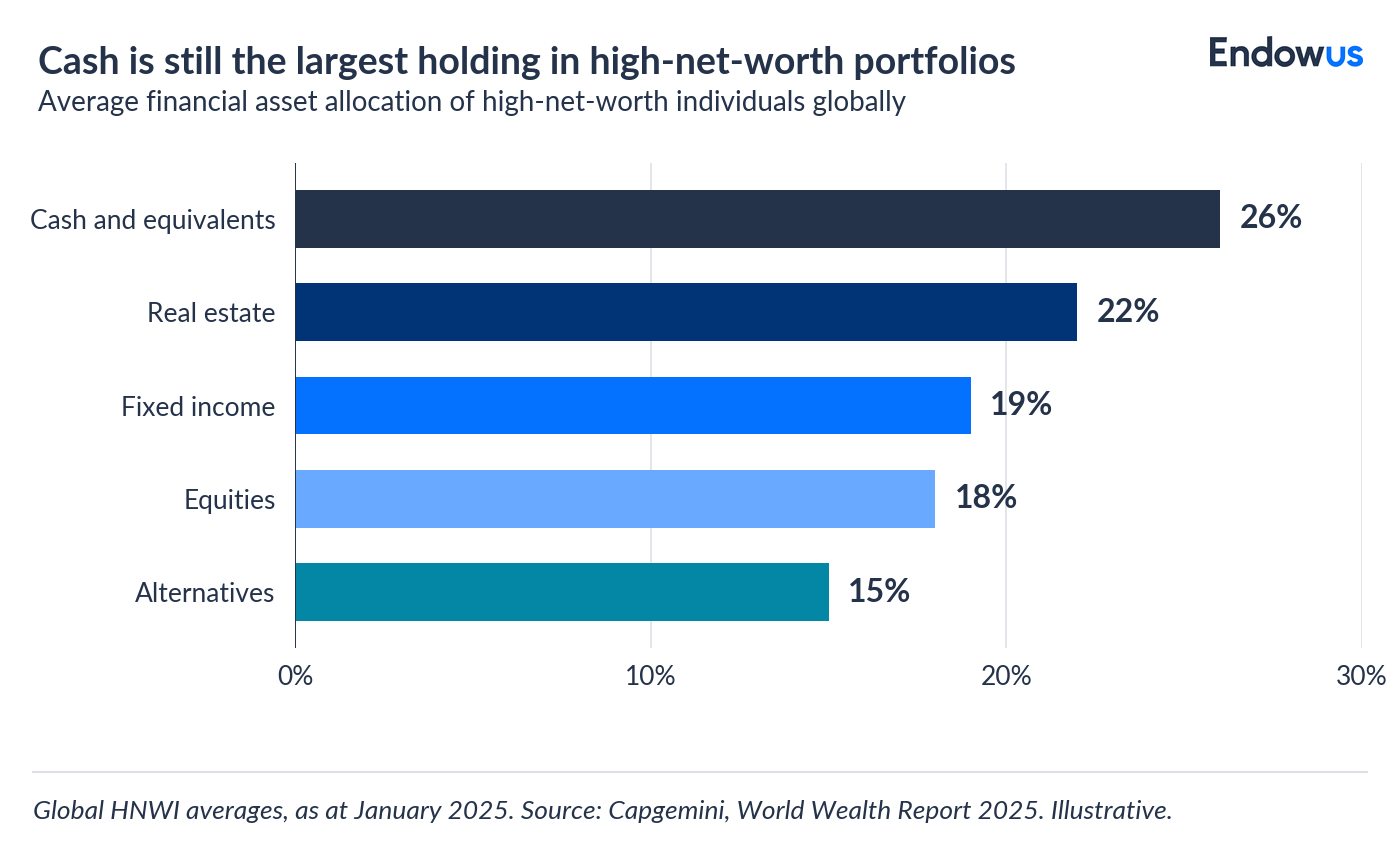
Markets do have an impact of course - by January 2026, after a strong year for both equities and bonds, equities had risen to become the largest single position at around 25%, with fixed income near 20% and alternatives close to 12%.
When asked directly, some 68% of HNWIs told Capgemini they planned to increase their allocation to private equity, and 88% said they work with more than one wealth manager specifically to widen their access to alternatives. Private markets — private equity, private credit, and infrastructure — are the exposures high net worth investors most often cite when they point to the need to have multiple providers.
How high net worth wealth management works
Four service models dominate the space.
- Private banks provide banking, lending, and investment under one roof, usually for clients with several million dollars to invest.
- External asset managers (EAMs) — independent firms that manage a client’s money while a bank holds it in custody — separate advice from product manufacturing.
- Multi-family offices pool the needs of several wealthy families, while single-family offices serve one.
- Discretionary wealth platforms manage portfolios directly under a delegated mandate.
The main distinction is between the discretionary and the advisory models. Under an advisory mandate, the client approves each transaction. Under a discretionary mandate, the manager invests within an agreed policy — including asset allocation, risk appetite, time horizon, return requirements, and restrictions — without seeking approval for each trade. Discretionary assets now make up more than half of the roughly S$7 trillion of assets managed in Singapore.
Singapore’s emergence as a family office hub is the clearest local expression of this shift. The number of single-family offices awarded tax incentives grew from 400 at the end of 2020 to more than 2,000 by the end of 2024.
Two schemes underpin that growth: Section 13O and Section 13U of the Income Tax Act. Both exempt a qualifying fund vehicle from Singapore tax on specified income, subject to a minimum fund size — S$20m and S$50m respectively — local business spending, and a requirement to deploy capital into eligible Singapore investments.
You can learn more about setting up a family office in Singapore here.
How it differs from mass-market wealth management
Strip away the branding, and high net worth wealth management differs from the mass-market offering in five substantive ways.
- Product access. Accredited status unlocks private-market funds, hedge funds, and structured products, at the cost of weaker regulatory safeguards.
- Minimum size A private-bank discretionary mandate or a family-office structure needs scale, because its fixed costs only make sense above a high asset threshold; the mass-market route relies instead on pooled funds and low minimums.
- Breadth of planning. High net worth advice usually extends into estate, tax, succession, and philanthropy, coordinated across a client’s whole balance sheet, rather than stopping at an investment recommendation.
- Dedicated advice. A named relationship manager and a wider product shelf replace the self-directed or lightly-advised experience common at the mass-market tier.
- Fees. High net worth pricing layers a management or advisory fee on top of performance fees, transaction charges, and — on some products — retrocessions (or trailer fees), the commissions a fund manager pays a distributor for placing its funds. Retrocessions create a conflict, because the adviser may be paid more to recommend one product than another. Industry standards addressed this directly: the Private Banking Code of Conduct, issued by the Association of Banks in Singapore, calls for firms to disclose commissions, rebates, and retrocessions in a fee schedule at account opening, and provides that firms should not retain retrocessions on discretionary mandates.
Each advantage also carries a cost. Broader access comes with weaker protection; bespoke planning with higher minimums and complexity; private-market return potential with illiquidity; and a wider product shelf with a more layered, and sometimes conflicted, fee stack.
Investment implications
For a high net worth investor in Singapore, access is a given. A much more complex task is to better understand cost, avoid conflict of interest, and remain diversified.
In our view, the right response is not to give up the advantages of the high net worth tier, but to capture them on better terms: institutional-quality funds, private-market access where suitable, and discretionary or advised portfolios, priced transparently and free of the trailer commissions that may distort product selection. That is the basis on which Endowus Private Wealth is built. It rebates the trailer fees a fund manager would otherwise pay a distributor, and gives accredited and high net worth clients access to private markets alongside a globally diversified core.
On one hand, the private-market and alternatives exposure that defines high net worth investing can improve a portfolio’s return and diversification when it is sized with discipline. On the other, those same assets bring illiquidity, higher minimums, and fees that reward scrutiny. The task is not to choose between access and discipline, but to hold both — which is where an adviser aligned with the client, rather than with a product manufacturer, earns their place.
Frequently asked questions
How many millionaires are there in Singapore?
UBS counted 244,000 US-dollar millionaires in Singapore as at the end of 2025. Estimates vary by publisher, because each measures wealth on a different basis, so the figure should be read as one credible estimate rather than an official count.
What counts as high net worth or ultra high net worth?
In industry usage, a high net worth individual holds at least US$1m in investable assets, and an ultra-high-net-worth individual at least US$30m, excluding the family home. Separately, Singapore’s accredited investor threshold — net personal assets above S$2m, net financial assets above S$1m, or income of at least S$300,000 a year — determines which products an investor can be offered.
Where do high net worth individuals invest?
Across cash, real estate, fixed income, equities, and alternatives, with a larger allocation to private markets than most retail portfolios. As at January 2026, equities were the largest single position for HNWIs globally, and most reported plans to increase their private-equity exposure.
Do I need a private bank to access private markets in Singapore?
No. Accredited investors can access private-market funds through digital wealth platforms as well as private banks. What matters is suitability, fees, and how the exposure is sized within a diversified portfolio, rather than the type of provider.
How is high net worth wealth management different from a retail platform or robo-adviser?
The main differences are product access, breadth of planning, and fee structure. A low-cost platform can now offer some of the same building blocks — including private-market access for accredited investors and discretionary or advised portfolios — often with more transparent pricing than a traditional layered fee model.
Retiring with a bucketing strategy

Webinar: Wealth — the wellness trend for women

Sparking joy: How to Marie Kondo your finances



%20F1(2).webp)

.webp)
.webp)






.webp)