


.webp)
.webp)
.webp)
.webp)






.webp)












%20(1).gif)
.jpg)
Register for the event
Endowus invites you to our exclusive event with Macquarie Asset Management, as we discuss unlocking opportunities in Infrastructure- a $1.3tn asset class.
This event is reserved for Accredited Investors (AIs) only. To register for the event, please indicate one of the following:
- Buying options to protect a portfolio is a form of insurance, and the premium has historically been priced above the losses it reimburses — which is why systematic hedging tends to lower long-run returns.
- The option Greeks show precisely what a hedger pays for: acquiring protection means paying so-called “time decay” every day in exchange for convexity that rewards the buyer only when realised volatility exceeds the volatility already priced into the option.
- For investors with a long horizon, adjusting the equity allocation, diversifying across asset classes, and rebalancing have historically delivered comparable risk reduction at a lower cost than continuously buying protection.
Between June 1986 and December 2018, a hypothetical strategy that held the S&P 500 and bought a put option 5% below the market each month (for downside protection) returned 6.64% a year, against 9.80% a year for the index itself, according to back-tested Cboe data compiled by Oleg Bondarenko. The hedge did its job in a crisis: in the fourth quarter of 2008 it was roughly flat while the index fell about 22%. Yet over the full period it turned a dollar into $8.08, against the $20.85 the index produced on its own. Remember: fixed costs (even if it’s insurance costs) compound and eventually detract from returns.
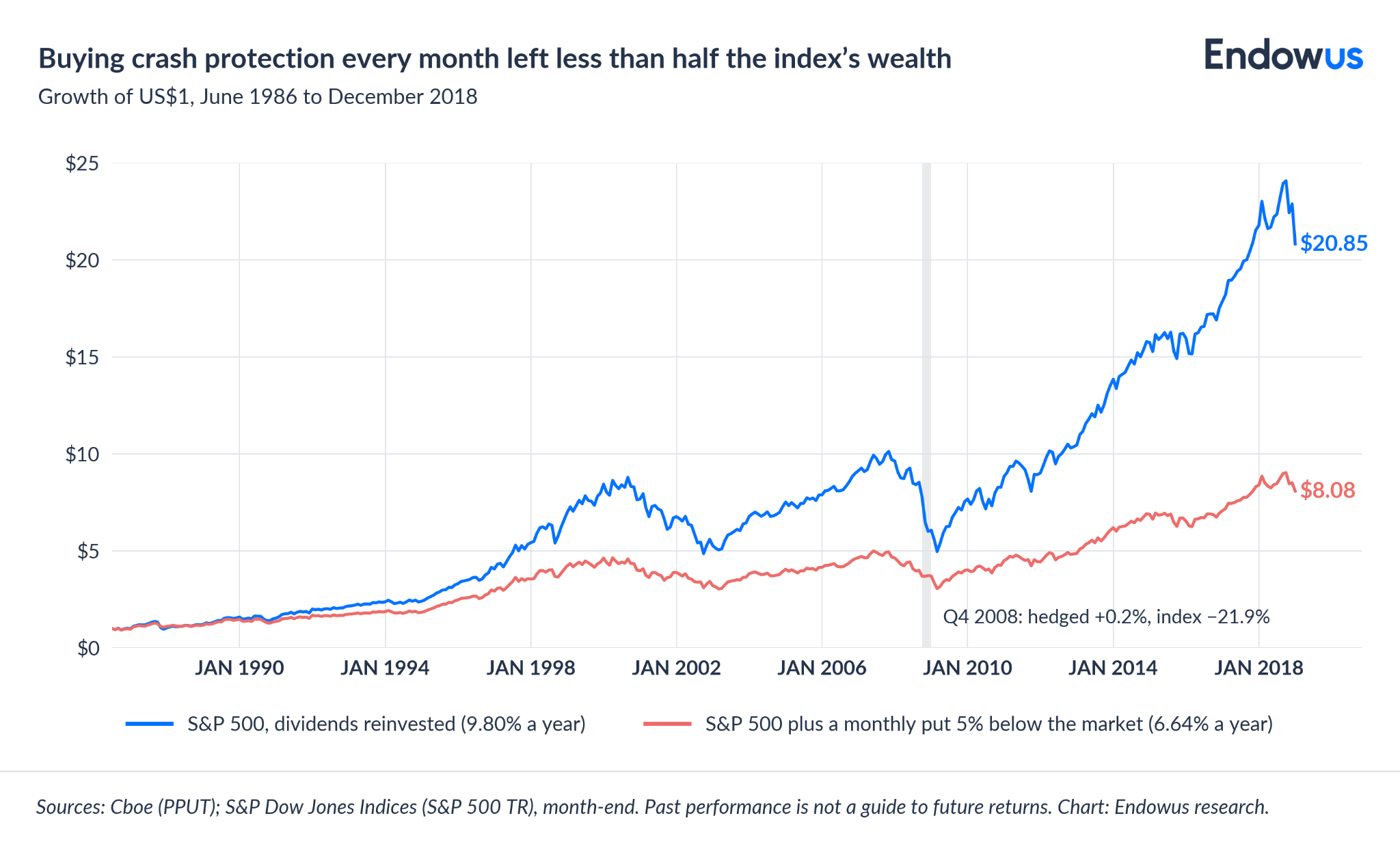
Hedging offers protection at a cost, but the cost is larger and more persistent than many investors expect. This article sets out how option-based hedging works, what the “Greeks” reveal about the recurring price of protection, and why, for a diversified long-term portfolio, adjusting allocation is usually a more efficient way to manage risk than buying insurance in the options market.
The analysis moves from the mechanics of protective puts and the option Greeks, through the dynamics of delta-neutral hedging, to the long-run evidence and the cheaper alternatives available to patient investors.
What is options hedging, and why the premium favors the seller
An option is the public market’s standardised form of insurance. The buyer of a protective put pays a premium today for the right to sell an asset at a fixed strike price, which caps the loss below that level (before accounting for the cost of the option - or premium); the seller collects the premium in exchange for absorbing the downside.
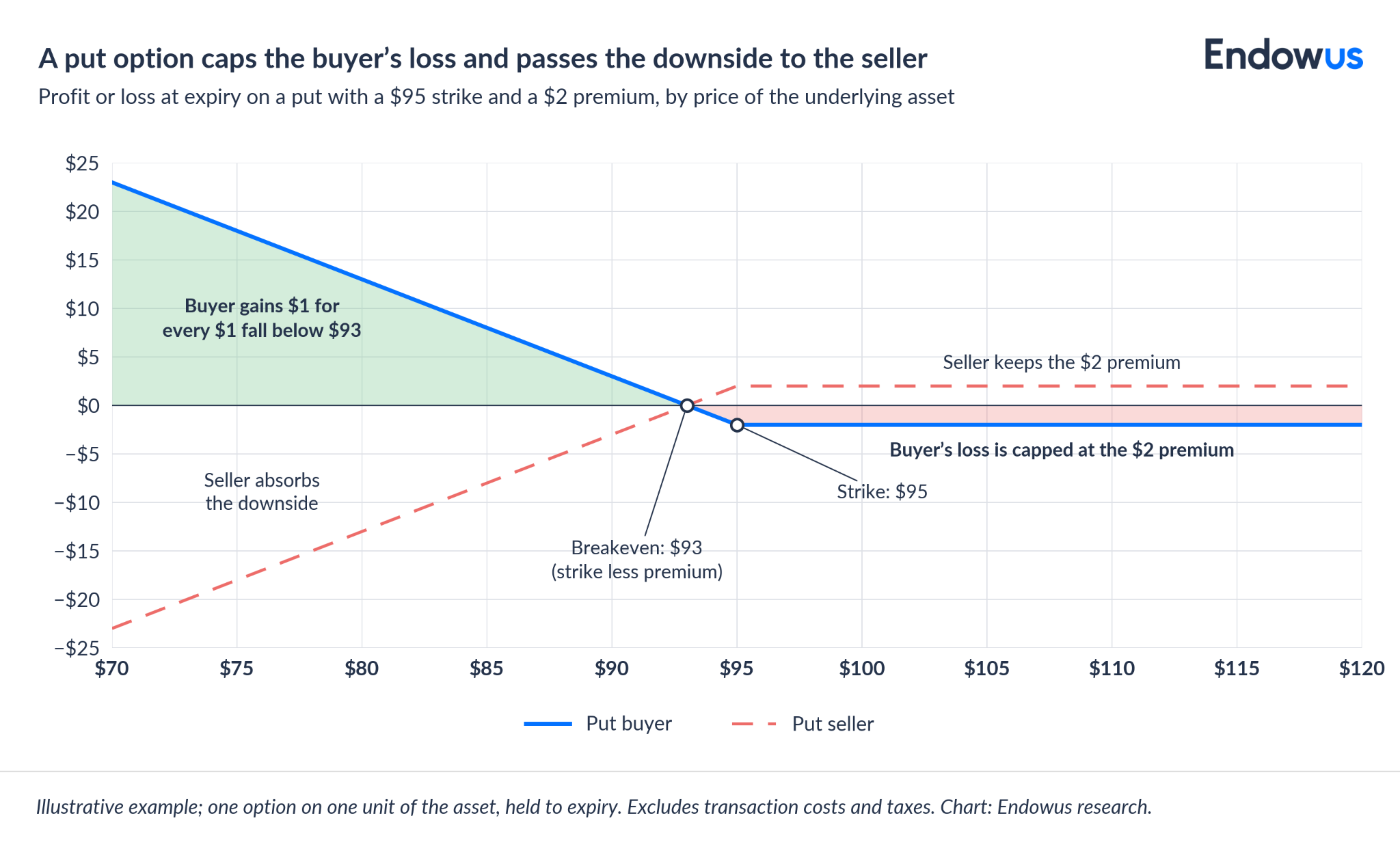
The premium is the visible cost for the protection buyer, with cost increasing together with expected volatility, because a more volatile asset is more likely to breach the strike, so it costs more to insure.
The difficulty for the buyer is that this expected volatility — the implied volatility embedded in the option’s price — has tended to exceed the volatility that actually follows. Between 1990 and 2018, the VIX index averaged 19.3%, while realised S&P 500 volatility averaged 15.1%. That gap of roughly four percentage points is the volatility risk premium: the margin the seller earns, on average, for providing cover. It is the same dynamic that lets a general insurer expect to pay out less than it collects. For the hedger, it means protection is priced above its actuarial value.
What are the “Greeks” and what they define
Under the Black-Scholes-Merton framework, the standard model for pricing European options, an option’s sensitivities are captured by the so-called “Greeks,” - letters that capture some of the major relationships between the underlying financial instrument (for example, a stock) and the option.
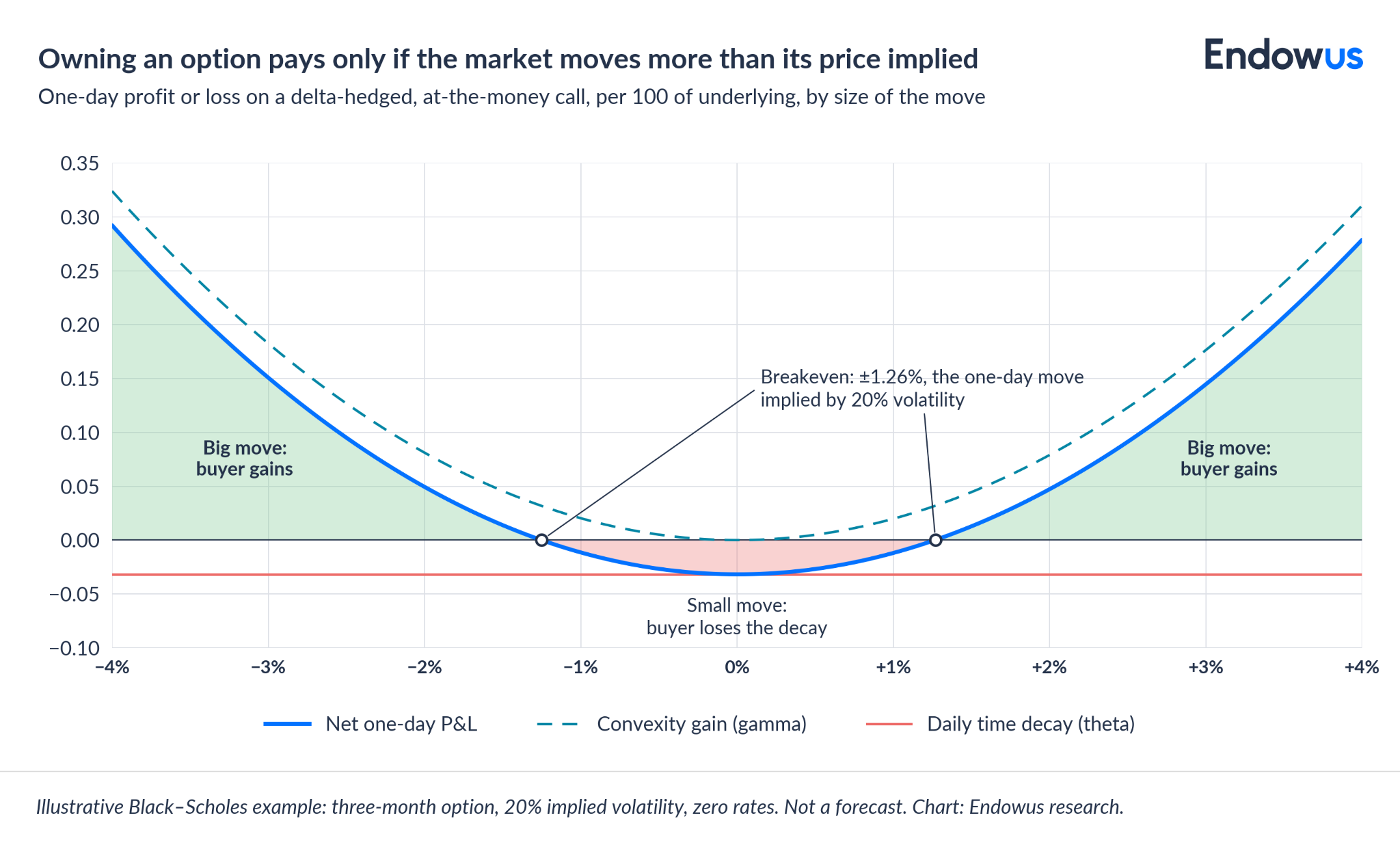
The decisive relationship is between gamma and theta. A “long” option position (the one held by an investor who has acquired protection) has positive gamma — it gains convexity, becoming more protective as the market falls — but it “pays” theta as it loses value every day as the option ages.
For an at-the-money option (an option that would be exercised if the value of the underlying was the same at its expiration) the two are tied together: the daily time decay is approximately proportional to gamma multiplied by the square of the implied volatility the buyer has paid for. Owning protection therefore means paying continuously for convexity, and that trade rewards the buyer only if the market moves more than the option’s price implied.
Black–Scholes, the standard model for pricing options, treats an option's value as depending on how far and how fast the underlying might move. Its price builds in an expected size of daily moves, and the buyer recovers the daily cost only if the market moves by more than that. This is key for an at-the-money option, the value of which is typically higher the larger the underlying asset’s daily moves, and the farther we are from expiration.
This is intuitive even if you have trouble figuring out the math: insurance is more valuable when we are far away from the event we want to insure against, because it is harder to predict what is going to happen further in the future. It is also more valuable the more unpredictable the factors driving the event are.
What is delta-neutral hedging
A position is delta-neutral when its net sensitivity to small moves in the underlying is zero. In the textbook case set out by John Hull in his textbook, an institution that has sold a call on 100,000 shares with a delta of 0.522 “neutralises” it by buying 52,200 shares.
But the hedge holds only for an instant, because gamma makes delta (the number of shares needed to hedge the option) change as the price moves. If the shares rise, delta climbs and the hedger must buy more; if they fall back, delta drops and the hedger sells. For the option seller, the hedge mechanically buys high and sells low, and these adjustments add up to a cost. That cost is what the option premium is meant to cover, and the seller comes out ahead only if the stock turns out to be less volatile than the price assumed.
file:///Users/alfonso/Downloads/The%20hedge%20that%20buys%20high%20and%20sells%20low.html
That loss is the price of being short gamma, offset by the theta the seller collects. A protective buyer faces the mirror image: positive gamma that earns money on rebalancing, but theta paid away each day. The profit and loss of a delta-hedged option reduces, in essence, to the difference between realised and implied volatility — the buyer gains only when the market proves more volatile than the price assumed. Transaction costs make this harder still: more frequent rebalancing may raise trading costs rather than removing risk, so the hedge is never free to maintain.
Is options hedging really needed
The monthly protective put described above surrendered about three percentage points of annual return over 1986 to 2018 to cut volatility by a similar amount, as mentioned above in this article. AQR’s study of a rolling one-month put 5% out of the money found it reduced the S&P 500’s excess return from 5.1% to 1.8% a year between 1996 and 2016.
None of this means protection never works. In the sharpest falls it does what it promises — the monthly put was roughly flat in the fourth quarter of 2008 while the index dropped about 22%. The issue is timing and cost: unless the purchase and its expiry align with a drawdown, the premium paid over the surrounding calm quarters tends to outweigh the payoff. Past performance is not necessarily a guide to future performance or returns.
For long horizons, allocation is the cheaper hedge
If the aim is to carry less risk, the most direct route is to hold less of the risky asset. Reducing equity exposure carries no premium, no time decay, and no rebalancing cost, and in Israelov’s research an investor who simply trims equities has historically achieved lower drawdowns and a higher risk-adjusted return than one who buys puts sized to the same average return.
Singapore’s retirement system is about to put this principle into practice. From the first half of 2028, CPF members will be able to opt into a new investment scheme of life-cycle products that automatically shift portfolios towards less risky assets as members approach their target date. The scheme manages the risk of a market fall near retirement by gradually holding less of the riskier asset. It does not buy protection against the asset’s volatility.
Diversification also helps protect the downside. Holding assets whose returns do not move together — high-quality bonds alongside equities, for instance — may decrease portfolio volatility without paying a premium.
Rebalancing adds a final low-cost layer, trimming what has risen and adding to what has fallen in a disciplined, counter-cyclical way.
For an investor whose horizon is measured in decades, these tools address the same need as a hedge — a smoother path to a goal — without the structural drag of continuously bought insurance.
Investment implications
For most long-term investors, option-based hedging is better understood as a specialist instrument than a default layer of risk management. In our view, the recurring cost of protection — the volatility risk premium, the daily theta, and the transaction costs of dynamic hedging — makes it ill-suited to a buy-and-hold portfolio, where the same objective can be met more cheaply through allocation and diversification.
Options can offer precise, immediate protection that is genuinely useful around a known, typically short-dated risk, or for a specific drawdown. But that precision is rented at a price that compounds against the patient investor, and the evidence suggests it is seldom recovered over long horizons. The more durable discipline is to size equity exposure to the risk one can actually bear, diversify the sources of return, and rebalance consistently. Endowus advisers can help calibrate that allocation to an individual’s horizon and risk tolerance.
Frequently asked questions
What is the simplest way to hedge an equity portfolio?
The most direct and lowest-cost approach is to hold less of the risky asset and more in cash or high-quality bonds, rather than to buy options. Reducing exposure carries no premium and no ongoing decay, whereas an option hedge must be paid for and rolled.
Does a “zero-cost” collar remove the cost of hedging?
No. A collar funds the downside put by selling an upside call, so no premium changes hands at inception, but it caps gains and the put it buys is typically priced more richly than the call it sells. Studies of index collars still show a drag relative to the underlying over long horizons.
Is the volatility risk premium always positive?
No. Implied volatility has exceeded realised volatility on average, but not in every period; in some crises realised volatility has overshot what options priced in, and buyers were compensated. That occasional payoff is the reason protection exists, but on average the premium has favoured the seller.
Forget your password? It's a good thing for your investments

The lesson of Hyflux: What water and diversification have in common

Free lunch: Diversification in investing is a gift
.jpeg)


%20F1(2).webp)

.webp)
.webp)






.webp)