


.webp)
.webp)
.webp)
.webp)






.webp)












%20(1).gif)

Register for the event
Endowus invites you to our exclusive event with Macquarie Asset Management, as we discuss unlocking opportunities in Infrastructure- a $1.3tn asset class.
This event is reserved for Accredited Investors (AIs) only. To register for the event, please indicate one of the following:
- Private markets assets are valued periodically through appraisals rather than continuously through live market prices, which causes reported returns to appear less volatile — and less correlated with public equities — than they would be if marked to market in real time.
- Smoothing is a structural consequence of illiquid asset pricing. Its statistical effects are well-documented - with material consequences over the asset’s beta and correlation coefficients.
- Unsmoothing — the process of adjusting reported return series to remove appraisal lag — is a standard analytical technique that helps investors interpret volatility and correlation figures more accurately and construct better-calibrated portfolios.
Private markets have attracted significant attention from investors seeking diversification beyond public equities and bonds. One of the features most often cited in favour of the asset class is its comparatively low volatility: private equity and private credit funds tend to report smoother return streams than their public market counterparts. As a practical example - a private equity fund might report quarter after quarter of steady, single-digit gains while the S&P 500 swings by several percentage points in either direction.
That apparent stability is partially driven by a pricing phenomenon known as smoothing, which is caused by the valuation approach used for private market assets. These illiquid assets are typically valued manually (level 3 assets, according to IFRS), using comparative transactions or lengthy asset appraisals, and because of that, price movements tend to be reflected with a lag. Because price changes are distributed across multiple reporting intervals rather than recognised immediately, returns in one period end up being positively correlated with returns in the prior period, a phenomenon called “autocorrelation.”
Smoothing does not undermine the case for private markets investing, but understanding it helps investors interpret what their portfolio is actually doing, set realistic expectations for how it will behave, and avoid potential risk understatement.
This article takes a deep dive into smoothing with the goal of educating investors on what the essential effects of smoothing are on portfolio construction, and why allocators need to take them into account.
What is smoothing in private markets?
In public markets, asset prices update continuously. Returns can be calculated precisely, in real time, and volatility is simply the observed variation in those prices over a chosen period.
Private markets assets — stakes in private companies, direct loans to non-listed borrowers, infrastructure projects, commercial real estate — do not trade on exchanges or over the counter. There is no live market price. Instead, fund managers assign a value to each asset at regular intervals, typically quarterly, through a formal valuation process. This process involves appraisals, discounted cash flow models, and, where available, comparable transaction analyses.
Because these valuations are updated infrequently, and because appraisers tend to incorporate new information gradually rather than instantaneously, the reported net asset value (NAV) of a private markets fund changes more slowly and more smoothly than the underlying economic reality of its assets. This is smoothing: the lag between changes in economic value and changes in reported value.
But while this is not an intentional way to make numbers more appealing, it does have measurable, material effects on how portfolio statistics appear.
How smoothing works: an illustration
Consider four hypothetical return series over four time periods. The overall equity market experiences a 10% surge in period two, with stable returns before and after. Three other assets each have a true beta of 0.80 — meaning each should ultimately respond with an 8% price rise (ignoring compounding). The difference is in the timing of that response.
The unsmoothed series responds fully and immediately: the entire 8% appears in period two, exactly when the market moves. The lightly smoothed series reflects 75% of its response (6%) in period two, and the remaining 25% (2%) in period three. The strongly smoothed series splits its response equally: 4% in period two and 4% in period three.
The statistical consequences are immediate. All three series share the same long-run mean return (2.0%). But the standard deviations diverge markedly: 4.0% for the unsmoothed series, 2.8% for the lightly smoothed, and 2.3% for the strongly smoothed. The correlation with the market falls from 1.00 (unsmoothed) to 0.94 (lightly smoothed) and 0.58 (strongly smoothed). Most strikingly, the reported beta collapses from 0.80 (the true value) to 0.53 for the lightly smoothed series and just 0.27 for the strongly smoothed series — a reduction of one-third and two-thirds respectively.
The asset has not changed. Its true risk exposure remains 0.80. Only the timing of the price response has changed, mostly because valuation updates for illiquid assets typically lag public market moves — and that timing difference is sufficient to make a genuinely risky asset appear, statistically, to be far more defensive than it actually is.
Why does smoothing persist?
In a perfect market, smoothing would not survive for long. Arbitrageurs would identify assets whose prices consistently respond with a lag and position accordingly: buying after the market rises (to capture the delayed response) and short-selling after the market falls. Competition among arbitrageurs would force prices to respond more quickly, eliminating the lag. Smoothing in tradable assets with low transaction costs and few barriers to entry is therefore self-correcting in theory.
In practice, two factors prevent this from happening in private markets.
Appraisals are not firm bids or offers
The return series of private markets funds are typically based on appraisals conducted for accounting and reporting purposes. They represent professional estimates of value, not prices at which transactions are actually taking place. An arbitrageur cannot simply buy a private equity fund at its appraised NAV, wait for the delayed price response, and sell at the updated valuation.
Transaction costs and structural barriers
Even where smoothed prices do reflect actual trading opportunities, the costs of transacting in private assets are substantial. Real estate provides the clearest example: sales commissions, transfer taxes, legal and financing costs, search costs, and inspection costs collectively create barriers that make exploiting a moderate pricing lag economically unviable. The potential gain from anticipating a lagged price response is frequently smaller than the cost of the transaction required to capture it.
Similar barriers exist across private equity and private credit. Secondary market transactions in fund interests do occur, but they typically involve discounts, lengthy processes, and limited counterparty availability. The friction is sufficient to prevent the arbitrage mechanism from functioning as it would in public markets.
International open-end equity mutual funds have historically illustrated the same dynamic: their reported NAVs were based on stale closing prices from markets that had already closed, creating temporary smoothing that arbitrageurs did exploit — leading fund companies to implement redemption fees and more accurate pricing methods.
What does smoothing mean for volatility and correlation?
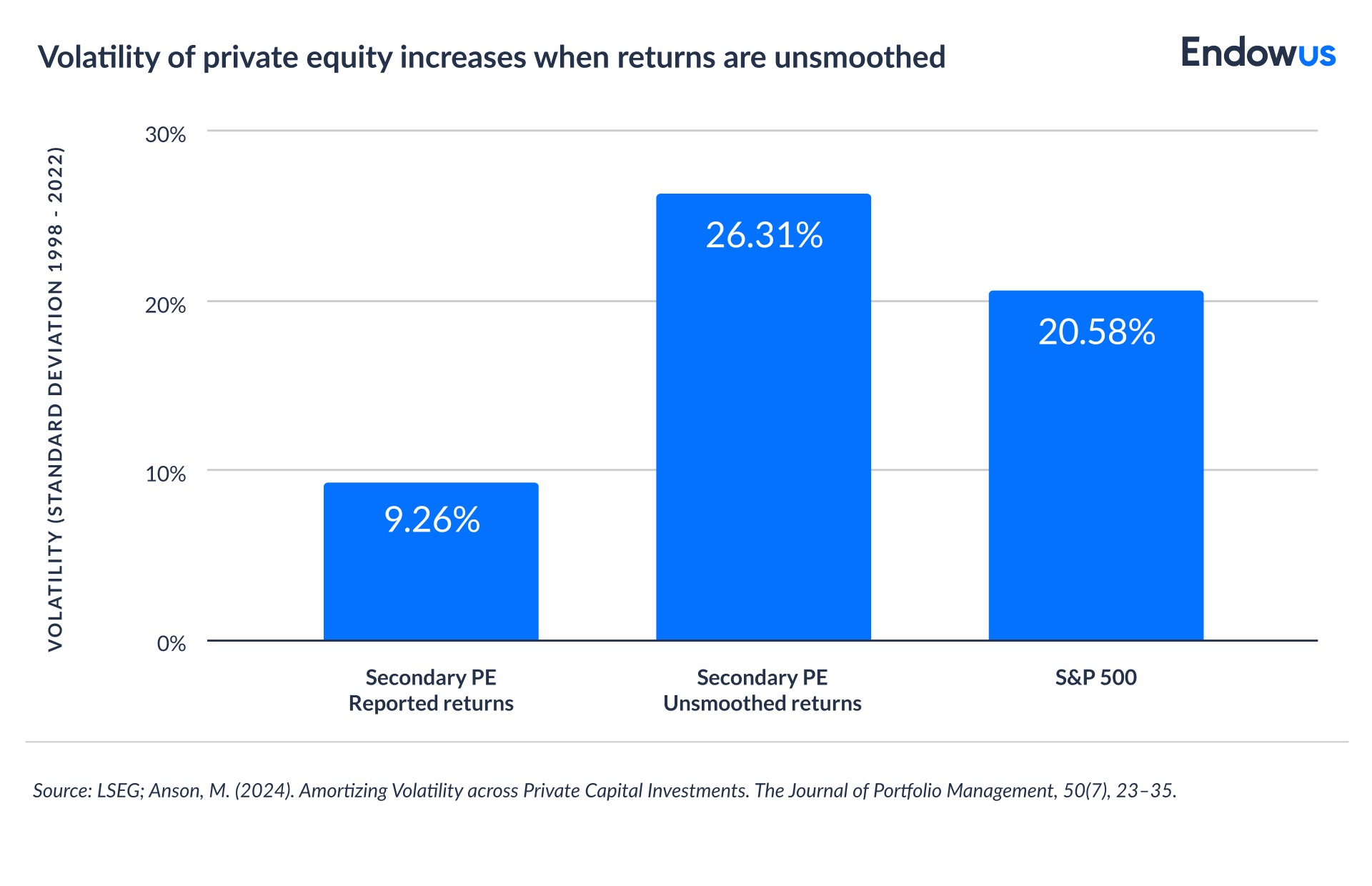
As Exhibit 1 shows, smoothing compresses reported volatility by muting the largest movements in the return series — the outliers that drive standard deviation. It depresses measured correlation with public markets by distributing the return response across multiple periods, weakening the contemporaneous relationship. And it produces a reported beta that is materially lower than the true economic beta.
Importantly, long-run mean returns are not substantially affected. In a 10-year return series, the average time-weighted return is determined primarily by the first and last prices. If one of those prices is misstated by 2%, the error in the average annual return is approximately 20 basis points over the full decade. The effect on measured risk, however, is far larger: if many of the prices within those 10 years are smoothed, the reduction in apparent volatility can be very significant, even as the mean return appears largely unaffected.
This asymmetry is important. An investor comparing a smoothed private equity fund to a public equity benchmark on a risk-adjusted basis — using Sharpe or Treynor ratios, for example — may observe a substantially higher ratio for the private fund, not because the risk-adjusted return is genuinely superior, but because the denominator (reported risk) is artificially compressed.
Unsmoothing: restoring an accurate risk picture
Return unsmoothing is the process of adjusting a smoothed return series to remove the effects of appraisal lag — restoring a level of volatility and correlation that more closely reflects economic reality rather than the timing artefacts of periodic valuation.
The technical approach involves identifying and removing the autocorrelation that smoothing introduces into the return series. In an unsmoothed return series, returns in one period carry no information about returns in the next. In a smoothed series, positive returns in one period are followed by positive returns in subsequent periods (as the delayed price response works through) — creating serial correlation that the unsmoothing procedure targets and removes.
The result of unsmoothing is typically a return series in which large market moves are concentrated in the period they actually occurred, rather than spread across multiple reporting periods. Standard deviations, correlations, and betas all rise toward their true economic values. The unsmoothed series will not match the public equity benchmark exactly — because private assets typically show different risk-return drivers compared to listed equities — but it provides a more defensible basis for portfolio modelling and risk budgeting.
Unsmoothing procedures are applied most commonly to real estate indices, private equity return series, and other illiquid real asset benchmarks such as farmland and timberland. The need for unsmoothing is greatest where: prices are based on appraisals rather than market transactions; valuations are infrequent; and transaction costs or trading barriers prevent arbitrage from correcting the lag organically.
A standard unsmoothing formula developed by Geltner in 1993:
True return = Current smoothed return - Previous Smoothed Return1-
where α represents the smoothing factor. A higher α means heavier smoothing. By testing a range of α values within the formula, fund managers can bracket the upper and lower bounds of how smoothing distorts actual performance of the underlying assets.
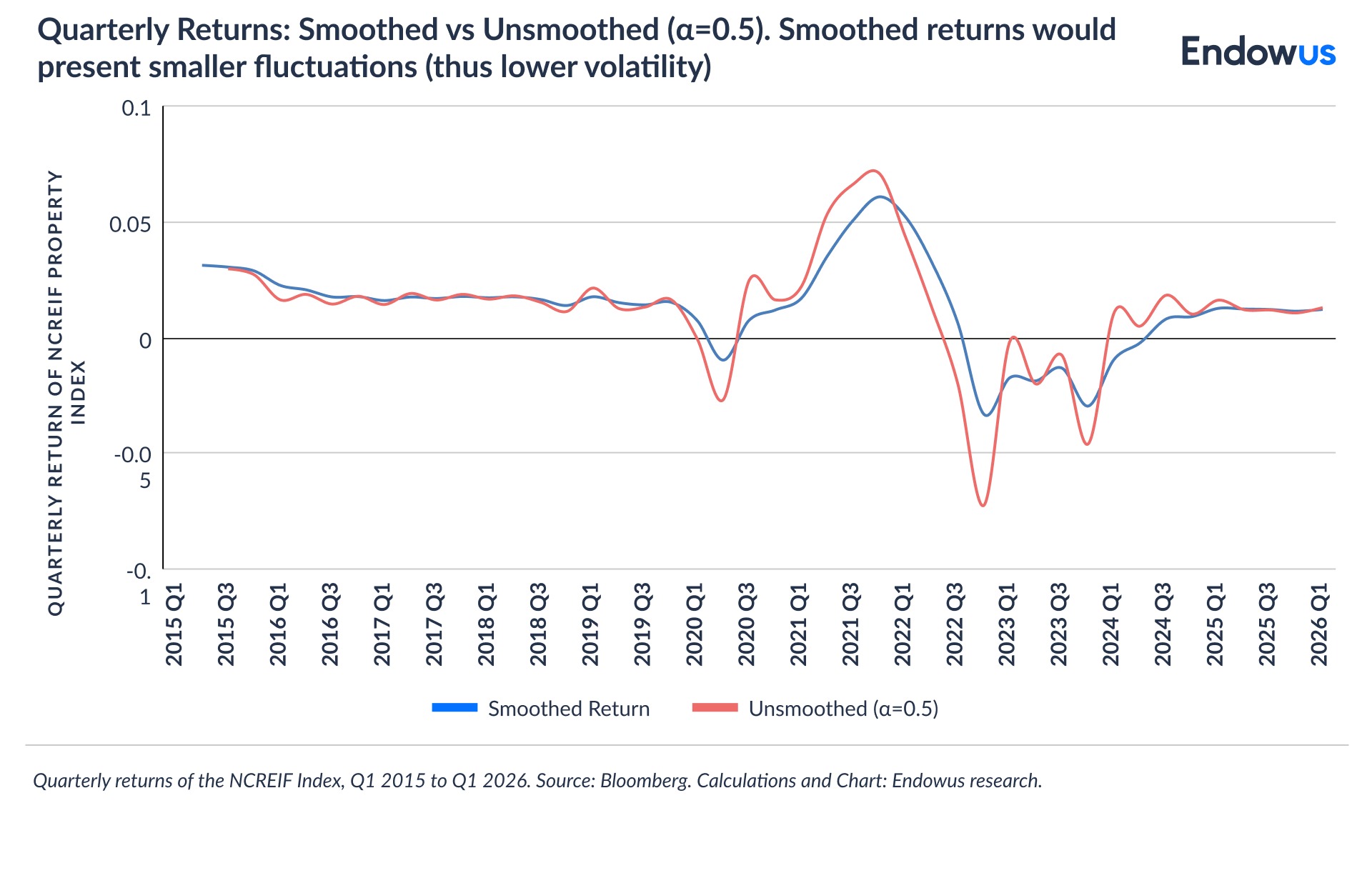
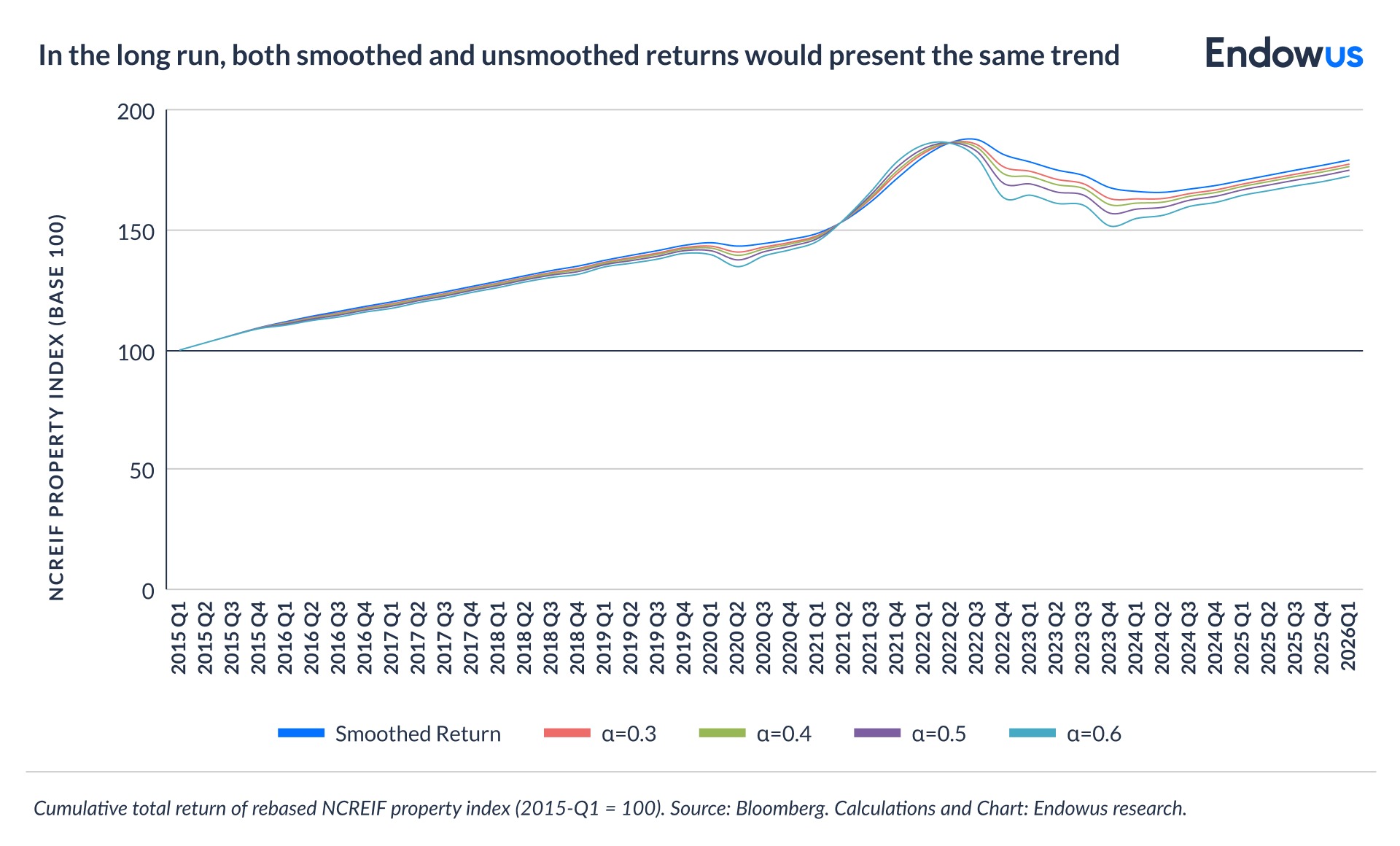
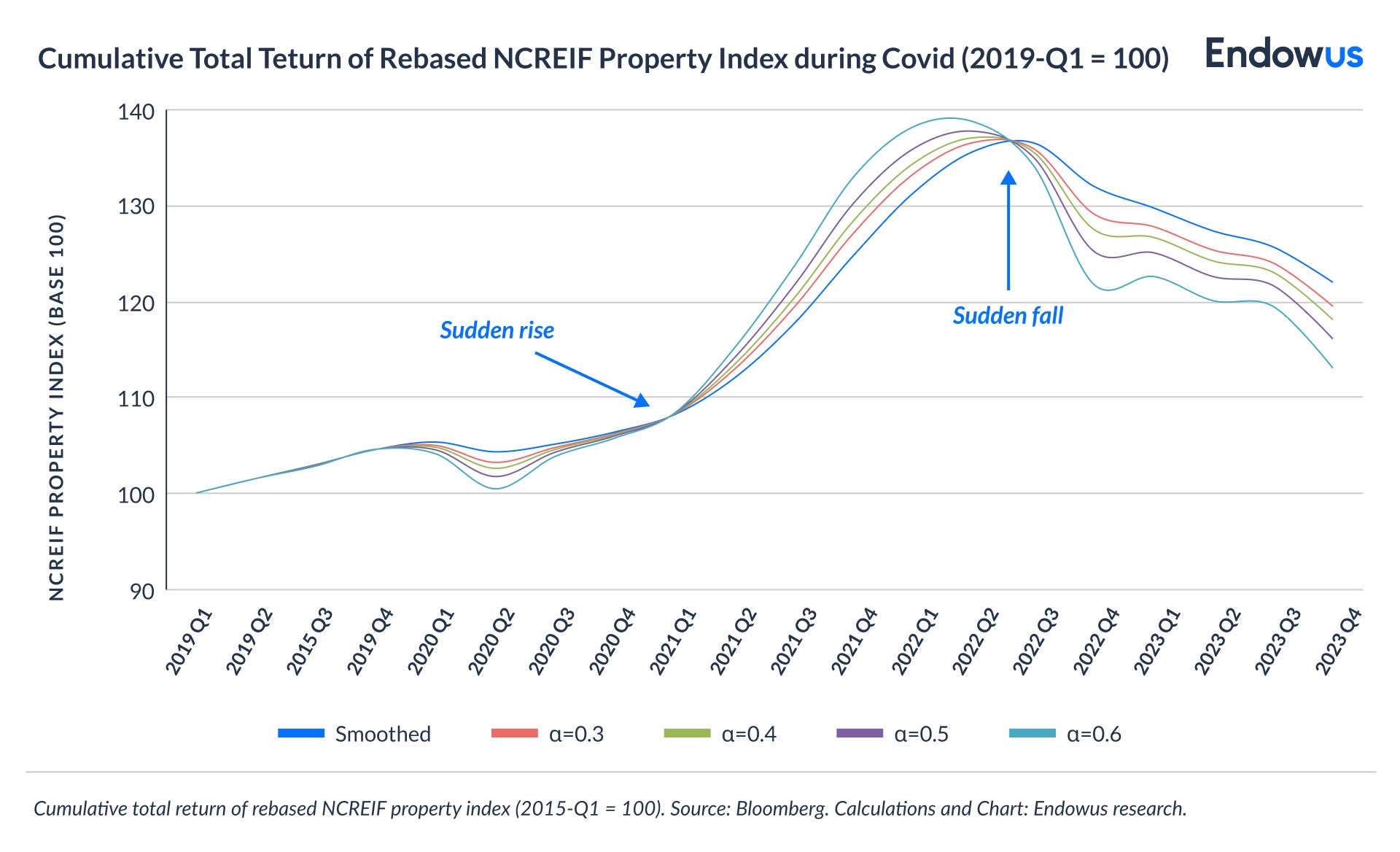
In the short run, when the index is suddenly rising, such as in Q1 2021, unsmoothed returns are generally higher than smoothed because the drastic rises are evenly spread in smoothed returns.
Whereas during a sudden fall, such as what happened in Q2 2022, smoothed returns would be higher than unsmoothed as smoothing hides the sharp drops by spreading the losses.
Portfolio construction implications
The consequences of smoothing for portfolio construction are direct and material. Portfolio optimisation models that take reported private markets statistics at face value are likely to systematically overweight private assets, because the inputs — volatility and correlation — understate the true risk contribution. The allocation that the model produces may appear well-diversified on paper while carrying more concentrated risk than the investor realises.
Risk budgeting
When allocating risk across asset classes, reported private markets volatility should be treated as a lower bound rather than a point estimate. A reasonable approach is to apply an adjustment to reported volatility before comparing it to public market alternatives, or to use a longer-period standard deviation that partially smooths through the lag effect. Portfolio optimisation models will tend to overweight assets with understated risk, and underestimated correlations due to price smoothing may also distort the estimation of appropriate hedge ratios.
Correlation assumptions
Correlation figures between private and public markets should be read with awareness that they reflect the appraisal lag as well as genuine economic relationships. Private equity, which invests in businesses subject to the same macro forces that drive listed company earnings, has a higher true-cycle correlation with public equity than smoothed return series suggest. Building an optimisation model on headline correlation figures may overstate the diversification benefit, particularly in severe and prolonged downturns when the lagged valuations eventually catch up.
Performance attribution
When evaluating the contribution of private markets to overall portfolio performance, the timing of reported gains and losses should be interpreted in light of smoothing. A private equity allocation that appears to have outperformed during a period of public market stress may be partly reflecting pricing lag rather than genuine defensive characteristics. Conversely, continued reported losses several quarters after public markets recover may reflect catch-up revaluation, not new deterioration.
Liquidity planning and redemption mechanics
Smoothed NAVs also affect redemption calculations in evergreen structures. An investor redeeming during a period of public market stress may do so at a NAV that has not yet fully reflected that stress, creating a temporary advantage for redeeming investors at the expense of those who remain. This is one reason that well-designed private markets funds maintain gating provisions: to prevent a first-mover advantage that would destroy value for long-term investors, and to ensure that the orderly repricing process can proceed without being disrupted by forced asset sales.
Investment implications
The existence of smoothing does not undermine the case for allocating to private markets. Instead, it reinforces the importance of understanding what private markets actually offer — and holding that understanding clearly rather than relying on statistics that may flatter the asset class.
The core argument for private markets — access to a broader opportunity set, return sources driven by contractual cash flows and operational value creation rather than sentiment, and genuine (if partially statistical) diversification — remains intact. Private markets may offer an illiquidity premium, though estimates vary and it is not guaranteed. It is, in fact, compensation for the very feature that gives rise to smoothing: the inability to trade at will, which produces the appraisal-based pricing that compresses reported volatility.
What changes with a clear-eyed understanding of smoothing is the precision with which investors can set expectations and monitor their allocations. Reported volatility should be treated as a lower bound on economic volatility. Reported correlation figures understate the full-cycle relationship with public markets. Sharpe and Treynor ratios that look impressive for private markets vehicles may partly reflect statistical compression rather than genuine risk-adjusted outperformance. And the apparent stability of private markets NAVs during public market stress should be read as a useful tactical buffer rather than evidence that private assets are economically insulated from macroeconomic forces.
Risks to consider
Private markets investments are illiquid. Capital is typically committed for multi-year periods, redemptions may be restricted, suspended, or gated at the manager's discretion, and secondary transfers — where possible at all — may only be achievable at a discount.
As this article sets out, the NAV at which an investor subscribes or redeems may not fully reflect the underlying economic value of the assets at that point in time. Valuations are estimates produced through periodic appraisal, not observable market prices, and may be revised.
Investors may not recover the amount invested and could lose the entire amount. Private markets solutions are not suitable for all investors and should be considered only in the context of an investor's own circumstances, liquidity needs, and time horizon.
At Endowus, our private markets offering is designed for investors who understand the nature of what they are accessing. Our role is to provide access to institutional-quality managers, to explain the mechanics clearly, and to support investors in constructing allocations that are appropriate to their financial circumstances and time horizon. If you would like to understand how private markets may fit within your broader portfolio, speak with your Endowus Client Advisor.*
*Endowus Private Wealth, Private Markets and Hedge Fund solutions are for accredited investors (AI) only. Open to all Singapore-based investors excluding US Persons.
Frequently asked questions
Does smoothing mean private markets returns are not real?
No. Smoothing describes a lag in how changes in economic value are reflected in reported valuations, not a fabrication of returns. The cash flows, dividends, and realised gains that drive private markets returns are genuine. Long-run mean returns are not substantially affected by smoothing; what is affected is the measured distribution of those returns across time periods, which artificially depresses reported volatility and correlation.
What is unsmoothing, and why does it matter?
Unsmoothing is the process of adjusting a smoothed return series to remove the effects of appraisal lag, restoring a level of volatility and correlation that more accurately reflects economic reality. It matters because portfolio optimisation models that use unadjusted private markets statistics may systematically overweight private assets and underestimate the true risk contribution of those allocations. Unsmoothing provides a more defensible basis for risk budgeting and portfolio construction.
How much does smoothing affect reported beta?
In a hypothetical example where the true beta of an asset is 0.80, a lightly smoothed return series — one that distributes 25% of its price response into the following period — produces a reported beta of 0.53, roughly one-third lower than the true value. A strongly smoothed series — distributing 50% of its response into the following period — produces a reported beta of 0.27, approximately two-thirds lower. The distortion is substantial and directly relevant to risk assessment.
Why don’t arbitrageurs eliminate smoothing in private markets?
In theory, arbitrageurs should exploit assets with consistently delayed price responses — buying after the market rises to capture the lagged upswing. In practice, two factors prevent this. First, private asset appraisals are not firm transaction prices; they are indications of value that cannot simply be bought or sold at the stated NAV. Second, even where transactions are possible, the costs of transacting in private assets — commissions, legal fees, search costs, financing costs — typically exceed the potential gains from exploiting moderate pricing lags. The barriers that make private markets illiquid are the same barriers that make smoothing persistent.
Should I avoid private markets because of smoothing?
Not on account of smoothing alone. Understanding smoothing is a reason to interpret private markets statistics carefully and to hold realistic expectations, not a reason to exclude the asset class. The genuine return diversification, contractual income streams, and access to a broader opportunity set that private markets offer remain compelling for long-term, accredited investors who can accept illiquidity. The key discipline is using adjusted or unsmoothed statistics when building and monitoring the allocation, rather than taking headline figures at face value.


%20F1(2).webp)

.webp)
.webp)






.webp)