


.webp)
.webp)
.webp)
.webp)






.webp)










%20(1).gif)

Register for the event
Endowus invites you to our exclusive event with Macquarie Asset Management, as we discuss unlocking opportunities in Infrastructure- a $1.3tn asset class.
This event is reserved for Accredited Investors (AIs) only. To register for the event, please indicate one of the following:
- CPF LIFE is the compulsory, government-backed annuity that forms the low-cost foundation of most retirement plans in Singapore; the private alternatives are best assessed by how much they add on top of it, and at what cost.
- Endowment plans, private annuities, investment-linked policies, and guaranteed income plans bundle insurance with investment, and generally carry higher distribution costs, lower flexibility, and a large non-guaranteed component that may erode the return an investor actually keeps.
- For accumulation rather than protection, separating term insurance from investment and using the Supplementary Retirement Scheme (SRS) to hold a low-cost, diversified portfolio may reduce the fee drag that compounds over a multi-decade retirement horizon.
Most working adults in Singapore already own a retirement plan by default. CPF LIFE — the national annuity that pays a monthly income for life — is compulsory for the large majority of members, and for many it is likely to be the single largest source of retirement income.
The question, then, is not whether to have a retirement plan, but what to add on top of CPF LIFE, and at what cost. The market offers a long list of options — endowment plans, private annuities, investment-linked policies, guaranteed income plans — and the labels can obscure a simpler truth: most of these products bundle insurance with investment, and the bundling has a price. The clearest way to compare them is to strip each one back to what it actually delivers, net of cost, over a multi-decade horizon.
This article sets out the main types of retirement plan available in Singapore, explains how each works, and compares them against CPF LIFE as the low-cost benchmark. CPF LIFE itself is covered in depth in our guide to CPF LIFE for retirement, so we treat it here at comparison level.
What is CPF LIFE?
CPF LIFE (Lifelong Income For the Elderly) is a longevity-insurance annuity administered by the CPF Board. At age 55, a Retirement Account (RA) is created, and savings are set aside up to one of three tiers: the Basic Retirement Sum (BRS), the Full Retirement Sum (FRS), or the Enhanced Retirement Sum (ERS). Members with at least S$60,000 in their RA at the payouts eligibility date are automatically included, and actual payouts may start any time from age 65 to 70.
For members turning 55 in 2026, the CPF Board sets the BRS at S$110,200, the FRS at S$220,400, and the ERS at S$440,800 (the ERS is four times the BRS). The level of lifelong monthly payout depends on the amount set aside. Illustratively, the CPF Board estimates a Standard Plan payout of roughly S$950 a month at the BRS, around S$1,780 at the FRS, and about S$3,440 at the ERS for this cohort.
RA savings earn government-mandate interest before (between the age of 55 and the beginning of the payouts) and during payout — up to 4% per annum on the relevant balances, with the floor extended to 31 December 2026 — plus extra interest on the first tranches of CPF balances. Because the scheme is non-profit and carries no commissions or distribution costs, very little of a member's capital is lost to fees. That is the benchmark every private product has to beat.
The payouts continue even when the sum is technically “depleted” for the single retiree - which is why CPF LIFE can be seen as a hybrid between an annuity and an insurance.
One recent change is worth noting. On 19 January 2025, the CPF Board closed the Special Account for members aged 55 and above; those savings were moved to the RA up to the FRS, with any remainder moved to the Ordinary Account. The practical effect is that savings previously earning the higher long-term rate may now sit in an account earning less, which sharpens the question of where retirement capital should be working.
How do endowment plans work?
An endowment plan is a fixed-term insurance-savings product. It combines a basic layer of life cover with a savings element, and pays out a lump sum at maturity. Participating (“par”) endowment plans invest premiums in the insurer's participating fund and pay two components: a guaranteed amount, and a non-guaranteed bonus that depends on how the fund performs.
The headline figure quoted at the point of sale is usually an illustration, not a promise. The Life Insurance Association Singapore caps the rates insurers may use in these illustrations at 4.25% per annum (upper) and 3.00% per annum (lower). These are illustrative assumptions, reviewed annually; they are not guaranteed, and past performance is not necessarily a guide to future performance or returns.
Two features deserve attention. First, endowment plans often have little or no cash value in the early years, because initial premiums are used to offset distribution costs such as commissions. Second, surrendering early may return less than the total premiums paid. An endowment plan may suit a saver who wants a disciplined, semi-locked savings commitment with some protection — but as a pure accumulation vehicle, the guaranteed portion may sit well below what a diversified portfolio has historically delivered, and the non-guaranteed portion is exactly that.
How does an annuity plan differ from CPF LIFE?
A private annuity is an insurance contract that converts a lump sum, or a series of premiums, into a stream of income. Immediate annuities begin paying shortly after a single premium; deferred annuities accumulate first and pay later. Payouts may run for a fixed period or for life, and typically combine a guaranteed portion with a non-guaranteed one.
The natural comparison is CPF LIFE, which is itself a form of annuity. The differences are instructive. CPF LIFE is government-backed, non-profit, and pays for life; many private annuities pay only for a limited period - until the value of the annuity is depleted - and carry distribution costs. Where private annuities may add value is flexibility — an earlier payout age, or a chosen payout window — which CPF LIFE does not offer. A member may only opt out of CPF LIFE if they have a pension or private annuity paying at least as much. For most investors, a private annuity is therefore a complement to CPF LIFE at the margin, not a replacement for it.
Why are investment-linked policies so often high-cost?
An investment-linked policy (ILP) bundles life insurance with investment in sub-funds. Premiums buy units; each month, some units are sold to pay the cost of insurance and other charges, while the rest stay invested. The policyholder bears the full investment risk, and an ILP usually has no guaranteed cash value.
The cost structure is where ILPs demand scrutiny, because the fees arrive in layers: the insurance (mortality) charge, which rises with age; the fund management fee; policy and administration charges; a premium allocation rate that means not all of the early premium buys units; a bid-offer spread; and fund-switching charges. Because the insurance charge climbs as the policyholder ages, more units may need to be sold over time, leaving fewer invested.
MoneySense, the national financial education programme, makes the point directly: an investor whose objective is protection may find an ILP is not the most suitable product, and an investor whose objective is investment should compare an ILP against buying the same or a similar fund without the insurance wrapper. That comparison is the heart of the matter. If the underlying sub-fund is available as a plain unit trust, the wrapper's extra cost has to justify itself.
What do guaranteed income plans actually guarantee?
Guaranteed income plans, sometimes marketed as retirement income plans, pay a regular income over a chosen period from a chosen age, funded by regular or single premiums. As with endowment plans, the payout usually splits into a guaranteed portion and a non-guaranteed portion that depends on the insurer's participating fund.
The trade-off is built into the design: a higher guaranteed component generally means a lower overall payout, because the insurer has to invest more conservatively to stand behind the guarantee. These plans can offer something CPF LIFE does not — a payout start date and duration the investor selects — and for some retirees that predictability is worth paying for. But the word “guaranteed” applies only to part of the illustrated figure, and the guaranteed floor may be modest once cost is accounted for. As always, past performance is not necessarily a guide to future performance or returns.
How the main retirement plans compare
The table below summarises the main vehicle types against CPF LIFE. It is a simplification: suitability depends on an investor's objectives, horizon, and existing portfolio, and every product's fine print varies. It is offered as a starting point for comparison, not a ranking.
How does the CPF Investment Scheme work?
The CPF Investment Scheme (CPFIS) is not a retirement product in the packaged sense. It is a mechanism for investing part of a member's CPF savings in included products, in the hope of earning returns above the guaranteed CPF interest rates. It is more similar to an investment account than to an annuity or endowment.
CPFIS allows members to invest part of their Ordinary Account (OA) and Special Account (SA) savings in unit trusts, exchange-traded funds, Singapore Government Securities, Treasury bills, insurance products, and shares. Members must retain a minimum of S$20,000 in OA and S$40,000 in SA; only balances above these thresholds are investable via CPFIS-OA and CPFIS-SA respectively. The purpose is to earn returns above the guaranteed 2.5% on OA and 4% on SA — but with the market risk that the underlying accounts do not carry.
The January 2025 closure of the Special Account for members aged 55 and above reshaped access. Members 55 and above may no longer make new CPFIS-SA investments, though existing holdings may be held until sold or matured. Members below 55 retain SA and CPFIS-SA access. CPFIS-OA remains available across all age groups.
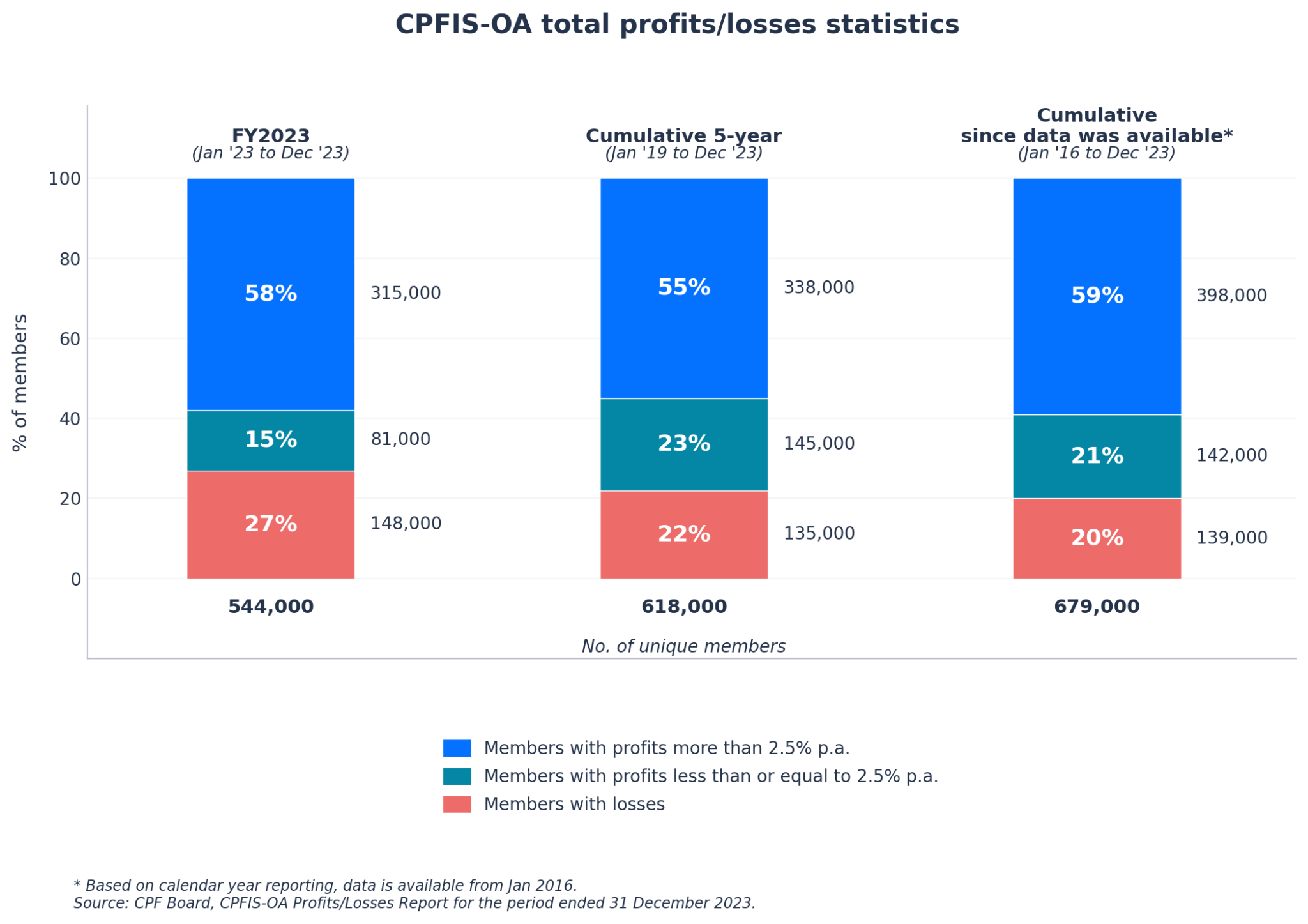
Two data points inform the trade-off. CPF Board figures indicated that between January 2016 and December 2023, 59% of CPFIS-OA investors beat the 2.5% OA guaranteed rate. Fees may vary, but the underlying point is that investment carries risk.
In Budget 2026, the Singapore government announced a new voluntary life-cycle investment scheme to be introduced in the first half of 2028, offering simplified, low-cost, and diversified products alongside CPFIS. It is intended for members who want investment exposure beyond the guaranteed CPF rates but prefer not to actively manage their positions.
Where does SRS fit in?
The Supplementary Retirement Scheme (SRS) is not a product but a tax-advantaged account, and it is where the accumulation argument comes together. Contributions attract dollar-for-dollar tax relief, subject to the overall S$80,000 personal income tax relief cap, up to an annual limit of S$15,300 for Singapore citizens and permanent residents, and S$35,700 for foreigners. Returns accumulate without tax until withdrawal.
At withdrawal on or after the statutory retirement age that applied when the first contribution was made, only 50% of the sum withdrawn is taxable, and withdrawals may be spread across 10 years to manage the tax further. The statutory retirement age has been raised to 64 starting 1 July 2026.
Opening an SRS account for the tax relief, then leaving the funds as idle cash, means the money earns a minimal interest rate of 0.05% p.a.. The tax deferral is only valuable if the capital is invested. SRS funds can hold a globally diversified portfolio — including through Endowus — which is where the tax-advantaged compounding actually happens. This is the same principle that runs through the whole comparison: keep the cost of the wrapper low, and let a diversified portfolio do the work.
Investment implications
For most investors in Singapore, the sensible structure follows from the benchmark. CPF LIFE is the guaranteed, government-backed base layer; topping up the RA toward the ERS may raise lifelong payouts, with the trade-off that the top-up is irreversible and committed to retirement income.
Above that base, the question for every packaged product is what it adds net of cost. An investor whose goal is accumulation may be better served by separating protection from investment — term insurance for cover, and a low-cost, diversified portfolio for growth — rather than paying for both inside one wrapper. The SRS is the natural home for that portfolio, because it adds a tax advantage on top.
Packaged insurance products still have a place. A bundled plan combines protection and savings in one vehicle, includes a guaranteed income floor, and imposes a forced-saving structure - features which some investors may weigh against the additional cost. The discipline is to read the illustration for its guaranteed-versus-non-guaranteed split, the surrender schedule, and the total distribution cost — and to compare the guaranteed return against what CPF and a diversified portfolio may offer, net of fees.
A third vehicle worth acknowledging is the CPF Investment Scheme (CPFIS). CPFIS allows members to invest Ordinary Account (OA) balances above S$20,000 in included investment products, including unit trusts and exchange-traded funds, and remains available across all age groups. What changes at 55 is the Retirement Account: savings set aside in the RA cannot be invested through CPFIS, and earn at least 4% per annum plus applicable extra interest until they are committed as CPF LIFE premium. So CPFIS applies to investable OA balances, offering potential returns above the 2.5% OA rate — but with market risk that CPF savings left in the accounts do not carry.
For members considering RA top-ups from OA balances currently held through CPFIS, the trade-off is between locking those dollars into the guaranteed lifetime income stream a top-up buys and continuing to accept the market-linked return profile of the CPFIS position. The right choice depends on time horizon, expected returns net of fees, and the weight the member places on guaranteed versus variable retirement income.
At Endowus, our advisers can help members work through this allocation across CPFIS, SRS and cash portfolios — considering age, risk profile, expected expenditure, and legacy intent — without any commission-based incentive from fund managers.
Endowus Core-Flagship CPF portfolios have mostly provided higher returns than the CPFOA. The only exceptions are the “Very Conservative” portfolio’s 1 and 5-year annualised returns, and the “Conservative” portfolio’s 5-year annualised returns, which trailed CPFOA. As a reminder, past performance is not necessarily a guide to future performance or returns. Capital is also not guaranteed.
Frequently asked questions
What is the best retirement plan in Singapore?
There is no single best plan, because suitability depends on your goals, horizon, and existing savings. For most people, CPF LIFE forms the guaranteed base, and an invested portfolio held in the SRS adds tax-efficient growth on top. Packaged insurance products may suit specific needs, but should be compared carefully on cost.
How is an endowment plan different from investing directly?
An endowment plan bundles insurance with savings and pays a mix of guaranteed and non-guaranteed returns, with distribution costs embedded in the premiums. Investing directly through a low-cost portfolio separates the two, so you pay only for investment management. The direct route carries market risk and no guarantee, but may retain more of the return net of cost.
Is CPF LIFE enough for retirement on its own?
CPF LIFE provides a lifelong income floor, but whether it is sufficient depends on your desired lifestyle and expenses. Many investors supplement it with additional savings and investments. You can estimate your expected payout using the CPF Board's tools and consider whether to top up your Retirement Account or invest separately.
How can I use the SRS to invest for retirement?
After opening an SRS account and contributing (within the annual cap for your residency status), you can invest the funds rather than leaving them as cash. Options include globally diversified fund portfolios, such as those available through Endowus. Investing the balance is what turns the tax deferral into long-term compounding.
Is CPFIS worth using given the guaranteed 2.5% OA rate?
The evidence has shifted meaningfully over time. According to the CPF Board's CPFIS-OA Profits/Losses Report for the cumulative period from January 2016 to December 2023, 59% of the 679,000 unique CPFIS-OA members achieved returns above the 2.5% OA rate, 21% earned profits at or below that rate, and 20% made losses. Whether CPFIS is worth using in your case depends on your time horizon, product selection, and cost discipline — the reformed product list and lower-cost exchange-traded funds have improved the odds, but one in five members still made outright losses.
CPF Board publishes historical CPFIS-OA portfolio performance in its CPFIS-OA Profits/Losses Report on cpf.gov.sg for members who want to review the actual distribution of investor outcomes.
Can I still invest through CPFIS after age 55?
CPFIS-OA remains available across all age groups, subject to keeping a minimum of S$20,000 in your Ordinary Account. What changed in January 2025 was the Special Account: it was closed for members aged 55 and above, so members 55 and above may no longer make new CPFIS-SA investments. Existing CPFIS-SA holdings may be held until sold or matured. Once Retirement Account savings are set aside at 55, they cannot be invested through CPFIS — the RA earns the tiered CPF rates until conversion to CPF LIFE premium.
What is the new CPF life-cycle investment scheme coming in 2028?
In Budget 2026, the CPF Board announced a new voluntary life-cycle investment scheme to be introduced in the first half of 2028. It is intended to offer simplified, low-cost, and diversified investment products alongside the existing CPFIS, and caters to members who want investment exposure beyond the guaranteed CPF rates but prefer not to actively manage their positions. Participation will be voluntary. Details on product providers, fee structures, and specific product design have not yet been published.
Are investment-linked policies (ILPs) a good way to invest?
ILPs combine insurance with investment and carry several layers of fees, including insurance charges that rise with age. If your goal is purely investment, it is worth comparing an ILP against holding a similar fund without the insurance wrapper. If your goal is purely protection, term insurance is usually more cost-effective. All investments carry risk, and past performance is not necessarily a guide to future performance or returns.
Retiring with a bucketing strategy

The Nanny State, Crazy Rich Asians and lessons for your retirement plan in Singapore

Should a new Singapore Permanent Resident make voluntary contributions to CPF accounts?



%20F1(2).webp)

.webp)
.webp)






.webp)