


.webp)
.webp)
.webp)
.webp)






.webp)












%20(1).gif)
Register for the event
Endowus invites you to our exclusive event with Macquarie Asset Management, as we discuss unlocking opportunities in Infrastructure- a $1.3tn asset class.
This event is reserved for Accredited Investors (AIs) only. To register for the event, please indicate one of the following:
- An exchange-traded fund (ETF) is an open-ended fund whose shares trade intraday on a stock exchange; global ETF assets reached a record US$23.11 trillion at the end of July 2026, according to ETFGI.
- The defining feature of an ETF is not the exchange listing but the creation and redemption mechanism, through which authorised participants arbitrage away gaps between an ETF’s market price and the value of its underlying portfolio.
- That mechanism keeps prices close to net asset value in normal conditions, but the stress episodes of 2010, 2015, and 2020 show both its limits and, in bond markets, its role in real-time price discovery.
In the 33 years since the first US-listed exchange-traded fund began trading, this type of investment vehicle has grown from a single index-tracking trust into a US$23.11 trillion global industry spanning more than 1,000 providers, as of the end of July 2026. Few financial structures have redrawn how capital is allocated as thoroughly, and few are as routinely misunderstood.
An ETF is best understood as two things joined together: a familiar legal structure — the open-ended fund — and an unusual piece of market “plumbing,” the creation and redemption mechanism. The latter explains why ETFs trade close to fair value most of the time, why they are relatively inexpensive to own (though they may be expensive to trade) and why their behaviour under stress divides regulators and academics.
This article covers the history of the vehicle, its legal and operational anatomy, the arbitrage mechanics that hold price and value together, the episodes when they came apart, and what all of this means for investors in Singapore.
What is the origin of the ETF? The answer might surprise you…
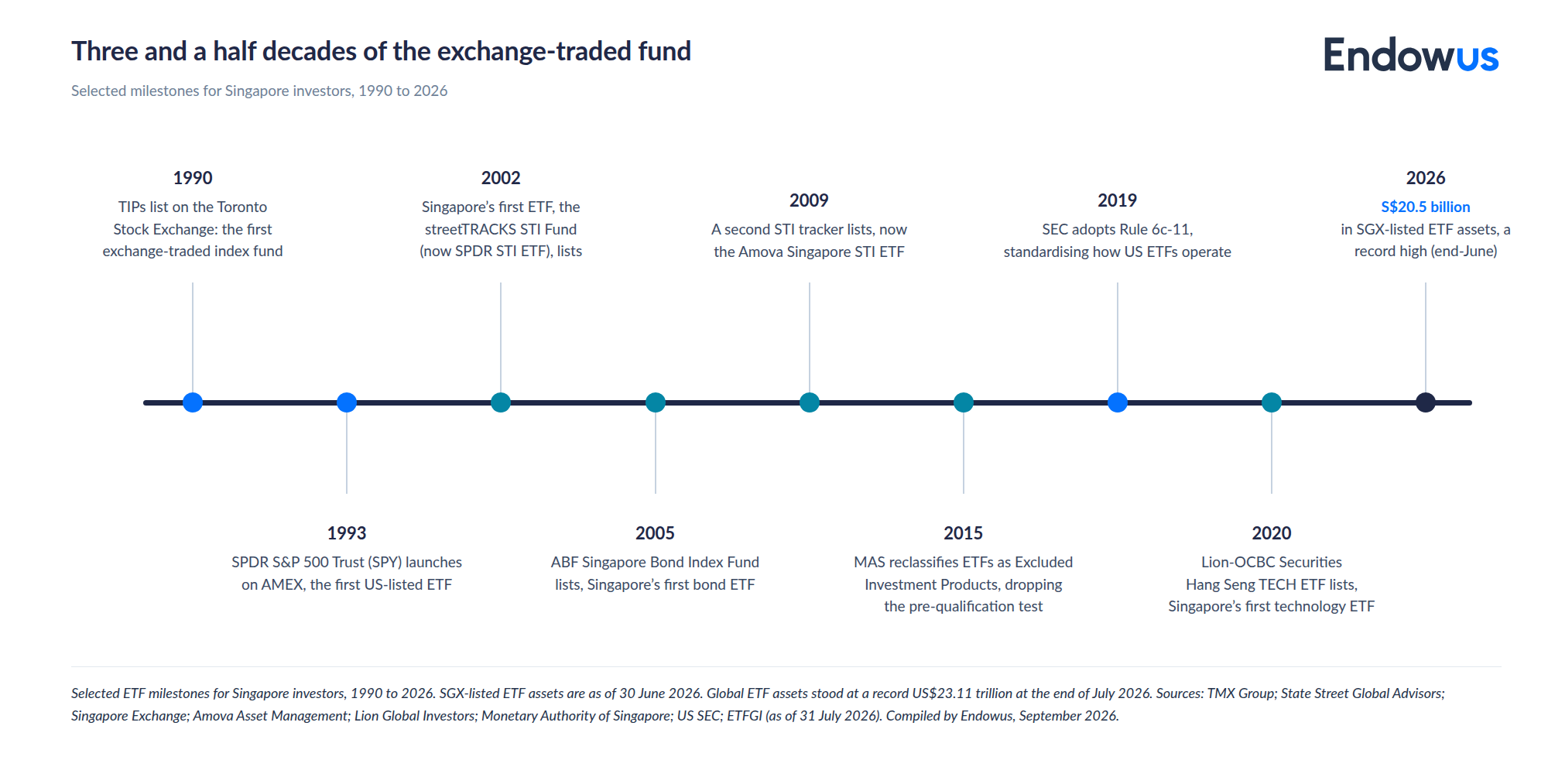
The intellectual origin of the ETF is the October 1987 crash. In its aftermath, staff at the US Securities and Exchange Commission (SEC) observed that the equity market lacked a single instrument representing the broad market in the way index futures did, and expressed interest in the development of such a security. The first working version appeared in Canada: the Toronto 35 Index Participation units (TIPs) listed on the Toronto Stock Exchange on 9 March 1990, the world’s first exchange-traded, index-linked fund.
The product that defined the category followed three years later. The SPDR S&P 500 ETF Trust (SPY), developed by Nathan Most and Steven Bloom at the American Stock Exchange with State Street as trustee, launched on 22 January 1993 as the first US-listed ETF. Asia’s turn came with a policy problem: after the Hong Kong government bought roughly HK$118 billion of equities to defend its markets during the 1998 crisis, it chose an ETF as the disposal vehicle. The Tracker Fund of Hong Kong listed in November 1999 with a HK$33.3 billion offering, then the largest initial public offering in Asia excluding Japan. Singapore’s first ETF, the streetTRACKS Straits Times Index Fund (today the SPDR STI ETF), followed in April 2002.
Regulation caught up with scale only recently. In September 2019 the SEC adopted Rule 6c-11, replacing three decades of one-off exemptive orders with a standard framework. The key elements are daily portfolio disclosure (what is inside the ETF), board-governed custom baskets, and mandatory publication of premiums, discounts, and bid-ask spreads. The industry’s growth since has been relentless. ETFGI reports record assets of US$23.11 trillion at end-July 2026, with year-to-date net inflows of US$1.71 trillion — the highest on record — and actively managed ETFs alone holding US$2.59 trillion.
What is the structure of an ETF?
Legally, an ETF is a collective investment scheme that continuously issues and redeems shares - structured as an open-ended fund - whose shares also trade intraday on an exchange. In the United States, most ETFs are open-end funds under the Investment Company Act of 1940. A handful of the oldest, including SPY, are unit investment trusts: a more rigid structure that must replicate its index in full, cannot lend securities, and cannot reinvest dividends internally between distributions. In Europe, the dominant wrapper is the UCITS fund, typically domiciled in Ireland or Luxembourg, whose diversification rules under Directive 2009/65/EC cap single-issuer exposure at 10% (which makes it impossible to have single-stock ETFs) and limit holdings above 5% to 40% of the portfolio in aggregate - the so-called 5/10/40 rule.
Most ETFs replicate an index physically, either in full or through sampling. Some, particularly in Europe, are synthetic: they hold collateral and obtain the index return through a swap, which introduces counterparty risk that UCITS rules cap at 10% of net assets per counterparty. The wrapper also accommodates active strategies and, at the aggressive end, daily-rebalanced leveraged and inverse products (this one is a funny example of an inverse product, if anyone ever heard about Jim Cramer) whose long-run returns can diverge sharply from a multiple of the index.
The short of it is - an ETF is not necessarily synonymous with “safe” or “boring” or “passive.”
It is also worth separating the ETF from similar-sounding names that have nothing to do with it. An exchange-traded note is unsecured debt of a financial institution not a fund, and carries issuer credit risk. A unit trust (or mutual fund) may also hold a diversified exposure, but deals once a day at net asset value through the manager. As a reminder, an ETF deals intraday at a market price that may sit above or below that value. Neither mechanism is inherently superior — they suit different uses — and we compare them directly in our piece on unit trusts and ETFs.
What was the key innovation that ETFs introduced?
An ETF does not sell shares to the public directly. It transacts only with authorised participants (APs): large dealers contractually permitted to create or redeem shares in large blocks called creation units. To create, an AP typically delivers a basket of the underlying securities — published by the fund each morning — and receives new ETF shares at net asset value; redemption is the mirror image. Because these transfers are usually in kind, the fund itself rarely needs to trade, which keeps transaction costs out of the portfolio and, in the US, allows low-cost-basis holdings to exit via redemption rather than taxable sales — the mechanical reason US ETFs seldom distribute capital gains.
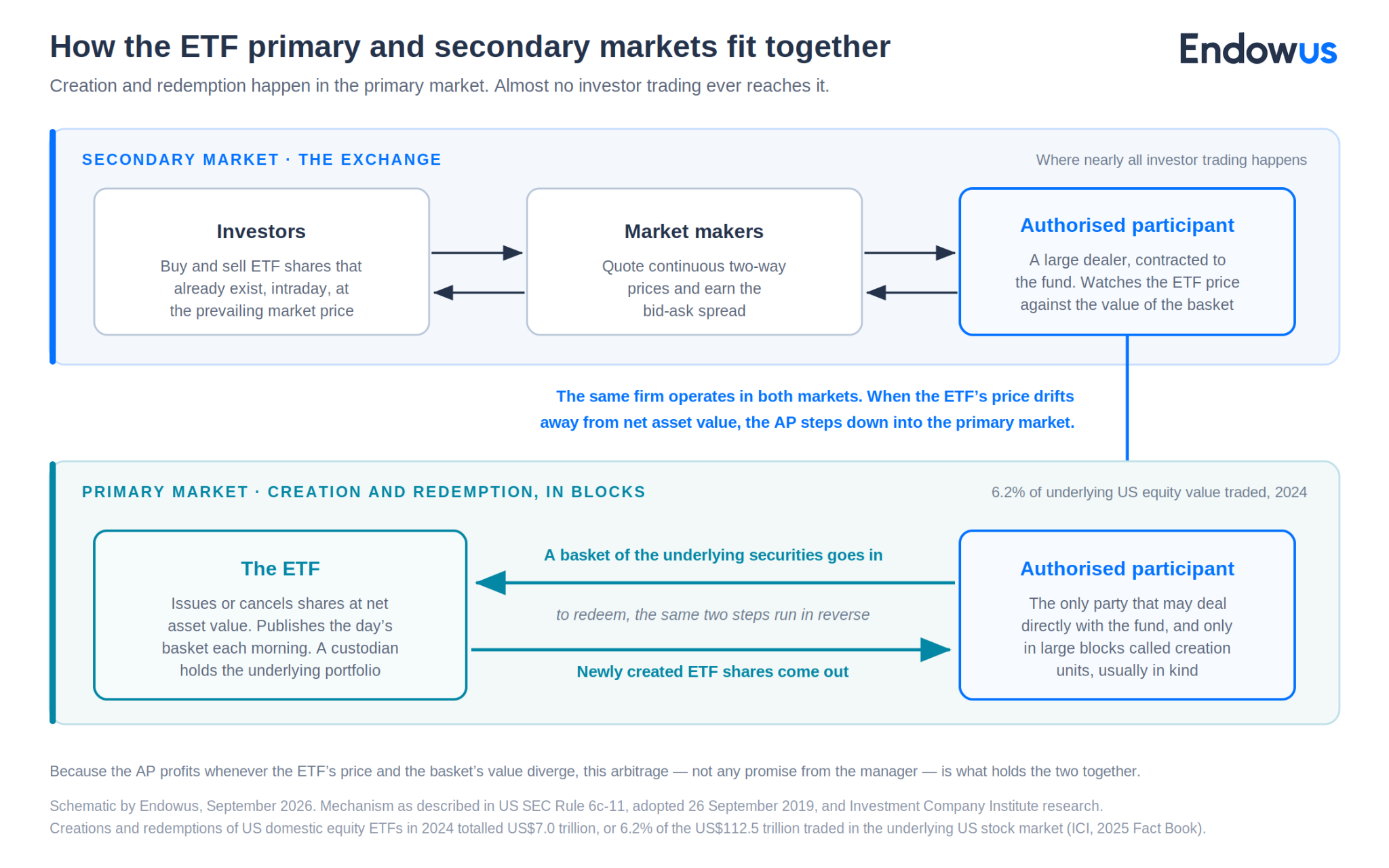
The arbitrage is a natural consequence. If an ETF trades above the value of its basket, an AP can buy the basket, deliver it for new ETF shares, and sell those shares at the premium; a discount invites the reverse. This is why ETF prices tend to hover close to the net asset value without any need for a promise from the manager. The ecosystem is deep: the Investment Company Institute (ICI) documented that ETFs contract with many more APs than are active on a given day, and that when Knight Capital stepped back in August 2012 and Citigroup paused creations in June 2013, other APs absorbed the flow within days.
A second point is worth discussing here: most ETF trading never touches the underlying market. In 2024, creations and redemptions of US domestic equity ETFs amounted to US$7.0 trillion - just 6.2% of the US$112.5 trillion traded in the underlying stocks that year, according to the ICI. Even at the extreme, ETFs accounted for 43% of total US stock market trading on 24 December 2018 precisely because investors used them to transfer risk quickly while underlying markets were strained.
Were there stress episodes that put the ETF mechanics to the test?
In the flash crash of 6 May 2010, ETFs were disproportionately represented among the trades that exchanges later cancelled, as liquidity evaporated faster in the wrapper than in the underlying stocks (SEC–CFTC joint report on the market events of 6 May 2010). On 24 August 2015, a disorderly US market open triggered hundreds of trading halts, and several large equity ETFs briefly traded at steep discounts to the value of portfolios whose own constituents had not yet opened (SEC staff research note on the events of 24 August 2015). Both episodes were about market microstructure at the open, unrelated to fund solvency — but they demonstrated that the arbitrage mechanism needs functioning two-way markets to operate.
March 2020 was the more instructive test. As the pandemic shock hit, large investment-grade corporate bond ETFs traded at persistent discounts to their net asset values. The Bank for International Settlements attributed the discounts to two forces: net asset values that updated sluggishly because the underlying bonds barely traded, and dealers too balance-sheet constrained to arbitrage the gap. On that reading, the ETF price was the more current estimate of value — price discovery, not malfunction — a view developed further in the BIS’s analysis of bond ETF arbitrage. The policy response was unprecedented: the Federal Reserve announced the Secondary Market Corporate Credit Facility on 23 March 2020 and began buying corporate bond ETFs on 12 May 2020, the first ETF purchases in its history; the facility closed on 31 December 2020 holding roughly US$14.2 billion.
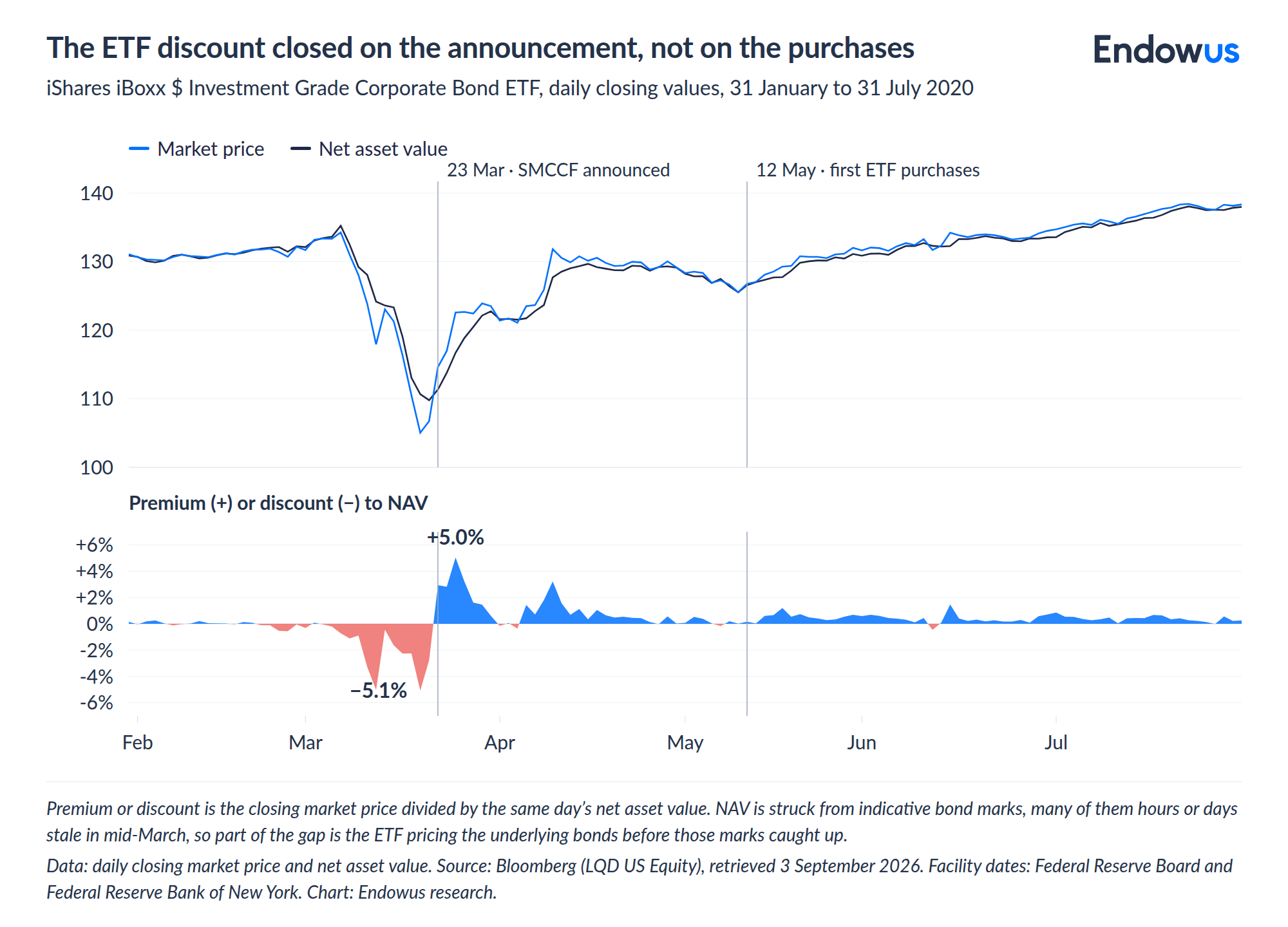
Academic literature is divided. Ben-David, Franzoni, and Moussawi (Journal of Finance, 2018) find that stocks with higher ETF ownership exhibit higher volatility, consistent with arbitrage flows transmitting noise into underlying prices. The ICI counters that primary market activity is a small fraction of underlying turnover and that spreads in ETFs are often tighter than in their constituents. Both observations can be true at once: the mechanism adds a fast lane for aggregate risk transfer, and fast lanes carry more traffic in a storm.
What the mechanics mean for the cost of ownership
The expense ratio is the stated annual fee; the tracking difference is the realised gap between fund (the ETF) and index (what the ETF is tracking) returns over a period; the tracking error is the volatility of that gap. The tracking difference is the number that eventually compounds, and it reflects fees, discrepancies due to index-replication technique, withholding taxes at fund level, and securities-lending revenue, which many managers use to offset costs.
Meanwhile, the bid-ask spread an investor pays reflects the liquidity of the underlying assets, not the ETF’s own turnover — an emerging-market bond ETF cannot be permanently more liquid than emerging-market bonds. Since Rule 6c-11, US ETFs must publish their historical premiums, discounts, and spreads, which makes these costs observable rather than theoretical.
Are ETFs listed on the SGX?
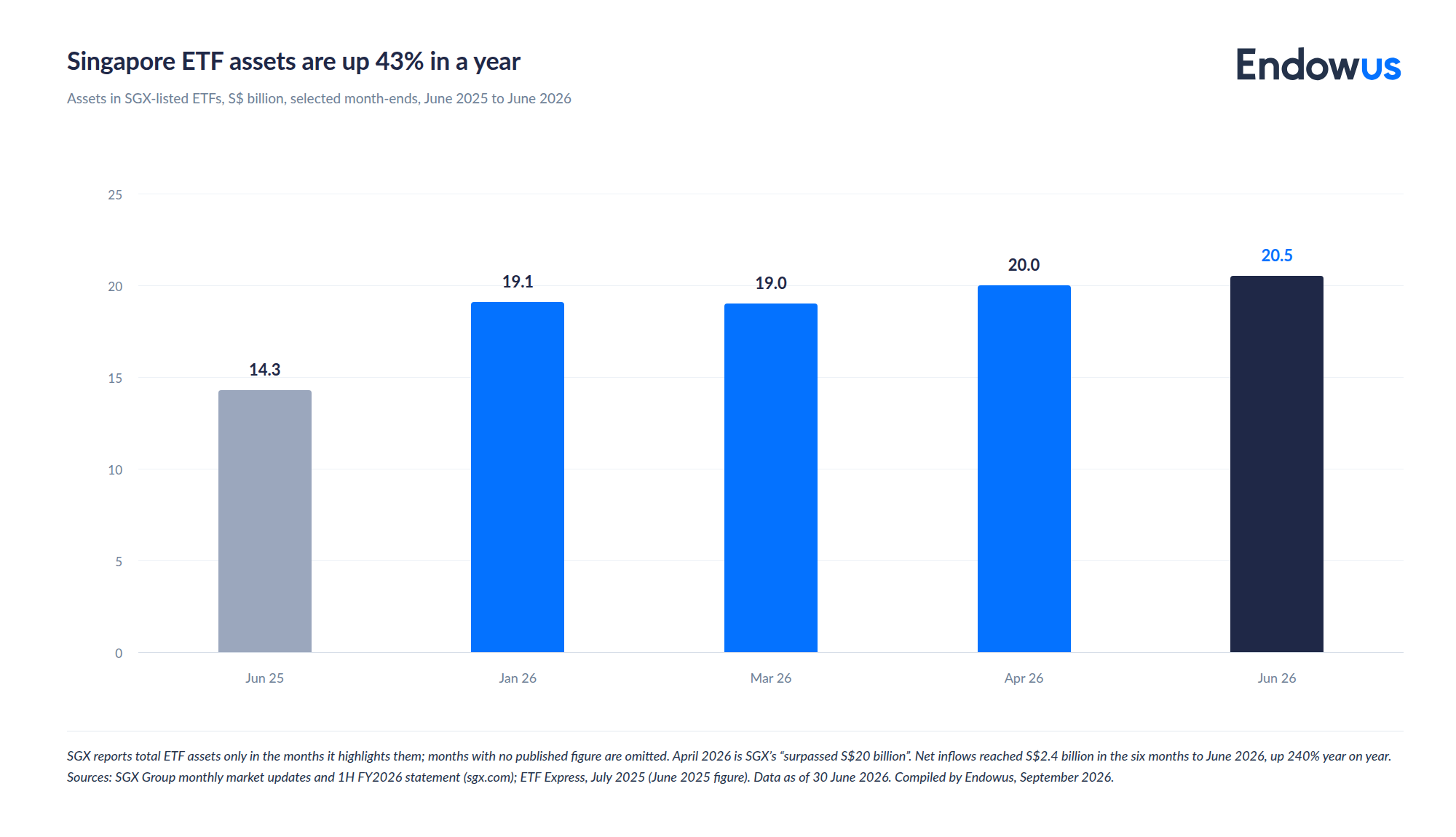
Yes. Singapore’s market is still relatively small but growing quickly. SGX reported 50 listed ETFs with record combined assets of S$16.3 billion as at 30 September 2025, 40% higher year on year (SGX market update; re-verify against SGX’s latest figures at publication). Under the Monetary Authority of Singapore’s complex-products regime, ETFs that make only limited use of derivatives have been classified as Excluded Investment Products since 29 April 2015, which means retail investors can buy them without a Customer Account Review; leveraged, inverse, and other complex ETFs remain Specified Investment Products with additional distribution safeguards. SGX-listed ETFs can be held directly through a Central Depository (CDP) account, which confers registered ownership, or via a broker’s custodian account.
Two Singapore-specific constraints deserve attention. First, access through CPF is narrow: the CPF Investment Scheme allows only a short list of SGX-listed ETFs, subject to the requirement to set aside the first S$20,000 in the Ordinary Account and the 35% cap on stocks and ETFs; the Supplementary Retirement Scheme (SRS) offers broader access to SGX-listed ETFs. Second, fund domicile drives tax outcomes. A Singapore investor in a US-listed ETF suffers 30% US withholding on distributions because Singapore has no comprehensive income tax treaty with the United States, while an Irish-domiciled UCITS fund incurs 15% at fund level under the US–Ireland treaty — and US-listed holdings are also US-situs assets for US estate tax above a US$60,000 threshold.
Investment implications
Understanding the mechanics changes the questions an investor should ask. Not “is this ETF cheap?” but “what is the realised tracking difference, where is the fund domiciled, how liquid are the underlying assets, and what does the wrapper do under stress?”
ETFs and unit trusts can both be included in an investment portfolio. Endowus portfolios are built with unit trusts accessed at institutional share classes, with trailer fees rebated in full, because daily net-asset-value dealing removes spread and premium/discount risk for investors who are allocating rather than trading; investors who want specific index exposures can combine funds through Fund Smart.
But investors with different goals can also add ETFs - better if they are carefully selected based on fees, liquidity and specific opportunities they cover.
In conclusion, our goal here was to get our readers to understand the ETF’s creation and redemption mechanism. ETFs have been a great piece of financial innovation, delivering intraday liquidity and low headline costs at scale. As in every financial product, however, there is a downside: the machinery depends on arbitrageurs showing up, the prices only approximate value, and the total cost of ownership extends beyond the expense ratio.
Frequently asked questions
What is an ETF in simple terms?
An exchange-traded fund is an open-ended investment fund whose shares are listed on a stock exchange, so investors buy and sell them intraday at market prices. The fund typically tracks an index, and a creation and redemption mechanism operated by authorised participants keeps the market price close to the value of the underlying portfolio.
How does ETF creation and redemption work?
Authorised participants deliver a published basket of the underlying securities to the fund in exchange for new ETF shares, or return ETF shares in exchange for the basket, in large blocks at net asset value. Because they can profit whenever the ETF’s price drifts from the basket’s value, their arbitrage keeps price and value aligned in normal markets.
What is the difference between an ETF, an index fund, and a unit trust?
An index fund is any fund that tracks an index; an ETF is a fund structure that trades on an exchange; a unit trust deals once a day at net asset value through the manager. The categories overlap — many ETFs are index funds — and our guides to index funds and unit trusts versus ETFs cover the distinctions.
Can I buy ETFs in Singapore with CPF or SRS money?
Only a small list of SGX-listed ETFs is included under the CPF Investment Scheme, subject to the S$20,000 Ordinary Account set-aside and the 35% cap on stocks and ETFs; check the CPF Board’s current list before investing. SRS funds can generally be used for SGX-listed ETFs through an SRS operator bank. Eligibility rules may change and should be re-verified at the point of investment.
Do ETFs distort the markets they invest in?
The evidence is mixed. Academic work has linked higher ETF ownership to higher volatility in underlying stocks, while ICI data show that primary market activity is a small share of underlying turnover — 6.2% for US domestic equity ETFs in 2024. In the March 2020 bond market, ETF prices arguably led stale net asset values rather than distorting them. The honest answer is that ETFs concentrate and accelerate risk transfer; whether that stabilises or destabilises depends on the episode.
Forget your password? It's a good thing for your investments

The lesson of Hyflux: What water and diversification have in common

Free lunch: Diversification in investing is a gift
.jpeg)


%20F1(2).webp)

.webp)
.webp)






.webp)