


.webp)
.webp)
.webp)
.webp)






.webp)












%20(1).gif)
Register for the event
Endowus invites you to our exclusive event with Macquarie Asset Management, as we discuss unlocking opportunities in Infrastructure- a $1.3tn asset class.
This event is reserved for Accredited Investors (AIs) only. To register for the event, please indicate one of the following:
Where more companies are staying private and for longer, the growing space of opportunities in the private markets have attracted more investor interest in recent years.
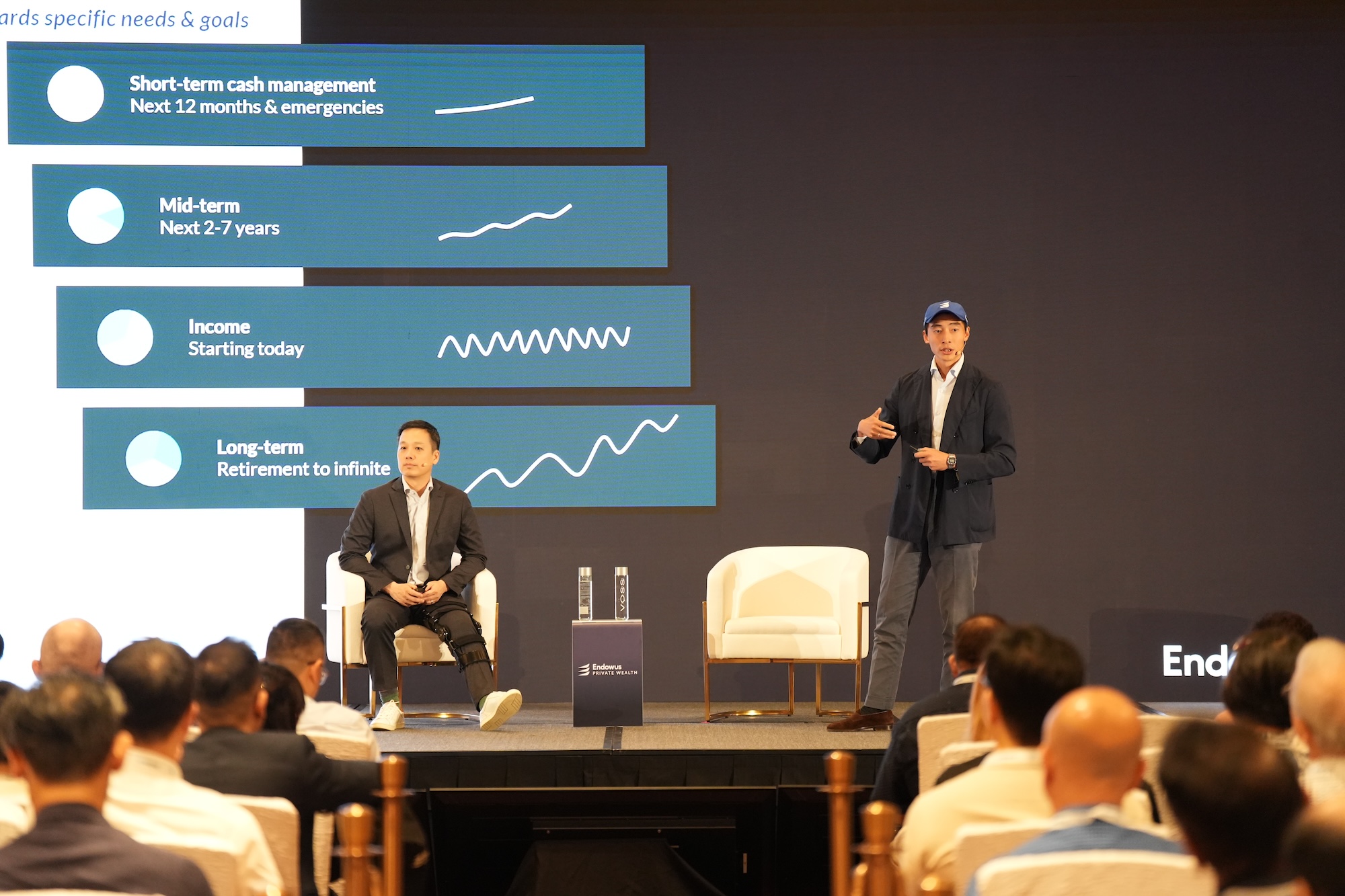
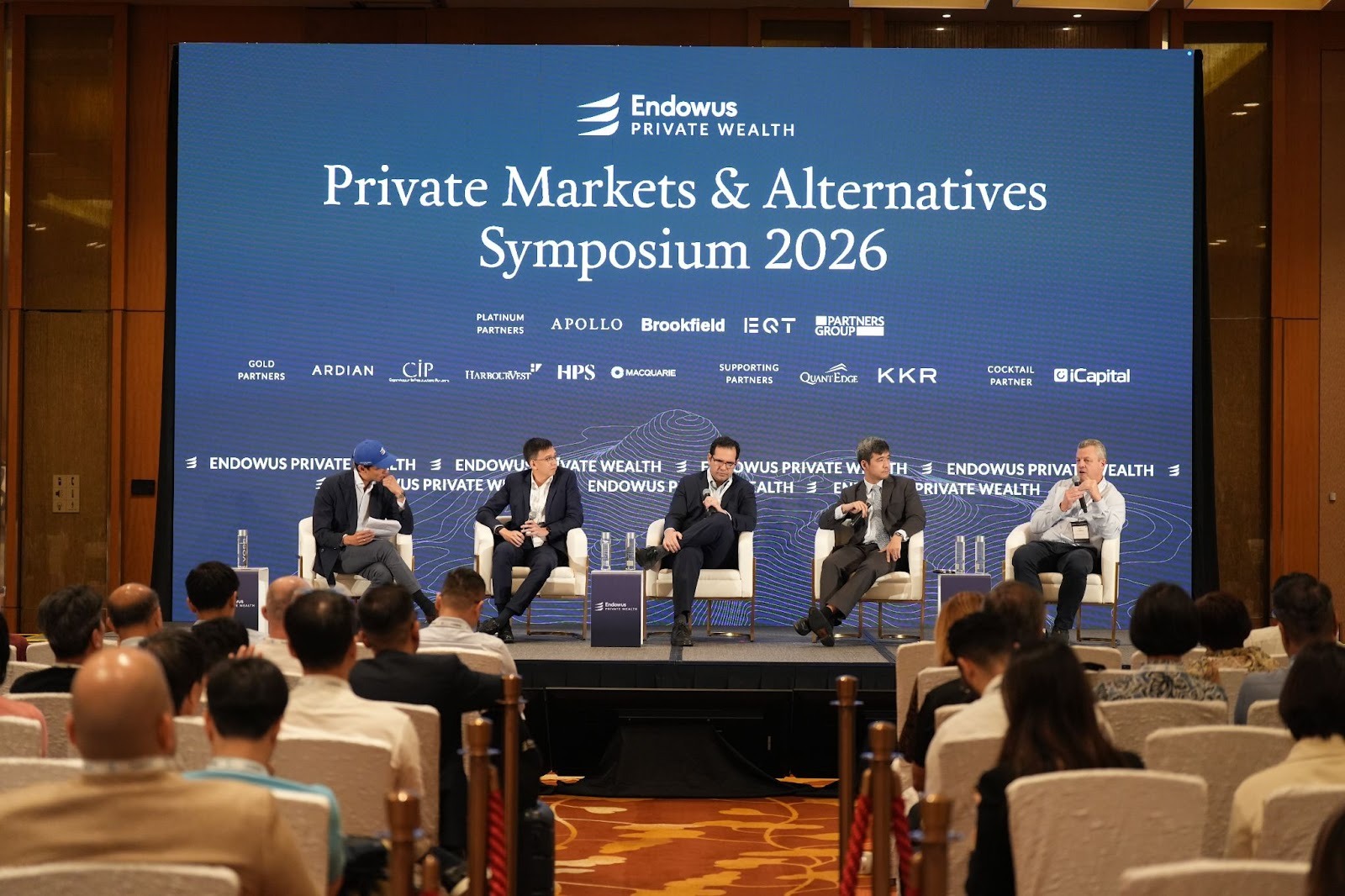
The Endowus Private Markets & Alts Symposium 2026 brought together world-class general partners (GPs) and industry experts to demystify the complex landscape of alternative and private market investments.
Speakers share strategies, risks, and opportunities in four thematic panels—hedge funds, private infrastructure, private equity and private credit—providing a holistic blueprint for integrating private assets into investor portfolios.
Hedge funds: Seeking alpha in complex markets

- Often misunderstood as a monolithic category of investment instruments, hedge funds are a “toolbox” of diverse strategies to add unique diversification and risk-adjusted returns to an investor’s portfolio. Strategy dispersion and manager selection are critical.
- Achieving scale in multi-strategy funds is important to ensure net returns to investors remain attractive, as pass-through fees can be quite significant.
- A stable capital base allows managers to tune out market volatility and maintain a necessary "margin of safety" during difficult periods. Having a broad playbook also allows managers the agility and flexibility to deploy capital when opportunities arise.
- For more niche strategies in complex markets to successfully generate strong returns, employing leverage and holding concentrated positions are required. Therefore, investors have to carefully monitor both upside and downside volatility and understand the cause-and-effect during both up and down cycles.
Private infrastructure: Building blocks behind transformational change

- Infrastructure providing essential services tend to be more resilient against macroeconomic shocks, creating significant downside risk mitigation for portfolios. Managers mitigate interest rate sensitivity by employing long-term debt and hedging interest rate exposure to support cash flows of the business. While infrastructure is capital-intensive, maintaining an optimal capital structure throughout the cycle is a key part of value creation.
- High barriers to entry often create monopolistic characteristics for infrastructure businesses, leading to stable and predictable cash flows. These businesses are often able to hedge against inflation, due to regulations or contractual clauses that allow inflationary pressures to be passed on to consumers.
- The surge in digital demand has been driving significant data center capacity increases, with managers focusing on "tier one" markets near population centers to ensure durable demand profiles. While demand is high, it is critical to have contracted demand before building to avoid capital impairment.
- Renewable energy and energy transition are no longer an "either-or" trade with traditional energy sources, as rising electricity demand—driven by AI and data centers—requires all available power sources to be utilised. The underlying fundamentals for energy transition are evolving, even as political narratives in some regions shift.
- Infrastructure secondaries aim to add value by enhancing day-one returns and mitigating the J-curve effect through asset purchases at a discount. A typical secondary fund might include exposure to hundreds of assets, providing immediate and exceptional diversification.
Private equity: Light at the end of the tunnel?
- GPs often adopt conservative valuation methodologies to prevent excessive volatility and ensure that performance is not artificially inflated during public market swings. These "marks" are typically set quarterly, and often lag the more frequent valuation changes of public equities.
- Secondaries offer a significant buffer for investors because they often trade at a further discount relative to the already conservative valuations of the underlying funds. This creates "two levels of buffer" against public market corrections.
- High-quality software businesses exist globally beyond the major tech hubs, with significant opportunities found in specialised sectors in Australia, Japan, and India. For example, there are global leaders in power-grid software in Australia and manufacturing software in Japan that are highly profitable.
- The private equity industry is currently undergoing a period of consolidation where larger platforms with scale and local expertise are beginning to dominate. Manager selection remains key, as smaller managers who might have done well in the last decade could struggle in today's environment.
- Evergreen structures have revolutionised access for the wealth channel, allowing individual investors to accumulate exposure more efficiently than traditional closed-end funds. These funds allow for better "vintage diversification" from day one, rather than having capital locked up for 10+ years in a single concentrated vintage.
Private credit: Where do we go from here?

- The vast majority of the Private Credit market is Investment Grade (IG) and current credit events are largely idiosyncratic and company-specific, rather than representing a systemic risk to the broader asset class. Many "stress" stories in the news involve specific underperforming companies rather than widespread conditions in the lending market.
- Private credit continues to offer a consistent yield premium of roughly 150 to 200 basis points over the public loan market. This premium is driven by the flexibility, access to capital and certainty of execution that private lenders can provide to borrowers.
- Direct lending to larger sponsor-backed companies may offer greater resilience due to scale equity/sponsor support and access to multiple sources of capital; however, credit outcomes are driven primarily by business fundamentals, use of leverage and cash-flow durability rather than company size alone
- The reduction in base rates is expected to be a positive development as it moderates the interest burden on borrowers while maintaining attractive nominal yields for investors. With rates settling at "neutral" levels, the risk of more systematic credit concerns triggered by high interest costs has diminished.
Join our next exclusive Endowus Private Wealth event
On the back of an increasingly growing client interest amid the backdrop of financial innovation, the Endowus Private Markets & Alternatives Symposium 2026 was held at Marina Bay Sands Expo and Convention Centre.
We were joined by over 500 verified accredited investors and industry partners, demonstrating the strong interest and the power of innovation in the alts space.
Want to learn about Endowus Private Wealth and be present in our next industry-leading wealth event? Schedule a call with our client advisors.
Read more:
- Are evergreen funds really the future of private market investing?
- Private markets and hedge funds: The how and when of diversification
- Highlights from the Endowus Alts Symposium 2025

Why are more family offices setting up in Singapore?

Webinar: Introduction to the art market
.jpg)
How alternative investments can fit into your portfolio



%20F1(2).webp)

.webp)
.webp)






.webp)