


.webp)
.webp)
.webp)
.webp)






.webp)












%20(1).gif)
Register for the event
Endowus invites you to our exclusive event with Macquarie Asset Management, as we discuss unlocking opportunities in Infrastructure- a $1.3tn asset class.
This event is reserved for Accredited Investors (AIs) only. To register for the event, please indicate one of the following:
- Singapore T-bills are short-term debt securities issued by the Monetary Authority of Singapore (MAS) on behalf of the Singapore Government, which holds the highest 'AAA' credit rating from Standard & Poor's, Moody's, and Fitch. Their default risk is therefore considered very low, though, as with any investment, this is not a guarantee.
- T-bills suit parking cash for a fixed, short period rather than building long-term wealth. They pay no income during their tenure, and their yield is set by auction—so it may be higher or lower than fixed deposits or the base return on Singapore Savings Bonds (SSBs) at any given time.
- Most investors buy T-bills through the internet banking portal of major banks, using cash, CPF-OA, or SRS funds. For the majority, a non-competitive bid is the simplest approach.
T-bills in Singapore—short-dated debt issued by the Singapore Government—are one of the most widely used means to hold cash for a fixed, short period while earning a market-set return.
This matters because a T-bill aims to preserve capital over a short horizon at low credit risk. It is a cash-management instrument, not a wealth-building one—and that distinction should determine how, and how much, you use it.
This comprehensive guide explains what Singapore treasury bills are, how they work, how to check current rates, how to buy them through local banks —with cash, SRS, or CPF—and how they compare with other low-risk products such as Singapore Savings Bonds (SSBs) and fixed deposits.
How to check the latest T-bill rates and auction results
T-bill yields are set at each auction, so any single figure quoted in a guide dates quickly. Rather than rely on a fixed number, check the source directly before you apply:
- Latest cut-off yields and past results: MAS Singapore Government Securities (SGS) auction results
- Upcoming auction and application dates: MAS SGS issuance calendar
The 6-month T-bill is auctioned roughly every two weeks and the 1-year T-bill roughly every quarter, so a current yield is never more than a couple of weeks away.
What is a T-bill?
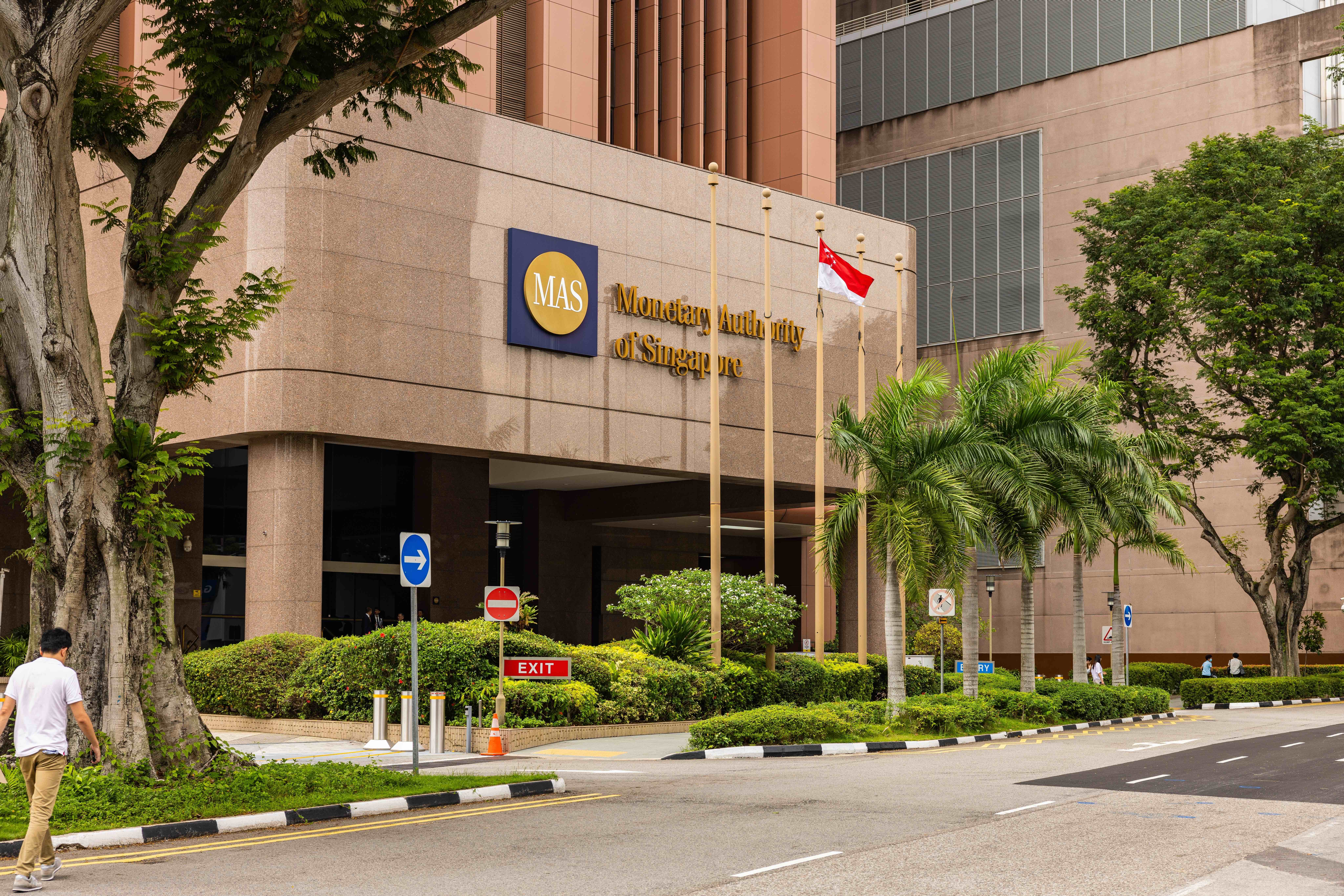
A Treasury bill—commonly written as a T-bill—is a short-term government debt security. In Singapore, T-bills are issued by the Monetary Authority of Singapore (MAS) on behalf of the Singapore Government. When you buy a T-bill, you are lending money to the government for a fixed, short period.
Purpose: The Government issues T-bills and longer-dated SGS bonds as part of its borrowing programme, which funds public spending and supports the development of the domestic debt market.
Core mechanism: T-bills do not pay periodic interest, or “coupons.” Instead, they are sold at a discount to their face value. Your return is the difference between the discounted price you pay and the full face value you receive at maturity.
How do T-bills work in Singapore?
In short: you pay less than the face value upfront, hold the T-bill for six months or a year, and receive the full face value at maturity. The gap between the two is your profit. The worked examples below use an illustrative cut-off yield of 1.90% per annum—actual auction yields vary, so treat the figures as illustrations of the mechanism, not current rates.
Example—S$10,000, 6-month T-bill:
- You apply for S$10,000 of a 6-month T-bill.
- At an illustrative cut-off yield of 1.90% per annum, you pay a discounted price of about S$9,905 upfront—not the full S$10,000.
- Six months later the T-bill matures and you receive the full face value of S$10,000.
- Your profit is about S$95 (S$10,000 − S$9,905).
Example—S$1,000, 6-month T-bill:
- You apply for S$1,000, the minimum investment.
- At the same illustrative 1.90% yield, you pay about S$990.50 upfront.
- At maturity you receive S$1,000, for a profit of about S$9.50.
How the yield translates to price
T-bills are quoted as an annualised cut-off yield, so the discount you receive is scaled to the tenure. As an approximation, your profit ≈ face value × cut-off yield × (tenure ÷ 12), and the price you pay is the face value minus that profit. For a 6-month bill the yield is effectively halved; for a 1-year bill the full annual figure applies. The exact price uses MAS's day-count convention, but this gives a close estimate.
T-bills are issued in two tenures, with auctions held on a schedule published on the MAS website:
- 6-month T-bill: the most common issuance, auctioned roughly every two weeks.
- 1-year T-bill: issued less frequently, typically once a quarter.
Key advantages for investors in Singapore
T-bills offer a specific mix of benefits, particularly for risk-averse investors or for the conservative portion of a diversified portfolio.
- Strong capital-preservation characteristics: Because T-bills are backed by the Singapore Government, their default risk is considered very low. Singapore holds the highest 'AAA' (or 'Aaa') sovereign rating from all three major agencies—Standard & Poor's (2026), Moody's, and Fitch—each with a stable outlook. This is not a guarantee of return, and selling before maturity can still result in a loss.
- Market-set yields: T-bill yields are determined by auction and reflect prevailing short-term interest rates. When policy rates are high, T-bill yields can exceed those on standard bank fixed deposits, which are pre-determined (and calculated based on different criteria, including the bank’s funding needs); when rates fall, that advantage narrows or reverses.
- Short commitment and flexibility: The common 6-month tenure means your funds are not locked up for long, letting you reassess every half-year.
- Tax-exempt returns: For individual investors in Singapore, profits from T-bills, SGS bonds, and SSBs are exempt from income tax.
- Using CPF savings to buy T-bills. You can buy T-bills with CPF Ordinary Account (CPF-OA) funds under the CPF Investment Scheme (CPFIS). To do so you need to be at least 18, not an undischarged bankrupt, hold more than S$20,000 in your OA, and have completed the CPFIS Self-Awareness Questionnaire—then open a CPF Investment Account with DBS/POSB, OCBC, or UOB and apply through that bank. At maturity, proceeds are credited back to your CPF Investment Account. One point that is often misstated: the CPFIS "stock limit" (up to 35% of your investible savings) and "gold limit" (up to 10%) apply only to shares, REITs, corporate bonds, and gold. T-bills and other Singapore Government Securities are not subject to these limits. For the full eligibility criteria, see the CPF Board's guide to investing your CPF savings and our guide to CPF investing. Note for members aged 55 and above: following the closure of the Special Account in January 2025, CPFIS-SA is no longer available to this group; CPF-OA remains the route for T-bills.
The risks and limitations of T-bills
Low credit risk is not the same as no risk. Understanding these trade-offs matters before you commit funds.
- Interest rate risk if you sell early: You can sell a T-bill before maturity on the secondary market through a bank's bond desk, but the price is likely to fluctuate. If you hold a T-bill yielding 3.5% and newer T-bills are issued at 4.0%, yours becomes less attractive and its market price may fall below what you paid. Selling before maturity is also less convenient than buying. While you apply for a new T-bill online through internet banking, selling one on the secondary market generally requires dealing through a bank's bond desk—which may mean a visit to a DBS, OCBC, or UOB main branch rather than a few clicks. Factor this in if there is any chance you will need to exit early.
- Reinvestment risk: When your T-bill matures, prevailing rates may have fallen, so you may have to reinvest the returned principal at a lower yield.
- No regular cash flow: Unlike SSBs, which pay interest every six months, T-bills return your principal and profit only at maturity. This may not suit investors who need a regular income stream.
- There is no cap on how much you can own—but each auction has allotment limits. You can hold any total amount of T-bills across auctions. Within a single auction, three MAS rules apply: non-competitive applications are capped at S$1 million per person; the combined competitive and non-competitive amount allotted to any one investor cannot exceed 15% of the issuance size; and non-competitive bids are filled first, up to 40% of the total issuance. If non-competitive demand exceeds that 40%, allotment is prorated—so you may receive less than you applied for.
Comparison: T-bills vs SSBs vs fixed deposits
How to buy T-bills in Singapore
This section sets out the end-to-end process for a typical retail investor.
Prerequisites:
- Singapore bank account: a savings or current account with one of the three local agent banks—DBS/POSB, OCBC, or UOB.
- Individual CDP account: a Central Depository (CDP) account holds securities bought with cash or SRS. If you have bought Singapore stocks before, you already have one.
- CPF Investment Account (for CPF-OA): to apply with CPF-OA funds, you need a CPF Investment Account (CPF-IA) with one of the three banks, separate from your CPF-OA.
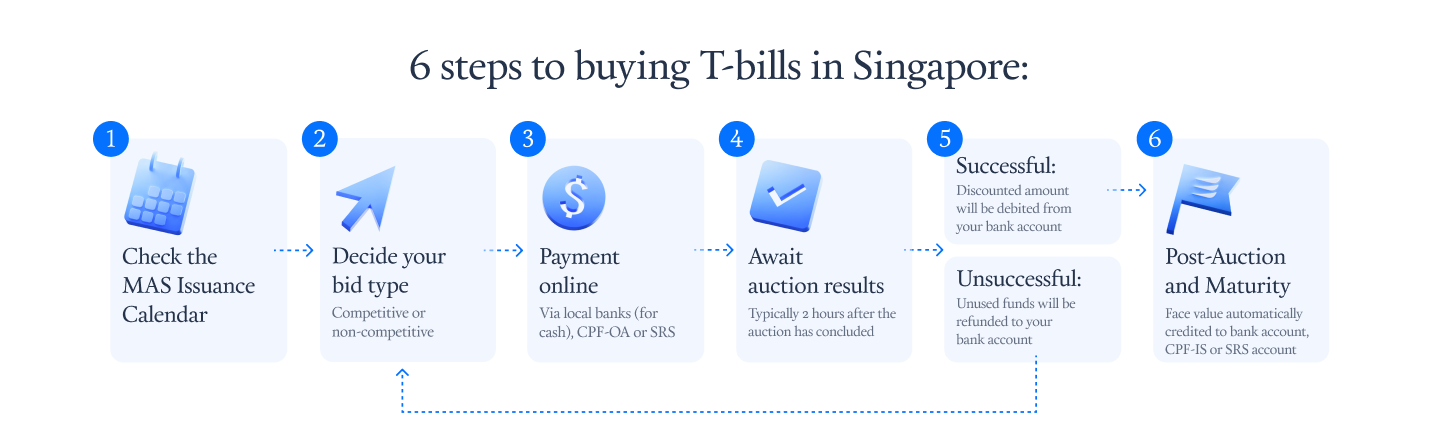
Step 1: Check the MAS issuance calendar. Note the announcement, auction, and maturity dates. The application window usually closes one business day before the auction.
Step 2: Decide your bid type. T-bills are sold through a uniform-price auction. Every successful bidder—competitive or non-competitive—is allotted at the same final cut-off yield, regardless of what they bid.
- Non-competitive bid. You specify an amount, not a yield, and accept whatever cut-off the auction sets. Non-competitive bids are allotted first, up to 40% of the total issuance. This is the simplest route and suits most individual investors, though if non-competitive demand exceeds 40%, your allotment is prorated.
- Competitive bid. You specify the minimum yield you will accept, to two decimal places. After non-competitive bids are filled, competitive bids are allotted from the lowest yield upward until the issuance is exhausted. A bid above the final cut-off yield receives nothing; a bid at or below it is allotted at the cut-off. This route suits investors who will only invest if the yield clears a threshold, and who accept the risk of no allotment. In short: a non-competitive bid trades yield certainty for allotment priority; a competitive bid trades allotment certainty for control over the minimum yield you accept.
Step 3: Apply via internet banking. Log in to your DBS/POSB, OCBC, or UOB portal, find the Singapore Government Securities or T-bill section, and follow the prompts. The minimum is S$1,000, in multiples of S$1,000. Select cash, your CPF-IA, or your SRS account as the funding source.
Step 4: Await auction results. Ensure your application is in before the cut-off on auction day. Results are typically published on the MAS website about two hours after the auction.
Step 5: Settlement and maturity. Where your allotment shows up depends on how you paid: cash applications appear in your CDP statement; SRS applications, in your SRS operator's statement; and CPF-OA applications, in the CPFIS statement from your agent bank. Full auction results are published on the MAS website about two hours after the auction closes.
Who is suitable for T-bills?
T-bills are not a tool for generating wealth or high-growth returns. They are a strategic cash-management and capital-preservation instrument, and they are best judged against that job rather than against equities or growth funds.
Who may suit investing in T-bills
- Parking money you have earmarked for a large short-term goal, such as a property down payment in one to two years.
- Holding emergency-fund cash beyond what you need for immediate access.
- De-risking part of a portfolio during periods of market volatility.
- Earning a potentially higher return on idle CPF-OA savings than the base 2.5%—when the auction yield exceeds it.
Who may not suit investing in T-bills
- Investors seeking long-term growth, for whom a diversified portfolio is better suited.
- Anyone who needs immediate, anytime access to cash, where a money market fund or an SSB may fit better.
Should I invest in T-bills in Singapore?
The practical question is not whether T-bills are “good,” but what role short-term cash should play in your plan. A T-bill locks a known sum for six or twelve months and pays no interest until maturity; a money market fund keeps cash accessible with a floating yield; an SSB offers long-dated flexibility with step-up interest. Each answers a different need.
In our view, T-bills earn their place for defined, time-bound cash—money you know you will need on a specific horizon and want to keep at low credit risk. For an always-on cash allocation with no lock-up and no auction guesswork, a diversified money market or short-duration solution may be more practical. The cash-management decision should follow the job the money has to do for you.
On Endowus, Cash Smart portfolios offer a way to hold cash in diversified money market and short-duration funds with no lock-up and no investment limits—a structural alternative for the portion of your cash that needs to stay flexible. As always, the right mix depends on your own circumstances.
T-bills vs Endowus money market funds
Frequently asked questions about Singapore T-bills
How do T-bills work in Singapore?
You buy a Singapore T-bill at a discount to its face value, hold it for six months or one year, and receive the full face value at maturity. Your profit is the difference. T-bills pay no interest during the tenure, and the yield is set at auction.
How much does a S$1,000 T-bill cost?
Less than S$1,000, because T-bills are sold at a discount. At an illustrative 1.90% annual cut-off yield, a 6-month S$1,000 T-bill would cost about S$990.50 (S$1000—S$19.00/2, because of the maturity, which is six months or half a year) upfront and return S$1,000 at maturity. The exact price depends on the auction yield.
What is the difference between a T-bill and an SGS bond?
T-bills are short-term (6 months or 1 year) and sold at a discount with no coupons. SGS bonds are long-term (2 to 50 years) and pay a fixed coupon every six months. Both are issued by the Singapore Government via MAS.
Can a foreigner buy Singapore T-bills?
Yes. Foreigners can buy Singapore T-bills provided they hold an account with one of the three local agent banks (DBS/POSB, OCBC, or UOB) and a CDP account. Applications for cash follow the same process as for residents.
Is the T-bill yield guaranteed?
No. The yield is only known once the auction closes. A previous auction's cut-off yield is an indicator, not a guarantee of the next one. Past performance is not necessarily a guide to future performance or returns.
Do Crazy Rich Asians only invest in real estate?

Change is the only constant in life: Are index funds truly "passive"?

The real difference between unit trusts and ETFs



%20F1(2).webp)

.webp)
.webp)






.webp)