


.webp)
.webp)
.webp)
.webp)






.webp)








%20(1).gif)

Register for the event
Endowus invites you to our exclusive event with Macquarie Asset Management, as we discuss unlocking opportunities in Infrastructure- a $1.3tn asset class.
This event is reserved for Accredited Investors (AIs) only. To register for the event, please indicate one of the following:
- MAS issues two different licences for financial advice — one to advise on and recommend investment products, another to build and manage them.
- You can quickly verify any firm and any representative on MAS’s public registers, as well as how an adviser is paid — commission, a flat or asset-based fee, or a mix. That fee structure may also have an impact on the advice you get.
- Similarly to medical advice, financial advice is a profession where there is a broad knowledge imbalance between the provider and the client, which is why alignment of interest is extremely important.
Financial advice in Singapore is typically offered by Banks, insurers, independent firms, and digital platforms all offer it under similar titles.
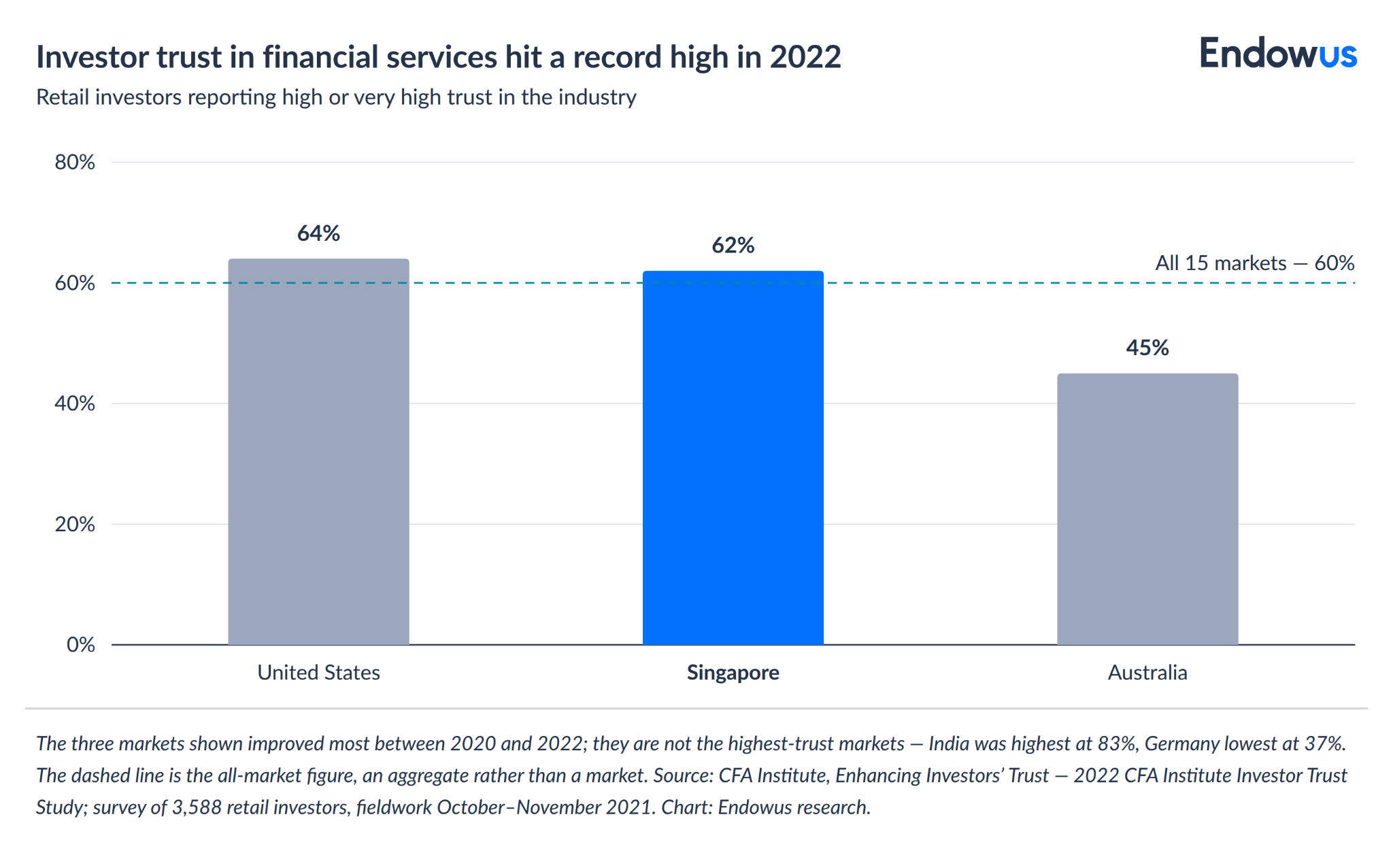
An apt premise is a series of CFA Institute studies on investor trust. In 2018, only about one in ten retail investors in Singapore said they believed their adviser always put clients’ interests first. Fast forward to 2022, and the situation appeared to have improved, with 62% reporting high or very high trust in the industry. The caveat is that the two studies asked different questions - general trust in the industry is one thing, full belief that an adviser would put client interest first is a different story altogether.
The more reliable approach is to treat the adviser choice as verification rather than trust: the licence a firm holds, how it is paid, and what its advice should cover are all either public record or fair questions you may ask.
This article aims to increase clarity about the financial advisory business in Singapore, with an emphasis on interest alignment and investor money stewardship. We will cover the two different licences issued by the Monetary Authority of Singapore (MAS), how to check any firm and its representatives on the public register, how advisers are paid and what each model rewards, what “good” advice should cover, the questions worth asking anyone (including us) and when you may not need to pay for advice at all.
Two different licences are related to financial advice
MAS issues several types of licences. A Financial Adviser’s Licence, under the Financial Advisers Act 2001, lets a firm (the “adviser” is always the firm, while the individual is called a “representative”) advise on and recommend investment products; a Capital Markets Services (CMS) licence for fund management, under the Securities and Futures Act 2001, lets a firm build and manage those products. Endowus has both these licenses.
The distinction matters because firms that look alike may hold different permissions. Under the Financial Advisers Act, a licensed adviser may do four things: advise on investment products, issue or promulgate research on them, market collective investment schemes, and arrange life insurance policies. A CMS fund management licence allows one to manage a portfolio of capital markets products, or a collective investment scheme.
MAS further separates fund products available to everyone, including retail investors, from those limited to accredited and institutional clients.
A licence should not be read as an endorsement or a quality stamp. It is simply an indication of the firm’s permission to provide a specific service.
You can check any firm on the MAS register in about ninety seconds
Every firm and individual permitted to give advice in Singapore appears on a public MAS register. There are two registers, because firms and the people who work for them are listed separately.
Start with the firm. Open the MAS Financial Institutions Directory and search its name in the box labelled “Find a financial institution, licence type or activity in Singapore”. The record shows whether the firm is incorporated in Singapore, the licence type it holds under “Licence Type/Status”, and the regulated activities covered by each licence. A firm can hold more than one.
Within the firm, the individual advising you should hold a representative number issued by MAS, which you can confirm on the Financial Institution Representatives Register. Search their name, and confirm the firm listed against them matches the one you are dealing with.
Absence can be just as informative. A firm or person that does not appear is not currently authorised by MAS for the activities you would expect, and MAS keeps a separate Investor Alert List of entities that may be mistaken for regulated ones. MoneySense, the national financial education programme, also reiterates that only authorised firms and individuals may legally give advice, and titles such as “wealth manager” do not by themselves imply authorisation.
How an adviser is paid shapes the incentive behind the advice
Advice in Singapore is paid for in three broad ways — commission, a fee paid by the client, or a combination of the two. Intuitively, the incentive structure can have an impact on how the advice is given.
Commission is paid by a product provider when the product is purchased, so the adviser’s income depends on a sale. Singapore regulates this closely: under MAS’s Balanced Scorecard framework (Notice FAA-N20), advisers and supervisors are assessed not on sales volume but on four non-sales measures — understanding a client’s needs, suitability, adequacy of disclosure, and professional conduct. For life insurance, MAS also caps first-year commission at 55% of the total and spreads the balance over several years, reducing the incentive to churn policies. This is not an exhaustive list of features included in the MAS regulatory framework and more broadly in Singapore’s legislation. For a better understanding please consider legal advice and consultation.
A fee charged to the client (could be flat, hourly, or calculated as a percentage of assets) is paid specifically for the advice - irrespective of the product purchased. A fee-only arrangement means the financial adviser will collect that fee but no product commission; a fee-based one is a combination of a client fee and product commissions. The labels sound alike and the economics do not, so it is worth clarifying which applies.
The one cost that is typically overlooked is a trailer fee, a recurring payment a fund manager makes to the distributor or adviser out of the fund’s annual charge, for as long as a client holds it. MoneySense notes such distribution costs are typically deducted from the fund itself, so many investors never see them on a statement. It is fair to ask whether your adviser receives one.
None of these models is disqualifying, but it is important to know what is the incentive structure for the adviser, as it is likely to have an impact on the products offered.
Financial advice covers more than which product to buy
A useful test of whether you are being offered advice or simply sold a product is whether the conversation broadens to cover other aspects of your financial life. Genuine advice looks at the whole picture (cash flow, national schemes, protection, investments, drawdown, and estate arrangements) rather than a single product in isolation.
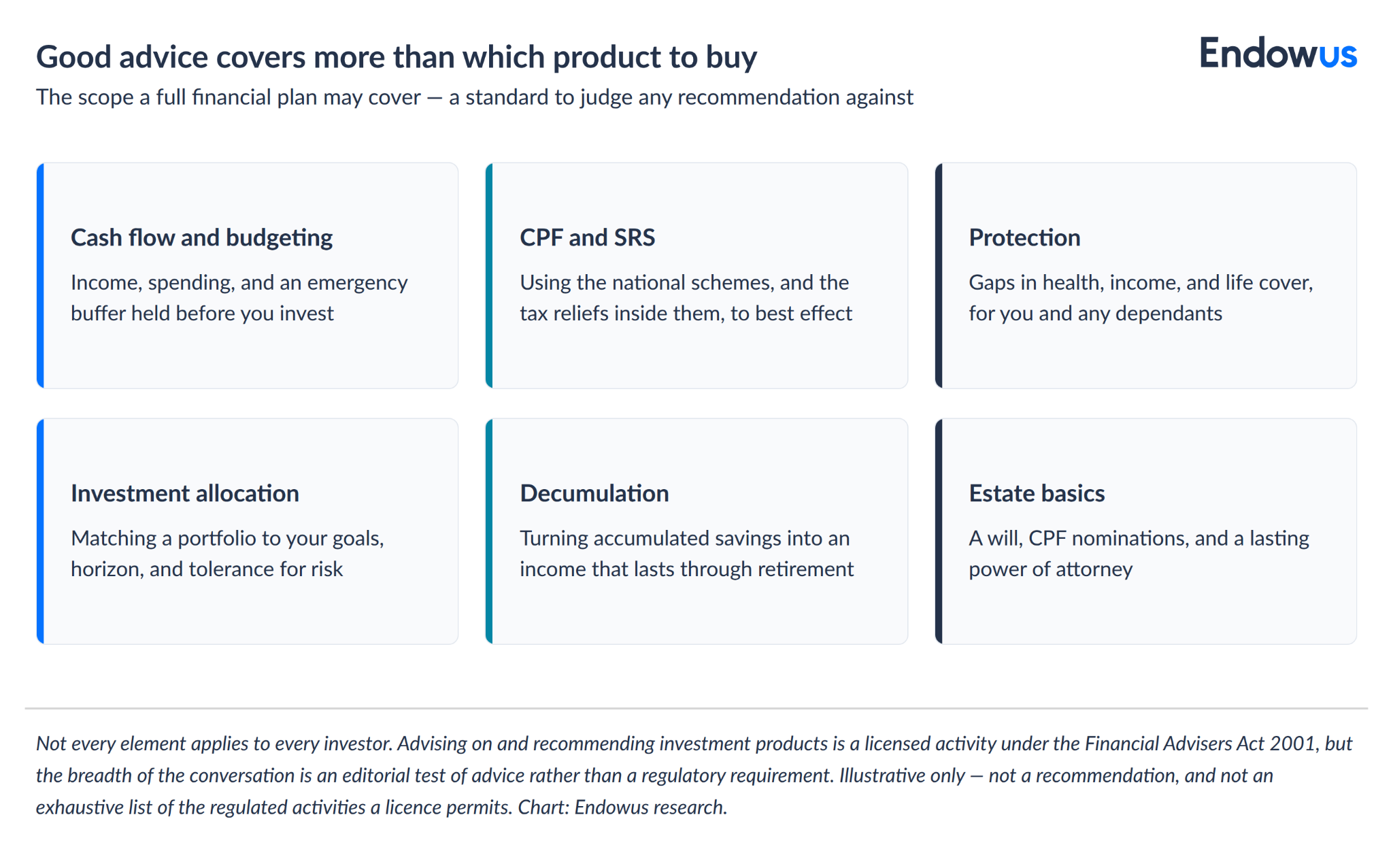
In a Singapore context, that scope includes:
- understanding your cash flow and suggesting an emergency buffer before you invest, using CPF and the Supplementary Retirement Scheme (SRS) well, since the tax reliefs (for SRS) and guaranteed CPF interest rate may be part of your return;
- checking for gaps in health, income, and life protection; and matching an allocation to your goals, horizon, and risk tolerance.
- Closer to retirement, it means planning how your CPF savings are paid out, how the CPF retirement sums shape later-life income, and estate basics such as a will and CPF nominations.
In conclusion, if the conversation is focused on a product, rather than being a holistic discussion about the client’s broader needs, then it is likely that the outcome will be the product’s sale and not financial advice.
What are the top 8 questions worth asking any adviser (including us)?
The most practical way to judge an adviser (including us) is to ask a few direct questions.
- How are you paid on this specific recommendation? A clear answer names the commission, the fee, or both, in figures. A separate question may be asked on whether the firm rebates trailer fees (see below).
- What licence does your firm hold, and what is your representative number? Both are on the MAS registers, and they are two separate lists.
- What happens to your pay if I choose a different product, or nothing at all? This shows whether the recommendation and the adviser’s income are positively correlated.
- Who else pays you in connection with my account? Trailer fees and provider arrangements should be disclosed unprompted.
- What is the all-in annual cost, including the fund’s own charges? What matters is the total expense ratio, not the headline fee alone.
- On what basis is this suitable for me? Any recommendation should have a reasonable basis in the client’s needs and objectives.
- What alternatives did you consider and set aside, and why? A considered answer points to broader advice; a single option points to a single product sale.
- What happens after I sign — is there ongoing service, and at what cost? Advice is rarely a one-off, and the relationship carries its own price.
If an adviser answers these plainly, that is a good sign, whoever they work for. Ask us the same questions: our licences are on the MAS register and our costs are in our fee disclosures, and we would rather you checked.
What low-cost solutions may be available to you
Depending on your investment horizon and risk tolerance, a low-cost, broadly diversified portfolio may be the right decision.
The same building blocks apply inside the national schemes: CPF savings can be invested through the CPF Investment Scheme (CPFIS), weighed against the guaranteed floor they would otherwise earn and with any returns flowing back into the CPF account; and SRS cash, which earns almost nothing left uninvested (it actually loses money, if you account for inflation) can go into eligible funds.
Different situations may require different levels of advice, especially as complexity increases with larger asset bases.
Investment implications
Pulling this together, here are a few steps for investors to pay attention to: confirm the licence number, understand how the adviser is paid, judge whether the advice covers your whole situation, and ask the questions above. In our view, the most valuable outcome is not landing on a particular firm, but arriving at a standard you can hold any adviser to — including us.
So you can apply the same test to us: Endowus Singapore Pte. Ltd. holds a Capital Markets Services licence for fund management and is an exempt financial adviser under the Financial Advisers Act, both verifiable on the MAS Financial Institutions Directory. Our fee schedule, including how we treat the trailer commissions in the funds we use (we rebate it in full) is in our fee disclosures, and we would encourage you to hold us to the same questions. If it helps, you can book a consultation with the Endowus team.
Frequently asked questions
What does a financial adviser actually do in Singapore?
A financial adviser helps you plan and make broader decisions about how to save and invest your money (cash flow, insurance, CPF and SRS, investments, and retirement drawdown) and may also recommend specific products. Under the Financial Advisers Act, advising on and recommending investment products is a licensed activity, so a genuine adviser is authorised by MAS to do it.
How do I check if a financial adviser is licensed in Singapore?
Search the firm on the MAS Financial Institutions Directory at eservices.mas.gov.sg/fid, and the individual on the Financial Institution Representatives Register at eservices.mas.gov.sg/rr. The records show the licences held and the activities allowed. If a firm or person does not appear, they are not currently licensed by MAS for those activities.
What is the difference between fee-only and fee-based advice?
A fee-only adviser, such as Endowus, is paid only by the client — a flat, hourly, or asset-based fee — and takes no product commission. A fee-based adviser combines a fee from you with commissions from product providers. The labels sound alike but the economics differ, so it is worth asking which applies before you commit.
How much should financial advice cost in Singapore?
There is no official benchmark, and costs vary with the model and the products involved. Ask for the full fee schedule in writing, including the fund’s own annual charges, not just the headline advisory fee. For life insurance, MAS caps first-year commission at 55% of the total, with the balance spread over several years.
Do I need a financial adviser if I already invest through a platform?
The more complex your situation, the higher the service tier you may need in order to help you navigate it. Some wealth platforms, such as Endowus, are also financial advisers.


%20F1(2).webp)

.webp)
.webp)






.webp)