


.webp)
.webp)
.webp)
.webp)






.webp)












%20(1).gif)
Register for the event
Endowus invites you to our exclusive event with Macquarie Asset Management, as we discuss unlocking opportunities in Infrastructure- a $1.3tn asset class.
This event is reserved for Accredited Investors (AIs) only. To register for the event, please indicate one of the following:
A conversation with Robert C. Merton, PhD, on models, risk, and the right measurement of a good retirement.
Professor Merton has spent 6 decades moving between two worlds that rarely meet. During his time in MIT and Harvard, he built much of the mathematical scaffolding of modern finance — the continuous-time models, and the options-pricing theory that earned him the 1997 Nobel Memorial Prize in Economic Sciences. On trading floors and in boardrooms, he has spent equally long in bringing those ideas into the real world.
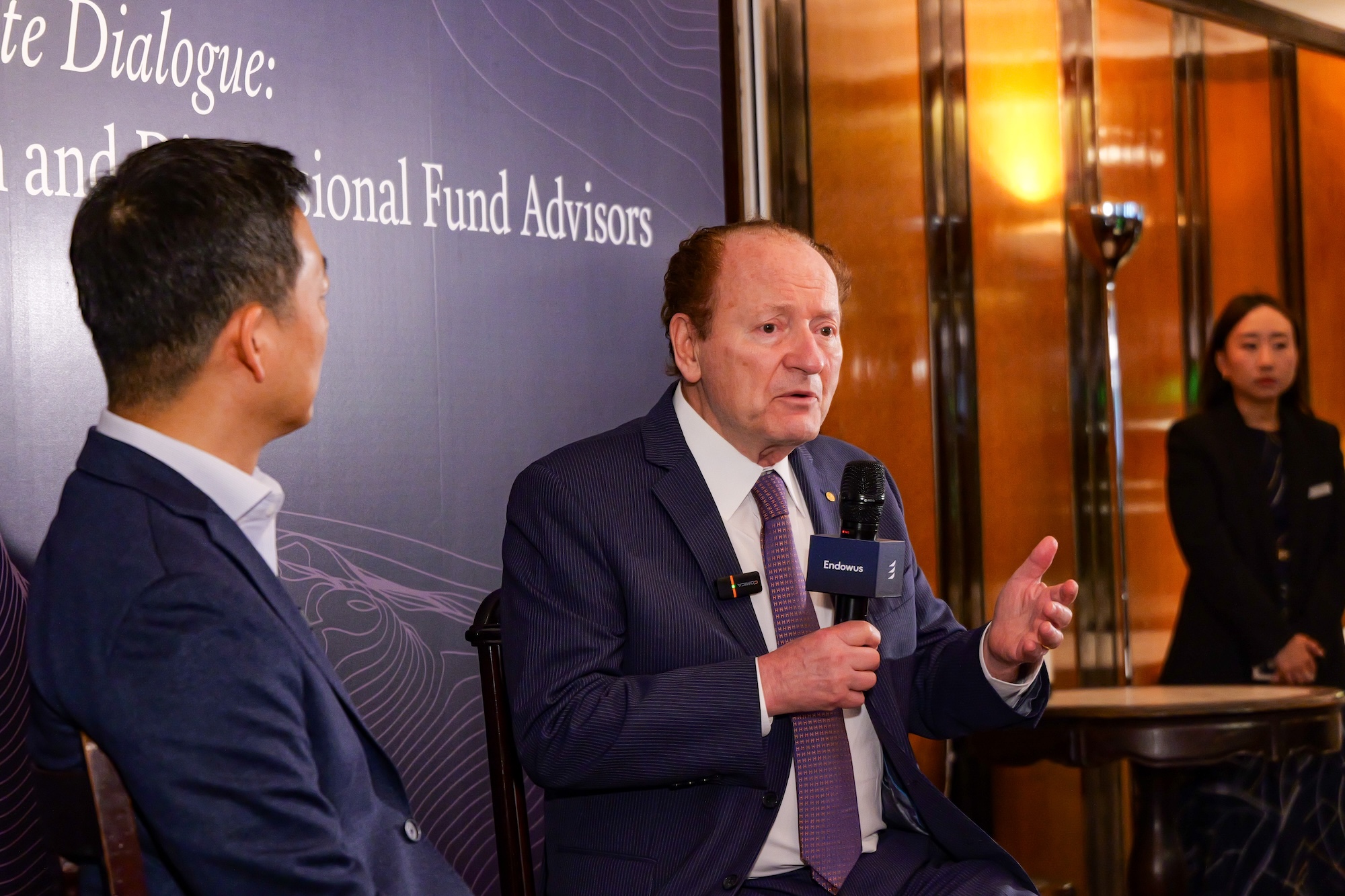
Now a resident scientist at Dimensional Fund Advisors, the firm with which he has been associated for much of his career, Merton sat down in Hong Kong with Samuel Rhee — the Co-Founder, Chairman & Group CIO of Endowus — for an exclusive panel in front of more than 250 Endowus clients. The conversation ranged across broad topics including the importance of financial models in real life, the understanding of risk, returns and success in the context of retirement investing, and the key features of financial advice.
Our conversation, slightly edited for length and clarity, is below.
Sam Rhee: You've lived an unusual life in finance, moving between MIT seminar rooms and trading floors, between Nobel-recognised theory and the very real challenges of implementing it. Most academics never test their ideas in markets, and most practitioners never produce the theory. Looking back, what has the market taught you that the equations did not? And what would you tell your younger self about the gap between an elegant model and the world as it actually behaves?
Professor Merton: I take a slightly different view of that. You often see the criticism of academic research — frictionless markets, perfect markets, no transaction costs, and so on. I’m a prime example: my models were built in continuous time, where you can trade continuously and at no cost. That’s pretty abstract. But I use those frictionless models as the first thing I do when I want to solve a problem, not just because they simplify but because if a result shows up in a perfect model — a prediction about what will still be risky, or about what drives differences in expected returns — then it isn’t telling me about the real world exactly, but it is telling me something essential for design. It’s telling me where “nirvana” is.
If a risk appears in a continuous-time model despite all the friction being stripped out, it is definitely going to be there — not just now, but forever, even with AI, or quantum computing. None of it can do better than perfect. So when you understand what survives in the frictionless case, you know what the core risks really are. You’ll never get to “nirvana,” but it gives you a North Star. It tells you which direction to go.
The second thing it gives you is a design principle. You look at where you actually are — all the frictions, the regulations, the missing markets, the missing computations — and you ask: How do I get from here towards the North Star? That’s a wonderful guideline. So it’s very practical. People may say these are just theories. But you have to have the right model. If you have the wrong model, it’s like taking a wrong turn on the motorway — it doesn’t get any better the longer you drive.
And the genuinely thrilling part is the moment when something you worked out in theory turns out to be something a person can actually do. Is it easy? Typically not. But nothing that’s really good is easy. It’s a path. That’s been my philosophy of doing this for 60 years.
Sam Rhee: That concept of defining the frictionless first, and the goal, and where we need to get to — but facing the realities of real markets and real frictions — really resonates. And I think if we can get as close as we can to that, that's the work of Dimensional, and that's the work of Endowus, to help us get there together.
Professor Merton: If you come up with something genuinely good — good for society, good for the people, as well as for the service providers — then you go to the regulator and make the case. I believe — and maybe I’m too much of an optimist — that if you are willing to take the time to find solutions, and you have something that is really good (not a way of getting around something, but something that genuinely is good) and you explain it, eventually it will be adopted. Regulators, like everyone else, want to do a good job. This is the path.
Sam Rhee: I agree wholeheartedly. In thirty-plus years of dealing with regulators, the conversation has almost always been constructive — they actually appreciate the engagement. Too many modern financial institutions are frightened of the regulator, but the job of all of us is to improve the financial services investors actually receive, and engaging the regulator is an absolute must. That has been the foundational principle of Endowus even in tackling CPF investing for example in Singapore. So thank you for saying that. You’ve mentioned risk already, and so much of your work rests on it. People say we’re living in an age of complacency. To you, what is risk, the way you define and measure risk - how has that evolved over the years?
Professor Merton: First, finance is a science. It has data, it has an organised approach, it has a rich body of theory — some of it rejected (things that simply don’t work) but also things that seem to have held up across all kinds of environments over decades.
For me, risk is part of this science and still fundamentally a trade-off between what you don’t like — uncertainty — and the benefit you get if you are willing to bear the right kind of risk. And it’s vital to remember that just because something carries a lot of volatility, it does not follow that you’ll be rewarded for it.
You might say: “I’m taking all this risk, so I must earn a high return.” But look at a lottery ticket — an enormous reward if you win, and you know perfectly well how unlikely that is. So risk has to be defined properly. The risk we want is a risk that you have reason to believe will earn you a higher expected return — expected, not realised — than you’d get otherwise.
And extracting information from the market is enormously important. There’s this curious notion that the market is somehow average. But think about what the market actually is.
Think of the market as a weighted average of knowledge. If you place a large trade, you move the price more, up or down — that’s just common sense. And who places the biggest trades? Not the everyman or even our own traders. It’s the institutions — the HKMA, CIC, Norway’s petroleum fund. They invest all over the world, they have enormous resources, and whatever they need, they can buy. If you assume they won’t have the best AI for investing — either built in-house or hired in — that is not a safe assumption. So the market is not an average person. It is a weighted average, and those with the biggest trades have the biggest influence.
Even if you’re clever, even if you have good insights, you cannot compete with people who are also clever, who work eighteen hours a day, and who have vast resources to gather data. Your competition is not the average person, but the people who hunt for opportunities, and when they find it, act on it — and the moment they act, the market absorbs it into the price.
So, in my opinion, it is very, very difficult to beat the market. I’m not saying don’t try; if you’ve found something you truly believe in, who am I to argue? But as a systematic strategy for your own money, beating the market is not a high-return activity.
Sam Rhee: Yes, the point about the market not being a mean average but a weighted average of all investors is an important point. I also agree, and risk is deeply personal and it’s important for people to take the appropriate risk for the goal they are investing for, and more importantly, to be compensated appropriately for the risk they are taking. Which takes me to one of the biggest risks we face as individuals, which is longevity risk — the lack of retirement adequacy, in Hong Kong, in Singapore, across Asia. You have argued, forcefully and for a long time, that the global defined-contribution industry has been measuring the wrong thing. We’ve trained an entire generation to think about retirement as a final wealth number — an account balance, a return. You’ve called that the wrong question. Walk us through why sustainable, inflation-protected income is the right unit of measurement, and what is lost when we manage to a wealth number instead.
Professor Merton: You always have to define the problem you want to solve, and you can’t know the problem until you know where you want to be. So the first question, before anyone discusses what to do, is: What are you trying to achieve?
A good retirement, in my view — and this isn’t original to me — would be to carry on living in the lifestyle you’d become accustomed to in the last part of your working life, for the rest of your life. We’d all like more, but most people would be very happy with that, because they’ve got used to how they live.
So what does it mean to maintain the same lifestyle? You’re really talking about the same standard of living. Let me give you a direct example. Suppose I’m 40 and I’ve been saving. I look at my balance — put on as many zeros as you like — and say I have a million dollars. I ask myself a perfectly sensible question: How am I doing? Am I on track?
Knowing you have a million dollars does not answer that — not even for my brightest MIT colleagues. Why? Take the ten-year US Treasury, the most liquid bond in the world. How much income would a million dollars buy you? 15 years ago, about US$50,000 a year. Today, around US$43,000. Six years ago, at 60 basis points? US$6,000 a year. Same wealth, wildly different retirements — anything from US$50,000 a year to US$6,000. And that’s not a hypothetical; those are the actual numbers.
I looked at roughly 20 years of data and I asked: For a given amount of wealth, what’s the difference between retiring at the highest interest rates over that period and the lowest? The answer is around 37% less income. For someone very well off, congratulations — I’m not worried about you. But for a national pension system, for most people, 37% is an enormous problem. That’s not losing one of your 3 cars.
Here’s how perverse it gets. Everyone saving for retirement is, in technical terms, short duration — all the contributions come in before any of the payouts go out, so the duration of your future benefits is longer than the duration of the assets you’ve accumulated. So which way should you be rooting? If you hold long bonds and rates fall, prices rise and you feel wealthier. If rates rise, your wealth falls and you feel poorer. But because you’re short duration, higher rates are actually better for your retirement, whether you’re 30 or 65. And what does your account screen show you when rates rise and your wealth dips? A nice, alarming red.
People understand income. Every day they decide what to buy. They live within a budget. They understand that spending here means not spending there. If they’re living on 100 and find they can only fund 60 in retirement, they know they’re short, and by how much. And then they can decide. One person may say, “I don’t need to save as much as I thought.” Someone else looks at sixty per cent and panics, and starts saving harder.
Same data, very different actions — but they get to make the decision, because you gave them the information in a form they understand.
Sam Rhee: I still struggle to explain to people that the definition of risk for a retirement goal isn’t the volatility of returns — it’s longevity, outliving your money. That is measured by the probability of success in achieving your retirement needs. So that means contrary to what most people think, cash is actually the riskiest asset of all because you are certain to not achieve your goal with such low returns that are below inflation.
Professor Merton: It’s like using the wrong currency. If you put your money in Australian dollars because the interest rate looks higher, you might feel good — but you’ve taken on currency risk you never intended. Same thing here: You want to measure risk in terms of income. And who already does this? Every pension fund in the world. They don’t look at what their portfolio is worth in isolation; they look at how much of their income promises they’ve covered. The puzzle, to me, is why anyone makes it hard for the client. People get frightened by a wall of choices. Give them the right units and they won’t be confused — and they’ll be better for it.
And yes, it takes a long time to change things. But remember when indexing was first introduced. Imagine walking into a prudent-person committee and announcing: “We have a marvellous idea. People should buy 500 American companies. We don’t know what they do. We’ve never read their balance sheets. We’ve made no forecasts. We’ll simply buy them in proportion to market value.” Do you suppose that committee called it prudent? And yet we do it routinely now. Good things often take a long time. If you don’t have patience, perhaps changing the world isn’t the right business to be in.
Sam Rhee: You have engaged some of the leading minds and regulators across nations, what are some of the new ideas or concepts that you are researching or have shared in your interactions with the largest pension managers. Any words for the MPF here in Hong Kong and CPF in Singapore, as they try to solve these problems from a regulatory perspective? Singapore is planning to launch a new lifetime retirement solution for all CPF members for example. What new research or innovation could apply here — glidepath designs, inflation-protected assets, and when we first met many years ago you had mentioned reverse mortgages as an effective tool too?
Professor Merton: Some things don’t change. 2 plus 2 is 4, whether you do it on a quantum computer or on a piece of paper. So just look at the facts. What is the biggest asset in most countries — developed or emerging? With the odd exception, the single largest piece of saving people do on their own is where they live. They buy a house or a flat. It needn’t be grand. But in almost every country, that’s the main source of meaningful personal saving — not through an account.
A well-designed reverse mortgage is a way to take that asset — the biggest one almost everyone has, wealthy or not — and use it far more efficiently. Done badly, like anything, it can be harmful. But done well, it could really move the needle. So why not make it available?
There’s a counterintuitive lesson here, like the use of oxygen masks on an aeroplane: Fit your own mask first — not because you’re selfish, but because if you don’t, you can’t help the child sitting next to you at all. It’s the same with the house. In many cultures the house is sacred, like a temple. But how many children today move into their parents’ home? Once it passes on, it becomes a financial asset. It is not wrong to borrow sensibly against that asset to live better in retirement. And if you live better, you ease the burden on the children who want to look after you. Failing to make full use of resources you already have is, frankly, a sin.
On the innovation side: There’s an instrument I’ve worked on that now actually exists. It’s a bond, but it’s designed to behave like a pension — you buy it, you receive nothing until the year you retire, and only then does it pay. The crucial feature is that it indexes not to inflation but to per capita consumption. So you’re not only protected against inflation; you’re protected against changes in the standard of living. If living standards rise over 30 years, you want your retirement to keep pace. The principle is always the same: Index to the goal.
Sam Rhee: One last question. For me, one of the most important assets isn’t financial — it’s relationships. You have a long and special relationship with Dimensional. Why Dimensional, and why does a firm like Endowus matter as a trusted adviser for investors?
Professor Merton: Dimensional, first of all, is a science-based firm, which makes it very comfortable for me. I’ve been involved with great firms and they have plenty of technology and science, but the science isn’t their culture. There, I’m always swimming against the current. At Dimensional, I swim with the current.
Then there’s the record. 45 years; US$1 trillion dollars in assets. You almost never see Dimensional’s name anywhere. So how did they reach a trillion dollars? 100% outside money. Nothing bought in — no acquisitions of a billion here, 2 billion there. All grown organically, with very little advertising. It takes 45 years, but it’s well built. That’s what I admire.
Third, and most important, is the philosophy — and this is my personal belief, though it happens to match theirs. If you have something of real value — you’re genuinely creating value, not running a shell game that only looks like value — then the best way to make the most money is to do the right thing. I’d hope people would do the right thing anyway, but I’m making the harder claim from a profit-and-loss point of view: when you have something of real value, you don’t have to make things up, you don’t have to fool anyone, you don’t have to hide things. And the one word for all of that is trust.
Trust has two parts. We usually think of the first — trustworthiness, the confidence that someone wants to do well by you. A fee-only structure, your fiduciary alignment, is designed to convince people who don’t yet know you that your incentives are lined up with theirs. That’s very good. But trustworthiness alone is not enough for trust. What else do you need? Competence. You might have a child who loves you and would never knowingly harm you — and you still wouldn’t ask them to perform open-heart surgery on you. You need both. Dimensional built both from the very beginning — David Booth insisted on it. And they did it not merely to be good, but because it was the way to create the most value of all.
Forget your password? It's a good thing for your investments

The lesson of Hyflux: What water and diversification have in common

Free lunch: Diversification in investing is a gift
.jpeg)


%20F1(2).webp)

.webp)
.webp)






.webp)