


.webp)
.webp)
.webp)
.webp)






.webp)












%20(1).gif)

Register for the event
Endowus invites you to our exclusive event with Macquarie Asset Management, as we discuss unlocking opportunities in Infrastructure- a $1.3tn asset class.
This event is reserved for Accredited Investors (AIs) only. To register for the event, please indicate one of the following:
- Two very different products share the name: short-term single-premium endowments are capital guaranteed at maturity - for some - and measured in months, while participating endowments and investment-linked policies (ILPs) are commitments of 10 to 25 years. Conflating them is a big source of investor confusion.
- The 3.00% and 4.25% figures on a Benefit Illustration are gross, non-guaranteed projected returns of the insurer’s participating fund set under Life Insurance Association Singapore (LIA) guidelines, not final returns; the number that matters is the illustrated yield to maturity.
- An endowment may suit a saver who values enforced discipline, a bundled death benefit, or - for some - capital guaranteed if held to term; an investor who prioritises liquidity, cost transparency, and control may be better served investing directly — though direct alternatives carry market risk and no capital guarantee.
Singapore households save at an extremely high rate - higher than most developed market peers.
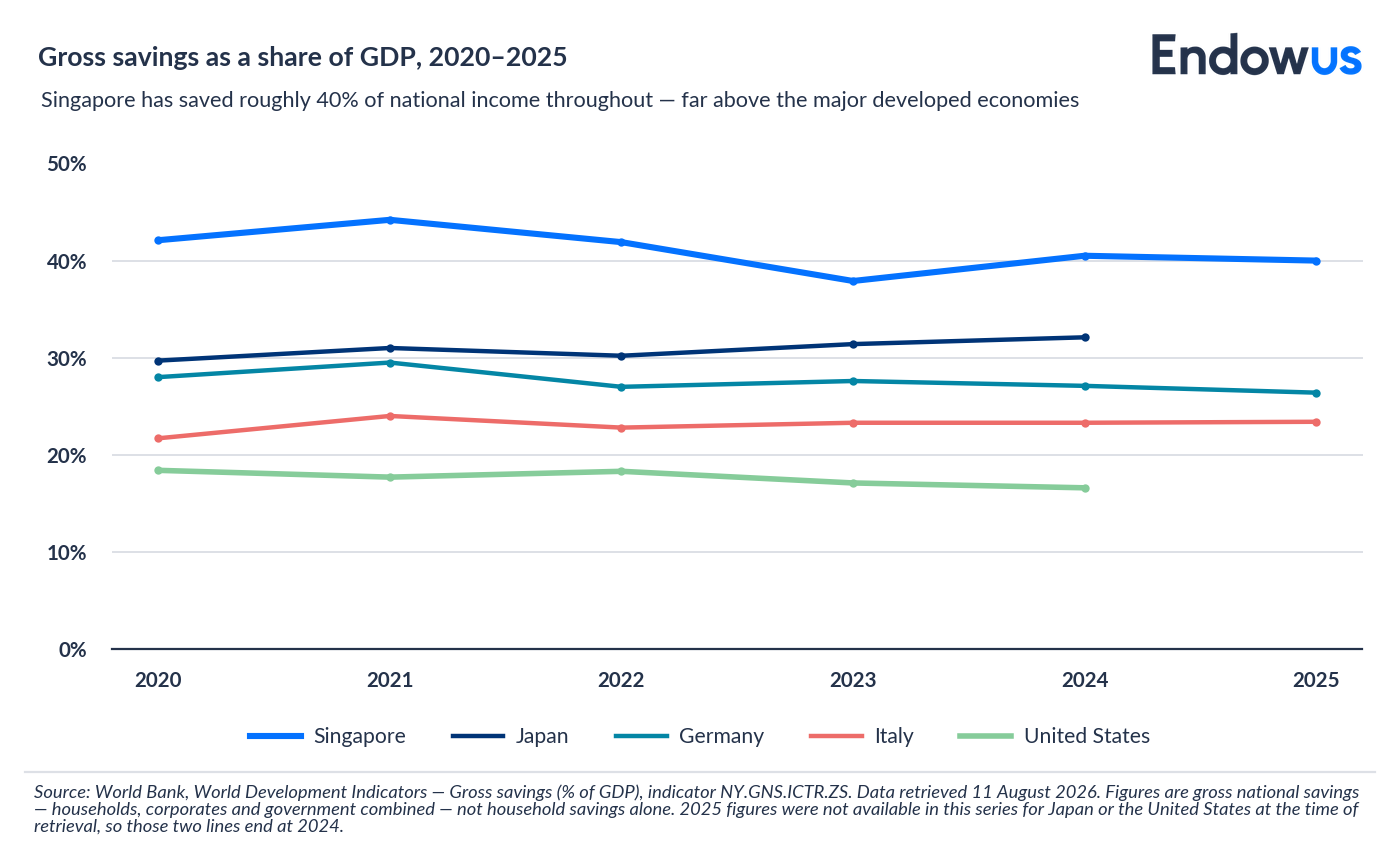
A large share of that saving is intermediated not through the markets directly but through the life insurance industry — in participating endowments, savings plans, and investment-linked policies sold across bank branches and adviser networks. These products are marketed on a straightforward promise: disciplined saving with a return attached. What that return actually amounts to, and when the saver can reach it, is considerably harder to establish from the disclosure itself.
The real question is not whether endowments are good products - what does “good” even mean in finance - but rather how much can an investor obtain and when, especially compared to the Benefit Illustration figure. Indeed, a typical error a policyholder makes is to read the illustration rate as the return they will earn. It is not, and the distance between the two can be a reason for disappointment after the product is bought.
This article separates the two product families that shelter under one name, explains how to read a Benefit Illustration and locate the number that actually describes your return, sets out what it costs to exit early, and weighs — factually — where an endowment earns its place and where investing directly does the job better.
Two products share one name, and the distinction decides everything
The word “endowment” covers two separate instruments with entirely different time horizons, risks, and purposes.
The first is the short-term single-premium endowment: a lump-sum product, typically of two to three years’ tenor, that is non-participating and capital guaranteed at maturity. Instruments of this kind can be used as fixed-deposit alternatives - though they are not fixed deposits; a saver weighs them against Treasury bills and cash-management products, on a horizon measured in months.
The second is the long-term participating endowment or ILP, which requires a 10 to 25 year commitment. A participating endowment pools your premiums into the insurer’s participating fund — the par fund — and pays a combination of guaranteed benefits and non-guaranteed bonuses: a reversionary bonus that accrues over the life of the policy, and a terminal bonus paid at maturity or surrender.
An ILP takes a different structure again, wrapping a selection of sub-funds inside an insurance policy, with the policy’s value rising and falling with the units it holds. These are retirement-horizon decisions, governed by an entirely different set of economics from the short-term tranche that happens to carry the same name.
Read the rest of this article with that division held firmly in mind. Most mistakes made in this space tend to be caused by collating these two types of endowments into a single product.
Short-term single-premium endowments compete with cash
For the short-term tranche, a relevant benchmark should be the suite of government-backed and cash-management options a saver could hold over the same horizon. That comparison is worth drawing explicitly, because the endowment’s headline feature — capital guaranteed at maturity — is one that several alternatives also provide, at yields that may be higher.
Rates as at the dates shown. Treasury bill, Savings Bond, and deposit rates move at least monthly, and short-term endowment tranches sell out and reprice — verify current figures before acting. Yields are not directly comparable without also weighing liquidity, credit backing, and whether the return is guaranteed.
Two features of this table deserve further explanations. The first is that the short-term endowment’s guaranteed maturity return, at current tranche pricing, sits below the yield available on a six-month Treasury bill of comparable safety — though tranche rates reprice frequently. The second is liquidity: a Treasury bill can be sold before maturity and a Savings Bond redeemed monthly without loss of principal, whereas the endowment’s guarantee holds only if the policy runs to its maturity date.
How to read a Benefit Illustration: what number matters
Every Benefit Illustration for a participating policy projects benefits at two rates: 3.00% and 4.25% per annum. These are the illustration rates set under Life Insurance Association (LIA) guidelines, and they have stood at these levels since 1 July 2021, when the caps were lowered from 3.25% and 4.75%.
These are gross projected investment returns of the insurer’s participating fund, net only of investment expenses, and they are non-guaranteed assumptions used purely for illustration — LIA states plainly that they do not represent upper and lower limits of par fund performance and are not a reflection of the actual returns a policy will earn. They are, emphatically, not the return the policyholder receives.
The policyholder’s return is the illustrated yield to maturity — the internal rate of return on the premiums actually paid, after the distribution cost and the other deductions the illustration is required to disclose in its “effect of deductions” table. That figure typically sits below the illustration rate.
A gross participating-fund assumption of 3.00% may translate into an illustrated yield to maturity that is significantly lower. Roughly a percentage point of the gross assumption can be absorbed before it reaches you, consumed by the distribution cost and expense deductions that the illustration lays out. Three things, then, are worth locating on any illustration you are shown: the total illustrated yield to maturity at each rate, the split between guaranteed and non-guaranteed benefits, and the distribution cost. The headline percentage is the least informative figure on the page.
One additional point is that LIA now reviews the illustration caps annually, a change from the previous three-year cycle, so the 3.00% and 4.25% figures may be revised in future.
What an ILP actually is, and where each premium dollar goes
An investment-linked policy bundles insurance protection and investment, which would typically be priced differently. Your premium buys units in one or more sub-funds, and the policy meets its charges by cancelling units as it goes. Understanding that charge structure is very nearly the whole of understanding an ILP, because the charges determine how much of each dollar is invested at all.
The premium allocation rate governs how much of an early premium buys units in the first place: a rate of 20% means that of a S$1,000 premium, only S$200 purchases units, with the balance meeting expenses — allocation rates typically climb year by year toward 100% and beyond. A bid-offer spread, usually up to around 5%, separates the price at which units are bought from the price at which they are sold. Insurance coverage charges — the mortality charges that pay for the protection element — rise with age and are met by cancelling units. Above these sit the fund management fee levied by the sub-fund manager, policy administration charges, and, where a policyholder exits or switches beyond a free allowance, surrender and switching charges.
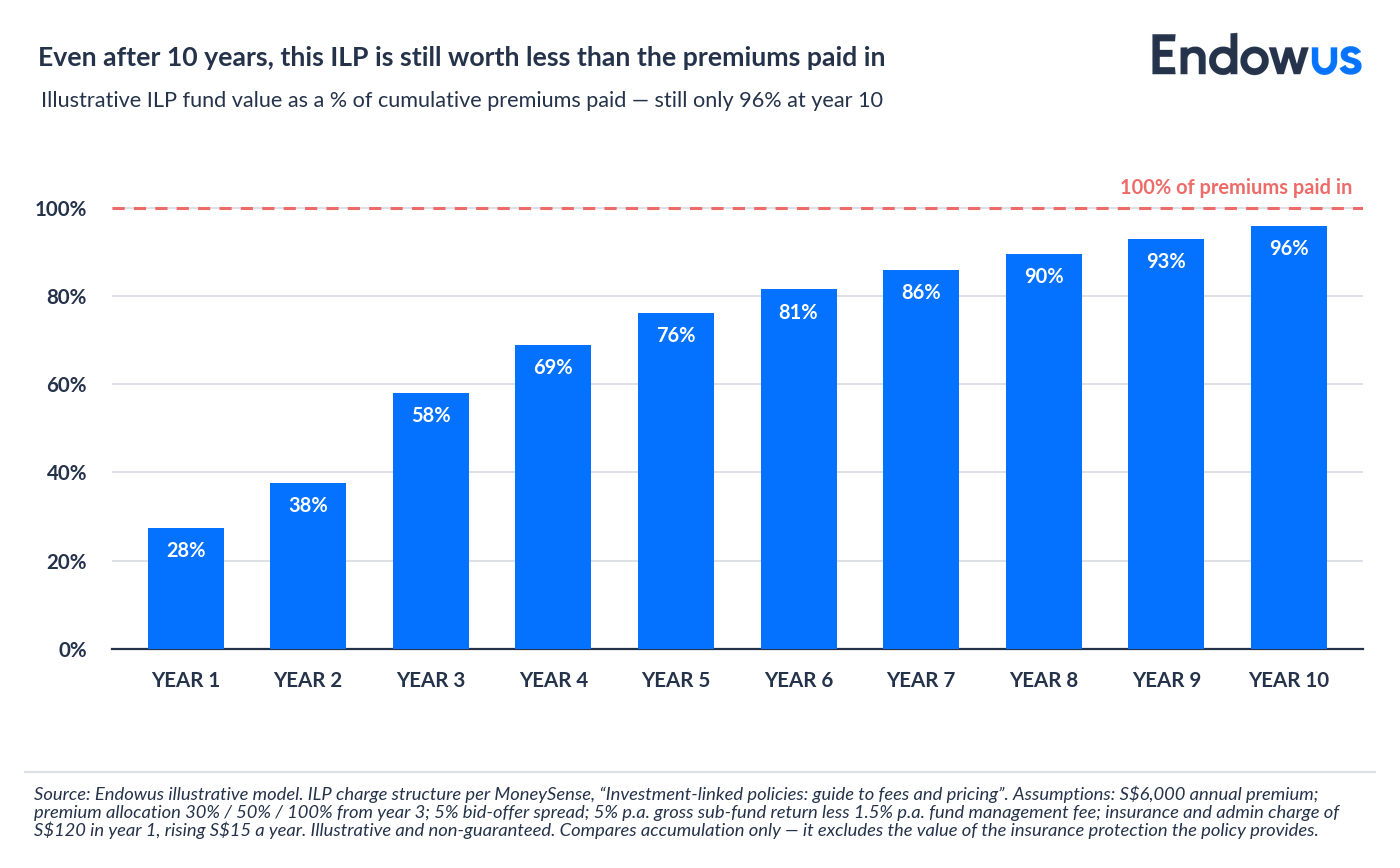
The consequence is that in the early years of a regular-premium ILP, a meaningful portion of what is paid meets distribution and expense costs rather than buying investments, and the invested proportion rises only as the allocation rate climbs. That is a neutral description of how the instrument works, but it is the mechanism a prospective policyholder should weigh, because it bears directly on what the policy returns across its life.
The cost of getting out early is mostly borne early
The defining feature of a long-term endowment or ILP is that its economics assume you hold it to term, and the penalty is higher the earlier the policy is surrendered.
Surrender value — the amount an insurer pays if you end the policy before maturity — is typically below the total premiums paid during the early policy years, and on a limited-pay participating plan the point at which surrender value catches up with premiums paid may fall well into the second decade. The guarantee that makes these products attractive is a guarantee at maturity; it says nothing about the value available on the way there.
Some guardrails are there to make sure the investor has time to look at the policy document - namely a free-look period of 14 days runs from the date you receive it. Where the document is posted, it is treated as received seven days after posting — during which the policy can be returned; for an ILP, the refund may be reduced by any fall in unit prices over those days (MoneySense; LIA). Beyond that window, exiting means accepting the surrender value.
Whether you should surrender a policy you already hold is a different question, and not one this article can answer. It depends on the specific terms and the current Benefit Illustration of your own policy, and it is regulated advice. A reader weighing that decision should read their policy’s own illustration and speak to a licensed financial adviser, rather than act on any general statement — including anything written here.
Where an endowment earns its place, and where investing directly does
For a saver who needs discipline — someone who would not otherwise save consistently — being forced to pay on regular intervals (or default and surrender the policy) may be helpful. For one who wants a death benefit bundled with saving, the protection element is a genuine feature. And for the risk-averse saver who will hold to term, capital guaranteed at maturity offers a certainty that market instruments cannot.
Investing directly answers a different set of priorities. It offers liquidity, since a diversified portfolio can be redeemed when needed rather than at a fixed maturity date; cost transparency, since fees are disclosed and separable rather than embedded in an illustration; and control over allocation and risk. Over long horizons, it may also offer the return premium from bearing market risk in a diversified, low-cost portfolio. The trade-off is explicit — those alternatives carry market risk and offer no capital guarantee.
Investment implications
For the saver comparing short-term single-premium endowment tranches, the decision relates to cash management, and the question is whether the guaranteed maturity return justifies the lock-in relative to liquid, government-backed alternatives at similar or higher current yields, or to money market funds. Endowus Cash Smart is aimed at short-term cash management, and readers may also want to take a peak at our guides to Singapore Treasury bills, Singapore Savings Bonds, and money market funds.
For the saver treating a long-term endowment as retirement saving, the question is one of portfolio construction: whether a capped return - with a guaranteed portion and limited liquidity - is the most efficient route to a multi-decade goal, or whether a diversified portfolio — accessible with cash, SRS, or CPF monies through Endowus Flagship, the SRS route, and CPF investing — does more of the work. In our view, the most useful discipline here is to price the guarantee: to ask what return is given up in exchange for capital guaranteed at maturity, and whether that certainty is worth its cost for the specific horizon and goal in question.
On the one hand, an endowment offers structure, a bundled death benefit, and — for the participating variety — a floor at maturity that a market portfolio cannot promise, and for some savers those features are decisive. On the other, that certainty is “purchased” by giving up liquidity, transparency, and, on the evidence of the illustrations themselves, a yield that is typically below what the headline rate implies; for a saver with a long horizon and the temperament to hold a diversified portfolio through market cycles, direct investing may yield better results.
The right answer is not universal. It depends on which trade-off a reader is genuinely willing to make — a decision worth taking deliberately, and well before the point of sale. Which of these makes more sense ultimately comes down to the individual's profile.
Frequently asked questions
What is an endowment plan?
An endowment plan is a life insurance policy that combines saving with a payout at a set maturity date. In Singapore the term spans two very different products: short-term single-premium plans of two to three years that may potentially be capital guaranteed at maturity, and long-term participating plans of 10 to 25 years that pay a mix of guaranteed benefits and non-guaranteed bonuses from the insurer’s participating fund.
What is an ILP?
An investment-linked policy (ILP) is an insurance policy whose value is tied to investment funds you select. Your premium buys units in one or more sub-funds, and the policy meets its charges — insurance coverage charges, a fund management fee, and administration costs — by cancelling units. It bundles investment with protection, its value rises and falls with the underlying funds, and it is not capital guaranteed.
Are the 3.00% and 4.25% figures provided by the ILA the ultimate return?
No. Those are the illustration rates set under LIA guidelines: gross, non-guaranteed projected returns of the insurer’s participating fund, net only of investment expenses. Your return is the illustrated yield to maturity, which is lower after the distribution cost and other deductions — on one insurer’s own illustration, a 3.00% assumption corresponds to a yield to the policyholder of 1.87% per annum.
What happens if I surrender an endowment plan early?
You receive the policy’s surrender value, which in the early years is typically less than the total premiums you have paid; a limited-pay participating plan may run into its second decade before surrender value matches premiums paid. Whether surrendering is right for your specific policy is regulated advice that depends on your policy’s own Benefit Illustration — read it, and speak to a licensed adviser before acting.
Is an endowment plan capital guaranteed?
A participating endowment is generally capital guaranteed at maturity, which is not the same as being accessible without loss beforehand — surrender before the maturity date can return less than you paid in. Short-term single-premium endowments are likewise capital guaranteed at maturity. ILPs, by contrast, carry no capital guarantee, since their value depends on the funds they hold.
How to start managing and investing your money (#adulting)
.png)
Are gambling and investing similar?
.png)
Goal-based investing and why it matters



%20F1(2).webp)

.webp)
.webp)






.webp)