


.webp)
.webp)
.webp)
.webp)






.webp)












%20(1).gif)

Register for the event
Endowus invites you to our exclusive event with Macquarie Asset Management, as we discuss unlocking opportunities in Infrastructure- a $1.3tn asset class.
This event is reserved for Accredited Investors (AIs) only. To register for the event, please indicate one of the following:
- Singapore's headline inflation rate was 1.9% in the year to June 2026 and averaged 0.9% across 2025, but over the past decade it has ranged from mild deflation to a 6.1% peak, so a benign long-run average can conceal years of materially higher price growth.
- Because inflation compounds, a 3% annual rate would roughly halve the purchasing power of a fixed sum within about 24 years, which makes it the central risk to retirement adequacy over a multi-decade horizon.
- CPF interest rates have exceeded measured inflation in most years, but cash and short-dated instruments may not, so a retirement strategy that seeks real returns typically calls for an appropriately diversified, suitably risked portfolio rather than excess cash.
Singapore's inflation rate has fallen a long way from its 2022 peak. Headline consumer prices rose 1.9% in the year to June 2026 and averaged 0.9% across 2025, far below the 2022 peak. But the direction of travel has turned. In April 2026 the Monetary Authority of Singapore (MAS) tightened policy for the first time since 2022, and it raised its 2026 forecast for both headline and MAS Core Inflation to a range of 1.5% to 2.5%, from 1% to 2% previously. For savers, the low recent readings are welcome. They are also easy to misread.
The risk inflation poses to retirement is the cumulative erosion of purchasing power over decades, beyond a potentially single scary number that makes news headlines in a given year. A retirement pot that grows more slowly than prices is shrinking in real terms, even as its nominal balance rises. The central question for a long-term saver is therefore not what inflation is this month, but whether their savings are positioned to outpace it over 20 to 30 years.
This article sets out how Singapore measures inflation, what the rate has done over the last 10 years, how price growth compounds against a fixed sum, and how cash, CPF, and a diversified portfolio compare in defending—or failing to defend—the real value of retirement savings.
What the inflation rate in Singapore actually measures
The headline figure most people mean by the inflation rate is the Consumer Price Index for All Items, compiled monthly by the Singapore Department of Statistics (SingStat). It tracks the average price change of a fixed basket of goods and services bought by resident households. The current basket uses 2024 as its base year, and its three largest components are housing and utilities, food, and transport.
On that measure, prices rose 1.9% in the year to June 2026. MAS Core Inflation—which strips out accommodation and private road transport—was 1.6% over the same period. Across 2025 as a whole, headline inflation averaged 0.9% and core 0.7%.
The distinction is important to grasp. Accommodation cost is dominated by imputed rents on owner-occupied homes, and private transport is driven by Certificate of Entitlement prices, both of which are volatile and shaped by administrative policy rather than everyday demand. Core inflation removes them to better capture the generalised, persistent price pressure that MAS weighs most heavily in setting its policy.
As a reminder, MAS conducts monetary policy through the exchange rate rather than interest rates. It manages the Singapore dollar against an undisclosed, trade-weighted basket of major trading partners' currencies, letting it crawl within a policy band. In an economy where trade is more than three times GDP and close to 40 cents of every domestic dollar is spent on imports, the exchange rate grips inflation far more tightly than the interest rate, which, with an open capital account, is largely set abroad in any case. MAS adjusts the slope of that band to keep core inflation consistent with medium-term price stability. MAS explains the framework in detail here.
Recent inflation movements have identifiable drivers. The mid-2026 pickup reflects higher global energy and transport costs. The larger step-up in 2023 and 2024 was amplified by the increase in the Goods and Services Tax from 7% to 9%, a one-off lift to the price level rather than a persistent rate of inflation.
What has Singapore's inflation rate been over the past decade?
A decade of data makes the pattern clear. Headline inflation has swung from mild deflation to a multi-decade high, even as the average has stayed low.
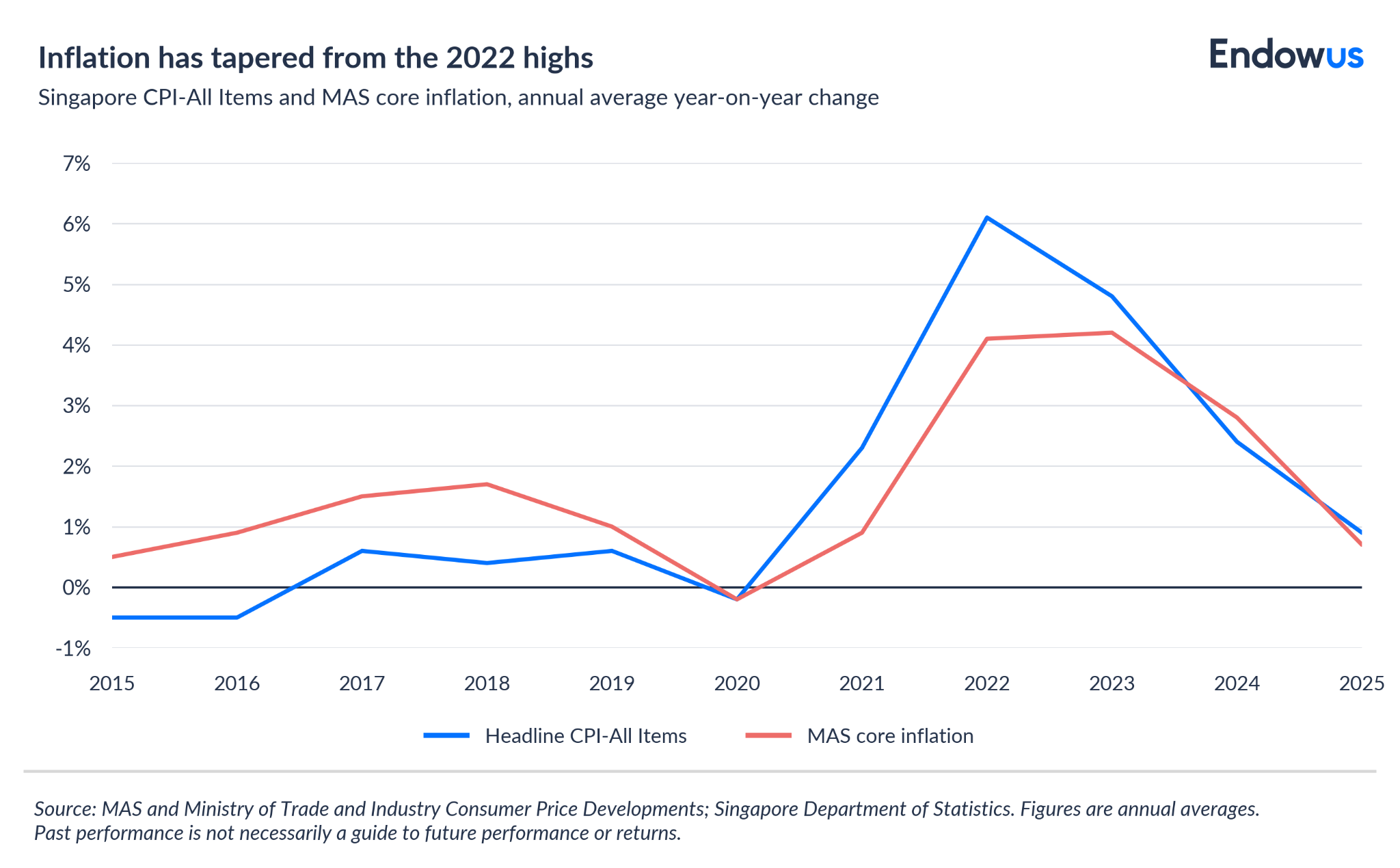
Over 2015 to 2025, headline inflation averaged roughly 1.5% a year, but the range runs from -0.5% in 2015 and 2016 to 6.1% in 2022. The deflationary years reflected weak global demand and lower oil prices; the 2022 spike was driven by post-pandemic supply-chain disruption, energy costs, and imported inflation, before the GST increases lifted 2023 and 2024.
For retirement planning, the low average is the wrong number to anchor on. A horizon of 20 to 30 years is likely to include high-inflation years, and planning to the average understates how much purchasing power may be lost along the way.
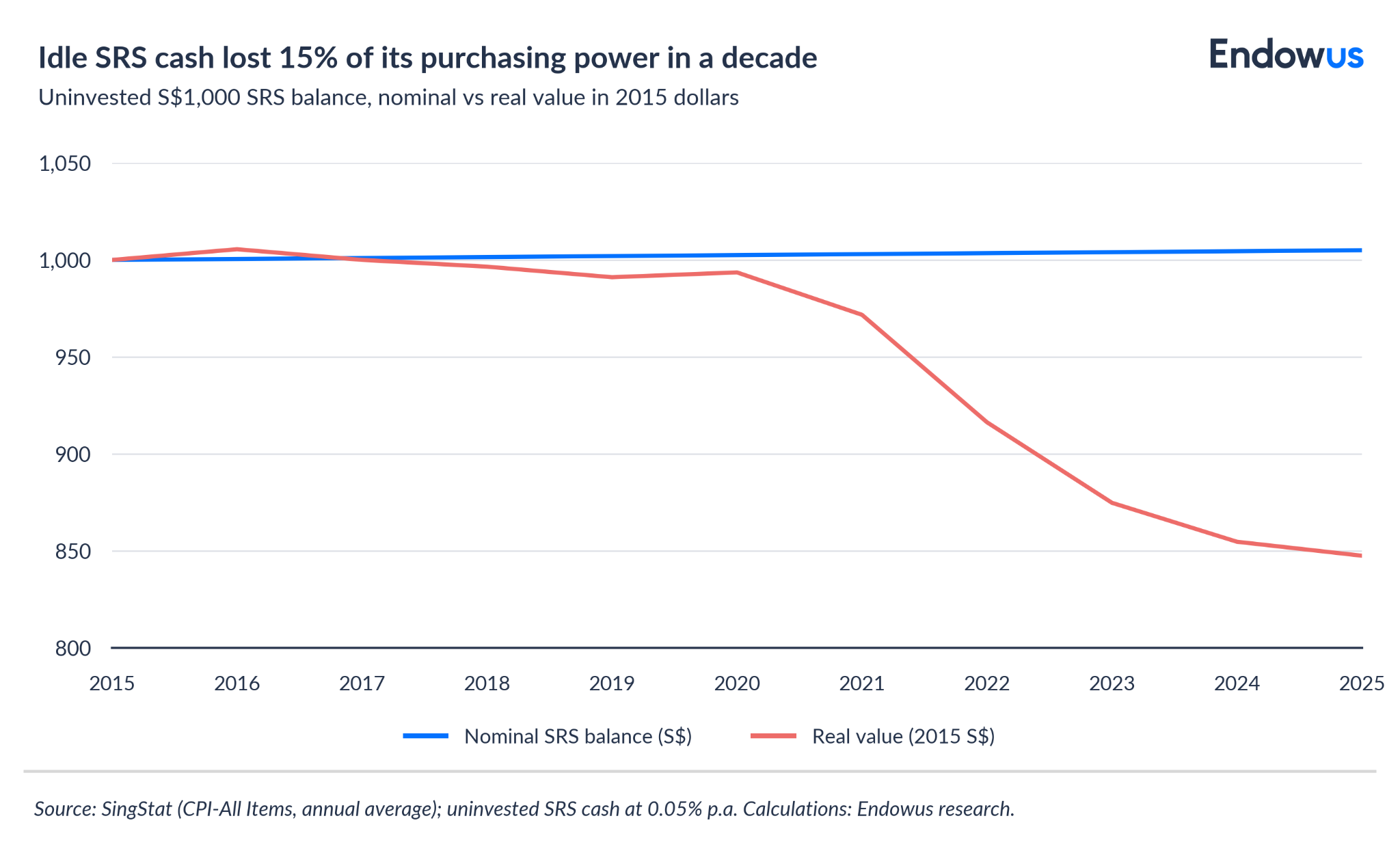
Even moderate inflation erodes retirement savings over time
Inflation matters to a saver through the gap between nominal and real returns. A nominal return is the headline rate an instrument pays. The real return is what remains after inflation, and it is the real figure that determines what savings can actually buy.
The effect compounds. The table below shows what S$1,000 of idle cash would be worth in today's purchasing power after 20 and 30 years at three constant inflation rates.
If inflation held at 3%, today's cost of living would roughly double within about 24 years, a direct application of the compounding shown above. Put the other way, a portfolio returning 5% while inflation runs at 4% grows purchasing power by only about 1% a year. Small real gaps, sustained over decades, translate into large differences in the standard of living a retirement pot can support.
Can CPF accounts and cash defend purchasing power?
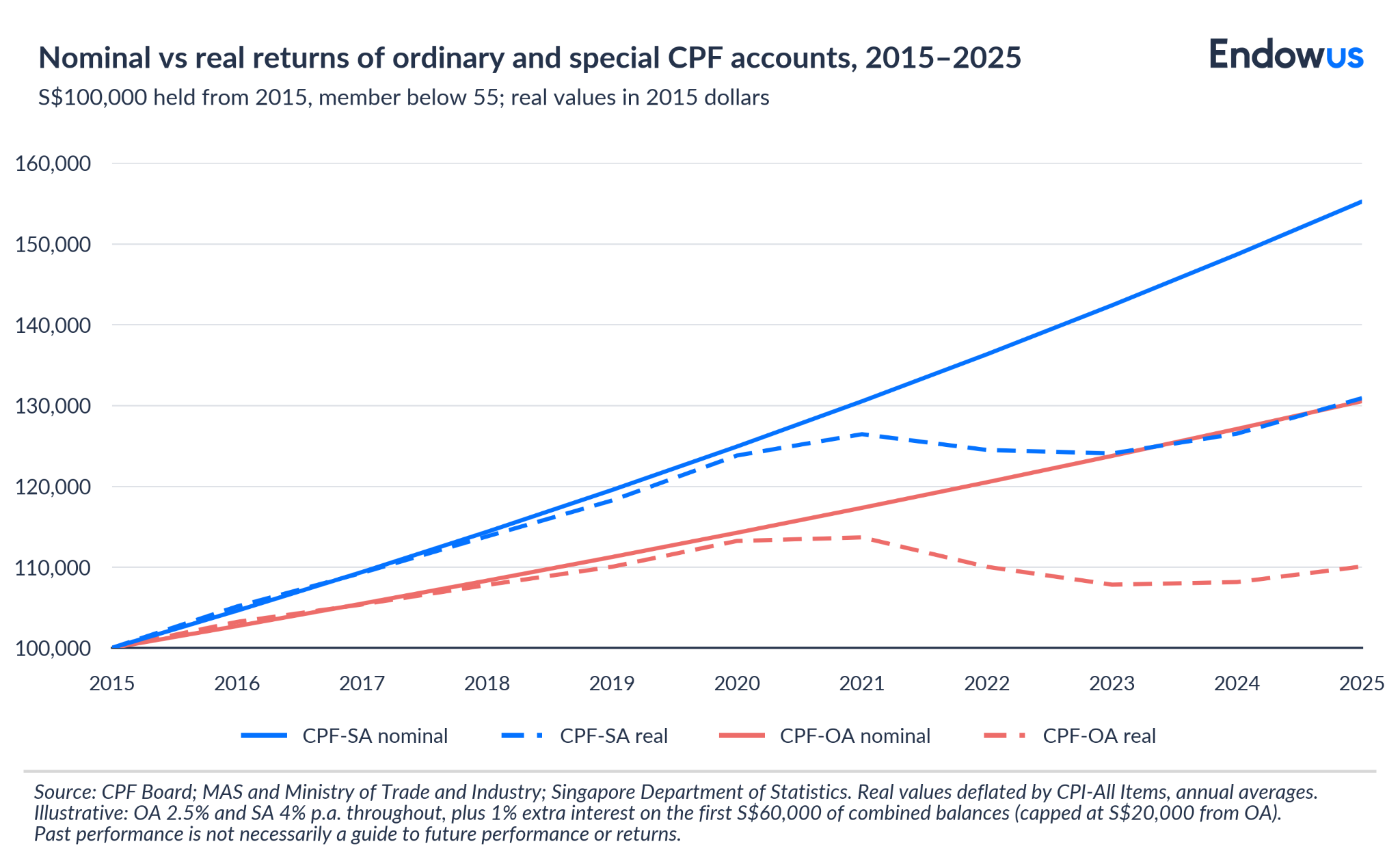
For many Singaporeans, the first line of retirement saving is CPF. For the quarter to 30 September 2026, the Ordinary Account pays 2.5% a year and the Special, MediSave, and Retirement Accounts pay 4%. Extra interest lifts the effective rate further: members below 55 earn an additional 1% on the first S$60,000 of combined balances, and members aged 55 and above earn an additional 2% on the first S$30,000 and 1% on the next S$30,000. In both cases, the portion of Ordinary Account savings that qualifies for extra interest is capped at S$20,000
Measured against the past decade, the 2.5% Ordinary Account floor has exceeded headline inflation in most years, but produced a negative real return during the 2022 to 2023 spike. The 4% floor on the other accounts has stayed ahead of inflation in most years, including 2024 and 2025. CPF is therefore a potentially strong, government-guaranteed base, but it may not outpace inflation in every environment, particularly during imported-inflation shocks.
Cash held outside CPF faces a potentially sharper version of the same problem. The six-month Treasury bill auctioned on 13 August 2026 cut off at a yield of 1.56%, and the September 2026 Singapore Savings Bond (SBSEP26) offered a first-year rate of 1.52%, rising to an average return of 2.25% a year if held for the full 10 years. With headline inflation at 1.9%, these capital-safe instruments sat close to the prevailing rate, implying potentially limited long-term returns.
Here, we should differentiate between investments and cash management—two substantially different concepts. Cash held for liquidity and emergencies helps in the eventuality of a sudden need during periods of market stress. But cash held beyond that need, at a yield below inflation, is tantamount to a decision to potentially accept a negative real return. A low-cost cash-management solution such as Endowus Cash Smart may improve the yield on a cash buffer, though returns are not guaranteed and vary with money-market conditions.
Real returns, not nominal safety, protect a retirement pot
Defending purchasing power over a long horizon has historically meant accepting some short-term volatility in exchange for a positive real return. Different assets sit differently on that trade-off.
Cash and deposits offer potentially elevated nominal safety but typically offer lower returns, and tend to lose value whenever inflation exceeds the yield. And since they are typically short-term instruments, there is potential for them to be a mismatch in periods of high inflation. One clarification here—however: low returns, especially if relatively safe, still offer some form of inflation offset compared to idle cash.
Savings Bonds can be redeemed in any month without penalty and return the principal in full. Treasury bills return their face value at maturity, though their price may rise or fall if sold beforehand. Both offer modest real protection at current yields. Nominal bonds are vulnerable to unexpected inflation, since rising yields depress prices. Equities have historically delivered positive real returns over long horizons and some inflation pass-through, as companies can reprice their goods and services, though that protection is weaker in the short run when valuations compress. Real assets have shown a more direct link to inflation.
The long-run evidence is instructive. The UBS Global Investment Returns Yearbook 2025, covering global markets from 1900 to 2024, records annualised real returns of 5.2% for equities, 1.7% for bonds, and 0.5% for bills; since 2000, global equities returned 3.5% in real terms. These are global figures, not Singapore-specific, and past performance is not necessarily a guide to future performance or returns. The direction of travel, however, is consistent: over decades, the assets that have best defended real value are not the safest in nominal terms.
This is why the sizing of risk—not its avoidance—tends to determine retirement outcomes. A portfolio built to a saver's horizon and risk tolerance can target a real return that cash alone is unlikely to deliver.
Investment implications
In our view, the practical response to Singapore's inflation is to structure retirement savings so they can potentially outpace it over time. Three layers are useful.
- First, it is prudent to hold enough cash for liquidity and near-term needs, while recognising that idle cash beyond that buffer can produce negative real returns when yields sit below inflation.
- Second, it is wise to use CPF deliberately: the 4% floor on the Special, MediSave, and Retirement Accounts has been a rare capital-safe, above-inflation anchor in most environments, and voluntary top-ups may strengthen it, subject to liquidity considerations and to other individual circumstances. The floor is not permanent, however, it is reviewed and extended periodically, and currently runs to 31 December 2026.
- Third, for the balance with a long horizon, seek a real return through a globally diversified, appropriately—for you—risked portfolio.
On the one hand, Singapore's typically low headline rate means the pressure to take risk is less acute than in higher-inflation economies. On the other, a decade that included a year with a 6.1% inflation rate (2022) is a reminder that purchasing power is always at risk. For investors who want help sizing cash, CPF, and invested assets to their own horizon and risk profile, Endowus advisers can assist.
Frequently asked questions
What is the inflation rate in Singapore?
Headline consumer prices (CPI-All Items) rose 1.9% in the year to June 2026, the most recent available data at the time of writing, and MAS Core Inflation was 1.6%. Across 2025 as a whole, headline inflation averaged 0.9% and core 0.7%. These figures are updated monthly by SingStat and MAS.
What has Singapore's inflation rate been over the last 10 years?
Annual headline inflation ranged from -0.5% in 2015 and 2016 to a peak of 6.1% in 2022, averaging roughly 1.5% a year over 2015 to 2025. The full year-by-year series is in the chart above.
What is the difference between headline and core inflation?
Headline inflation (CPI-All Items) covers the entire consumption basket. MAS Core Inflation excludes accommodation and private road transport to capture the persistent, demand-driven price pressure that guides monetary policy.
Does CPF interest keep up with inflation?
The CPF floors—2.5% on the Ordinary Account and 4% on the other accounts—have exceeded headline inflation in most years of the past decade. The Ordinary Account floor produced negative real returns during the 2022 to 2023 spike, so CPF is a strong base but may not outpace inflation in every environment.
How can I protect my retirement savings from inflation?
Historically, defending real value over long horizons has meant seeking a positive real return through a diversified, appropriately risked portfolio, while holding only the cash needed for liquidity. Past performance is not necessarily a guide to future performance or returns, and the right approach depends on your circumstances.
Retiring with a bucketing strategy

The Nanny State, Crazy Rich Asians and lessons for your retirement plan in Singapore

Should a new Singapore Permanent Resident make voluntary contributions to CPF accounts?



%20F1(2).webp)

.webp)
.webp)






.webp)