


.webp)
.webp)
.webp)
.webp)






.webp)












%20(1).gif)
Register for the event
Endowus invites you to our exclusive event with Macquarie Asset Management, as we discuss unlocking opportunities in Infrastructure- a $1.3tn asset class.
This event is reserved for Accredited Investors (AIs) only. To register for the event, please indicate one of the following:
The original version of this article first appeared in The Business Times.
Almost a decade ago, Warren Buffett famously said in an interview: "People start being interested in something because it's going up, not because they understand it or anything else. But the guy next door, who they know is dumber than they are, is getting rich, and they aren't."
He added: "And their spouse is saying: 'Can't you figure it out, too?' It is so contagious. So that's a permanent part of the system."
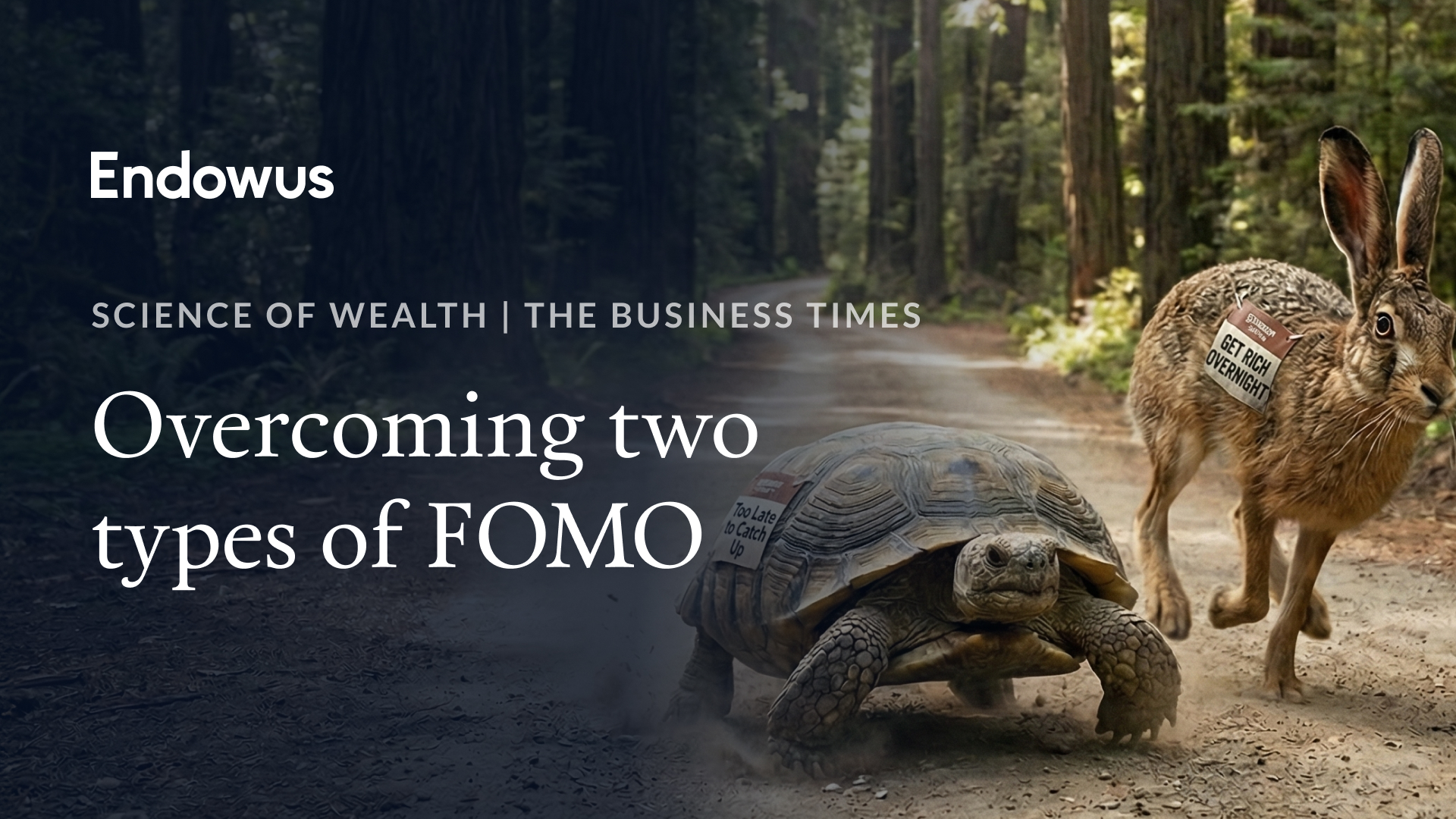
There are, however, two types of fear of missing out (FOMO).
"Get rich overnight" FOMO
In my first experience in markets during the 2008 global financial crisis, my fear of missing out crippled my first brokerage account. From being up 400 per cent to down 90 per cent, I felt a full spectrum of emotions, from arrogance to sickness. From that experience, I knew there had to be a better way to build wealth.
FOMO is real. It is emotionally tearing and makes you sweat at night and pinch yourself as friends tell stories of their latest stock picks shooting up. The widely recognised, frantic, "get rich overnight" FOMO is the siren song of the speculative market—the blogger posting a screenshot of a 50 per cent gain; the hot tip whispered at a dinner party; the obligation to constantly check stocks, refresh market news and trade every time a talking head shouts or shows you trend lines on a chart.
Driven by the brain's threat-and-reward circuits, the amygdala and the nucleus accumbens override the prefrontal cortex, the rational decision-making part of the brain, with a hit of dopamine, leading to:
- Impulsive decisions: Emotions often operate much faster than logical reasoning, leading to snap judgments to jump into a surging market.
- Ignoring risk: The dopamine hit can reduce an individual's awareness of risks, making them less likely to conduct due diligence or consider underlying valuations.
- Herd behaviour: A desire for social conformity and fear of being left out drives investors to follow the crowd, which can lead to market bubbles and subsequent crashes.
- Loss aversion: The pain of a potential loss is felt more intensely than the pleasure of an equivalent gain, which can cause investors to make irrational decisions in an attempt to avoid missing out.
It feeds the illusion of control, convincing you that you must react to every headline or risk falling behind. It is a stimulus loop that is built for the profit of media, trading platforms and many financial services businesses that generate more profit for themselves on activity, not passivity.
As technology makes reacting even more accessible, the viciousness of these cycles will increase, and that unfortunately, further moves wealth from the vulnerable to those in control. We must all learn to be in the group with control.
The "too-late-to-catch up" FOMO
The second type of FOMO has a far-greater impact on our lives, but goes almost unnoticed day to day. The "too-late-to-catch up" FOMO relies on the quiet power of compounding rather than getting rich overnight, and a potential step change in lifestyle and wealth over time.
Twenty or thirty years may pass before this FOMO hits you. Maybe you have to move to a smaller home, or cannot afford to go on that dream vacation that your neighbours just returned from. Maybe you need to start relying on your children to help pay some bills, while your neighbour is helping their kids pay their bills.
Compounding is the engine of exponential growth, but it requires a few critical non-negotiable inputs:
- Your portfolios are suitable for your life goals and behavioural tolerances.
- Your portfolios are built on evidence-based investment strategies.
- Fees are not eroding your returns.
- You are disciplined, can stay the course, and tune out the noise.
A common pitfall I see is not managing money holistically. People often have too much allocation to cash, and some smaller allocations to speculative punts. Even if some of those punts paid off from time to time, unless they were a big chunk of your assets, they would barely move the needle for your entire portfolio.
Let's say you have S$1 million in savings. You invest S$20,000, which is 2 per cent of your portfolio, in your friend's stock tip. You get lucky and it doubles. You feel good about your gamble, but unless you are invested with the rest of your money, you have gained only 2 per cent on your overall wealth.
On the other hand, investing in a balanced portfolio, which is much safer with a higher probability of success, would have yielded you over 12 per cent so far this year.
Every dollar you save should be allocated to a future purpose, generating returns and taking a degree of risk appropriate for the time horizon, liquidity and volatility tolerance commensurate to your specific goals. The set-up is important. Once set up properly, you can ride rather than fight the markets, and let the power of compounding take over.
The impact of a slightly higher return for a few years is not a big deal. But when extended over decades, which we all want for our money, the impact becomes massive, and the FOMO will be real.
Reflecting on 2025 and thinking ahead
All through life, we are told the story of the tortoise and the hare. When it comes to building wealth, the tortoise will win, because the finish line is not dinner this weekend with your friends to brag, but what I am able to spend to maintain my lifestyle after inflation, or leave to my grandchildren many decades from now.
The financial world rewards noise, but true wealth rewards patience and silence. Quiet compounding is not merely a financial strategy; it is a life philosophy that frees your mental energy for other important pursuits.
Start the new year by committing to a year of deliberate, financial stillness. Do not chase the loud FOMO of a quick gain. Embrace the quiet FOMO and be comfortable missing out on anything that stops your money from compounding in peace.
Before 2026 starts, consider these two steps:
- The calendar block: Schedule a single, quiet hour in the next few weeks to review all your assets and make sure you are set up for your future needs and goals.
- Automation check: Ensure that 100 per cent of your saving and investing is set to autopilot for the coming year, so your savings are deployed efficiently and effortlessly. Make the investment allocation decisions once, then let it disappear into the background so you can focus on life.
Forget your password? It's a good thing for your investments

The lesson of Hyflux: What water and diversification have in common

Free lunch: Diversification in investing is a gift
.jpeg)


%20F1(2).webp)

.webp)
.webp)






.webp)