


.webp)
.webp)
.webp)
.webp)






.webp)










%20(1).gif)
Register for the event
Endowus invites you to our exclusive event with Macquarie Asset Management, as we discuss unlocking opportunities in Infrastructure- a $1.3tn asset class.
This event is reserved for Accredited Investors (AIs) only. To register for the event, please indicate one of the following:
- Cash, CPF and SRS money should follow the same investment principles: diversify, keep costs low, and match risk to your time horizon. What differs is how flexible each source is, what it earns when idle, how it is taxed and how it is drawn down.
- Goal-based investing ties these together. Set each goal's horizon and risk level first, then fund it from the sources whose rules fit.
- In this article, we guide you through building a holistic financial plan within the parameters of CPF and SRS rules.
Investing your Central Provident Fund (CPF) and Supplementary Retirement Scheme (SRS) money should follow the same principles as investing cash. Diversify, keep costs low, and match risk to your time horizon.
What differs is the set of rules attached to each source. They decide how easily you can reach the money, what it earns if left alone, how it is taxed and how you eventually draw it down. Together, those rules shape which goals each source is best suited to fund.
Many people treat CPF and SRS as "safer" money, to be handled more conservatively than cash. Behavioural finance calls this mental accounting: seeing wealth as separate pots rather than one whole. Goal-based investing offers a more useful lens. Each goal gets its own time horizon and risk level, and cash, CPF and SRS are drawn on together to fund it, within each scheme's rules.
Several of those rules changed in 2026. The statutory retirement age rose to 64 on 1 July, which sets the prescribed retirement age for anyone making their first SRS contribution from that date. CPF Board also extended the 4% floor on Special, MediSave and Retirement Account savings to the end of 2027. A new CPF life-cycle investment scheme is also due in 2028.
This article starts with how flexible each source is, then shows how goal-based investing allocates across the three. It then covers how the sources fit together when you start drawing down.
How flexible is each source of money?
Cash, SRS and the two CPF accounts sit at very different points on the flexibility scale. Investing CPF savings runs through the CPF Investment Scheme (CPFIS), which sets what each account may hold.
From most to least flexible, the order is:
- Cash: fully liquid.
- SRS: accessible, but withdrawals before the prescribed retirement age are penalised.
- OA: locked except for housing and other CPF uses.
- SA: locked, and forms the RA at 55.
CPF also pays extra interest. Members under 55 earn an extra 1% on the first S$60,000 of combined balances, with the OA portion capped at S$20,000. From 55, members earn an extra 2% on the first S$30,000 and 1% on the next S$30,000 of combined balances, with the OA portion capped at S$20,000. The first S$20,000 in the OA and S$40,000 in the SA cannot be invested, so members keep earning this extra interest.
How does goal-based investing work across cash, CPF and SRS?
Goal-based investing starts with what the money is for. Each goal has an amount, a target date and a priority. Together, these set its time horizon and how much risk it can reasonably carry.
Under this approach, a goal's time horizon sets its risk level, whichever account funds it. A retirement goal 25 years away can take more risk than a home purchase in three years. The scheme rules then decide which sources can fund which goals.
Cash is the only source that can fund every goal. In practice, though, many investors have limited cash, so CPF and SRS savings are used to complement it within a portfolio.
The lock-ups of CPF and SRS may suit long goals. Money you cannot easily withdraw is less likely to be pulled out during a downturn. Over decades, short-term volatility may matter less to whether a retirement goal is met.
Within one goal, the sources can be combined. The example below is hypothetical and for illustration purposes only. It is not a recommendation and does not constitute financial advice.
Take a hypothetical retirement goal with a target of 60% growth assets and 40% lower-risk assets, across S$300,000 of savings:
Because SA savings earn a guaranteed floor, some investors may consider them as part of the goal's lower-risk portion. That leaves room for SRS and investable OA savings to hold more growth assets, while the goal's overall risk level stays on target.
Two cautions apply. OA savings earmarked for a home belong to the home goal, so their horizon runs to the purchase, not to retirement. And as you approach age 55, the SA's horizon shortens, because it closes and forms the Retirement Account. You will not be forced to sell existing SA investments, but savings in your RA, including further contributions, cannot be invested.
What do you give up when you invest each source?
Each source has a hurdle rate: what the money would earn if left idle. Investing may make sense only if the expected return over your horizon beats that hurdle after costs. The hurdle, and the nature of the risk, differ by source.
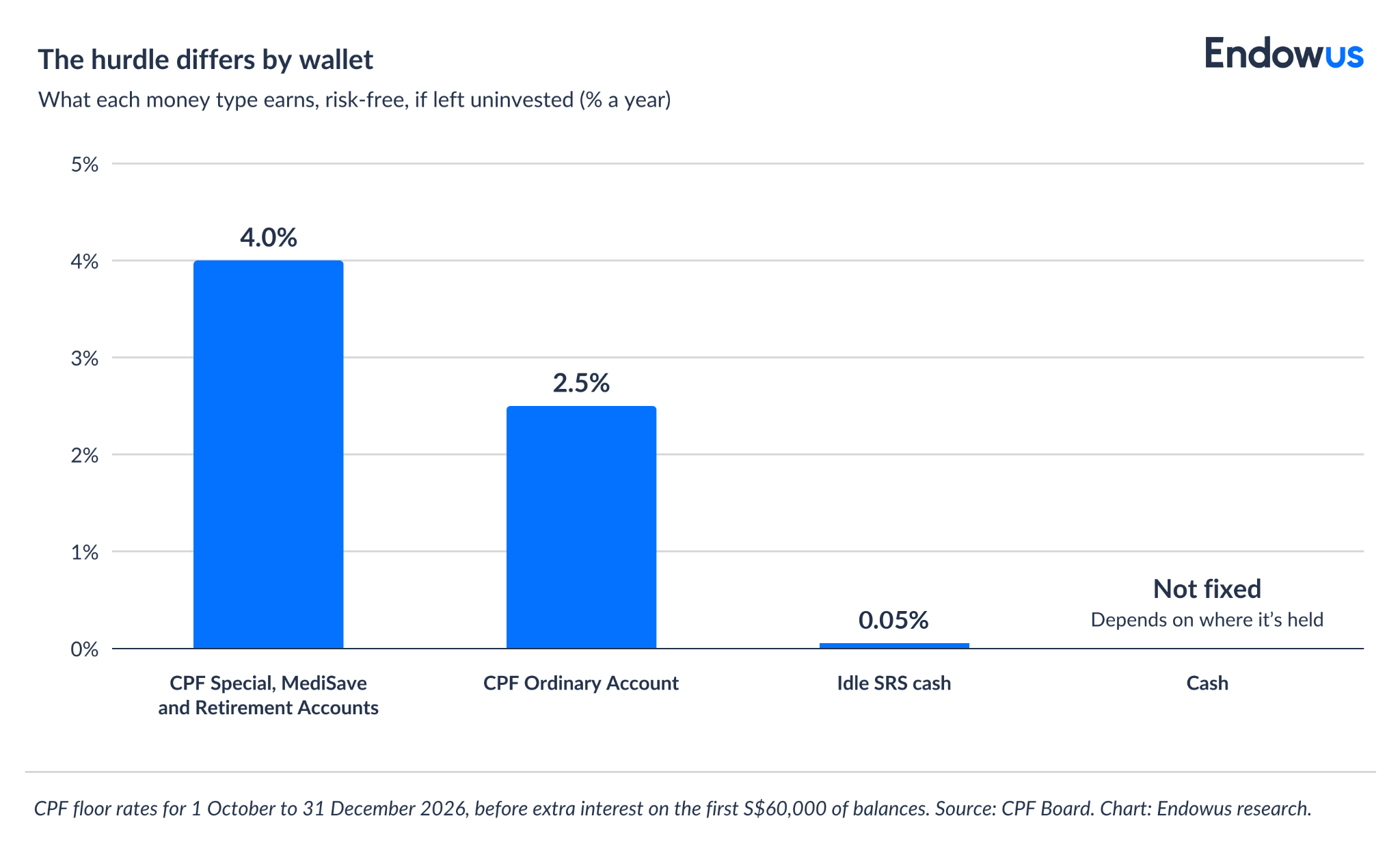
Cash: The hurdle is usually low, and idle cash loses purchasing power to inflation over time. The risk of investing is market loss. Cash investments keep their flexibility, though, so you can rebalance or withdraw when your plans change.
CPF OA: Investing means giving up a 2.5% floor, and capital is not guaranteed. A loss in the OA reduces money available for both housing and retirement. Investing OA savings may make sense only if you expect to beat 2.5% over your horizon and do not need the money for a home.
CPF SA: Giving up a 4% risk-free floor is a high bar for any investment to beat. Some members prefer to leave it uninvested to balance out riskier allocations elsewhere in their portfolios.
SRS: Idle SRS cash earns 0.05% p.a., so the hurdle is close to zero. Leaving the money uninvested has an opportunity cost: you may give up decades of potential tax-deferred growth. Investing it carries market risk, however, and the value of your SRS investments can go down as well as up. There is also liquidity risk: SRS money you may need before your prescribed retirement age is costly to withdraw.
The tax relief itself is earned when you contribute. Contributions earn relief equal to the amount contributed: up to S$15,300 for citizens and permanent residents, and S$35,700 for foreigners, within the overall S$80,000 personal income tax relief cap. The value of that relief depends on your marginal tax rate. The example below is hypothetical and for illustration purposes only.
Leaving SRS money in cash keeps the relief but forgoes any return on it. Earning only 0.05% interest p.a., uninvested SRS are also subject to erosion of real value due to inflation.
Which investments might suit each source within a goal?
Once each goal has a target allocation, the next step is deciding where each part of it sits.
Because hurdles and horizons differ, it may make sense to hold more growth-oriented assets in sources where the hurdle is lowest and the lock-up is longest. Lower-risk or more liquid holdings would then sit where you need flexibility. The goal's overall mix stays the same while each source holds a different part of it.
The investment universes also differ. CPFIS-included funds must meet cost caps set by risk class and carry no sales charge, and wrap fees charged on CPFIS investments are capped at 0.40% a year. SRS and cash face none of these product restrictions.
The three investor profiles below are hypothetical and for illustration purposes only. They are not recommendations and do not account for any individual's circumstances.
Hypothetical investor A: mid-30s, buying a flat in three years. OA savings earmarked for the purchase have a three-year horizon, so investing them would add risk to the down payment. Cash holds the emergency buffer. Long-term investing might run through cash beyond that buffer, and through SRS if they contribute for tax relief.
Hypothetical investor B: mid-40s, higher income, home already financed. Annual SRS contributions earn tax relief and may stay invested for around 20 years until withdrawal: a long horizon with a near-zero hurdle. OA savings above S$20,000 that are not needed for housing could be weighed against the 2.5% floor. SA savings might be left earning 4%.
Hypothetical investor C: early 50s. The SA closes at 55, so its horizon is now short. The SRS withdrawal window may be around a decade away, so planning shifts towards how those withdrawals will be spread to reduce tax. A cash buffer becomes more important as retirement nears.
How do cash, CPF and SRS work together when you start drawing down?
In retirement, the three sources can play different roles: a lifetime income floor, a planned withdrawal schedule, and a flexible reserve.
CPF LIFE: the income floor. From the payout eligibility age of 65, CPF LIFE pays monthly income for life from your RA savings. You can defer payouts up to age 70, which raises them by up to 7% for each year deferred. CPF LIFE payouts are not taxable. They provide baseline income that does not depend on market conditions.
SRS: the planned withdrawals. From your prescribed retirement age, you can spread withdrawals over up to 10 years from your first withdrawal, with 50% of withdrawal amounts taxable per Year of Assessment. Timing matters. The example below is hypothetical and for illustration purposes only. It is not tax advice.
Consider a hypothetical retiree whose only income in a year is an SRS withdrawal of S$40,000. Half, or S$20,000, is taxable, which falls entirely within the 0% band. Spreading withdrawals across lower-income years, such as after you stop working, may reduce or eliminate the tax on them. Money not yet withdrawn can stay invested.
Cash and other investments: the flexible reserve. This layer covers irregular spending and absorbs shocks. It also helps manage sequence risk: the risk that a market downturn early in retirement forces you to sell investments at low prices. A cash buffer covering a period of spending may give the rest of your portfolio time to recover.
How you combine these depends on your tax position, other income, health and spending needs. A common structure covers essential expenses with CPF LIFE, draws SRS on a planned schedule, and keeps cash for flexibility.
What changes in 2028?
Budget 2026 announced a new voluntary CPF life-cycle investment scheme, due to launch in the first half of 2028. CPF Board will select two to three providers, to be named in the first half of 2027. Existing CPFIS eligibility rules will apply, and the scheme's all-in fees will be capped.
It does not change the rules above. It adds another route for members who want a simple, low-cost option that automatically shifts the allocation as they age.
So how should you invest your CPF and SRS alongside cash?
Start by setting each goal's amount, horizon and risk level. The remaining question is which sources fund each goal, within each scheme's rules, starting with how flexible each source is.
In our view, the most useful shift is to stop sorting money into "safe" CPF and SRS on one side and "investing" cash on the other. All three can be treated as one balance sheet governed by different rules.
Why invest your cash, CPF, and SRS with Endowus?
Both CPF and SRS are built for long-term saving, so how you invest them matters as much as how much you contribute. Investing your CPF savings means giving up the risk-free interest they would otherwise earn, and returns may be lower than the CPF interest rate, so consider your horizon and risk tolerance first.
Endowus helps you match your cash, CPF and SRS investments to your goals, track them alongside your other retirement savings, and keep them on course over time. The annual Endowus Fee for cash portfolios ranges from 0.15% to 0.60% depending on the amount invested, while CPF and SRS portfolios are charged a flat 0.30% p.a. (single-fund) or 0.40% p.a. (multi-fund). Fund-level fees charged by fund managers also apply. See our pricing page for details.
Portfolios built by experts
Our Core Flagship Portfolios are built and managed by the Endowus Investment Office, led by Chairman and Group Chief Investment Officer, Samuel Rhee, and Chief Investment Officer, Hugh Chung.
The Investment Office brings together diverse experience from leading global financial institutions, including Morgan Stanley, Goldman Sachs, UBS, Macquarie, and HSBC. The team carries out due diligence on every fund before it is onboarded onto our platform, and continues to monitor each fund regularly.
Calibrate your cash, CPF, and SRS investments to your risk tolerance and time horizon
Choose from six portfolios within the Core Flagship Portfolios suite. Each has a tailored asset allocation to suit different risk appetite and time horizon, with a thoughtful fund selection designed for long-term investing. They are rebalanced automatically, so their respective asset allocations stay in line with your chosen risk level.
All you have to do is to choose your funding source(s), set a one-time or recurring transfer, and we will invest your cash, CPF, and SRS monies for you.
Still unsure which Endowus advised portfolio suits you? Feel free to speak to our client advisors.
Track your retirement savings in one view
Endowus makes it easy for you to track your progress towards retirement. Within one platform, track your investments across all fund sources—your cash, CPF and SRS. As you near retirement, you may want to take on less risk. In just a few clicks, you can move your investments into lower-risk portfolios or funds.
Let us do the heavy lifting for your retirement investments. Invest with confidence and manage your retirement savings within the Endowus app. Start investing today.
Frequently asked questions
Can I invest my CPF, SRS and cash in the same portfolio?
They can work towards one goal, but each source is held separately under its own rules, and the underlying funds may differ. You cannot pool them into a single holding, but you can group them as a goal within the Endowus app.
Is it worth investing CPF OA money that earns 2.5%?
It depends on your horizon, housing needs and risk tolerance. The first S$20,000 cannot be invested, and capital is not guaranteed. Investing OA savings may make sense only if you expect to beat 2.5% over your horizon and do not need the money for a home.
Should I invest my CPF SA?
The SA earns at least 4% risk-free until the end of 2027, a high bar for any investment to beat. Only amounts above S$40,000 can be invested, and the SA closes at 55. For many members, leaving SA savings in CPF is reasonable.
What happens if I leave my SRS money uninvested?
It earns the operator bank's rate at 0.05% p.a. You keep the tax relief earned at contribution, but do not receive any investment return on that money.
What happens to my CPF investments when I turn 55?
From 55, the SA closes and your savings help form the RA, up to your cohort's Full Retirement Sum. Existing CPFIS-SA investments can continue to be held. When they are sold or mature, the proceeds go to the RA, or to the OA once the Full Retirement Sum is met.
In what order should I draw down cash, CPF and SRS in retirement?
There is no single order, because it depends on your tax position, other income and spending needs. A common structure uses CPF LIFE payouts for essential expenses, spreads SRS withdrawals over up to 10 years to manage tax, and keeps cash as a flexible buffer.
Endowus CPF Portfolios outperform average returns of CPF Investment Scheme (CPFIS)-included funds in 2020

5 Things to know before investing your CPF

Webinar: Starting your CPF Millionaire journey early



%20F1(2).webp)

.webp)
.webp)






.webp)